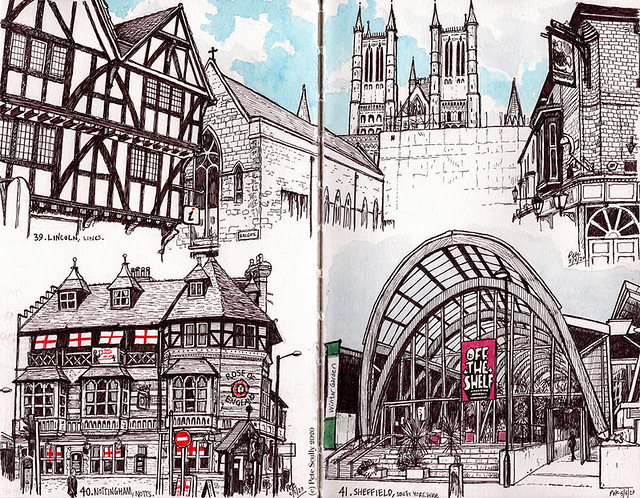
(39) Lincoln, (40) Nottingham), and (41) Sheffield

GB 39-41 sm
Onwards through great Britain we go. Last time out we were in Skegness, Lincolnshire, and that’s a big country so I decided to stick around. I really want to visit Lincoln some day, to draw the big cathedral. I would love to do a real tour of all of England’s cathedrals, but them into a big book. On this virtual trip however I couldn’t get a great view, but you can see it poking its head out from over that scaffolding in the panorama at the top of the spread. Lincoln of course is the name of one of the great American presidents, Honest Abe Lincoln, wearer of tall hats. The city does date back to the Romans, Lindum Colonia, though that grew from an older Iron Age settlement. The Cathedral was, believe it or not, the Tallest Building In The World for about 200 years in the Middle Ages, but the really tall spire that gave them that title fell down a long time ago and they never bothered putting it back.

Next up is Nottingham. I used to wonder a lot about Nottingham when I was a kid. Obviously I always associated it with Robin Hood, but I would read road maps of Britain before going to bed at night (and Europe too; I was really into travelling in my head) and Nottingham would pop out as a place that wasn’t far from all the other places in England. Now it makes me think of that film “This Is England”. So while virtually wandering Nottingham, I found a big old pub called “Rose of England” covered in England flags, so I decided to draw that. I needed somewhere with lots of England flags, since I drew a pub in Cardiff covered in Welsh flags. I never found a pub covered in Scotland flags, but ah well, maybe if Street View goes around Glasgow during the next football World Cup they’ll find some. Oh, ok, maybe not the World Cup, er, maybe the Rugby Six Nations. Anyway Nottingham is also the place where Brian Clough, one of the greatest football managers of all, worked as the gaffer of Nottingham Forest, leading them to two European Cups, one Football League Title, and a helluva lotta League Cups. I am a big fan of Cloughie and his funny ways, especially all the stories his former players would tell about him. but of course with Nottingham we have to think about one man only – the Sheriff of Nottingham. Oh, and Robin Hood. The Sheriff was played by one of my favourite actors of all time, Rickman. Rickman’s voice was perfect, nasal and dismissive. Anyway enough of Nottingham, time to move slightly further north into South Yorkshire, and to the Steel City.

Sheffield is big, and has an important history. This is where our knives and forks were made, the steel industry here being world-famous. In sporting terms, the oldest professional club is Sheffield FC, while the two other bigger clubs have a long history in the game, Sheffield Wednesday and Sheffield United (who are the “Blades”). I used to watch the Snooker World Championships every May on TV which take place at the Crucible in Sheffield. One of my favourite bands, Pulp, are famous Sheffielders, as is the singer’s namesake Joe Cocker. There’s something intrinsically normal and unpretentious about Sheffield, and I’d like to walk about its neighbourhoods one day with a sketchbook. I drew the quite modern looking Winter Gardens entrance on my virtual tour. But despite all of this, whenever I think of Sheffield, I get flashbacks of nightmares I had for years because of one TV miniseries that came out in 1984: “Threads”. If you haven’t heard of Threads, it was a dramatization of a nuclear attack seen through the eyes of local people in Sheffield. It was so realistic, it scared the absolute living bejeezus out of me. The woman peeing herself in the street. The white flash melting milkbottles and people. I was only eight and the Cold War was very much a thing and something I worried about a lot, I had that book “When The Wind Blows” and I remember “Protect and Survive”, the government information advising us to paint the windows white and take the doors off their hinges. So yeah, if I think of Sheffield I think of when it was blown away in Threads.

And on that bleak note, we will move into the Peak District and continue westwards on the virtual Great Britain tour, and take our minds off of fictitious 1980s nuclear wars that still wake me up in the night.

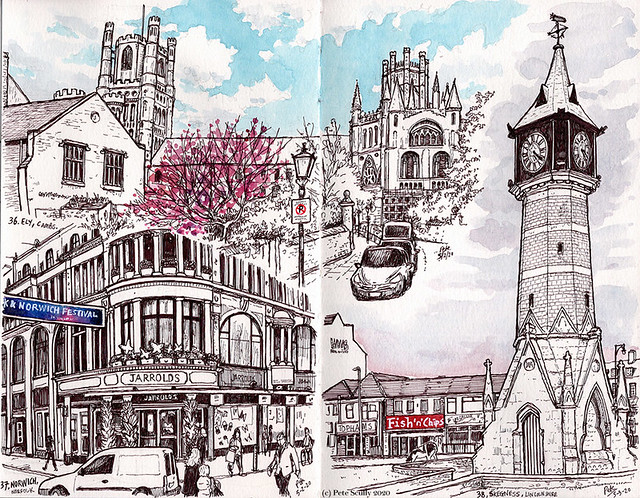
(36) Cambridge, (37) Norwich, and (38) Skegness

GB 36-38 sm
I’m not doing East Anglia any justice. It might not be as dramatic as Wales or as culturally diverse as London, but there are lots of places to explore, immense amounts of history and legend, and despite geographically not being that far from London it sometimes feels far away and distant. At least that’s how I usually felt when going there as a kid, but even now Premier League football teams in London will often fly to games in Norwich rather than take the coach. So in this virtual tour I am really rushing past this important part of England, just stopping off at a couple of places to say hi before heading into the north of the country.

First up is Ely, a small cathedral city in Cambridgeshire. Ely might be small but the cathedral is huge, and I’ve always wanted to go back there and draw it. The first time I was in Ely was in 1995 visiting my friend Jacki for the day, looking at the cathedral, the river, Oliver Cromwell’s house, the shops, and the Woolworth’s, but not the Little Chef which I had heard a lot about, before I caught my train back to King’s Cross; I think I stopped by Ely again briefly a year later, but memory fails me a bit. I do have a few sketching friends in Ely now and have wanted to get back there for a while to draw that cathedral, but I’ll have to make do with virtual sketching for now. The Woolworth’s is long gone, as is the Little Chef I expect. Ely is in the Fens, and the name probably comes from the “isle of eels”, or so I was told at the time. The Fens are a flat and marshy landscape, spreading out across northern East Anglia right up to The Wash. They bring to mind the great Anglo-Saxon hero Hereward the Wake, who held out against the Norman conquerors (who probably called him “The Wake” as an insult like online trolls now dismiss people as “Woke”). Hereward the SJW led a virtue-signalling rebellion (or was it a radical left riot?) against the freedom-loving Normans who had come to England in 1066 to create jobs (building castles, chopping heads, harrying norths). They didn’t have Twitter in those days, just scribes who used no punctuation whatsoever (so a bit like today). It was here in Ely that Hereward made his stand against William the Conqueror’s Normans, who even brought along a Witch, an actual Witch, in a tall mobile wooden tower to try to freak the English out with magic and spells, though that didn’t work and the English just set fire to the tower (true story). The isle of Ely (as it was an island in those days) ultimately fell, and Hereward escaped to live as an outlaw in the Fens, with his brothers Thereward and Everywhereward (not a true story).

So that’s Ely, now it’s time to head into Norfolk. I decided to miss out the Suffolk part of East Anglia, which is a real shame as the countryside is really nice there. Think Constable, Gainsborough, and the others. I needed to get to Norwich, the biggest city in East Anglia and a place that has a lot of childhood memories for me. My aunt Pat lived in Norwich when I was a kid, in a house next to the big Heath with lots of my cousins. We’d visit them from time to time, this house with what seemed like so many rooms, even a basement (I still get excited when a house has a basement). When I was seven I spent a few weeks staying up there with my aunt when my little sister was a baby, mostly playing with my cousin Daniel, speeding down the steep slope of the Heath on bits of cardboard box, playing Star Wars, going to see Superman III, eating out at a place called Zaks. My cousins were Jehovah’s Witnesses so I remember bedtime stories being stories like Lot’s wife turning into a pillar of salt, which didn’t give me nightmares but made me really wonder about the physics of that. I think I still have the book of those stories my aunt gave me somewhere. Speaking of salt, when I was visiting as a kid my cousin Daniel decided to pour loads of salt into my orange squash, to see what would happen. I remember saying, this tastes funny, and he told me what he’d done. Oh ok, I said, and I kept drinking it, assuming it was some Norfolk thing. Then we sat down for breakfast and I erupted in vomit like Mount Vesuvius, all over my older cousin Debbie’s nice leather jacket. Daniel got in trouble, I just kept throwing up, but the lesson learned was don’t put salt in orange squash. The last time I visited Norwich was when I was 15, we popped by to see my aunt and to my cousin Denise’s. I still have a lot of family around Norwich and Norfolk, I wish I had the time to pop by and say hi to them all, and Norwich would be a fun place to explore and draw. I chose to draw Jarrold’s, the big department store in the centre of town, I vaguely remember my cousin telling me about it when I was a kid, but I don’t know if I ever went there.

And finally in this spread, we leave East Anglia but stick with the flatter Fen counties, going into Lincolnshire, on the other side of the Wash. This is the coastal town of Skegness, traditionally seaside holiday spot on the North Sea. Since I missed out all the other east coast seaside spots like Clacton, Walton-on-the-Naze, Great Yarmouth, Caister, Sheringham, I had to include Skeggy, though I have not been there myself. I drew the clock tower on the seafront, and you can see in the background there are several fish and chip shops. There seem to be so many chippies around here, and that is a very good thing, I think you always need a good fish and chip shop nearby, it’s a requirement. Being northern and by the sea the fish and chips are bound to be pretty good. When I think of Skegness, as with many coastal towns, I think of chalet parks, caravan parks, chip shops, arcades, bingo, sticks of rock. We used to stay in chalets at holiday parks in Caister as a kid, and we would go further north on the other side of England to the Pontins resort in Southport, near Blackpool. We would also go to a caravan park in Walton-on-the-Naze in Essex, and occasionally to Camber Sands on the south coast. But never to Skegness, always just a bit further away, most Londoners wouldn’t head that far, again unless they went up to Blackpool. “Skegness” as a name sounds very “Danelaw”, and the name does come from Old Norse, with Skeggi either being the name of a Viking or just a word meaning “beard-shaped”, with “Ness” being a coastal headland. What’s the Danelaw? That’s the portion of England that was cut diagonally across the country in late Anglo-Saxon times that was effectively taken over by the Vikings, in short. You’ll find a larger number of place-names of Norse origin, lots of -thorpes and -bys and -holmes and -nesses. Looking at the map as I take the virtual trip I see a lot more of them popping up the further we travel up this way.

But next up, we are heading west again, to Lincoln and further inland.

(34) Oxford, and (35) Cambridge

GB 34-35 sm
Oxbridge. The Brangelina of cities. What those of you outside of academic circles may not know though is that they are in fact two completely separate towns with very little in common. Sure they have world class universities that are hard to get into. Well, it was hard for me anyway, so I didn’t even try. You needed a lot more “As” to get in there, and my single “A” in English wouldn’t have been enough. Also I don’t know if I’d have been able to choose between the two. So I ended up staying in London and going to Queen Mary, and I liked it there. Just going to University itself was to open a different world to me than the one I knew from Burnt Oak, it was completely uncommon among most people I grew up with, so the idea of Oxbridge would have been like the idea of going to work at Buckingham Palace or something. Still, I wonder what it would have been like if I had set Oxbridge as a goal earlier in my school career. Probably no different. Even at sixth form college, I knew nobody who went there, or had applied there, it was just seen as effectively off-limits. I’ve met so many people since, great academics of course, who either went there or teach there now, and it seems strange to think of it as something so distant, but I still wouldn’t get in, unless they have a degree in drawing fire hydrants or making bad puns.

So, Oxford then. There are so many places to draw here, but I had to draw one of the big grand college entrances. This is the front of Brasenose College, right in the heart of the city. The University’s colleges are located throughout Oxford (as are Cambridge’s). The University of Oxford itself was founded in 1096 (possibly), although it was really around 1167 that it grew after King Henry II forbade students from going to the Sorbonne in Paris (in case the Sorbonne stole their data, good job we don’t have leaders like that now). Brasenose dates from 1509, its name coming from an old brass door knocker on the old Brasenose Hall. Famous alumni of Brasenose include David Cameron, who had some brass himself; Michael Palin, whose travel shows and books made me want to be a travel writer when I was a kid (yeah, working on that); William Webb Ellis, who invented rugby; and Field Marshal Haig, who was played by Geoffrey Palmer in Blackadder Goes Forth. I’ve been to Oxford a few times, always thought it a place I could live if we were ever to go back to England. I suppose I’m drawn to university towns, I like being close to big libraries.

I decided to skip past all of the places in between “Ox” and “Bridge”, such as Milton Keynes, and Luton, which I’ll be sure to include in a future virtual sketchbook, honestly, and proceeded to the other great university city of Cambridge. The University of Cambridge was founded in 1209 after there were big punch-ups between the locals of Oxford (“town”) and the scholars of the University (“gown”). Actually it was pretty serious – three Oxford scholars were hanged by authorities following the death of a local woman, kicking off a load of violence. Many fled to Cambridge and decided to start a new University right there. Just like in Oxford the colleges are scattered among the town; just like in Oxford there is a “Bridge of Sighs”; just like in Oxford there is a river that winds around town between the colleges, which just like in Oxford is full of “punts”, those long flat boats where people will punt along by pushing a long wooden stick against the riverbed. I’ve done it myself, not easy to navigate at first, but I managed not to fall in. I really like Cambridge, a bit smaller than Oxford, although last time I was there it was pretty crowded with tourists. I first went to Cambridge when I was 19, to visit a friend who I had met on a college exchange trip to France. I remember that day, getting the train up from King’s Cross, walking about town, going to the shopping centre (I bought a Boo Radleys CD there, I remember clearly), reading the Cambridge Evening News and laughing at the hilarious headline “Rising Bollards Claim Another Victim”. I liked being 19, it was a simple time. I’ve been back to Cambridge a number of times and I always like it there, and though it’s somewhere I could definitely sketch I decided on the virtual trip that I would not draw another college building, just creating a mirror on the spread with Oxford, so I chose to draw the Round Church, which as you can see is just that.

Now these being 34 and 35 you’ll notice that we are now over the halfway point in our journey around Great Britain. We will zigzag around the country missing out many a great town and including some which you might think, wow you skipped Ipswich for this place? But the obvious next stop in this virtual journey is just up the train track from Cambridge in the Fens city of Ely…

(31) Ironbridge, (32) Birmingham, and (33) Worcester

GB 31-33 sm
So we virtually cross over the virtual border into the virtual country of England, and three more Places I Have Never Been. This will be the case for most places. I’ve lived more than a third of my life away from Britain, and certainly the majority of the most important bits, and when I still lived in London most of my travels would be across the channel (it was usually cheaper). So I have missed out on lot of interesting places in Britain, so the purpose of this virtual journey was partly to imagine myself travelling about them with my sketchbook, like a kid mountaineering on the staircase, but also to scout them out for future visits. The inspiration for a trip like this was a book I was given several years ago by my cousin Dawn, called “Richard Bell’s Britain”. It is a fully illustrated account of the artist Richard Bell’s year-long solo tour around Great Britain, drawing in brown pen and watercolour, mostly sketching nature such as plants, wildlife, hills, cliffs, really focusing in on the geology, the old country walls and fences, but also the occasional urban scene. Even the writing is in the same brown pen, printed on soft cream coloured paper. It was published in 1981, when I was very young, and in love with Watership Down – in fact Bell was one of the artists on that animated film, and he revisits the actual place in his book. (Fun fact – Watership Down was the first book without pictures that I ever read, and I remember it took me ages, and gave me nightmares, but I still have that original copy).

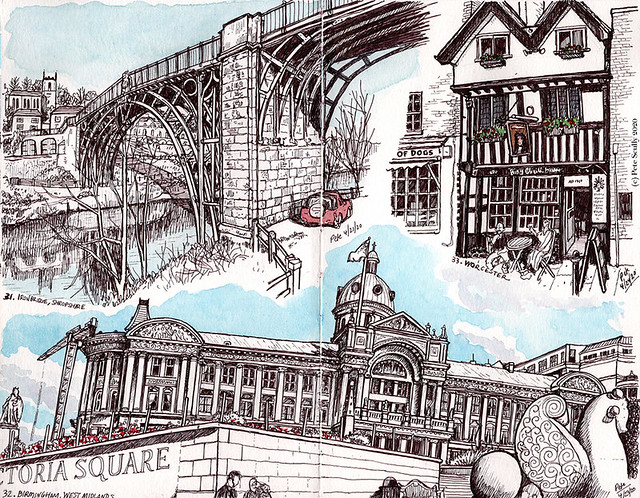
As I said, my cousin Dawn Painter, herself a brilliant all-round artist and expert (particularly of the natural world), sent me the book, having picked it up at a second-hand bookstore in London. In the note she left inside the book she had drawn a picture of the Iron Bridge which spans Ironbridge Gorge in Shropshire, at the town of Ironbridge. She said that there is so much to draw, and so much history and from my virtual tour I can see that I really have to come here some day. I like drawing a bridge, and this one made me concentrate. If I go in real life I need to practice that bridge. If it rains though I’m starting under an umbrella and then drawing the rest from a photo with a pint in the pub. So what’s the deal with Ironbridge then? This was in fact the first cast iron bridge in the world. This is where the Industrial Revolution started. You know the Industrial Age we all like, we’re all big fans of, well this is where it came from. Coalbrookdale, the village around the corner, is where Abraham Darby smelted iron ore. As all his friends would say, “he who smelt it dealt it”. Funfacts: Tony Stark was born here, and this is where he first built Iron Man, and the hidden realm of Kun Lun is also around somewhere around here, which is where you’ll find Iron Fist, and rock band Iron Maiden, they were made here too, and the Iron Throne from Westeros was forged here, and…Sorry, I let it get silly. Ironically, irony was not born here. Now another town just a smelted iron ore’s throw away from here is Telford, which I did not draw, but I remember as being a ‘new’ town which would actually advertise itself on TV, “come and live in Telford, a lovely place to live,” or something along those lines. It was named after Thomas Telford, who, as you will remember from my last post, built the big bridge over the Menai Straits. It’s actually very close to The Wrekin, a tall cone-shaped hill I learned about as a kid. It is pronounced “reekin” (he who smelt it dealt it, eh, Abraham). The story I learned was that there was this giant who really hated Shrewsbury, because he kept pronouncing it “shrow-sbury” when locals insisted it was “shroo-sbury”, so he decided to flood the town, or “floooood” it as he would say mockingly. So he goes and gets this massive great big mound of earth and sets off towards Shrewsbury. On the way he meets a cobbler carrying a sack of old shoes (or “shows”, I’m not sure). When the giant asks him the way to Shrewsbury, the cobbler realizes what the giant plans to do and thinks quickly, telling him that “no no Shrewsbury is a really long way away, look at all the shoes I have worn out coming from there!” Now you and I know this was just, haha, a load of old cobblers, but the giant thought, well that does look quite far, and decided to dump the massive pile of earth right where he stood, and went off home I suppose. The mound became known as the “Wrekin”, pronounced “reckin”, but just to annoy the giant even more local people started pronouncing it “reekin” instead.

Enough gadding about Shropshire legends, let’s head into the second city of England, Birmingham.  We have established I’ve never been there, and in all my life I have never once thought of ever going there. I used to be mildly obsessed with the Birmingham, or “Brummie”, accent when I was a kid, because of Barry from Auf Wiedersehen Pet, although I’d be lying if I said it was in my list of top accents in the country. (My top three by the way are Liverpool, Glasgow, and probably Swansea, though that might be just specifically Elis James’s voice.) But I sometimes hear the accent and it just blows me away how gentle and soothing it can be. I can’t say the same for my own Burnt Oak accent of north London, which has more of the “oi you f*#!in’ w@%ker” about it, though that can really come in handy in a tight spot. All I’m saying is that when pushed, the fake transatlantic British accent steps aside and the Burnt Oak comes right back out again. But I used to try to practice accents when I was a kid, and Birmingham was one I always tried, though usually it just made me sound a bit bored. This is what I’m missing out on in this virtual tour, all the accents, and those found across the Midlands are a big gap in my knowledge. I remember watching Crossroads as a kid, with that one very Brummie character Benny on it, but I wasn’t really interested when he wasn’t on screen. We all know Slade and Ozzy Osbourne and Def Leppard from that Vic and Bob sketch. I used to like Bovril. So virtually touring Birmingham, I found it very much as I had always imagined it, a big city that wasn’t London, lots of canals (so many canals). Birmingham is famous for the quiz question, “Watt Steam Engine was invented in Birmingham?” It is also famous for its “Bullring” shopping centre in the middle of town. But I was most drawn to this grand building in Victoria Square, which houses Birmingham’s Museum and Art Gallery. I was really happy with the slightly Dutch camera angle layout, even though it only left me a small place in the top right corner for whichever town I was heading to next.

Which turned out to be Worcester. None of your sauce. Most people know Worcester from the joke about the Bicester Times and the Worcester Times, but it also has a history with the King Charles II. After losing the Battle of Worcester in 1651, Charles popped into this very pub for a post-battle drink and probably had some lovely Worcester Sauce flavour crisps, hiding out while Oliver Cromwell’s New Model Army looked for him in the most famous game of Hide and Seek ever played in Britain, if you don’t count the one Richard II played with his nephews in the Tower of London (BTW, the Princes won that game). The New Model Army wasn’t an Airfix kit, and while they were called Roundheads, it’s not because they looked like Playmobil figures. But that’s what I see whenever thinking about Civil War era England. Anyway Charles II, son of the recently beheaded Charles I (shortest English King ever, for obvious reasons) hid in here, probably wearing a t-shirt saying “Worcester. Day. Ever.” This pub is now called the King Charles House, which I presume it wasn’t called at the time, because that would have been a really bad place to hide. Or a genius place, because Cromwell surely wouldn’t look there. After the Roundheads turned up, he ran out the back door, as you would in any pub when the Millwall firm shows up. Charles went on to hide in various places (such as in the branches of trees, which is why you get so many pubs called the “Royal Oak” in England) (incidentally the Colonel who hid in the tree with him was called Colonel Careless, who for obvious reasons had to speak in a whisper, and I think you know where I’m going with that) before eventually making his way to France where he hung out for nine years until it was safe for him to come back, like Dirty Den in Eastenders.

This was a really interesting leg of the virtual journey, and there are so many other places I had to miss out. I didn’t draw Warwick, or Stratford-upon-Avon, or the Cotswolds villages, or Coventry, or any of the other urban areas of the West Midlands like Wolves or West Brom. I was on the clock, so I hightailed it down to Oxford, back on the River Thames (or the “Isis” as they call it there, unless they have stopped calling it that, like when Lord Grantham’s dog was killed off in Downton Abbey). So join me next time as we go to Oxford and then straight away to Cambridge to compare the two.
(29) Menai Bridge, and (30) Conwy

GB 29-30 sm
The last of the Welsh trilogy brings us right up to North Wales, although I wish I’d made space for the interior. I had to weigh up whether I needed to include Wrexham, but later on leave out Sunderland? It’s a weighty issue, and I’d only be including Wrexham because they knocked Arsenal out of the FA Cup that one time. I really enjoyed this spread though, I hope it shows. It was a very enjoyable virtual journey, very peaceful. It was still a couple of days or so before our flood, when I was still at the desk downstairs, and so it’s funny that two bridges ended up on these pages. Or not. But I imagined myself walking these areas, like Tony Robinson in that TV series I have watched a lot of lately. I’ve been thinking a lot about walking the UK, planning out hikes, right down to deciding which walking poles to bring. Of course I would need to factor in sketching time, so each walk would take a lot longer, but I draw pretty fast, and can always do half and finish the rest at the local pub in the evening, listening away for accents and dialects. I studied the history of the English language, and one of my popular-academic linguistic heroes lives up this way, David Crystal, on Anglesey. I have read many of his books, and I’ve always wanted to meet him and talk language and its history and future with him.

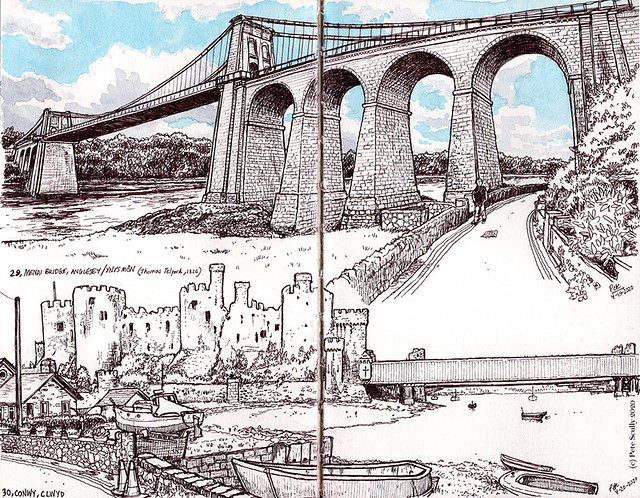
So, let’s have a butcher’s at the first drawing then, this is the mighty Menai Suspension Bridge, which crosses high above the Menai Strait that separates the mainland from the island of Anglesey (Ynys Môn in Welsh). The bridge was built by the great civil engineer and architect Thomas Telford and was opened in 1826, and the road that goes across it is actually the A5 – the very same road that links up what we call Watling Street, although that Roman road did not come out this far, although in that Watling Street book I started reading the author does continue past Wroxeter and up to Holyhead, but fails to talk about this amazing bridge. So technically this links it up with the first spread of the book. Now, this sketch was drawn on the Anglesey side of the Menai Strait, so technically it is not on the island of Great Britain – exception to the rule – but you can see the island of Great Britain in the drawing so no rules broken. The name “Anglesey” is likely of Viking origin, but the best place name on the island is unmistakably Welsh: Llanfairpwllgwyngyllgogerychwyrndrobwllllantysiliogogogoch. It means “Stmaryschurchinthehollowofthewhitehazelneartotherapidwhirlpoolofllantysiliooftheredcave”, which is easy for you to say. It’s where you go to take a picture of the train station sign using panoramic mode on your phone. I have to go there.

It’s North Wales, so another castle was needed, and I like the one in Conwy, mostly because Caernarfon would mean backtracking again, and I’d already done that, or putting the first sketch on the bottom of a spread, and I had done that already. I’m trying to make the book interesting to pick up and look through. Not that I have any interest in publishing, this is just a curio to bring to events in future, but it’s good to mix it up. I get it right a few more times, and less right on a couple, but mostly I’m very happy with the spreads from Wales onwards, and this one more than most. I love a bridge, I love a castle. So for Conwy I needed to find a good angle, and so I went across the River Conwy and found a nice spot next to a little cottage, I can imagine standing here sketching, maybe with the brolly sticking out my coat, saying hello to a local old fellow who passed me by, and nodding while I pretended to understand what he was saying to me, and complementing him on the beautiful countryside as if he was personally responsible for it, and him telling me something about how when he was a kid he’d catch cockles and cook them up for breakfast but that his grandkids just want to listen to records and go to London and work at desks, but they come back for Christmas and they always want cockles for breakfast, but I’m a bit old to get out there now with my back the way it is. Nice chap, this completely imaginary passer-by. Now the castle itself is another one built by Patrick McGoohan from Braveheart, and it is a World Heritage Site. It is a proper example of a proper castle, one that if you have kids and they like castles you should take them to this one.

There’s a lot more in North Wales to draw – coastal towns like Llandudno, which always reminds me of Neville Southall, the great Wales and Everton goalie (and a great follow on Twitter), the peaks and valleys of Snowdonia, and resort towns like Rhyl to draw caravan parks, chalets and chip shops. But as it is, we had to get back to England, to the Midlands, to draw yet another bridge – the very first one made of cast iron…

(26) Swansea, (27) Portmeirion, and (28) Harlech

GB 26-28 sm
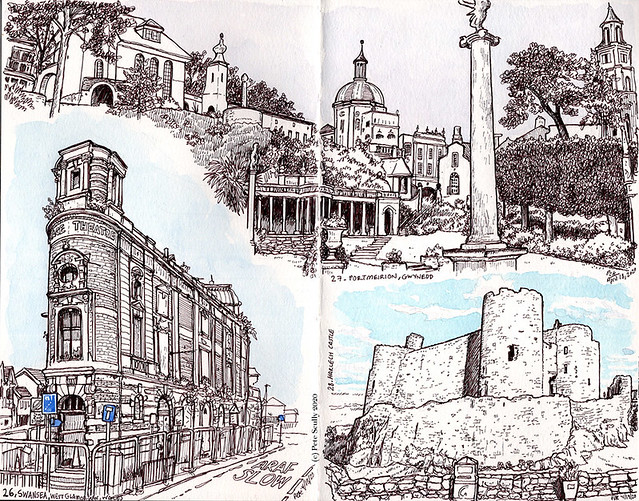
Part two of the virtual trip through Wales, Two of three. Wales is not a big country, although there is a lot to draw and you could fill whole books just on the castles. But I am on the clock, so whistle-stop it is. It’s a beautiful place, and I had to totally miss out Pembrokeshire. But here is a spread of three interesting places. Well, I assume Swansea is interesting. I liked their football team being in the Premier League. So that city is first up: Swansea. I went around the town virtually looking for something that would make a good illustration. One spot there was a bloke who looked he had fallen over, and as the virtual camera went down the street, all you see looking back is this guy just lying on the ground, nobody helping him. It looked like it was early morning  and perhaps he was getting over a night out but seeing someone just lying on the ground in Google Street View was a bit disturbing. I couldn’t virtually help, so I just felt virtually guilty. I remember once years ago in London, down near Leicester Square, I was on my way to the night bus stop after visiting friends in Notting Hill, and this old man who had been at the pub walked nearby me, tripped and fell right onto his face on a doorstep, CRUNCH. Good job I was there, I stayed with him until the ambulance came. Anyway, on this virtual occasion I kept wandering virtual Swansea, and this old boarded up run-down theatre building opened its legs wide and held out its chest and roared “whooooOOOOOAAAAAHHHH TO BEEEE or not to beeeee….”. It looked very dramatic. I just had to sketch it. Swansea is known as “Abertawe” in Wlesh, that is, the “Mouth of the River Tawe”, and it is Wales’s second city. Because of its copper smelting past Swansea has another nickname, “copperopolis”. I grew up very near to the police training school at Hendon and that’s what we called that place too. One of the most famous people from Swansea was the poet Dylan Thomas. I’ve not read much Thomas, I know a few lines, but they all make me think of that one guy lying on the pavement in Google Street View, unhelped and helpless.

So I moved on from Swansea up the coast, missing out the impressive Pembrokeshire coast, Carmarthen and Cardigan, Aberystwyth and Dolgellau, and stopped in Portmeirion. I have wanted to visit Portmeirion since my brother showed me the TV show The Prisoner when I was a kid; this was “The Village”, the place you couldn’t escape from, ebcause you would be chased by large white balloons (why didn’t Number Six carry a knitting needle?). While the show was a bit mad, I loved the music and those opening credits, and the colourful locations, and McGoohan’s indomitable, suspicious, suppressed-sense-of-humour personality. It’s always amazing to me that Portmeirion is a real place, and most people I know who have been there say it’s a nice place to visit. It was the bright idea of Sir Clough Williams-Ellis who back in the 1920s wanted to build an Italian style coastal town on the breezy banks of a Welsh estuary. It reminds me a bit of the town in Chitty Chitty Bang Bang. I just want one of those jackets that Number Six wears, the black one with the white trim along the lapel.

Next stop, I actually had to backtrack a bit and go back across the Afon Dwyryd to the coastal castle town of Harlech, on Cardigan Bay. I used to think it was called that because it gets a bit cold sometimes. I like the look of Harlech, the landscape around the castle and town looks like it could inspire an epic poem. Lot of steep hills in the town as well, but I drew the castle, another one started by Edward I, the English conqueror of Wales. Wales has a lot of castles, largely because of English kings such as Edward I building them to keep the Welsh locals in check. You’ll remember Edward I if you saw the mid-90s fantasy movie Braveheart which of course wasn’t based on true events except those that are an unintended coincidence. In that made-up drama there were a few ‘real’ historical figures such as Edward Longshanks, the villainous English king with an indomitable, suspicious, suppressed-sense-of-humour personality, played by none other than Patrick Number Six McGoohan himself. He also played the prison warden in Escape from Alcatraz starring Clint Eastwood, who in turn also played the Outlaw Josey Wales, thus coming full circle.

Next up on the virtual tour of Great Britain in 66 sketches, the final leg of Wales, and then we turn back to the midlands of England.

(24), Tintern Abbey, and (25) Cardiff – Wales!

GB 24-25 sm

And so to continue the virtual tour of Great Britain, we have passed into a land i have never been – Wales. It’s quite amazing I’ve never been to Wales, but maybe not that surprising. It’s quite far, and I’m told it rains a lot. I suppose like a lot of places I always figured, it’s not going anywhere, I will get there some day, and then I moved to America and all those places were suddenly thousands of miles away.  I have only ever flown over Wales, on the way to Ireland, or back from America. After spending a good deal of time Google Street-Viewing my way around, I really want to go to Wales now. Looks beautiful there. Plus, we just learned that my wife’s family dates back to this part of Wales several hundreds of years ago, and some fairly historically prominent figures too, so now we want to go there and explore where they were from. Some day. We watched some videos earlier about Welsh food, and now I want to eat Welsh rarebit. Or maybe just cheese on toast will do me, I’ve not had that in a while. One of the first places I found in Wales was the lush Wye Valley, specifically the grand ruin of Tintern Abbey. I really want to do a walking trip around there. The abbey is a crumbling heap, but spectacularly evocative. It dates back to the twelfth century, but after Henry VIII dissolved the monasteries it fell into ruin. Looks like it’s been literally dissolved. Henry VIII and his big bloody ideas. Good job we don’t have leaders like that now eh. Great poets and artists would come here over the centuries and do their thing. Turner did a series of paintings, one of which is called “The Chancel and Crossing of Tintern Abbey, Looking towards the East Window”, which I totally get, thinking up a snappy title is really hard. Thomas Gainsborough did a nice graphite sketch of the abbey which is also at the Tate. Wordsworth wrote some poetry about this place, called “Lines Written A Few Miles Above Tintern Abbey“. He probably had drones and a camera, I doubt a helicopter could get a few miles into the air. My point of view was just outside. It was just like being there.

I let the sketch spread across the bottom of the page, which meant that the next sketch above the top would have to be constructed carefully. The next stop was Cardiff, the Welsh capital, and I didn’t know what I wanted to draw. I wandered lonely as a crowd, until I found an interesting view in a narrow street looking up at a church, next to a pub with lots of Welsh flags outside – perfect. So this became my favourite spread yet, I was pleased with this one. I quite like the Welsh accent, though I’m not super able to discern all the differences between the Welsh accents, that is another reason I’d like to travel there and learn more about. I really like listening to Elis James, a Welsh comedian who is often on my favourite football podcasts (he’s a Swansea City fan; we’ll be in Swansea next time), he has a lovely soft lilt in his voice. When my son was small he was obsessed with Fireman Sam, the Welsh kids cartoon. Often kids shows from the UK such as Bob the Builder were dubbed into American voices, but for some reason they kept Sam in the Welsh voices, so he’d always be doing the voices of Norman Price or Elvis Cridlington. I know a few words in the Welsh language but that’s it, although I did used to watch “Pobol Y Cwm” when I was a kid. That is a Welsh-language soap that was on S4C, a Welsh channel in the UK. I also had a teacher at school whose first language was Welsh, he was my history teacher and he ended up leaving the school to focus on his career as a Welsh-language rock singer (if I remember rightly his band was called Ian Rush, although I cannot remember his name). The Welsh do like singing, traditionally. He did say to the class right before leaving though that “some people in this class are not going to pass this A-Level”, meaning specifically me, which turned out to be a true prediction, because I gave the history A-Level up after a difficult first year, although it felt a bit too dismissive at the time and was probably the reason I quit. I remember my GCSE English teacher saying something similar when I was 16, she said that I would not pass that class and put that in my report, but only when another teacher, the awesome Mr Hedgers, stepped in and disagreed with that assessment, tutoring me and encouraging me, did I turn around and pass English GCSE; I went on to get an English A-Level grade A and later on a Master’s in English – medieval English at that, where you need to be a historian – so I’m glad for Mr Hedgers who said actually no, actually you can do it. Certainly made me believe I could.

So one day I’ll get to Wales in real life, have some of that delicious looking cake they have there, do some more sketching, and maybe even do some of that writing they do there, or maybe if I don’t get time I’ll just look out of the window of the plane going to London and write a few lines from a few miles above.

Nest up – more Wales! Swansea, Harlech and a place I’ve wanted to go for a long long time, Portmeirion. Be seeing you.

TLC

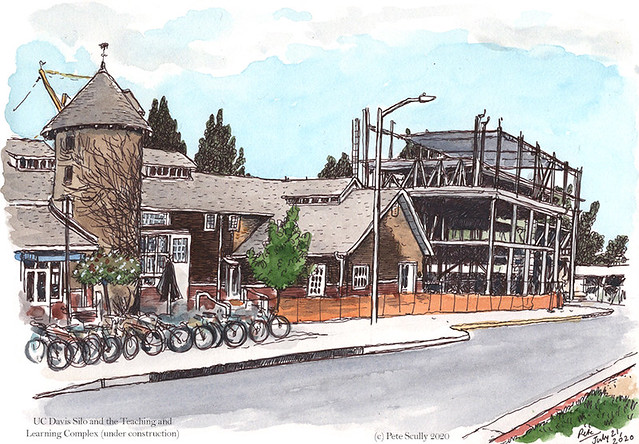
Silo and Teaching Learning Complex (under construction...)
There’s a new building on campus. I might not have been on campus much the past few months, while working from home, but I cycled in recently a couple of times to see what’s going on – not a lot – but this new building is going up next to the Silo. It will be the “Teaching and Learning Complex”, or “TLC”. Unsurprisingly this isn’t on the Med Centre because staff there wear scrubs and the TLC don’t want no scrubs. Right, obligatory TLC joke out of the way. It’s always fun having a bit of construction to draw, because you know it’s something new and interesting that will look different next time. Also it is something new in a familiar location. This was a parking lot. The one above, I drew on the way into the office one lunchtime, but the one below was done last Friday after being in all day and finishing early, but by that time of the afternoon, about 4pm, it’s getting way too hot. I stood in the shade, but I walked home afterwards very much in the sun and I wish I’d brought my bike, but oh no, gotta get my steps in, gotta walk. I have been running a lot lately, slowly building up my speed and instances, very slowly but every bit of progress counts. I ran my first four mile run on Sunday, felt a great accomplishment afterwards, and took a rest from the running today. I have to run early in the morning, but too dry and hot later on. Davis in the summertime.
Teaching Learning Complex UCD July 2020

down to the shouting sea

Rockaway beach Pacifica June 2020
Taking a break from posting about my virtual tour of Great Britain. The shelter-in-place is tough. As much as I love being at home around all my stuff, in this oppressive Davis heat some cooler outside time is needed, and in California you cool off at the beach. That is where the cool air blows in. We took a day in Pacifica, just south of San Francisco, sat on the beach at Rockaway. It’s nice there, although my legs got a bit burnt as the rays snuck undetected through the bands of fog, and my sunscreen wasn’t quite thick enough. We had missed out on an expected weekend here in May, when the soccer tournament we’d signed our team up for was cancelled. Shame; I was hoping to win it this time. I didn’t climb the rocks, but I drew them, so that’s the same. In this sketch I actually used a masking fluid pen for the waves, I had picked that up in London last year, I don’t use it much but it was great for this purpose. I had sand in the fingers and sand between my toes. This reminds me of the illustration in the A.A.Milne book, “When We Were Very Young”, specifically the one for the poem I just mentioned, “Sand-Between-The-Toes”. I loved that book as a kid, and loved it as a parent too when my son was really small, but I really loved the drawings, and especially that one. It reminded me of being at beaches on cold, windswept days, looking out at the sea, tasting salt in the air, then heading somewhere warm for fish and chips and a cup of tea. On this day in Pacifica, we were masked up down at the beach, thankfully not too many people about, before walking around the little community of Rockaway Beach a bit, and getting a milkshake at Johnny Rocket’s (although I got the wrong flavour, in a case of misunderstanding through the mask).

Jeez I want all this to be over, this bloody pandemic, but it’s not. I have been posting on Twitter a bunch of “this time last year” or “on this day in 2016” or whenever posts, showing where I was and what I was sketching, somewhere far away in a time when people were fine mingling all together. This time last year we were on our summer trip through Holland and Belgium and France, and then London, and this year we had hoped to see Italy again, but Americans can’t go anywhere now. We did manage to take a few days earlier this month to drive down Big Sur, which was pretty spectacular. I suppose if you’re going to be stuck anywhere, California is a pretty nice place to be. Just this Davis summer heat, it’s oppressive.

(21) Barnstaple, (22) Bristol, and (23) Bath

GB 21-23 sm
Now for Barnstaple, Bristol and Bath; I like the Bs, I like to make them rhyme. After a brief whistle-stop tour of Cornwall we are back in Devon, but this time North Devon, which is different. Devon’s a big county. First stop is Barnstaple, which I wanted to stop in because I have been there twice in the past couple of years, and I had wanted to draw this bookshop. Barnstaple is where my uncle Billy lived, until he passed away last year. He loved his music, knew more about music than anyone I’ve ever known, I still have several old Beatles and Pistols records that he gave me when I was a kid, but he also loved to read and had a huge library of books about music and crime in his living room, so sketching a bookshop seems appropriate, though I couldn’t find a good record shop to sketch. Right opposite this bookshop is an amazing chip shop. Seriously amazing chips there, but I always like chips in towns like this, usually a lot better than in London. When we visited Barnstaple for his wedding, my older brother and I stayed out late one night playing pool and afterwards went to a kebab shop near here to get some sort of local food called a “Jemmy Twitcher”. It has every kind of meat in it, plus lots of other stuff. I didn’t eat one but fair play, my brother did and he finished it. Helped sop up all the Guinness! So that’s Barnstaple. I remember coming to North Devon when I was a teenager, well just over the border in Somerset, camping with our local youth club, we did some into Devon a lot for activities like canoeing and walking about.

I’ve never been to Bristol. It’s been in the news lately, with statues of slave-traders going into the river. I didn’t really know much about Bristol as a city, except for the two football teams – City and Rovers – and the accent, and even then I couldn’t pick the accent out of a crowd. I know people who went to university there, I think, it always seemed like a college town people used to live in but now live somewhere else (bit like Davis). So the virtual tour was an eye-opener, it looks like a really interesting place, and a bigger city than I realized, lots to see and sketch, lots of places to walk, the big Clifton Suspension Bridge, there’s a cool looking market area, but I just really enjoyed all of the terraces of old houses, usually with different coloured doors. There was something really characteristic about them. So that’s what I drew. I must have virtually walked around the whole town. I wish I had been there in real life.

Something I noticed a lot which made me really sad was looking at the Google Map and everything, cafes and shops and pubs and especially theatres, everything had “temporarily closed” next to the name on the map. That was horrible, this whole thing is horrible, but these cities are their places and this virtual tour was one of imagination, imagining what it would be like standing there on the street, wandering through that market then popping into that pub for a local beer, to listen to that accent, but it’s not to be. Some day perhaps, I just hope all these places are still open when we come out of this. On that note, I went to the next spot on the tour, one I couldn’t miss out, and that’s Bath. I have only been to Bath once before, on a day trip from London when my wife first moved to England, with a tour group of Americans in the UK on student-work visas (we went to Stonehenge that day too), and it was very pretty. All the buildings are the same colour though, all made from the same type of stone. When I was a kid Bath was in a small county called Avon, named for the River not the Lady, but now it’s just part of Somerset. This drawing is a place I think we came for tea, Sally Lunn’s Historic Eating House, a little cafe named after a Huguenot refugee called Solange Luyon who became known for her delicious buns. People called her Sally Lunn because they couldn’t pronounce her name properly, but mostly they wanted to make it rhyme with “bun”. The thing called Sally Lunn’s bun isn’t even a bun, they just call it that to make it rhyme with “Sally Lunn”. See? Logical. So “Sally Lunn’s Buns” it is. They look pretty massive, Sally Lunn’s buns.

Ok that’s that. The next chapter in the virtual tour of the island of Great Britain takes us into the country of Wales. I am reminded of a joke I loved as a kid, “How do you get two whales in a Mini? Drive down the M4”. Now I live in America nobody gets that joke, so I have to try making a local equivalent, Americanize it. “How do you get two whales in a Ford SUV? Stick em in the back seat with the two giraffes!” It’s not quite as funny, but it makes me laugh on the inside. I suppose I could try it with a smaller car, like a Prius or a Corvette. “How do you get two whales in a Corvette? How the heck would I know, wise guy!” You have to do the 1930s gangster voice and say “myeaaaah, shee” as they did. I suppose I need to use an equivalent road, but it would have to go to a town that sounded like Whales, or maybe somewhere more American that sounds like a big animal in a small car. “How do you get two Antelopes in a Mini Cooper? Drive up I-80 past Sacramento!” That’s quite local for our area, I suppose, one for the Davis folk. Or maybe not an animal, how about “How do you find two needles in a garbage truck? Drive down Route 66!” Needles is a town that is on the old Route 66, at least it said so when I went there, the map says it’s actually on 40. No, best stick with the old classic, but even then it only works of you live in London or along the M4. Bath is close enough for it to still work. If you live in Wales you’d have to say “How do you get two baths in a Mini? Drive down the M4 and then turn off the A46 at the Tormarton Interchange!” Which we can all agree is much funnier. Right, see you in Wales!