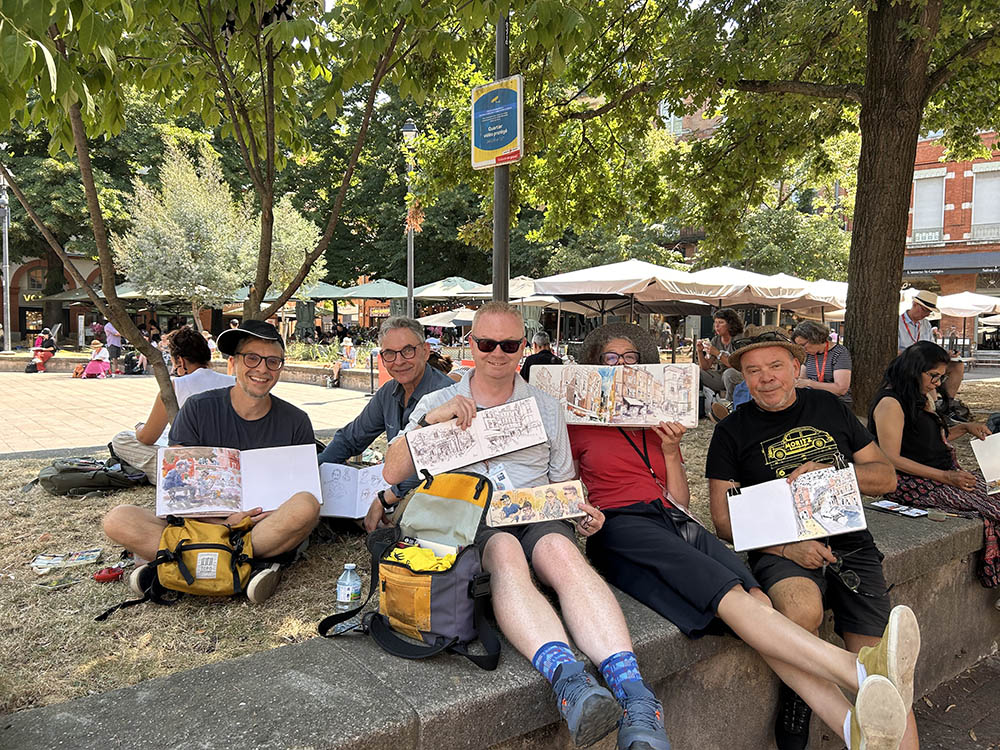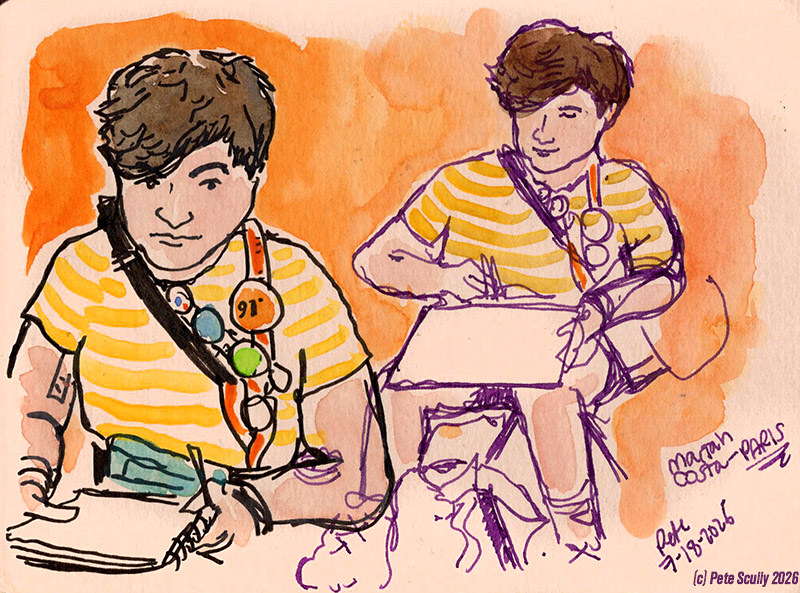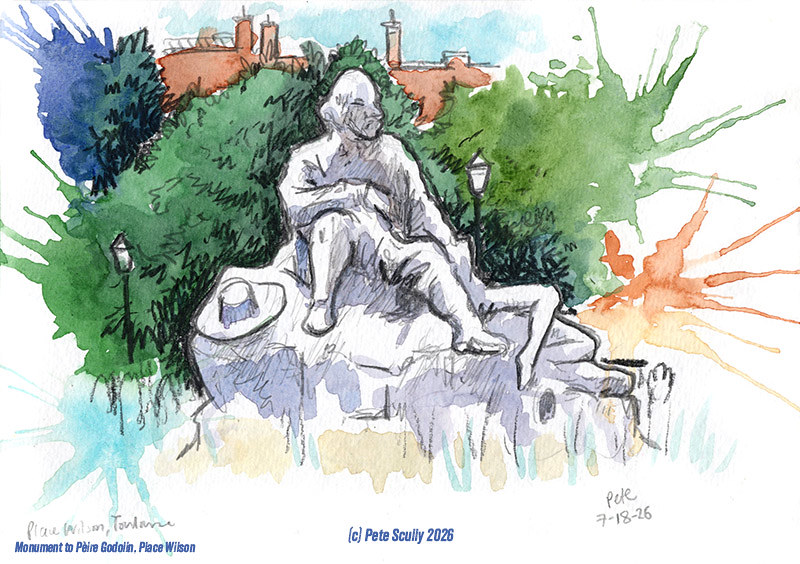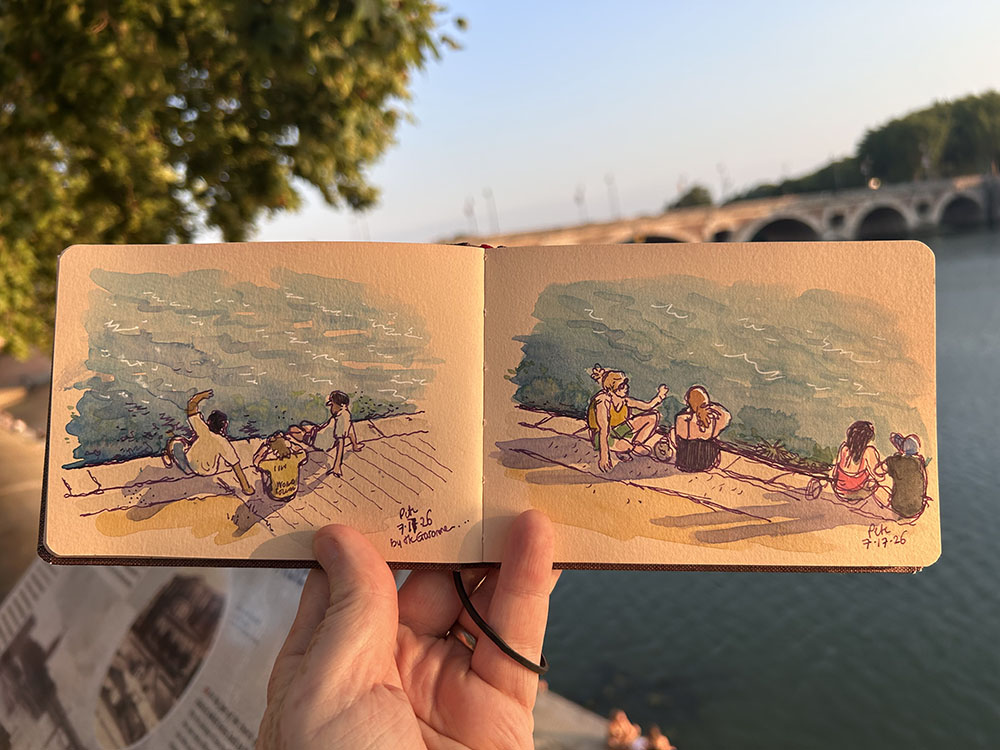
Some Time in Soho

Soho St Annes Church 082925

Back in London from Berlin, I rested for a day before heading down into central London on Friday for some more sketching before heading back to California. I had a standing ‘groundling’ ticket to see Twelfth Night at the Globe Theatre, but since it looked like rain and I was not up for a trek to the South Bank, I decided to go down to Soho and sketch around there before meeting up with my friend Roshan. If I’m going to stand for a few hours I may as well be sketching. I like exploring Soho. I made my way to St.Anne’s Churchyard on Wardour Street. I always liked the steeple of St. Anne’s. Many years ago when my mate Rob lived in Soho at the end of the 90s we could see the steeple from his living room window. It reminded me of a Teletubby. They have those big round ear things, if you remember, I didn’t really watch Teletubbies. I stood in the Churchyard and sketched the colourful bunting, love a bit of bunting, especially love the word ‘bunting’, it’s so ‘England’. Takes time to draw though. While sketching, two women (Romanian I think, I recognized some words) came in and sat in the churchyard dragging oversized suitcases with them. One of them was very noisy, yelling at the other in a loud raspy voice. It was a bit distracting, but you don’t really expect silence in Soho. I stood next to a tree, and soon an old man came up and started throwing bird seed on the ground, right in front of me. I didn’t think I thought I was a bird, but right away several dozen pigeons came out of the trees and surrounded me. This would make a good magic trick in a story, I thought, the old man throws birdseed, you are surrounded by pigeons and then VOOM you are gone, transported to a pigeon dimension. Actually that would be quite a bad story, the sort of one that would have been made in the 1970s and replayed right up to the 90s in the 5:10pm slot on BBC1 kids TV. I’d still watch it. At least no pigeons pooed on me. I was going to say ‘SHOO’ but remembered that this is an anagram of ‘SOHO’ and I thought, better not, magical anagrams and all that. It didn’t rain, a few droplets, so I drew the steeple as well. It doesn’t really look like a Teletubby, now I think about it. I looked up their website; St. Anne’s was built by William Talman, who was ‘clerk or works’ to Sir Christopher Wren, and consecrated in 1686. Then the Blitz came and destroyed it in 1940. It was rebuilt in 1990. I didn’t go inside, but being outside under the bunting was enough, like being in a village churchyard.

Soho St Annes spire 082925

I remember coming down there as a teenager in the early 90s wandering about exploring London, when I would occasionally sketch but mostly just explore the city, make a map of it all in my head. Soho was a bit like stepping into a different, dangerous world, like Dickensian London but set in the 70s, all sex shops and seedy cinemas and prostitutes openly hanging about on a Saturday lunchtime. The corner below, leading into that little alley of Walkers Court just off Brewer Street, was one of the seediest spots, I remember being shocked at all the neon lights and dark doorways leading to god-knows-what, it was a world that I wasn’t part of and definitely didn’t want to be. Rupert Street facing it had market stalls and newsagents alongside shops selling bondage gear and ladies of negotiable affection calling out to passers-by, and passing down the narrow Tisbury Court back up to the relative normality of Old Compton felt like a passage through a frightening dimension. I found it fascinating that this was a real place in the middle of the city, and yet also just another neighbourhood where people lived their normal lives. I remember at school, I was about 16 and we were tasked with doing a project about ‘community’, and I struggled for ideas, but I remember walking through this area and realizing there was a community living here, even here in this bizarre world of neon lights flashing ‘girls! girls! girls!’ and shifty men in doorways, there were people that just lived around here. Soho is a blend of communities but it is and always has been a residential area, a village in the middle of the city. London has a lot of those. A few years later when I was at university and my mate Rob lived on the corner of Rupert Street and Winnett Street with his girlfriend, it was still an area of sex shops but already seemed less scary, and we would pass through Walkers Court on the way to the supermarket to buy milk and tea, not paying any mind to the red light district we were passing by. I remember that we stayed up and watched the whole Star Wars trilogy (back when there was only one trilogy), while from his kitchen window you could catch a glimpse into other windows, where there were other fantasies going on, some in full view (did these windows not have curtains?). These days, this part of Soho feels quite different. There are a few sex shops and the big green Sosh’s Book Store on the corner of Walkers Court feels less like a seedy emporium and more like a cheeky part of Soho’s adult-themed heritage, but this mostly this area feels like it has gone upmarket now with fashion stores and such. Raymond Revuebar, the big theatre and strip club that I felt was the centre point of Soho, opened by Paul Raymond in 1958 but finally closed in 2004, having stood lighting up this corner for decades. I vaguely recall going to a gig there in about 99 or 2000, or maybe that was at Madame JoJo’s next door. When my friend lived around there he actually met Paul Raymond, and said he really was the King of Soho. There’s a fashionable clothes shop there now. I stood on the corner of Rupert Street to sketch this, thinking about all of this past, and how everything moves on.

Soho Walkers Ct 082925

Below, the spread of Wardour Street, just a few steps away from the last sketch. I feel like I spent a lot of the 90s down this street too, a busy but relatively narrow thoroughfare splitting Soho in two. I stood in a precarious location to draw this, a traffic island that has been converted as a parking spot for those electric bikes you see all over the place, with a narrow bike lane to my right. As I took a quick picture of the scene before starting to sketch, a policeman came up and said, “ello ello ello, what’s going on ‘ere then, you gotta be careful sah, there is ‘orrible tea-leaves on bikes who will nick your dog-and-bone, sunshine”. Actually he didn’t say it like that, my head was still in old 1970s films. He just said to eb careful taking pictures with my phone as there are people on bikes who will snatch it from my hands very quickly. I knew this is a particular plague of London these days and have been quite careful with this, though especially here you can’t be too careful, and I actually smiled and felt genuinely grateful that there are police out there watching for this and warning people. Though what I said was, “oh it’s ok, this is my old phone”. which it was – I used my old phone when out and about in London, just in case – but I was grateful and thanked him. Still, I held tight onto my sketchbook as I drew the scene, out of the way of the e-bike bandits. Wardour Street was always one of my favourite streets, and it contains The Ship, one of my favourite pubs in London. It used to contain The Intrepid Fox as well, the best rock pub in the city, where I sometimes would meet up with my friends from the Hellfire Club (on Oxford Street) and attempt to listen to figure out what each other was saying over the loud heavy metal music. It was sad when that place closed (it actually moved to New Oxford Street before closing for good). For a little while in ’96 I went out with someone from Italy, and she used to work in an arcade further down Wardour Street near Leicester Square, before she switched jobs to work in Las Vegas, not the city but the arcade on the left of this sketch, which still has the same sign as it had 30 years ago, a Soho relic. Cinema House is next door; this area is at the heart of the British film industry too, or at least it was (Cinema House has a fashionable clothes store now, because there aren’t too many of those). What was the Intrepid Fox next door is now a steak house, but you can still see the old stone sign of The Intrepid Fox on the outside corner. The sky was looking nice, above Oxford Street in the far distance. You can just about make out the Telecom Tower poking through on the right (follow the arrow). For some reason I remember being about 19 or 20, walking down here on a late afternoon having been to the Virgin Megastore, where I’d bought myself the Beatles Complete (Guitar/Vocal Edition), a massive book with all the Beatles songs in it (which I still have), and treating myself to a pastry and some tea at a nice cafe as a self-reward for finishing up all of my college projects and homework, and that being quite a nice moment down here. It often feels a little too busy or a little too cramped to stop and sketch on the corners around here, but I’m glad I spent the time looking at it again. Soho is always worth sketching. I’ve been back to London since this trip last summer, and I was in Soho sketching again just last month. By this rate I post my sketches on this blog, those will probably be up by about 2028. Click on the image to see it bigger.

Wardour St, Soho (London)

auf wiedersehen, Berlin

Berlin Wall Memorial 082625 sm

I’ll finish up with the remainder of my Berlin sketches and thoughts. I definitely had a lot of thoughts when visiting the Gedenkstätte Berliner Mauer (Berlin Wall Memorial) in the northern section of the city, close to the Nordbahnhof. before heading up there I walked over to the Hackescher Höfe, which I had visited a couple of days before with Omar. I wanted to visit the art and bookshop there, at the Haus Schwarzenberg, which is covered in graffiti and has a stairwell full of art and posters and stickers (and signs saying not to take photos; I broke that rule). The shop I visited was called ‘Neurotitan’ and was an incredible place, I bought some zines and stickers there, and asked the assistant if they had Detlef Surrey’s book ‘The Wall Revisited’ (I’m pleased to say I held a conversation in German and was totally fine; normally I need a couple of beers before the German comes flooding back). I had heard that this store stocked it, but she said that the last copy had just been sold that day, probably by someone else who had seen his talk in Poznan. I showed her my sketches of that talk, she said that I could probably get in touch with the publisher to get a copy (I did, once I got back to the US, but it took some time and a bit of extra money – thanks a lot, bloody tariffs – to get one sent over to America). I had that book on my mind now especially because I was going up to the Berlin Wall Memorial, which Detlef had talked about at length. I took the S-Bahn out to Nordbahnhof (I realize that sentence implies that I simply got on the S-Bahn, and just went to Nordbahnhof, but leaves out that I got on the wrong train in the wrong direction at least twice, like when you try to fix a scratch but end up smashing up the table, but I did end up at Nordbahnhof in probably more time than it would have taken to walk). The Berlin Wall Memorial is a preserved section of the Wall and the Death Strip, along Bernauer Strasse. It was already early evening when I arrived at Nordbahnhof (sketched below), which during the Cold War was closed down, a ‘Ghost Station’ on the divided S-Bahn system, where West Berlin trains would not stop but passengers would catch a glimpse of a time capsule manned with armed guards. I found the Berlin Wall Memorial chilling. This was not like the East Side Gallery, here was the Wall as it looked, along with rows of metal poles installed like bars you can walk through. One section remains closed off to give an idea of what the Death Strip really looked like. Berlin is a city that dares you not to forget its past. On a metal display in the middle of the grass are the names and faces of every person who was killed trying to escape from the East into West Berlin, 136 in all. The faces as they look out at you, some so young – even children – was frightening. There were blocks occasionally showing where people were shot trying to escape. The Wall was up from 13 August 1961 until 9 November 1989. I didn’t get to see all the areas of the Memorial, nor the documentation center, but I sketched the Wall as the light was fading, then took a tram out to Prenzlauerberg and back to the hotel.

Berlin Nordbahnhof 082625 sm

After a late dinner of spaetzle from the hotel restaurant I walked back over to Hackescher Markt. All over Berlin, but especially around here where there had once been a large Jewish population, you find the ‘Stolpersteine‘, or ‘stumbling stones’, which are actually little square brass plaques in the pavement that are slightly raised so that you might trip on them, by design. Each has the names of people who lived there previously, usually Jewish but many Roma, homosexuals, disabled, who were removed or forced to flee by the Nazis, along with the year, how old they were, and their fate (you see ‘Ermordert in Auschwitz’ a lot). This is an initiative by the artist Gunter Demnig started in the 90s, and has now spread to many other cities commemorating victims of the Holocaust. Each of the Stolpersteine is handmade. Berlin makes sure it does not forget. I went back over to Hackesche Höfe and had a beer at the Cinema Cafe, which I sketched in the poor light. It is interesting that a lot of places in Berlin are cash only, where I got so used to using my card everywhere in Poland, same back in California. It wasn’t a busy evening, it was Tuesday, but it was an interesting cafe to sketch, and I used my fountain pen. The outside area of the cafe is in that alley with all the graffiti and would have been an interesting sketch, if I could find somewhere to sit with a good view, which I couldn’t. After this, tired, I went to bed.

Berlin Cinema Cafe 082625 sm

On my last morning in Berlin, at the end of my Poland-Germany trip, I was ready to go back to London but had a last sketch or two in me. I had considered adding in a short trip to Denmark onto the end of this adventure, since it was 30 years since my strawberry-picking visit there, but decided a couple more days in London would be better for me. I had also considered taking the overnight train from Berlin to Brussels, a fairly new service, and passing a couple of days in my old Belgian haunts, but I’m glad I didn’t in the end. It was nice to spend some time by myself in Berlin but it’s not 1998 any more. I walked down to the Museum Island (sketching a man fishing in the Spree along the way) and sat next to the Dom, drawing the view of the Museums in pencil.

Berlin fisherman
Berlin Museuminsel skecth 082725 sm

It is fun (and quick) to draw in pencil but I don’t really like straight lines much. I do love that sky though, and miss those wispy cloud skies. Before long I was back up in the wispy clouds myself, and sketched the view on my very small plane (see below). It was easy to get the S-Bahn out to the Brandenburg airport, but took a very long time getting through the security line, which seemed to have one line per baggage inspector and the inspector seemed to have to open up every single bag and inspect every single thing. I eventually had to ask them to let me through as I would miss my flight despite being there super early. Word of warning for you in Berlin airport, it can be slow. I flew back into a new airport for me though, London City Airport out past Docklands, a very small and convenient place to end up. I jumped right onto the DLR to Bank, and onto the Northern Line back home to Burnt Oak. Auf Wiedersehen Berlin, it was nice to reconnect after all these years. I would like to get back to Germany again soon, but I’d like to go back to the South and West again, maybe explore the Rhine Valley at last.

BER-LCY 082725 sm

East Side

Berline East Side Gallery 082625 sm

I took the U-Bahn out to Warschauer Straße, a wide busy road well out into the East, full of hostels and clubs and new buildings. I was headed to the East Side Gallery, a famous stretch of the remaining Berlin Wall that separates Mühlenstraße from the banks of the river Spree. Popular with tourists, I’ve been here before, but almost didn’t recognize the other side of the street, now all built up with tall steel and glass hotels and apartments and businesses, plus a big modern concert arena, not like the concrete DDR era blocks and empty spaces I saw on my last visit. The East Side Gallery starts close to the Oberbaumbrücke, a decorative bridge over the Spree, and is the longest bit of Berlin Wall left standing. It was covered in artwork by over a hundred artists in 1990 after the Wall fell, and has been left as a testament to the fall of the DDR. Some of the artwork has stayed in place over the years, much of it has been updated or renovated, or even had new artwork put in place. Some sections have even come down, as Berlin has started redeveloping, but this is considered to be the largest open-air gallery in the world and contains some now famous paintings such as the one of Brezhnev and Honecker kissing, My God, Help Me to Survive This Deadly Love by Russian painter Dmitri Vrubel. I stood and sketched the section above, showing Alles Offen (‘Anything Open’) by Rosemary Schinzler. I drew in pencil and watercolour (on that horrible bobbly Moleskine paper) and I likely had in mind the looser style of Detlef Surrey having been so inspired by his work at his talk. Plus it was just faster; I get bogged down with my penwork sometimes, and it’s good to be free; where better to be free than at the broken Berlin Wall. There were a lot of tourists about but it wasn’t crowded. I tried to find the spot where a photo of me was taken in 1998, and it was besides Wir Sind Ein Folk (‘We Are One People’ aka ‘Worlds People’) by Schamil Gimajew. I got someone to take a photo of me, so I could put them side by side. It’s clear that the original painting looks fairly different to the updated version, but still in that very distinctive style that I was so drawn to. The side by side photos are below. I remember we used a highly stylized black and white version of that photo in a poster for our small university production of Brecht’s Caucasian Chalk Circle (performed in German; I was Azdak the judge, the best possible character to play ever; that was a chaotic student production for our German Play course, in which I co-directed the first half, and designed the set to be projected on stage by one of those overhead projectors you get in schools, with extra characters drawn in pen and moved about alongside the real actors by me, it was very strange but we were on a budget and had to be creative…). Wir Sind Ein Folk is a really long piece and you could spend hours looking at all the details; there is more information about the piece and the artist on the East Side Gallery Exhibition website. Anyway here are the two photos, almost three decades apart (note the odd socks in the older one); I still stand in the same way.

After exploring the East Side Gallery I walked along the Spree, the Sun was out and I like to find the shade, so I stood next to a big boat (which was also a hostel; seemed like a fun place to stay, or maybe not, maybe 1998 Pete would have enjoyed it). I wanted to draw the long Oberbaumbrücke. I had intended to colour it in but couldn’t be bothered in the end. It is a double-decker bridge, and connects two neighbourhoods (Friedrichshain and Kreuzburg) that were divided by the Wall. This bridge was built in 1896, replacing an older wooden crossing, and has those two distinctive brick towers inspired by those in the city of Prenzlau. Updates were made following reunification. While I sketched, an American man started to chat with me, he was another sketcher who had been at the Symposium and was part of Urban Sketchers LA, Kevin Riley, really good sketcher, so now I’m following him on Instagram. It’s this whole thing about urban sketching, we get to recognize our people out in public, make connections.
Berlin Oberbaumbrucke 082325 sm

Here’s another picture of me in Berlin in 1998 standing on the Oberbaumbrücke, with the Fernsehturm in the background. I had thought about taking one of those riverboats down the Spree, that would have been interesting. Can’t do it all though. After I finished the sketch of the bridge, I walked back over to busy Warschauer Straße, had a fairly gross tasting vegetarian currywurst at the station, and headed back to the hotel for a rest before seeing some more remains of the Berlin Wall before it got dark.

west side

Berlin KW Gedanktniskirche 082625 sm

For my second full day in Berlin, I had a few things I wanted to do. You can’t do it all; I couldn’t for example go out to Charlottenburg, where I had never been; nor to Neukölln and Tempelhof, which had been recommended to me; nor out to Potsdam, which I had explored in ’98 anyway. Things always take longer when I have my sketchbook anyway, but I spent a bit of time going about on the U-Bahn and S-Bahn. I had a leisurely breakfast in my hotel room, sat looking out of the window and strumming on the uke, then headed out to West Berlin, to the Zoobahnhof, the busy shopping street of Kurfürstendamm, and to the Kaiser Wilhelm Gedächtniskirche (Kaiser Wilhelm Memorial Church) at Breitscheidplatz. I was covering old ground; this is one of the first places I visited in 1998 on the day I explored the city on my own. It is the shell of a large bombed out church, with the more modern church structure next to it, a large concrete edifice made up of small windows of stained glass. The older building stands as a monument to the destruction of war, and there is an exhibit of its history inside, along with an iron nail cross from Coventry Cathedral, also destroyed by aerial bombing in the war. The two cathedrals have held a long friendship together. The original church was not that old, having been built by Kaiser Wilhelm II in the last years of the 19th century, opening in 1906. The new church doesn’t look much from the outside, but inside the largely blue windows create a thrilling effect as they surround the space, it reminded me of Liverpool Catholic Cathedral, though this is a Protestant church. I had always thought (probably someone told me when I went there years ago) that the glass was recovered from the original building, but that is not the case, the glass in fact being designed by Gabriel Loire. That makes more sense, I think that when clearing up they probably weren’t saying “collect all those little bits of glass, ja, that might come in handy”. I really enjoyed sitting in the new church and sketching, something about all that blue really calms you down. I also liked the design of the floor, all colourful circles. There is a big golden Christ with a long face flying above the altar; it’s actually made from a bronze alloy metal called tombac and designed by Karl Hemmeter. I sketched in there (below) before sitting outside and sketching the old and new, above.

Berlin KW Gedanktniskirche (inside) 082625 sm

This is the commercial hub of the city and it feels like it, the Capitalist island in the old Communist sea; I remember that road map of Europe I had when I was a kid, West Germany was fully detailed, but only major cities were shown in the otherwise blank East Germany, except for those three autobahns that went from the West directly into the isolated West Berlin, with little warnings telling motorists they were not allowed to leave the road. According to that old road map, East Germany was a place that geographically didn’t exist. In his talk at the symposium, Detlef Surrey said that you got used to living with the Wall and the fact that there was this other place just over there, but that you mostly didn’t think about them, or maybe were encouraged not to. It was a different time, but I wonder about modern Korea, where you can say the Berlin Wall still exists, how do the people in the South think about those in the North. Germany is all one now, ever since 1990, but I hear many Germans say that it still feels like two, those divisions from decades ago and the years of change afterwards were a lot to expect to just heal. Was Germany ever really one? I always think about the north-south divide (sometimes called the Weißwurstäquator, depending on the type of sausage you might eat in different parts of the country), and the division between mostly Protestant and mostly Catholic regions, but in truth Germany as a federal nation has always been made up of very diverse places with differing histories. It’s a country and a language (all the different varieties) that has intrigued me since I was a kid, it is not a monolithic block. I would like to really explore it in more detail, but as I said, I don’t have time to go everywhere, mostly I’ll just draw the old buildings, and I don’t even eat sausages, well not pork ones. I was thinking of the old East-West as I walked around here though, since it had not changed as much as the other side had since my last visit in the 90s. I walked through the mall to find the toilet, and half expected to see posters of Hasselhoff in record shop windows. While we are talking retro, below is another photo of me in the 90s, posing like Bono with someone else’s sunglasses down in the Zoo station. Check out the little beard thing I had then, that is how you can tell it was the 90s. I took a photo of that sign as I pass through, it hadn’t changed much.

I had planned to take a wander through the Tiergarten. I wasn’t planning to go to the Zoo itself, who has time for that, but I love a massive park. This one is pretty big, and I only covered a small part of it. I started drawings some old lamp-posts, which were from all over the German-speaking world, plus some from other countries, a really interesting display of civic artistry all hidden together in this corner of Berlin. It was well past lunchtime now, and I was feeling hungry so decided to find the S-Bahn station and go back to the hotel for a rest before exploring the East Side. I wish I had been reading a novel set in Berlin, and that time passed a lot more slowly, to sit in the park or on the S-Bahn reading would have been perfect. As it was, I was still reading Agatha Christie’s Lord Edgware Dies (spoiler alert by the way) and it was taking me forever, because I’m a painfully slow reader.

Berlin Tiergarten lampposts sm

Prenzlauerberg

Berlin Prenzlauerberg 082525 sm

After a short rest at the hotel, I got back to exploring Berlin. I got on the U-Bahn at Rosa-Luxemburg-Platz and went a couple of stops up to Eberswalder Straße, a station above ground in the busy Prenzlauerberg district. I had struggled to remember exactly where I stayed on that trip to Berlin in 1998, just remembering that it was somewhere in East Berlin, where there was a busy intersection and an U-Bahn station above ground with some magnificent ironwork. I looked in my old journal from that trip – instead of bringing guidebooks that would weigh down my bag I simply got a notebook, filled it with information from each book, copies of maps and metro systems, and left space at the back to write a journal of the trip, five weeks around Europe on the trains. No smartphones in those days. I had kept a separate journal for more detailed and personal writing (lot of time to write on trains and in hostels) but in my main one I wrote down when I arrived and left, what I did, who I met and where I stayed. When I went to Berlin, it was not from an overnight train but a shorter journey from the pretty city of Lübeck where I had slept for a couple of nights at a hostel, and had met a couple of Australians called Pete and Kat who were also going to berlin the next day. We went together, and after arriving at Zoobahnhof we were right away being approached by people offering places to stay at hostels or otherwise. This it turns out was very normal especially in the Eastern European cities, and Berlin I suppose was the furthest East I’d been yet (in my life). An older woman called Frau Wurst (Mrs. Sausage) offered to rent us her small apartment for a few days, and being in our fearless early 20s we all said yeah why not. This was many years before the concept of AirBNB. She took us on a bus, getting angry with the ‘Wessis’ (who were very rudely just minding their own business and not bothering her at all) for sitting in the front seats upstairs, she was scolding and scowling at them, to their (and our) confusion. I learned that ‘Wessis’ were West Berliners and ‘Ossis’ were East Berliners, and Frau Wurst it seemed was no fan of a Wessi. Me and my two new friends who were both Aussies (not to confuse things) just looked at each other like, what have we got ourselves into here? Frau Wurst told us all about Berlin from the top of that bus, all in German that I translated for the two Australians as best I could, and especially about life following the fall of the Berlin Wall, and I learned about ‘Ostalgie’, the nostalgia for the life in the old DDR. It was an education. We ended up in the area which I now realize was Prenzlauerberg, and I wrote down the address in my little journal so that decades later I would remember where it was we stayed – Schliemannstraße. Frau Wurst told us how she had lived in the flat before the Wall fell, and then after German Reunification she suddenly had to start paying rent and had all these other unexpected living expenses, so she converted the flat to rent out to tourists and was making extra money that way during the summer. It was the 90s though, so instead of posting online she had to literally go to the station and talk to people getting off the train. She had a fascinating story and I’m really glad we met her and stayed up there, as it was an interesting and convenient place from where to explore Berlin, but it still felt like two cities with two vibes. Not so much any more. I walked around the neighbourhood, finding the street where I had stayed with two Australians all those years before. It was different, very busy, diverse, lots of cafes and shops, and I sat outside a fast food joint on the corner and sketched the view of the station while Berliners whizzed past on e-bikes.

Me and a Trabant in Prenzlauerberg in 1998

Berlin dragon fountain 082525 sm

Everywhere I had read told me that Prenzlauerberg had gone very upmarket and was one of the trendier parts of Berlin, but I didn’t feel that so much. Buildings were covered in graffiti, which seemed more the norm in Berlin that other cities anyway and it added character, but it was scruffier than expected, but again I didn’t mind that. I walked to a little park that cuts across Schliemannstraße, where people were playing games, reading, talking, walking their dogs and in my case, sketching a big green metal water pump, which had a dragon’s head for a tap. I found a nice bookshop opposite the park and had a look around in there (no sign of Detlef Surrey’s book), and wandered about a little bit more before heading over to Mauerpark. I found one of those Photoautomats, the old-school instant photo booths found all over Berlin that all the hipsters want to find. I had to have a go (see below). In the first couple I didn’t realize it was even working properly, in the third I held up my sketchbook, and in the last one I held up my blue plastic ukulele that I’d brought along to play while sat in the park.

Mauerpark is a grassy space just a short walk from Eberswalder Straße. As the name suggests, it is a park next to what was a stretch of the Berlin Wall, and was part of the infamous ‘Death Strip’. These days it’s a lively park where they hold a flea market and regular open-air karaoke, but there are always people spraying new graffiti designs on the stretch of concrete on tope of the steep embankment. I sketched the wall and listened to a group of four teenage artists debate over what to paint and how, the familiar sound of cans being shaken and music being played over tinny speakers. One of the kids said that he could not be out too long as his mother had called him home for dinner. I found it fascinating watching the street artists at work, and I sketched that part of the wall before sitting on the steps strumming my ukulele as the sun started to go down. A pretty good evening in Berlin.

Berlin Mauerpark 082525 sm

Berlin Photoautomat sm

I took the tram back to Eberwalder Straße and walked about a little more, checking out the Kulturbrauerei (finding another little Photoautomat, above), before deciding to grab some groceries at the supermarket and head back to the hotel. It was dark by now, and I was hungry. I ended up going for a late dinner at the much more Bavarian Hofbräuhaus, near Alexanderplatz, where I had a hige liter-sized ‘Maß’ of Bavarian beer and some schnitzel, while listening to some Bavarian oom-pah music (not very Berlin but very fun), and trying not to overhear the conversation an Irish man was having with his date behind me, I say conversation, more like monologue. I tried to sketch it all in pencil, Monday night in Mitte. And then, home to bed.

Berlin Hofbrauhaus 082525 sm

through the heart of Berlin

Berliner Dom 082525

When I’m so behind in posting my sketches it is overwhelming to think of how much catch up there is, but then I remember that I’m looking back on my adventures from last summer, and it’s sometimes good to reflect on them when they are less fresh so you have had the time to digest them. Berlin is a lot to digest all at once, especially if you are mostly digesting by going around drawing it all. Berlin is a city with a lot of stories, and you can’t draw it all, and you can’t absorb it all. All those stories go through your head as you stand and look at them and try to make sense of things. You see how things are in the present day and you see how easily things went from one situation to another situation so quickly in the past and you think, well of course we should look at the past. Right now we are living in other peoples’ past. I remember feeling this very strongly the first time I was in Berlin, back as a scrawny 22 year old student dashing about Europe on night trains, feeling like this was a city coming to the end of the twentieth century where there were a lot of open wounds, but that it was about to become a different city again. Almost three decades later I was back with a more accomplished sketching habit to take a look around, and on this day I left my hotel near Alexanderplatz and walked down towards the MuseumInsel, which I’d explored the evening before with Omar. I sat in the grassy square outside the huge green-copper-domed Cathedral (Berliner Dom), which was peaceful except for the gangs of young women with indeterminate accents approaching people from all angles with clipboards. You see those gangs in many cities, they really want your signature for something or other, and your wallet too when you let them get too close. You have to keep these obvious pickpockets away from you, and I had to tell them to go away several times, eventually telling them to f-off, but I could see them going up to people all around the square. I was feeling pretty relaxed though, and was really happy with my drawing of the Dom with the Fernsehturm in the background. The cathedral itself has a long history going back to the 1400s, and has had several different iterations, but the present building designed by Julius and Otto Raschdorff was inaugurated in 1905. I didn’t go inside. It was a nicely overcast day, perfect for sketching where I’m not bound by looking for shade, and I think this was my favourite building sketch of the trip, drawn in the portrait sized Hahnemuhle, two page spread.

I was going to walk all the way down towards the Brandenburg Gate, but it was a long walk down Unter den Linden and there is an U-Bahn that goes all the way down it now. I love travelling on metro systems in other cities, it’s a whole new level of concentration. Berlin’s system is easy enough, the U-Bahn underground intermingled with the S-Bahn above, but that didn’t stop me getting lost a few times, or getting on a train in the complete wrong direction more than once, taking longer to mess about in stations than it would have taken me to actually walk the short distance. It was easy enough to get from the shiny Unter den Linden station down to the U-Bahn station formerly known as Unter den Linden but now called Brandenburger Tor.

Berlin Brandenburger Tor 082525 sm

The Brandenburg Gate is for many the most well-known architectural symbol of Berlin, especially of my generation and before who lived in the Cold War era. This was that big ghostly gate, stranded in the no-man’s-land between the Berlin Wall, which we Westerners could only see the back side of. It was on the news a lot when I was a kid. I remember the strange thrill of being able to walk through it when I went in ’98, less than nine years after the Wall fell, while souvenir sellers hawked old Soviet and DDR era army hats and badges. It used to be at the very real and dangerous dividing line between two worlds. I was planning to see more of the old Berlin Wall locations on this trip, inspired by Detlef Surrey’s presentation on his book (which I now have) and the stories he told about his younger life living next to the Wall. The Brandenburger Tor was built in 1791 during the height of the Kingdom of Prussia. Since the Wall fell it has been a symbol of German and European peace and unity. I stood in Pariser Platz, tourists all around taking photos, a man on a platform talking about something or other political, tour guides (‘Tor’ guides?) pointing out the window at the nearby Hotel Adlon where Michael Jackson once dangled his baby (remember that?), and I sketched the gate and the people milling about. I always feel a little awkward sketching columns, I have always felt that life is too short to draw columns, but I just don’t like drawing straight lines. When I was done admiring it all, I walked through the gate and into what used to be called West Berlin.

Berlin Brandenburger Tor (from West) 082525 sm

I had to sketch it again from the other side. I have a photo of me from that trip back in 1998 looking young and skinny, standing with this view in the background. there’s the picture below, along with another of the young me sitting where the Wall once stood (with the sort of look on my face that you see in YouTube thumbnails with clickbait headlines like “Berlin: Was It Bad?”). The view has not changed that much really, though my poor eyesight and short memory led to me write ‘Hotel Adler’ above the Hotel Adlon. There’s the Fernsehturm, finding a way to get into every sketch. Traffic rushed by this busy junction, and the massive Tiergarten park loomed behind me full of trees and joggers. I had thought about getting up in the morning and having a run through the Tiergarten, but decided against it. It’s really big.

So I walked down Ebertstraße towards Potsdamer Platz, following the line of the old Wall, but first I was going to visit somewhere which was both moving and chilling, the Denkmal für die ermordeten Juden Europas ‘Memorial to the Murdered Jews of Europe’, also known as the Holocaust Memorial. Berlin does not turn its face away from the dark past, and the location of this huge memorial space is significant, nearby the Reichstag, on an area which used to be part of the infamous Death Strip inside the Berlin Wall, and close to where Hitler’s bunker was located. The memorial looks like a filed of smooth grey concrete blocks all lined up in symmetrical rows, appearing to move up and down as the ground level gets deeper and the slabs get taller. It resembles a graveyard, a colourless crop field, a grey grid system city that feels like a labyrinth; the designer Peter Eisenman left it open to interpretation. As you enter the monument the concrete blocks are short, resembling tombs, and children jump from one to the other, though they are not supposed to. The further you walk down each corridor, the taller the blocks get until they tower above you and everything feels…cold. There are people around, but you feel isolated. You might see them pass by ahead or behind, quickly in and out of view (reminding me of that scene in Yellow Submarine), leaving you along again. The rows may be meant to put you in mind of the lines of Jews being led into the camps or onto the transports, and you feel trapped inside this grey world seeing the sky above that can’t be reached. I felt a bit scared in there, not that anything would happen to me, but that the feeling of isolation descended so fast. It is not a labyrinth, every path is a way out, but it was easy to feel suddenly lost. It was sunny when I emerged and I needed a rest. I sketched the Memorial, with the green Tiergarten away to the left, the glass dome of the Reichstag and the solid block of the U.S. Embassy in the background.

Berlin Holocaust Memorial 082525 sm

It was a longer walk than expected to get to Potsdamer Platz; perhaps I was just tired. The day was already getting away from me, and I hadn’t eaten lunch. The last time I was in Potsdamer Platz it was just a building site, the biggest in Europe, but now it was all big modern buildings and infrastructure. The train station was complicated; you had to go back outside the find the U-Bahn, I decided to go back to the hotel for a rest before I did any more exploring. That was a lot of history for a small area.

Back To Berlin

Berlin Fernsehturm & St Marienkirche 082425 sm

Ok, a month of not posting (I went to England) but let’s get back to last summer before this summer comes around. After Poland, I spent a few days in Berlin, a city long on my go-to-and-sketch list (a list that includes all of the cities, but some are nearer the top than others, like Berlin). I was last there in 1998, which may as well have been in a different century. Which it turns out it was. I was staying in Mitte, in a hotel not far from Alexanderplatz, a good central location to explore from, but in the heart of the old East Berlin. This was a changed city from the last time I was there, but so am I. I arrived by crowded train from Poznan, which was headed for the Hauptbahnhof (a station that wasn’t even there in 1998) but ended up diverting to a different station at the last minute, confusingly. It was all good in the end. I got to my hotel, and then met up with fellow Urban Sketcher Omar Jaramillo, who has lived in Berlin for many years now. He showed me around on an extensive walking tour of the city centre, giving me all the histories and showing me all the details that I might have missed on my own. That was really great, and a nice introduction to the city before my sketching adventure (plus Omar’s awesome and I’ve been a big fan of his art since the first days of USk). I didn’t sketch him though! The first sketch I did of Berlin was the one above, of the massive Fernsehturm. The iconic TV Tower which can be seen from all over Berlin, a real Ost-Berlin landmark. I didn’t go up this time. I thought about it. I did go up in 1998, and there was a revolving restaurant up there. I love big telecommunications towers. I drew the BT Tower while I was in London as well. In the foreground there is St.Marienkirche. I stood out on Karl-Liebknechtstrasse as it was getting dark and looked up. Birds were circling the steeple. I had to remind them this was not a 1970s art film. When I was done I went to a small restaurant near the hotel and ate some spaetzle (which was not very good) and had a beer (which was also not good). Ah well, can’t win them all.

Alexanderplatz 082525 sm

I got up and it was Monday. I had two entire full days on my own just to wander the whole of Berlin sketching what I can. I had a rough idea of where I wanted to go, but all the best Berlin stories start with a meeting under the big World Time Clock, Die Weltzeituhr, at Alexanderplatz. I wasn’t meeting anyone but myself on this day, and I was late, so while I waited I sketched. Those yellow streetcars hummed along dodging stray pedestrians, and the base of the Fernsehturm can be seen behind the big arch of Alexanderplatz station. I love this sketch. It was not that early in the morning, and the sky was threatening some light rain, but people were out and about and the city moved around me. I didn’t see any people meeting underneath the clock, unless they were spies, in which case good job lads, I never noticed you. I probably wouldn’t have been a good Cold War spy, I’m too obvious standing there with my sketchbook, or maybe that’s the most genius spy design. Anyway before we start my journey through Berlin, here are some other Berlin things I drew that I though I should share here.

Berlin Ampelmanner sm

If you have been to Berlin you will recognize these, the Ampelmännchen, which were the old East German street crossing lights that have become a big symbol of Berlin. You can’t move for tourist tack featuring the green Ampelmann in his hat and the red Ampelmann with his arms outstretched. And I couldn’t get enough of it, I bought the lot, even got Ampelmann socks, candies, stickers, one of those plastic reflective things you put on your bike, I loved them. When I did that 1998 trip I took notice of these, and the street-crossing signs, in many of the countries I visited, and drew them in my journal. Seeing these everywhere reminded me of that obsession. I don’t care, I love street furniture. Speaking of which, below is a fire hydrant from Alexanderplatz. Like London these are mostly underground and have to be brought up.

Berlin hydrant sm

Berlin Fernsehturm from hotel window 082625 sm

And finally, a sketch of the Fernsehturm that I did the next morning while looking out of my hotel bedroom. I stayed at the Lux on Rosa-Luxemburgstrasse, nice hotel but very slow elevators, especially when I need the loo. It was a lot sunnier that day and I ate breakfast in my room and played my blue ukulele a bit while watching the city. I sketched, and made the decision to add a little paint, golden yellow and turquoise blue, but unfortunately it was on that horrible new Moleskine paper and didn’t have the effect I was after. Still, I had a nice time drawing it. See you in the next post…

super bowl sunday

Living Room during super bowl 020826

Time to pause from posting my sketches from last summer, and bring it back to 2026 for a moment. I sketched this last weekend while the Super Bowl was on, I wasn’t really watching (I think it was the Seagulls vs the Parrots; all the NFL teams are named after birds I think) but I did catch the halftime show, since it’s all everyone in the whole country was talking about, and it was very good. A lot better than watching Spurs lately; we sacked another manager. Anyway we were at home not doing much, as you can see from the decorations, there was a significant birthday in the house the day before. Well half a century feels significant, but I didn’t want it to be, so we ended up staying in and having a curry. I had a nice ice cream cake though. There was a surprise mini-celebration at work a couple of days before that I wasn’t expecting, that was very nice of everyone to do that. I get embarrassed by attention. Anyway that’s happened now, we are doing something fun in May to celebrate more, I’m looking forward to. The world in general seems to just be increasingly awful and anxiety-inducing in so many ways, but my ice cream cake was nice. One thing about turning a significant number is the amount of looking back you do, and particularly over the last ten years. I have progressed, got a promotion to a job that keeps me busy and gives me the chance to do and learn different things, I have travelled to a lot of new places, I’ve bought a house, coached a load of youth soccer teams, I have drawn in my sketchbooks more than ever before and got a lot more confident with it, but I haven’t done any more books since 2016, and I had plans in my head I’ve not gotten around to. I’ve had a lot of art on display (mostly in the Pence) but my last solo art show was 2016 at the UCD Design Museum. There was also a pandemic and we’ve all had various growths or setbacks related to that. So I feel there is still more I could have achieved, and more I still want to (need to) do. Maybe by the next significant birthday I’ll have it all figured out. But for now, just get on with the jobs in front of me, and sketching the world around me, and see what happens. And hope Spurs can finally get better.

Poznań (Part 8) – Sunday morning

stary rynek pano 082425 sm

The Symposium was over, and it was the last morning in Poznań. I had a train to catch to Germany, but still a bit of Poland to sketch. I slept ok after getting back from the closing reception and the drink-and-draw that went on well after midnight, but still got up early to go out into the sunshine and finally draw that colourful row of chocolate-box buildings on the main Stary Rynek square. I drew fast and used my fountain pen; I didn’t have time to colour in there so did that later, but I drew a lot in a short amount of time. It was so nice out. There were still some sketchers about, and I even finally bumped into Joe Bean who I’d been trying to meet with for a few days. So many people at this symposium, it was hard to find everyone. I wonder how many others I didn’t get a chance to talk to this time. The little stalls in the arches were setting up, it would have been a really good day to just spend all day in the square sketching, but I was ready to move on from Poznań, interesting city though it was, Berlin was calling me. I did have time to do one more sketch below of a fountain I’d wanted to draw, which again I had to colour in later, but then I had to dash back to the hotel and get a cab to the train station.

poznan stary rynek statue 082425 sm

Here are a couple more Poznań sketches, that I started but didn’t draw until later. Some graffiti I had spotted while about town, I really liked the two-headed cartoon pig. There’s the sign for Zabka, the little mini-market conveniently located everywhere, I missed that when I left. And below, I had really wanted to draw one of the nice manhole covers, these are the things I like to look out for in new cities. So that was my trip to Poland, a week in a very interesting country that had nice people, great architecture, good trains, convenient stores, fresh beer, good food, an attractive sounding language full of long words with frightening spelling. I’ll definitely be back to explore more some day, maybe I won’t leave 27 years in between trips this time.

poznan graffiti sm
poznan drain cover sm

And so, on to Berlin.

Poznań (Part 7) – Saturday Night

Before I knew it, the Symposium was coming to a close. I had a short rest at the hotel, and set out for the final big group photo. I have missed the final photo in at least two Symposiums and so was determined not to miss this one, and of course I very nearly did because I was walking to the wrong place. I figured it out in the end. Hundreds of us gathered in this big town square, Plac Wolnosci (that I had never been to before), and you can see the big photo on the Urban Sketchers site. After the big photo all the different sub-groups got together for their own photos, the Symposium Faculty, the Volunteers, the Poznan sketchers, the German sketchers, the Brazilian sketchers, the Californian sketchers (I’m in that group), the UK sketchers (I’m in that too but I missed their photo), the Antipodean sketchers (good contingent came from Australia and New Zealand) plus many more, all having lots of fun. My real group though was small, and we spent a while trying to gather us all together, we were the Last Remaining Originals from Portland 2010. There we are above – Elizabeth Alley, Shiho Nakaza, Liz Steel, Mike Daikabura, Kalina Wilson, and me. The only other Original who attended Poznan was Rita Sabler, but we couldn’t find her despite much searching. We took a few photos, and then I had them all do the ‘Brucie’ pose, (without explanation) as you can see above. Good game, good game, didn’t they do well. The more normal non-Brucie picture is below. By the way you can see the very first Symposium group photo on Liz Steel’s blog; fifteen years ago!

Once everyone started to disperse, the final Sketchwalk started. People got back into their ‘Sketching Zone’, we all have our Zone, before the festivities of the final reception would begin. I had been approached the day before by a local sketcher Martha, who asked if I’d be interested to give a demo or talk to some local sketchers. I didn’t really have time to arrange anything formal like that, but said if they wanted to come to the Sketchwalk I could show how I approach a drawing. So after everyone dispersed, they met me on the steps and it was just her, another sketcher, and her young son, and I let them watch over my shoulder while I drew the scene below, while I explained what I draw first, how I add people, perspective, little bit of paint in the sky. It was a fairly quick and simple sketch but hopefully I got my point across ok. Her young son sketched next to me and did a great job himself, and as I was sketching afterwards he came up and gave me his drawing! I was very moved by that, made my day. His mother Martha even left nice surprise of some Polish cakes at the Symposium hub for me, I ate them when I got back to London. So, I joined the rest of the Sketchwalk people at the end point and looked at everyones’ sketches, I was really impressed again by the amazing work from the Korean sketchers, it really is one thing to see these online and another in person, they blew my mind. Coming to the Symposia and seeing so many people out doing these incredible drawings really gives me that extra boost of motivation as an urban sketcher.

Plac Wolnosci Poznan 082325 sm

hydrant stary rynek poznan 082325 sm

By the way, I drew that hydrant just before the big group photo, because I just had to draw another hydrant. I think it was at Stary Rynek, which by this point I was calling ‘Stary Stary Rynek’, but only to myself. That bobbly Moleskine paper makes the page look dirty, but it wasn’t, it;s just the way it scanned. You can see the same effect in the sketch below as well.

usk poznan closing ceremony 082325 sm

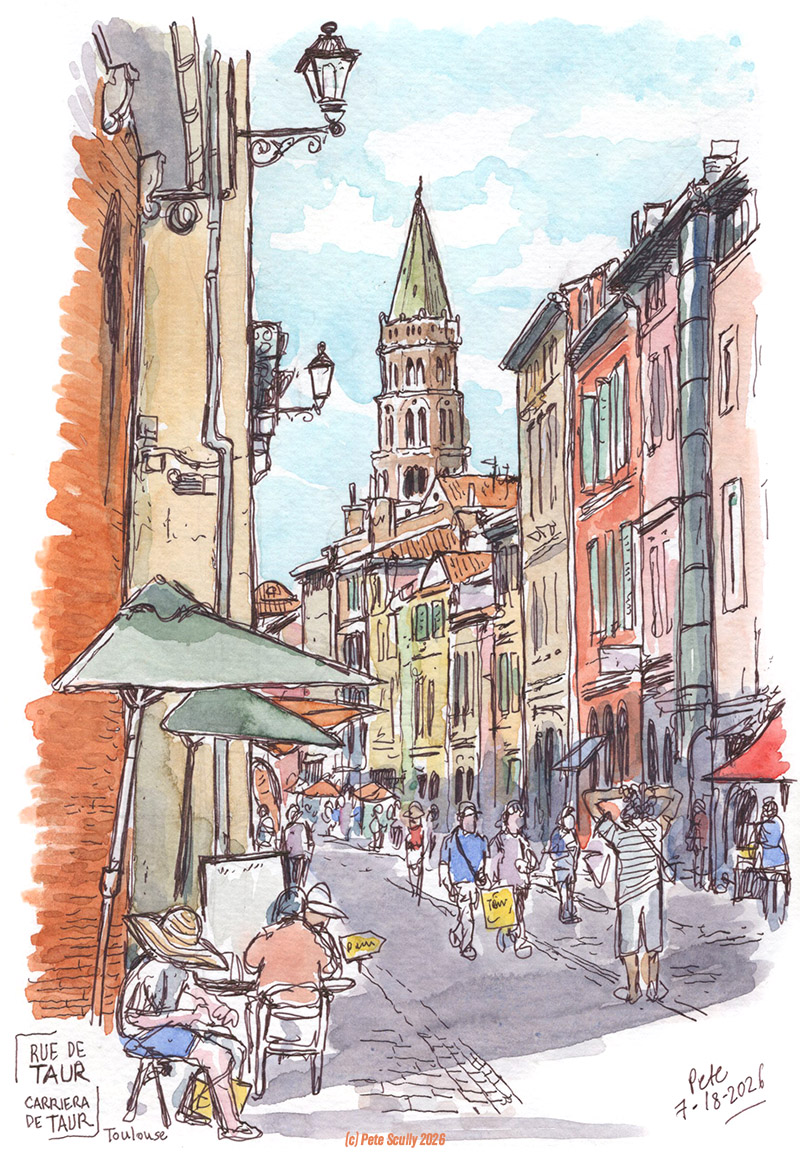
The closing reception of any Symposium is always exciting, because that’s where we learn the very secret location of the next Symposium. My guess would be a return to Asia, and since there was a big group from Korea I was convinced they would be announcing Seoul, which would be a fantastic choice. They really draw the announcement out (do I even need to say ‘pun intended’, that’s a given) but there is a lot of fun stuff before that. For example, there was a performance of traditional Polish music by a couple of classical violinists, one of whom was one of the local organizers of the Symposium. It was beautiful music, and as well as the musicians (above) I sketched a couple of sketchers listening to it below, Cecilia Novello from Argentina on the left, and Shari Blaukopf from Montreal on the right (I really enjoyed her workshop in Amsterdam). I sketched some others too, a few people in the row behind me, plus Eric Ngan from New Zealand who was on the USk Executive Board, and Dan Archer who is British and lives in Hong Kong, I chatted with him on the first day and he was very friendly, plus his work’s great. Anyway, the big announcement for 2026, the Symposium will be in…Toulouse! In the South of France! I was delighted to hear that; I’ve not visited Toulouse, but for me France (especially the South) is like going home. The day I met my wife (in Aix-en-Provence), she had just come back from Toulouse. That’s two European Symposiums in a row, a bit like 2018-2019. So I am hoping to make it to that Symposium, but you know, it’s very competitive to get in, I didn’t apply to be an instructor or give a demo or talk on time (early deadline, also very competitive) and summer 2026 is a bit of an unknown for me anyway, so we will see. I might apply to be the Correspondent, since I like going round drawing everyone anyway, but I wasn’t selected for Poznan, and that’s fine. Still, I reckon I’d be good at it, though July in Toulouse can be rather hot, and the World Cup is happening then…

cecilia & shari 082325 sm
marcy & co poznan 082325 sm
eric & dan - poznan 082325 sm

I didn’t spend all my time sketching though, I mostly mingled and chatted to people, a number of whom I had no chance to see during the Symposium and people who I’d seen online but not met in person, such as Taria from Taria’s Sketchy Adventures, whose work is great, she is from England but lives in South Africa. I also chatted a lot with Fred Lynch and his wife, and caught up with Fabien DeNoel who I last saw in Lille. I spoke with a lot of people, and the food and drink was really good.

sketchers saturday night poznan 082325 sm

All the sketchers in the world were at the hotel bar. I nearly went home after the reception, but saw many familiar faces and went over to catch a last beer with them, joining Suhita, Liz, Paul, Omar, Uma, Joel, everyone sat around sketching and talking. I got to finally meet Peter Rush from Australia, who so many people had been talking about with his cereal box sketches. I sketched the group above with Omar in the middle, I didn’t know some of the people behind, but Andrew James from New Zealand who I’d met a few times on the trip, he’s in this twice, once standing up and once sitting on a very low stool. He told everyone a funny sketching story about a watermelon. I sketched some people in my brown paper book below, there’s Nick Patyczak again this time wearing a tie with pigs on it; there’s Taria again; there’s a woman whose name I didn’t catch; there’s Alessandro Britto from Spain/Brazil/USA, who said “you hold your stuff like a crazy person!” (yes, I do; Lapin called it “L’Incroyable Tenue du Crayon de Pete” back in Portland); finally there’s Andrew telling the watermelon story.

nick & taria - poznan 082325 sm
alessandro & sponsor lady - poznan 082325 sm
andrew james - poznan 082325 sm

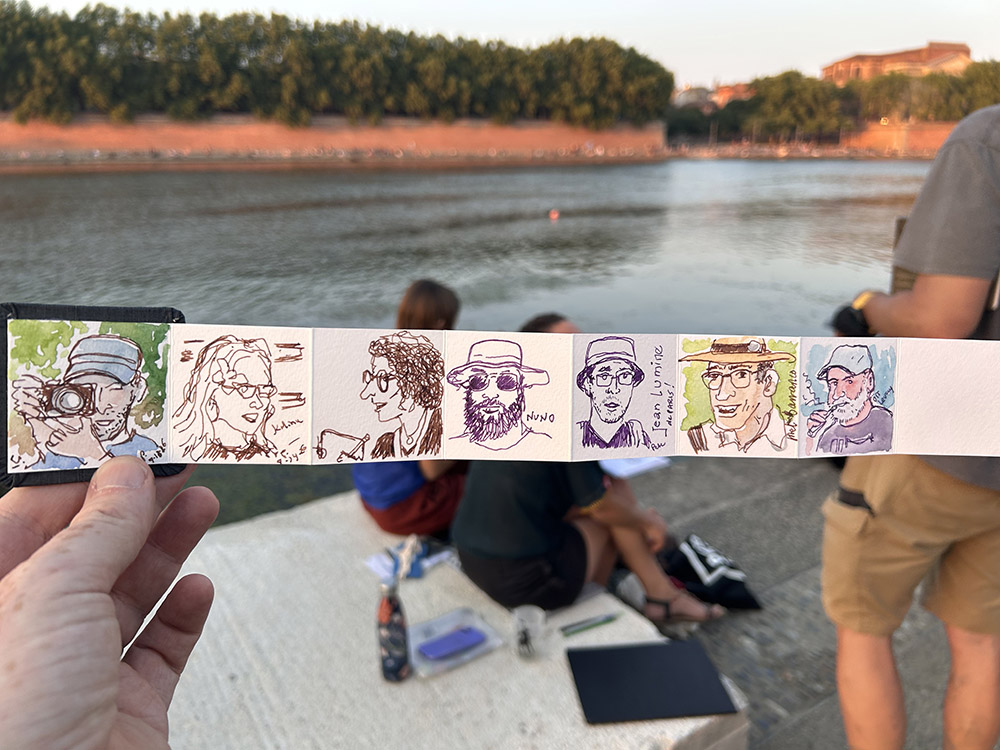
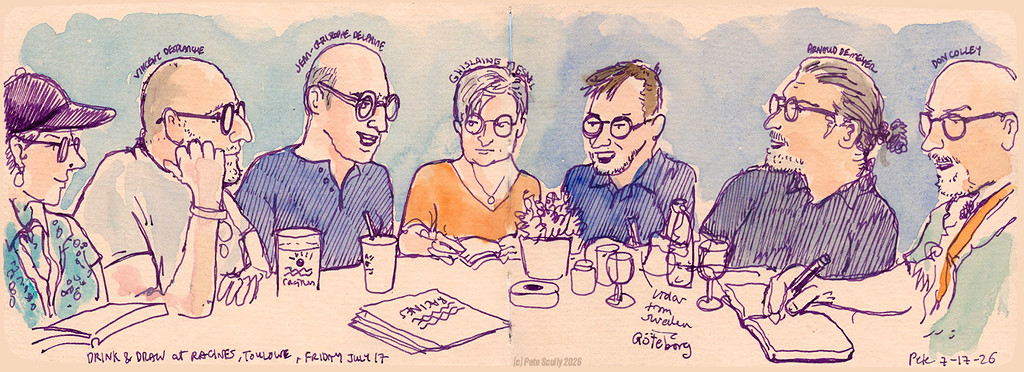
It was definitely bedtime after this, I was off to Berlin the next day. And so, that was the 2025 Symposium! We will see if I make it to Toulouse. If you are reading this and are thinking about going to a Symposium, well I’ll say you should do it and you will probably have a great time, it’s overwhelming, exhausting, and a lot for introverts like me, but it’s all about relaxing and meeting the other sketchers, we are all like that, and all learn from each other. I drew a lot, but if I wish I’d done anything, I wish I’d drawn even more other sketchers. The sketches of people in those quick moments are what makes the memories for me. They aren’t all accurate, not even 50%, but it’s what came out and it’s what I had time to record, and that’s what counts. Ok, one more morning left in Poznan, and then on with the journey.