porto party

Symposium people
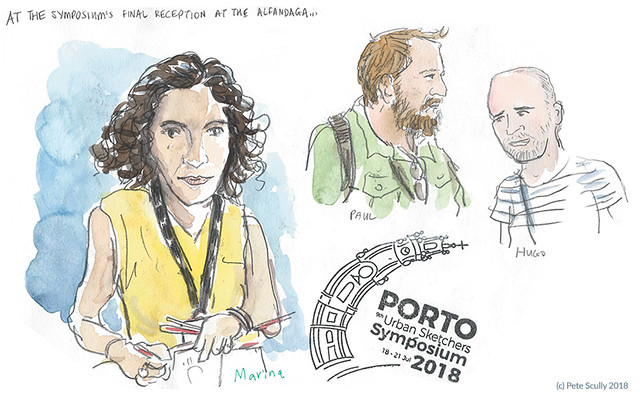
And so here are some sketches from the final evening of the Porto Symposium. On these final get-togethers we usually spend a lot of time chatting and sketching, often speaking to people we may have not had a chance to see yet (easily done in this 800-large event), before going to dinner very late and generally feeling exhausted. Some wine was also drunk. Above, I sketched Marina Grechanik, from Israel, who this year was one of the symposium correspondents and another old urban sketchers friend whose work I’ve admired for years. She has a very creative and playful style (she appeared in my last book, on people sketching) so we drew each other in a portrait duel. I do love portrait duels and wish I could do more of them, I didn’t do enough of them in Porto.  Also on this page are Paul Heaston (who of course I know and have followed for years, but didn’t meet until 2016) and Hugo Costa, from Porto, who I’d not met before but whose work is awesome.

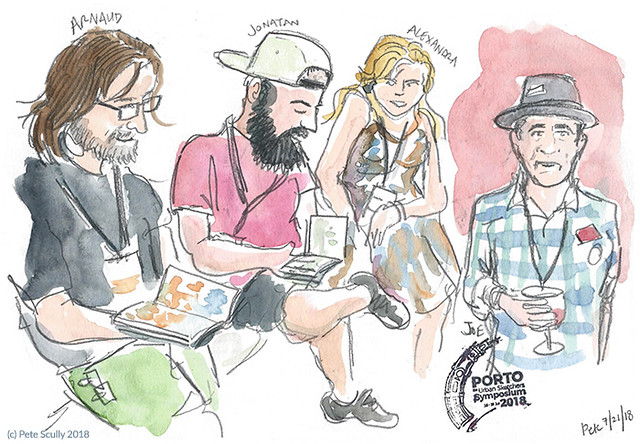
Below are Arnaud De Meyer, from Luxembourg, who I met in Manchester 2016. I really like his sketching work (especially his two page spreads), and really hope to sketch with the Luxembourg group some day; two sketchers I do not know but were from Germany, Jonatan and Alexandra; and Joe Bean, who I had the pleasure of meeting at a London sketchcrawl in 2016 and whose work I also really admire (in particular his in-construction sketches of Headingley Stadium in Leeds).
Symposium People
Below are a couple of sketchers I also met in Manchester 2016, Peter Dutka (UK) and Tine Klein (Switzerland), and though they both had colourful outfits I had didn’t have time to add paint while I stood with them. They both had amazing sketchbooks though, I spent some time looking through them, very productive and creative.
Symposium people
And below, the only other sketch I did, of a very tried and hungry group of urban sketchers – Liz Steel (Australia), Elizabeth Alley (USA), Fernanda Vaz de Campo (Brazil), and once more Paul Heaston (USA). Behind us were several more who I did not sketch. We had tried in vain to get dinner but it was late – late night dinner is less of a thing in Porto, this isn’t Madrid – but we found one place willing to serve us cheese pizza. The waitresses were for some reason very interested in my sketchbook. It was a fun evening, and I can’t wait to see evertyone again in Amsterdam! (Though I did see both Liz and Genine (unseen, at the table behind) in Lisbon a couple of days later).
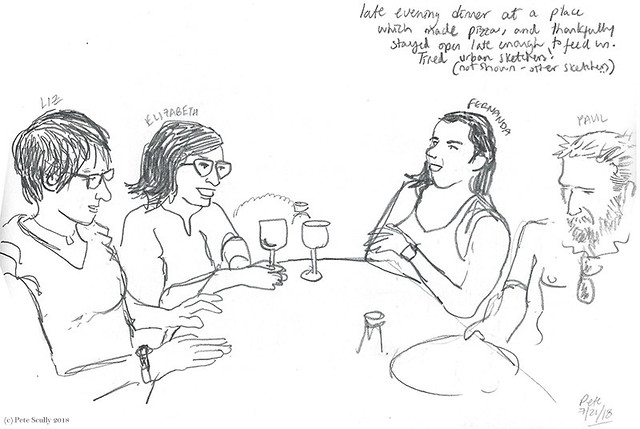
Dinner after the Symposium
Oh yes, Amsterdam – I didn’t mention, but that is the location of the next Urban Sketching Symposium. Far fewer hilly streets there than Porto! I really hope to go to that one. Next time, I will actually tell people I am going, make connections ahead of time, and I’d also like to spend a bit of time in Belgium first, catching up with old places, meeting sketching friends, before the craziness of the Symposium.
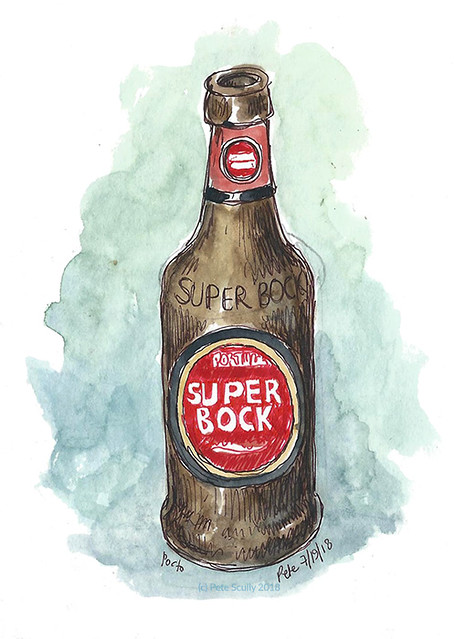
Super Bock
Oh, and one last thing – this is Super Bock. It’s one of two beers you see everywhere in Portugal (the other being Sagres). This is one of the most Portuguese things to sketch. I hope you have enjoyed this trip through Porto with me, I hope I have managed to show some of my enjoyment of this city, but I didn’t see it all and would love to come back some day. I know some friends in England who would love it there. Adeus, Porto!
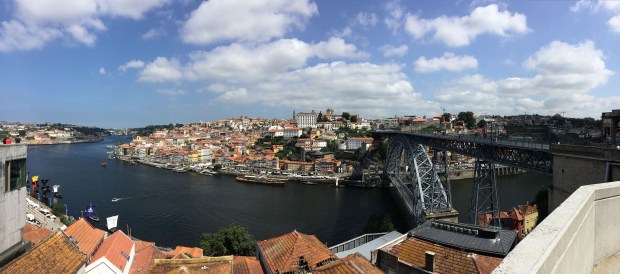
IMG_8459-smaller

porto perambulations

Rua Loureiro, Porto

Taking a break from the people sketches, here are a few more sketches of Porto’s streets and hills. Before going to Porto, I checked out the roads I might be walking through on Google Street View, and picked my hotel behind the train station thinking, yeah that’s not too bad. My legs felt otherwise. The streets are pretty steep! There were a few different ways back to the hotel, none of which were easy climbs and one of which (Rua da Cima) was a little bit dodgy feeling at night, some seedy looking establishments behind doorways with ladies leaning in the half-light and men lurking in shadows nearby. So, I explored a few different routes. The street above is not far from there, and I came across it while walking down toward the Se Cathedral area from my hotel, this is Rua do Loureiro. I really liked sketching how the street weaved downwards, with those colourful garlands crossing from window to window. They are left over from a recent city celebration, I was told. As I sat and sketched, on an overcast Wednesday morning, some children played in the street nearby. It felt very much like a neighbourhood. That’s a bit patronising; of course it’s a neighbourhood. Porto is struggling at the moment with a relatively recent upsurge in popularity, with many locals being priced out of the old Porto quarters by the influx of tourist apartments. If the graffiti I read around town is accurate, anyway. Porto is no longer the undiscovered secret it used to be.

Rua da Madeira

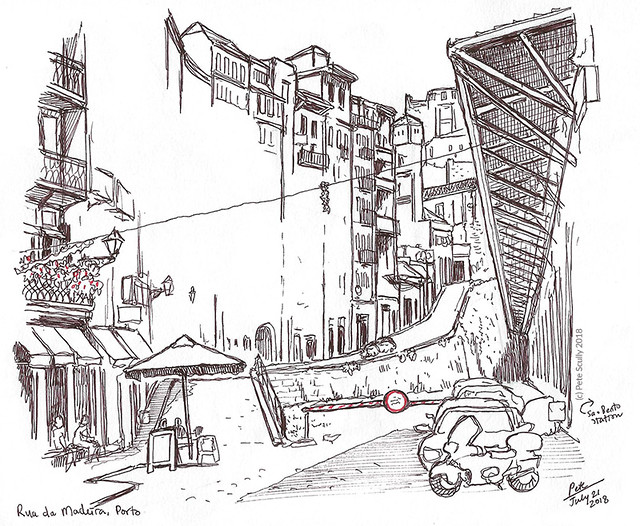
Above, another street that ran next to me hotel, this one was right outside my window. Rua da Madeira. Again, one that I didn’t mind going down in daylight, a bit less so at night (though there weren’t as many small seedy, ahem, ‘nightclubs’ along the way). It’s less a road and more an alley with a large staircase. However, it’s filled with graffiti, much of which looks commissioned by the city, large interesting murals mixed in with down to earth tagging. I had to draw it. This part is as far as you can drive down from Batalha, before the steps begin, running alongside the back of the Sao Bento train station. Streets behind train stations look like this all over the world. Even in Burnt Oak; it reminded me of those alleys behind the tube station on Watling Avenue, like the one I used to go down to go to Cubs when I was a kid. This is very far away from Davis, but I felt a little bit more at home here. There is a nice view over Porto, with the Clerigos tower in the distance.

Rua da Madeira, Porto

This is the bottom of that street. It is really steep! I stood next to Sao Bento, in the doorway of a hostel, on the Saturday afternoon to sketch this. Across the street some members of a youthful rock band were drinking the day away. I know they were a rock band because (1) they had long hair, and (2) I had seen them earlier in the day waiting outside a rock club across from here with all their instruments, while the singer (I presume he was the singer, he looked like the singer) was on the phone to someone complaining that they couldn’t get in to leave their instruments somewhere. Obviously a band on tour, with not enough roadies (or any). I knew they were a rock band then. They sounded Australian or south African, but they may just have been British and just Talking Like That. Anyway they were getting lubricated as you do when you are in a foreign country and you are young and in a rock band, minding their own business, and I heard another man swearing at them, a local by the sound of it, very drunk himself, swearing in English. Then a very large man, who must have been a roadie or their minder or dad or someone, escorted said swearing-man away from the cafe. That is it, that’s the whole story. I’m glad I wasn’t in a band in my early 20s. I was rock and roll enough, without growing my hair long.

Rua 31 de Janeiro

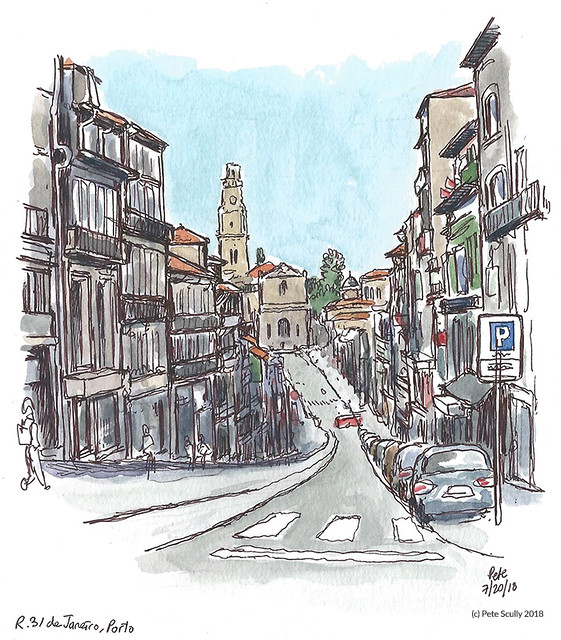
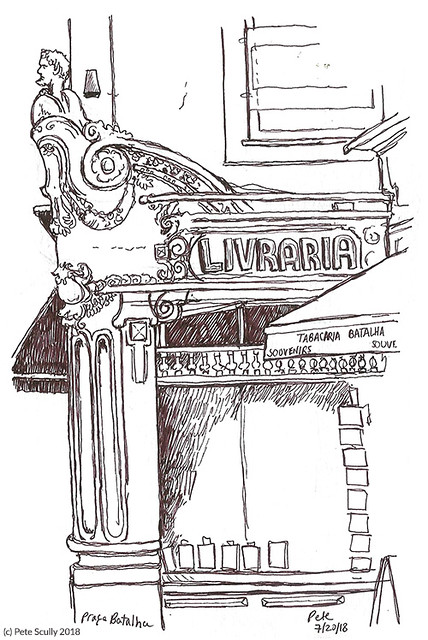
Now this street was very normal and wide and a great option for walking home at night, however it’s just too damned steep. Rua 31 de Janeiro, which slides down from Batalha and then slides up again to Clerigos, took me absolutely ages to walk up at night. By the time I reached the top I was exhausted. Thankfully there was an ice cream shop at the top that stayed open until almost midnight. The top of this street is at the junction of Batalha and Rua Santa Catarina, a much nicer part of town with more upmarket shops and – amazingly – no steep hill to climb. I never did sketch the Cafe Mjestic, nor did I find the Bolhao Market nearby, but I did sketch the outside of this lovely bookshop, below. In case you are wondering, no, this is not the famous bookshop of Porto, Livraria Lello. That is the one with the magnificent curving staircase. I never actually went there. Well, IO tried, but on a Saturday afternoon it was packed with a very long line out of the door. You have to buy tickets to get in. The Urban Sketchers instructors were all given a free couple of hours after closing to come in and sketch one evening, but I’m not an instructor so couldn’t do that. It was also further away from where I was staying than I realized. Ah well, I’ll save that place for next time. And maybe next time, I’ll stay at a hotel closer to the bottom of the hill.
Batalha Bookshop

Stay tuned for more Porto!
porto potty

Pedro Loureiro
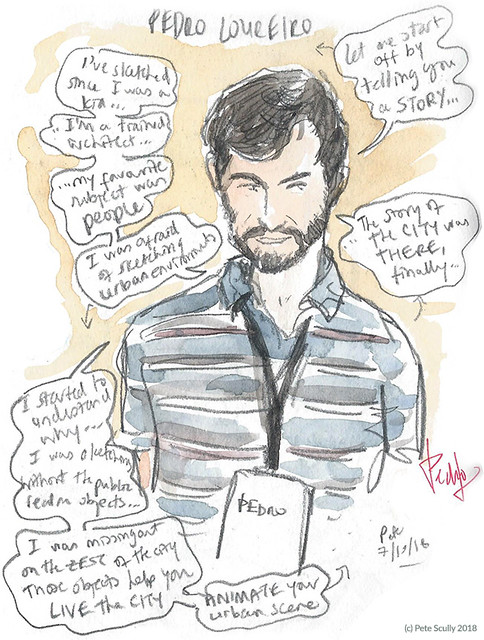
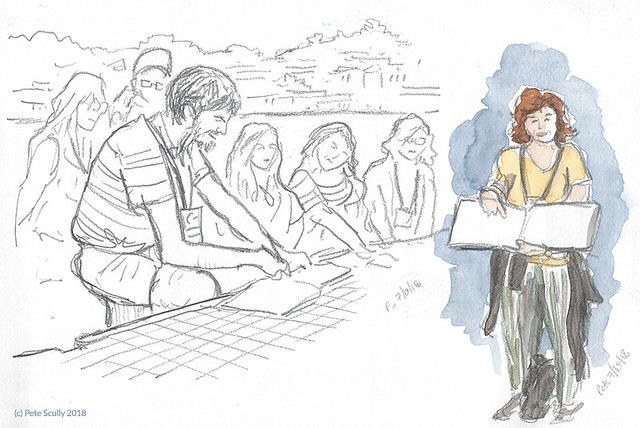
Now we move on to the workshops I took in Porto. I registered for a ‘Basic Pass’, which meant I could take two workshops (the Workshop Pass was for four, while the Sketching Pass was for zero). I do like to just sketch, but at a symposium it’s fun to do at least some workshop stuff, to learn a few things, see sketching from a different angle, and also meet new people. For my schedule, I decided on workshops on Thursday and Saturday morning, leaving all of Friday for just free sketching. On Thursday morning I took a workshop taught by Pedro Loureiro, whom I had met in the Manchester Symposium. There he is above, giving his introduction.
Pedro's workshop
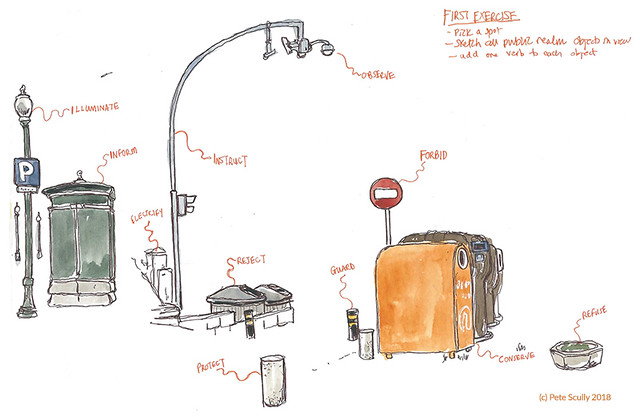
It was called “Public Realm Objects”, and was about focusing on those parts of a scene that are often overlooked – lamp-posts, bins, bollards, street signs; “fire hydrants” I chipped in, “yes thanks Pete, fire hydrants”; things that are typically there as part of the city’s functionality. For the first exercise we had to draw a street scene but leave out absolutely everything except those ‘public realm’ objects. There was an additional point – we had to add a verb to each public realm object, one that might describe its function. In this way, we are starting to think about its purpose.
USk Porto Pedro workshop exercise 1
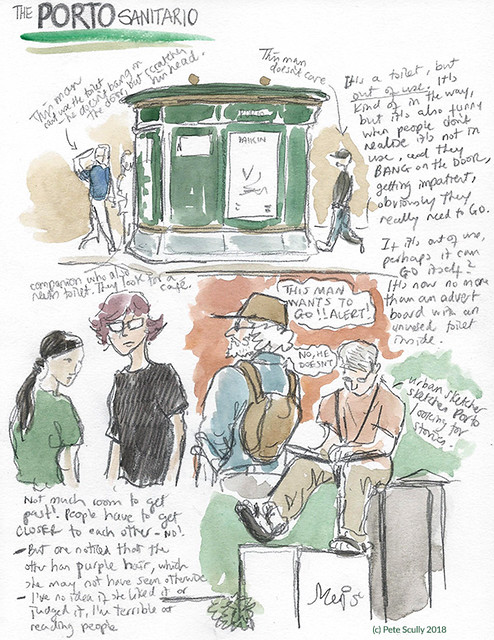
For the next exercise we had to pick one of the objects we drew, and then study it in greater detail. What’s it made of? Are there finer details? Who made it, and when? Why is it there? How big is it? I selected the green metallic object that was slightly up the hill, the one that I had marked ‘inform’ because it had an advertisement on the side. It turns out that it was a toilet, and an out-of-order one at that. A ‘Porto Potty’ if you will (right, I have found a blog post title!). So I studied it, as best I could; see below. While drawing it, some people did come by and try to use it but quickly moved on. One fellow didn’t though. He stood outside patiently, then maybe a little less patiently, then he was banging on the door asking whoever was inside to hurry up. He wasn’t Portuguese, so maybe didn’t know what “Indisponivel” meant. It’s ok, I didn’t even know this was a toilet at first. Anyway after we did this exercise, we had a little show-and-tell gathering where we had to talk about our objects.
USk Porto Pedro workshop exercise 2
The final exercise was a longer one, where we had to show how the the object interacts with the world at large. People walking by, using it (glad it was indisponivel, I wouldn’t have drawn that!), that sort of thing. I stood on the other side of the street and sketched it, adding in people walking past or trying to use it. Nobody really banging on the door this time. I felt like a tabloid celebrity journalist, staked out in front of a pop star’s house, watching for a story, any story, anything will do. I tried to make a story about the fact that the sidewalk is very narrow there because the loo is in the way, and people have to be in much closer quarters as they pass, which can be awkward. One woman gave another purple-haired woman a glance as she passed; right there’s a story. It was a fun thing to explore the world around this broken-down bog.
USk Porto Pedro workshop exercise 3
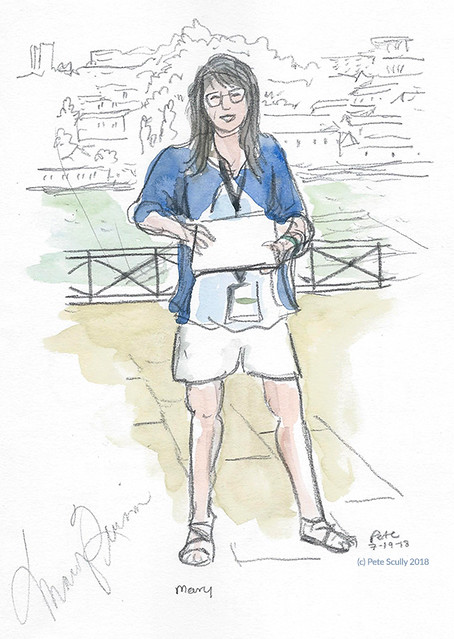
Below, fellow workshop participant Mary talks about the object she sketched. I can’t remember what it was because I drew her page blank.
USk Porto Mary

Oh, and later on that day, I was passing by this area and of course, predictably, I needed to use the toilet. And couldn’t, because this was indisponivel. I had to find a restaurant, who charged me a whopping 50c to use their for-customers-only bathroom. Now there’s a story.

porto people

Porto Dinner

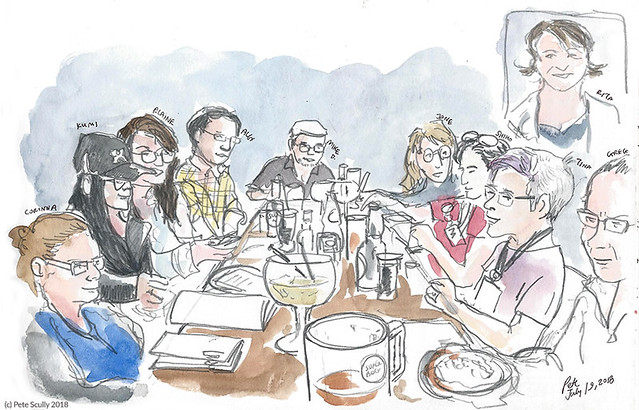
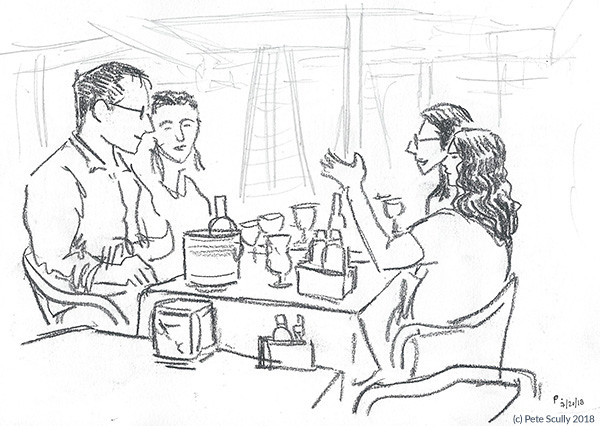
The Symposium always offers a chance to feel ok about drawing people. Everyone is doing it, nobody judges you about how unrealistic it looks, and nobody feels self-conscious about someone sketching them. Well, usually. I mixed up sketching the public with sketching the participants, and tried to keep it fast (far less than the ‘five minutes’ per person!) and tended to stick to pencil, with a bit of watercolour for effect. I used a Palomino pencil that a pal of mine sent me from Japan (cheers Tel), it does wear down fast though, I had to keep sharpening. Pencil moves fast though, so is good for those really quick people sketches. Above, dinner on the Thursday evening with several of my old sketching buddies. You can see Kumi Matsukawa (from Japan), Shiho Nakaza (from Santa Monica) and Rita Sabler (from Portland), all of whom wrote chapters in my 2015 book ‘Creative Sketching Workshop’ and all of whome I met in the 2010 symposium, which is also where I met Mike Daikabura (from Boston), at the end of the table. There’s also Tina Koyama (from Seattle) who of course I have met at other symposia, great to see her again with her partner Greg, and Corinna from Germany, who I did meet briefly in Manchester. Others at the table are Jane (from LA who was in Portland, but I’d never met), and Elaine and Alex, who I didn’t speak to. It was a nice gathering for the “Drink’n’Draw”. The Drink’n’Draw events were generally done at the Ribeira square next to the river, and were generally hundreds of sketchers messed all over the place, so the fact I actually found several sketchers that I already knew was nice. It was a nice evening.

Porto people
Porto people

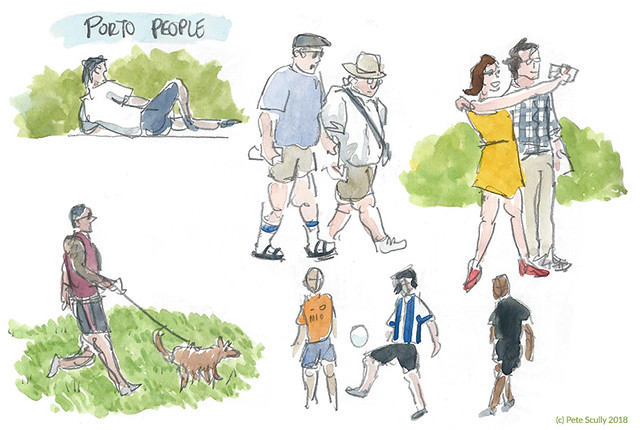
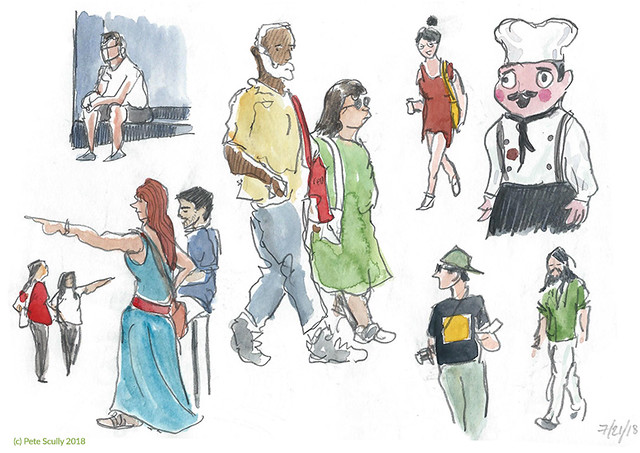
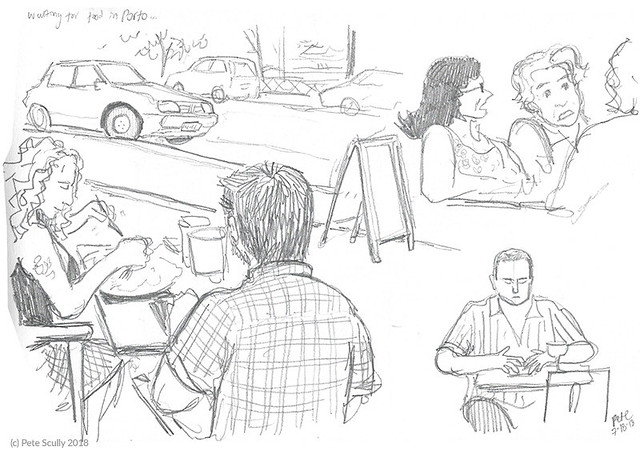
Above, sketching the locals. And the tourists. I stood in a couple of spots and tried to capture people as they passed by. I liked the lads in the Porto kits kicking the ball about up the Alfandega, I kinda wanted to join in. The bizarre looking Chef with the big eyes is actually not a person, nor a Frank Sidebottom mask, but a large figure in the window of a restaurant. Below, some people I sketched while waiting for my Francesinha.

Porto people at lunch

Below, some other locals or maybe tourists, eating dinner at Ribeira. The woman on the right, I might have drawn her head slightly too small. The giveaway is that the person behind her has a larger head. As does the person sitting opposite, who is further away from my POV than she is. Now unless they are wearing Frank Sidebottom heads, I’ve got that wrong. Ah well.

People at dinner porto

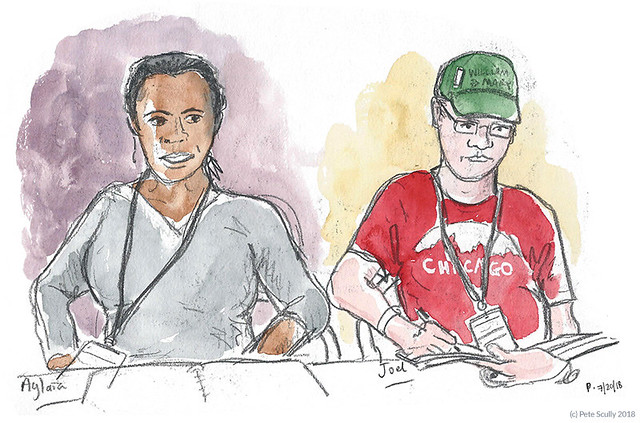
And below, two fellow sketchers I enjoyed a beer with on Friday evening, Aglaia and Joel, both from the US. Joel I had met in the Manchester symposium, he was busy during this one with accounting and money stuff for Urban Sketchers. He’s wearing his red Chicago symposium shirt, from last year’s event (that I missed). Aglaia teaches history at a university, so we had a long discussion about history and what not. At one point they mentioned they had seen the Beatles film A Hard Day’s Night again recently, and asked about the Wilfred Bramble character and why they kept saying he looks ‘very clean’, which is a reference to steptoe and Son that many Americans these days would probably not get, so I got to do an Harry H Corbett impression and say “you dirty old man!” Also I think I may have done a Simon Schama impression or two. A fun evening.

Aglaia and Joel

Stay tuned for more Porto sketches!!!

porto performative

Amber Sausen, USk President
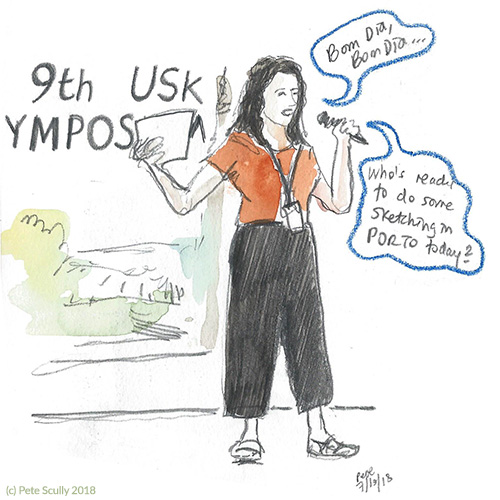
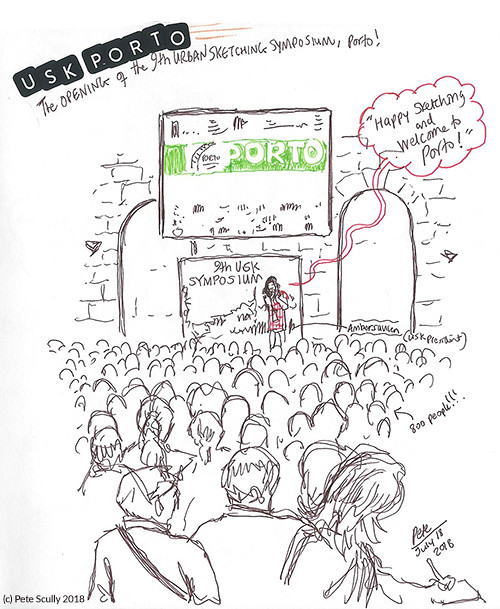
The reason we were all there in Porto was for the 9th Urban Sketching Symposium. “USk Porto 2018” as it is known (see the hashtag #USkPorto2018 on the various platforms) was the largest one yet – 800 registrants, with a similar number descending on Porto just for the ride. Urban Sketchers is quite big now. The first Symposium back in Portland in 2010 (check out my Flickr album, or look at my Portland 2010 blog posts) had less than 80 people, many of whom had only ever met each other online and never in person, and yet we all seemed to get to know each other. The ‘Woodstock of Sketching’ Matthew Brehm called it. With 800 people it was hard enough to find the people you knew! Yet I still managed to meet new people, though for sure, it was a really big crowd. Above, the current Urban Sketchers President, Amber Sausen, sings to the gathered Thursday morning crowd before they set off for their workshops. Below, Amber introduces the Symposium at the Wednesday evening reception. There was a show of hands; over 50% were first-time symposium participants!
USk Porto opening ceremony
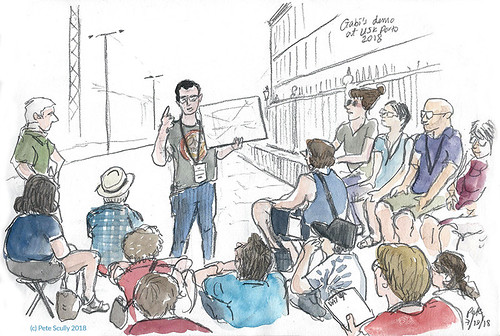
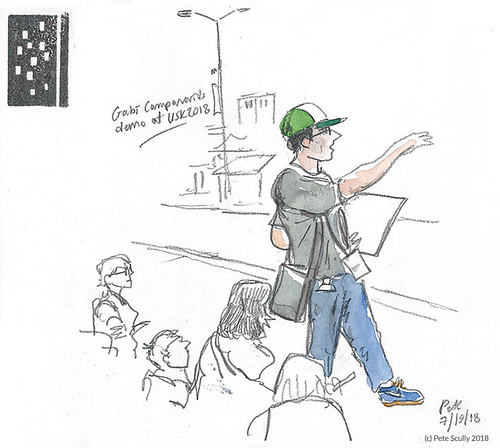
One aspect of the symposium this year were the demos. There have been demos before, but this year we had to sign up upon registration and choose whose demo we wanted to attend. Most were held outside on the streets, in the urban setting, our little groups shepherded by friendly volunteers. I went to the demo of Gabi Campanario, Seattle-based journalist and the founder of Urban Sketchers. I’ve not seen Gabi in person since Lisbon 2011 so it was nice to see him again. He was the one who invited me to be a correspondent on the new blog ‘Urban Sketchers’ when it was first launched, back when it was tiny, so it is great to see a decade later just how big and popular it has become. Gabi’s style of sketching is very particular, he works fast but gets in a lot of information; he sketches for a newspaper after all. I’ve always been in particular impressed with his approach to perspective, and it was this that he helped to demonstrate first. He usually draws fairly small, but sketched on a large pad for the demo so that everyone could see. I drew the group watching and learning.
Gabi demo
We were on the Alfandega, which has a lot of very interesting vistas to sketch, so Gabi continued his demo by showing us a bit about how to go about composing such a sketch. I like the poses he gives. The demo is very much a performance, a piece of street theatre that is both instructive and interactive.
Gabi demo
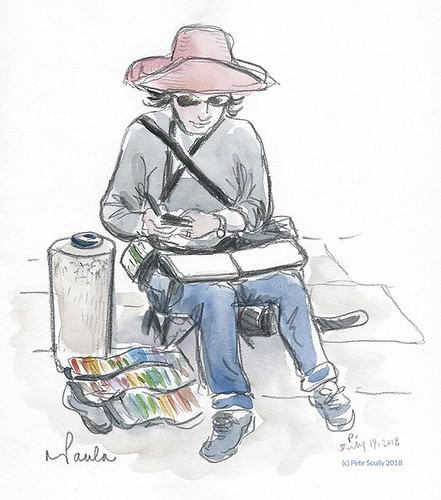
Finally, here is another sketcher, called Paula. I will post more pictures of the other sketchers I drew, though to be honest I don’t feel like I drew enough of the other sketchers this time. There were 800 other participants after all, plus about that many who just joined in the crowds in Porto. I don’t think she minded me sketching her; it’s expected at the symposium, you will be sketched. I’m including this though because she was very much in the act of sketching (actually by this point I think she was checking her phone). I have always wondered about the line between sketching and performance.
USk Porto Paula

On one hand we are working in our private journals, they are our business and not really anybody else’s. You aren’t under any obligation to show anybody anything you have drawn. On the other hand, there is an unwitting performative element to the urban sketcher. I think it’s one that fascinates the public. This is something that I would love to explore further; years ago I used to do interactive theatre, and so many of the workshops and skills and ideas I picked up in those days have informed my attitude to urban sketching. I really want to explore this somehow. When we as sketchers are out in public, creating art, we are in fact engaging in two kinds of performance art. There is the result, the sketch that we share online (and we usually do, as part of Urban Sketchers). Then there is the act of sketching itself. Once I stopped finding a place to hide when I sketch, I started to lose my fear of being watched while I sketch. Why do people watch? They are fascinated that you are creating something. So many times people will come up and say, oh wow that is beautiful, and I have literally drawn five pencil lines and spent ten minutes squinting up at a building. Is that really the thing that is beautiful, or is it the act of going out and actually trying to draw something that is beautiful? I think it’s more often than not the latter. “Wow, did you draw that?” I know artists who get very upset with that statement; in the early days, I would often imagine sarcastic responses too, and mumble them under my breath, but that’s not what the person is asking. They aren’t asking if you drew that. They are making an exclamation of wonder, often not even of the drawing but of the act of drawing, of the bravery that it takes to attempt the drawing in public, the performance. Honestly I could write a long article on this, and go back to my old drama degree theory stuff, Eric Bentley (A plays B watched by C). It is worth thinking about though, when you are next out sketching, how much of it is personal and how much is public performance, albeit of a quiet kind. If that is the case, USk Porto 2018 was one of the largest pieces of public theatre I’ve been to in ages.

porto parochial

Santo Ildefonso, Porto

It was a bit of a race for me: will I draw more fire hydrants or more churches? Fire hydrants was always going to win because of the ease/speed factor, but by day two it was neck and neck and if I hadn’t spent so much time schlepping up and down hills I might have spent that drawing even more Porto churches. There are so many beautiful ecclesiastical buildings in Porto, with accompanying dizzying views, sculpted masonry and often those very Porto-esque blue and white tiles. Above is the church of Igreja Paroquial de Santo Ildefonso, at Praça Batalha, which was right outside my hotel (I drew a map, below) and on the other side of a deep valley facing the iconic Torre Clerigos. A lot of sketchers drew this church. I never went inside, but I loved all of the tiles outside. This was the first sketch I did in Porto, sat outside my hotel eating a couple of ‘Natas’ and drinking a Fanta Orange.
Porto Map Batalha

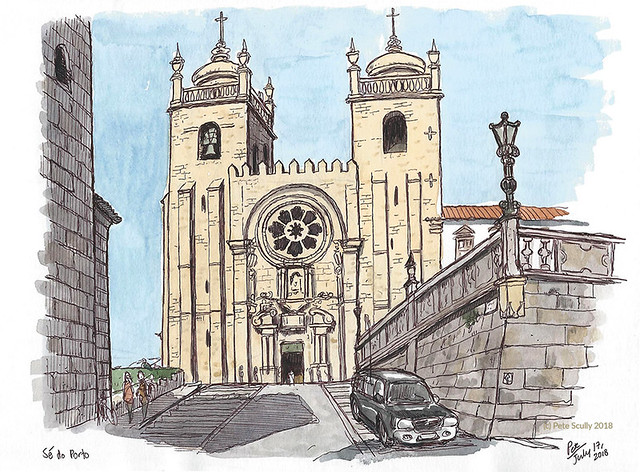
Below is the Cathedral of Porto, the Sé, another magnet for sketchers, not least for its incredible views over the city. I do wish I had drawn it more than once from another angle, as I really liked the views approaching the cathedral from behind. I wanted that view of the front with the sun shining down on it. I stood outside some houses in the shade, looking up, a group of older Portuguese men stood to my left just chatting and smoking, and shaking hands with the occasional local passer-by, while an old lady sat outside her house to my right yelling at pigeons while another one (or maybe the same one, I wasn’t paying much attention) threw things at pigeons from an upstairs window while hanging out laundry. Ok, why am I drawing cathedrals? I should be drawing that. The Sé building dates from 1737.

Se do Porto

Now below is the one that, if you were an urban sketcher and didn’t sketch this at the symposium, you weren’t really there. Ok that’s how it seemed anyway. The Torre Clérigos was used as the symbol of the Symposium and was that one tall tower visible from everywhere. I sketched this one (below) on the last Saturday of the Symposium, making sure I managed to get it in before I left the city, forgetting I had actually drawn it three or four times already from a distance. It’s on a very, very steep slope which is great for the perspective sketching, and I sat in the afternoon sunshine with a wide-brimmed hat on to draw this. The Clérigos was built by renowned baroque architect Nicolau Nasoni, who designed many other grand buildings in Porto.

Clerigos Porto

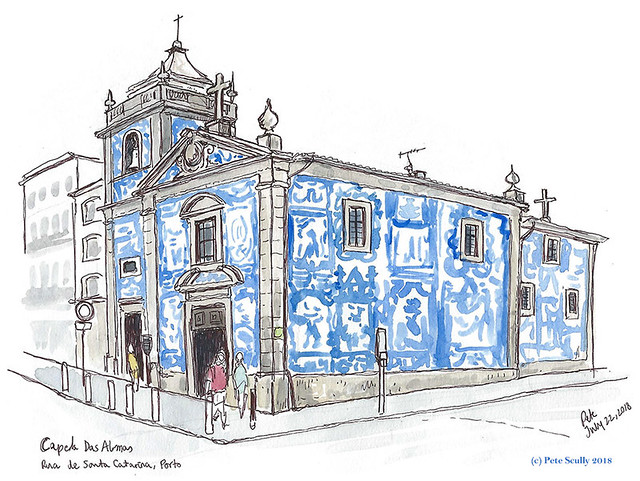
Below was one of the more spectacular churches I saw. The building shape itself was not inspiring, but you don’t look at a painting and say, yeah but it’s just a rectangle of canvas. It was the amazing decoration, covered completely in smooth blue and white tiles, covered in beautiful ornate paintings. It was like the Sao Bento train station but inside out. I didn’t have time to go inside. I came across this church, while walking around late at night looking for an easier way back to the hotel that involved no mountaineering. By the way it is called the ‘Capela das Almas’ and is located on Rua Santa Catarina, opposite the Bolhao Metro station (Santa Catarina is actually one of the few I walked down that was actually a flat surface). This church dates from the 18th century but the tiles were added in 1929 by Eduardo Leite. At night it was lit from outside and so it shone like a beacon, with all those smooth tiles, but I was tired so drew it in the daytime, my last sketch in Porto before leaving. In fact I only had time to draw the lines, I added the paint afterwards. This would be an amazing one to do a huge drawing of, spending a long time with intricate details, but I would need (a) better glasses, (b) loads more time and (c) loads more natas.

Capela Das Almas, Porto


Here it is in the flesh, at night:

IMG_8406

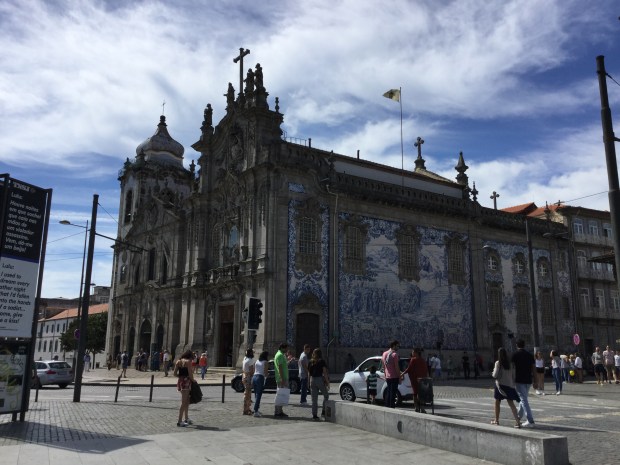
There were so many other church buildings I did not get to sketch, such as this one below. Actually it is two, right next to each other, located near Porto University. Perhaps next time I’ll draw all the ones I missed this time.

IMG_8638

Stay tuned for more Porto sketches!


porto perspectives

São Lourenço (Grilos), Porto

It is time to post my Porto sketches, and I have decided against the linear storytelling method of posting, rather I will loosely theme my blogs, and when I say loose, I probably mean barely connected at all. I will tell the story of the symposium from my own point of view, the people I met, the places I visited, the panoramas, the perspectives, the perambulations, and other words that will inevitably all begin with ‘p’. In fact the letter ‘p’ will probably be the prominent/predominant theme. Photos will be presented along with pen, pencil and paint pictures. So without further pause, let’s proceed.

I arrived in Porto from Madrid and took a cheap shuttle from the airport to a downtown bus station that was unfortunately just outside the range of my map. Being the navigator I am, I decided to follow my nose. My nose however had other ideas and led me and my small rolling suitcase in the complete opposite direction, into a neighbourhood of steeply sloping streets, brightly coloured tiled houses, and old women standing around yelling at each other, while old men stood around shrugging at each other. My initial encounter with Porto is still how I would describe the city, even after almost a week there. I was looking for my hotel, but did not mind being lost; I wasn’t in a hurry, though I wanted to start sketching. Eventually I found my way to within the boundaries of my small Lonely Planet guidebook map (note to self, the nose can smell pastries from a hundred feet but has no sense of direction whatsoever) and made it to my hotel, on Praça Batalha.

Igreja São Lourenço

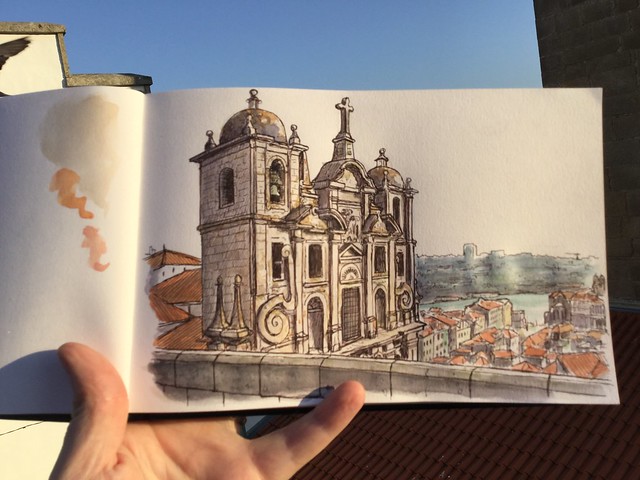
The photo in this golden early evening light brings out the colours in the sketch more than the cold scanner


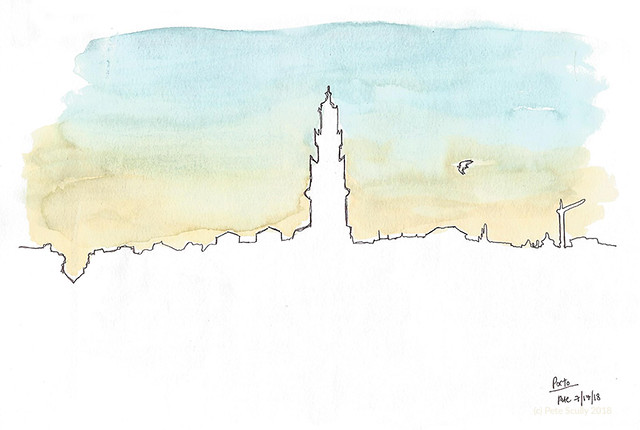
So it looks like I am starting out by telling this story chronologically after all. Well let’s move on from that, and go with the theme of exploring. Hang on, that doesn’t begin with a ‘p’. ‘Perspiration’, perhaps, from all the steep hill-climbing this city forces you to do. Ok then, let’s start with ‘perspectives’. The sketch at the top of this post is São Lourenço, aka ‘Grilos’, and was in fact the fourth sketch I did on my first day in Porto. I left the hotel and explored, sketching churches and fire hydrants, and found that it was hard to get very far because everywhere is so sketchable. Everywhere you turned, an impossible view. Already several sketches in by this point, and having come across many other sketchers dotted around the city already – my people! – I felt it was time to go and eat dinner somewhere, try some local cuisine. The sun was lowering and the light was golden, and I turned around a corner and saw this view, looking over the city with the tall ornate façade of São Lourenço sweeping down a cliff like an opera in stone. There was the river Douro, there were all the orange-red rooftops, showing me that all two-dimensional maps of this city were woefully inadequate; what I had though may be short cuts turned out to be like hiking up and down impenetrable mountain paths. The perspective was exciting. I stood on a bench for a slightly better view. You can see from my eye-line how high up this was, as high as the peaks of the hills across the river. The street down below in the distance is roughly parallel to this building so followed through to the same vanishing point, but other streets twisted and followed their own paths. I was pleased when I was done as it was the first Porto sketch I did that I felt encompassed how I saw the city (I hadn’t even drawn the bridge yet…). As I sketched I overheard young travelers from other countries talking the way young travelers do, the way I might have done twenty years ago when I was a young backpacker. I spoke to a few other sketchers, all of whom had the same ‘I must stop and sketch this now!’ moment I did. This view was one of many epic views over the city I would encounter, and you can’t draw them all but at certain times of day the light demands it. Dinner can wait. I ended up having a cheap kebab on Aliados if you must know, followed by a Nata. Well, there was another view I wanted to draw, the rooftops with the iconic Clerigos towering above them. All I had time for was the outline, and the glowing dusk.

Porto skyline

I think I will stop here for now. Please join me for the next chapter, which will either be “Porto People”, “Porto Parrochial”, or “Porto Postcards”. Or perhaps none of those?

holy toledo!

Toledo Puente de San Martin

I expected Toledo to be full of holes. Or I expected it to be completely and utterly Toledo. I don’t know exactly where the phrase originates from but ‘Holy Toledo!’ is one of those American exclamations you don’t hear very often now, and is often confused with all the various ‘Holy’ exclamations used by Robin in the Batman TV series of the 1960s. Those I think were derived from ‘Holy Toledo’. Oh hold on, this just in, Toledo was a very holy city historically in Spain. There is a big cathedral there after all. There is a Toledo in Ohio, and if you say ‘Ohio Toledo’ quickly it sounds a bit like ‘Holy Toledo’ but no, no it doesn’t really. I think it has some relevance to baseball announcers, “Holy Toledo, what a hit!” or similar. So with all that on my mind, we got on a train from Madrid, and we went to Toledo.

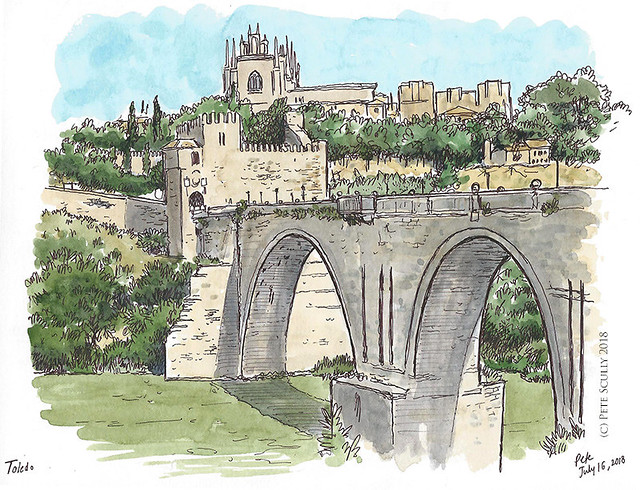
I think ‘Hilly Toledo’ is a more accurate phrase. That place was full of steep streets and winding narrow alleys. We arrived and jumped onto one of those open top tour buses outside the station, not a cheap ride, but it went all around the edge of the town for all the amazing views over this well-contained citadel perched on a hill in a bend of the Tagus river. It is a beautiful sight, a medieval city preserved in all its old Castilian glory. The droning voice on the headphones told us about the Moors, and the old Visigothic Kings, and how Toledo was the ‘City of the Three Cultures’ for its blend of Muslim, Jewish and Christian populations, and lots of other interesting facts presented in a dull, sleepy way. I mimicked it which was not too hard as I too am dull and sleepy. Well, in real life perhaps, but when I was an open-top-bus tour guide in London I was much more animated about presenting history. One of the spots I liked most was the Puente de San Martin, above, a 14th century stone bridge. I sketched it from a bus stop on the other side of the river while waiting for the tour bus to pick us up again after I had literally flown across the Tagus…more on that later. Not too far from here is a church where the great El Greco painting ‘The Burial of the Count of Orgaz‘ is displayed. El Greco, the great painter of the Spanish Renaissance, lived in Toledo. El Greco wasn’t of course his real name, he was just called that because he was Greek. A bit like Nick The Greek from Lock Stock, I suppose. Anyway it was very impressive.

Toledo Don Quixote

Also associated with Toledo are two things – steel, and Don Quixote. You see him everywhere. You also see shops selling knives and swords everywhere, often with a figure of don Quixote outside, or maybe a knight in armour. I mean, a LOT of knife shops. They must love cutting things there. We were waiting for a tour of the cathedral, and while I was waiting I decided to do a quick sketch of the Don Quixote at the knife store next to us. He looked like a surprised Count Dooku, like when Dooku had his hands cut off by Anakin Skywalker and Chancellor Palpatine said “Kill him, Anakin. Kill him now.” After about 30 seconds of sketching a woman who worked in the store came out and looked at me quickly before going back inside. She came back out a minute later and said I couldn’t sketch there because people wouldn’t be able to see the knives in the window. There was a massive window next to me full of knives. She said I could come in and draw the other Dooku – I mean, Don Quixote – inside the shop, but I was like, I will be sketching for maybe another 30 seconds and can also just step back one step if standing here is bothering you. Bear in mind there were lots of other people standing there waiting for the tour to start as well, none of them were holding a sketchbook so none of them got asked to move. And before you knew it, I was done. It’s almost like I have written a book about drawing people quickly or something.

Toledo cathedral interior sm

Next, we took a tour of Toledo Cathedral. That place was amazing! So many ornate details inside. Our tour guide was giving us a lot of the history, but he was speaking in English and Spanish simultaneously, switching language several times in the same sentence, which was starting to get a little distracting. My son was getting a bit antsy as well, so we left my wife on the tour and went off to do a bit of sketching. Just in pencil, I wanted to sketch fast and I had intended on adding paint, but never got around to it. My son drew the same scene below. Not every day we get to sketch a massive historic cathedral together!

IMG_8086 There was no way I was going to tackle sketching all the ornate sculpture of this place. Look at the shot below, with the light coming in from the ceiling. This place was amazing.

IMG_8100

I did draw outside though. We had a little bit of time before we needed to get back to the train so we took that time to grab a Pepsi Max and sit in the shade, resting our legs, while I drew the cathedral. I couldn’t get too far though, so drew the outline and about half of the details, the important ones – I added the rest along with the colour later.
Toledo cathedral sm

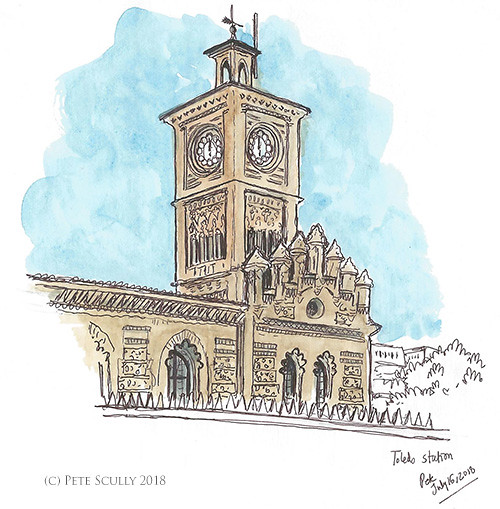
This is the Toledo train station, which I sketched while waiting for our Madrid-bound train.

Toledo train station sm

And below, here am I ‘flying’ over the river. I ziplined across thanks to a company called ‘Fly Toledo‘ which operates a zipline near the San Martin bridge. That was exciting. I had to walk the equipment back over the bridge afterwards but I got a photo of me posing at the end as if in mid flight. I suppose at that point I could have, like all the other photos, appeared to be more of a daredevil and had my hands free but I’m not a daredevil am I. It was the first time I had ziplined since I was 17, so yeah, not really a daredevil. It was exciting though. (Photo by Fly Toledo)

IMG_9928

We didn’t have time to go to Segovia on our Madrid trip, but that is the other day excursion I would have liked to do. Not only because it is another beautiful historic and of course Roman town, but also because it sounds like that place in Avengers that Ultron lifted into the sky and threw back to the ground. Next time perhaps!

out and about in madrid

Mercado San Miguel Madrid

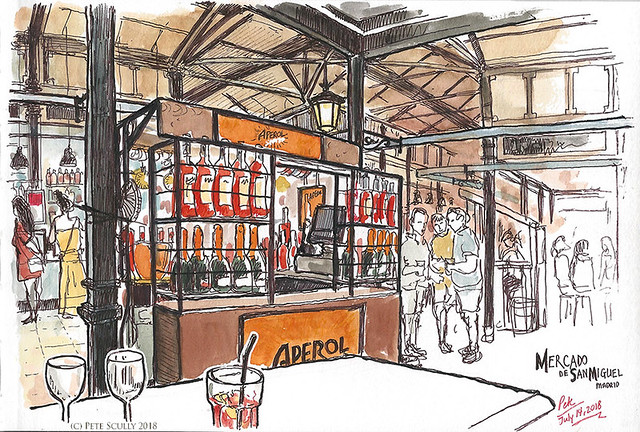
Not far from where we were staying in Madrid was the Mercado San Miguel. This covered market – well, more like a food hall – was chock full of fresh food and drink to buy and enjoy in a very Madrid atmosphere. We came here a few times for tapas, churros, sangria, but I decided it needed sketching so late one evening when the family went to bed I came across the street, got a sangria and some olives stuffed with mussels, and sketched the bustling gourmet mercado before going home at midnight. The red sangria was delicious. There were lots of tourists there, Americans dragging their sleepy teenaged kids around to experience late-night Spanish culture, some groups of English men on more sensible weekenders than the ones down at the Costa Brava, young ladies sampling Spanish wine and desserts, and occasionally a few locals too, I guess, or maybe visitors from other parts of Spain. I wasn’t really paying much attention to all the people and their conversations, I was looking at the ironwork on the ceiling. I did really enjoy this place, though it is very self-contained and not as large or diverse as the big market in Barcelona that I sketched in 2003. However it was a nice taste of Madrid, literally.

Palacio Cristal

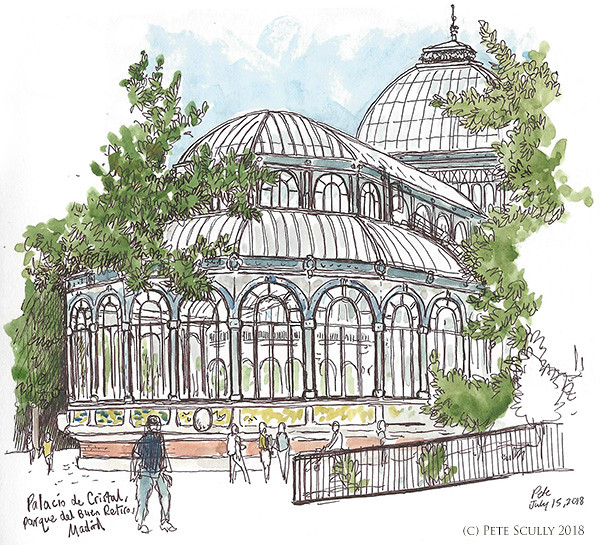
Above is the Palacio Cristal, located in the Parque Dell Buen Retiro, the expansive green space in the heart of the city. We spent an afternoon wandering about here, among the trees and lawns, and we sat for a while by this lovely old building. This might have been my favourite part of Madrid. I sometimes forget in my rush to see big exciting urban wonders that I actually love great urban parks more than anything. I always loved Hyde Park, Regents Park, Central Park in New York of course. Buen Retiro (“Pleasant Retreat”) is exactly that, and dotted with great structures such as this, the Palacio Cristal. This was built in 1887 by Ricardo Velázquez Bosco, possibly inspired by Paxton’s great Crystal Palace in London. Unlike that one, this palace was never relocated to a southern suburb to become the name of a football team and then burn down, and it still sits pretty among the greenery today. I sketched it while we took a break from all the walking. There was a pretty steep street to enter the park, Calle Claudio Moyano, lined with second-hand book stalls and the occasional cold drinks spot, so by the time we reached the middle of the park our feet needed a rest. Well my son’s didn’t, he wanted to kick a ball around but had left it at the apartment. So, we drew this.

Atocha Station Madrid

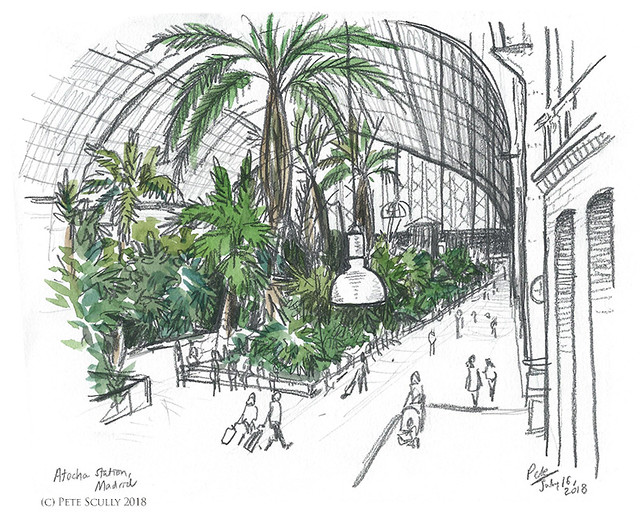
Speaking of greenery, this is the Atocha train station, in Madrid. We went there to catch a train to Toledo, and were then delayed by the fact you need to wait in a long line to buy a ticket to Toledo. More like Delayed-oh. Sorry, that was a bad pun, even for me. So, it gave me time to do a sketch of the incredible botanical garden they have inside the main atrium. This was also one of the stations where the awful terrorist attacks of 2004 took place, killing 193 people. The legacy of that atrocity is still visible in the fact that to board a train in Spain, or at least the ones we boarded, you need to go through security and have bags x-rayed.

Madrid People 071518 sm

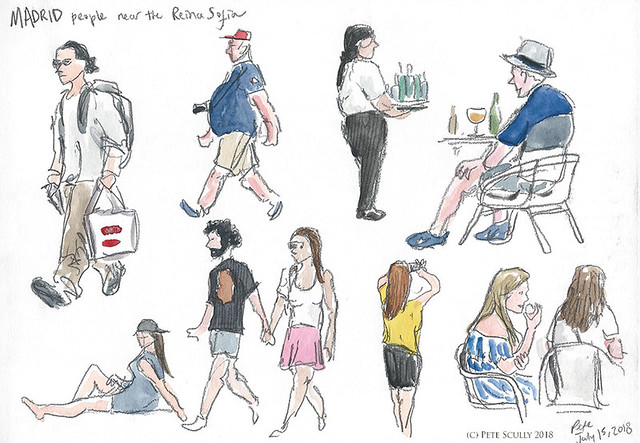
Here are some Madrid people, sketched while we lunched on pizza outside the Museo Reina Sofía. We spent all morning in the Museo Nacional Centro de Arte Reina Sofía, yet barely scratched the surface of this large art gallery. I was there first and foremost to see Guernica, Picasso’s huge classic, which paints the horrors of an aerial bombardment of a small Basque city by German planes late in the Spanish Civil War. It’s been one of my favourite paintings since I was at school, so to finally see it for real in all its vast, immersive terror was quite an experience. It was accompanied by lots of Picasso’s preparatory sketches, and other paintings by him and by other artists around the time that led up to and influenced this masterpiece. There was a whole section on the art of the Spanish Civil War. That is one conflict I feel I have never really understood properly. It’s always been talked about, written about, painted about, but its legacy lived on right through the end of Franco and probably beyond. Being in Madrid for the first time, I felt a sense of urgency that I need to educate myself about this civil war and about the people of Spain, which I think is a much more complicated country historically than many non-Spanish people know. So, I need to start doing some reading. If our trip to the Reina Sofía has done anything it has made me resolve to learn more. The other thing I enjoyed about the Reina Sofía was the abundance of works by that other great cubist, Juan Gris. I used to love Juan Gris when I was an A-Level art student, I did a project on him and we all went to see an exhibition of his work at Whitechapel. My favourite thing about him though was all the jokes I could use with his name, all really based on either being Hungry or Angry. As I repeated quite often, “Don’t make me Juan Gris, you won’t like me when I’m Juan Gris.” I bet Picasso and Braques used to say that to him all the time.

porto pumps

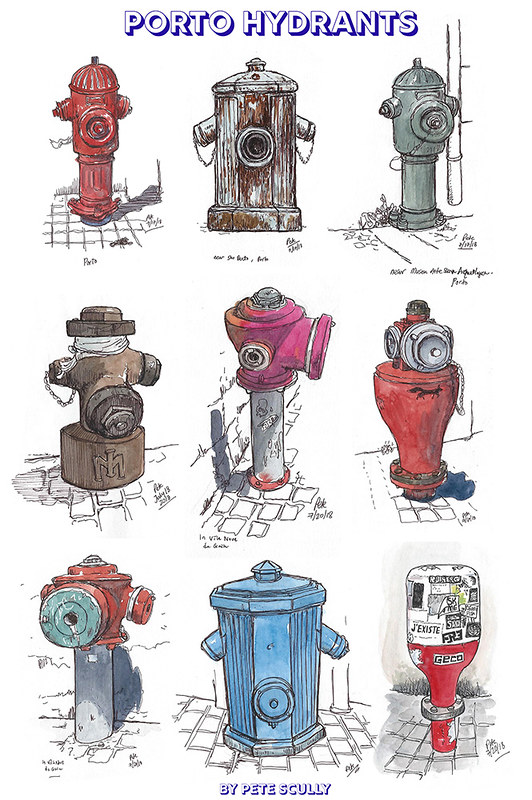
Porto Hydrants sm
I should start at the beginning. I should start in england, with the few sketches I did there, and with stories about watching England win and then lose in the World Cup, with the heatwave of London proving too much for my air-conditioned Californian constitution. I should maybe even add my sketches of Madrid first, since they at least are all scanned now; one of the great things about coming back from a trip where you fill an entire sketchbook in a short amount of time is that there is so much scanning to do to digitize them when I get home. I always do that as I go along, a point that came in handy for my ten-year retrospective exhibition in 2016. I could dive straight into the Porto symposium, although I am still digesting my experiences there, and figuring out what new things I have learned (something that may take me months). So I will start with the easy stuff, the fun stuff, the thing that I am known for the most (actually the second-most – I certainly got the “oh you’re the one who holds his pen in a funny way” more than “oh you’re the one who draws the fire hydrants” this time when meeting new people.). I sketched fifteen hydrants in Portugal, nine in Porto and six in Lisbon (quickly checks my maths). Actually I just realized there was one more, but it is small and part of a larger reportage sketch so doesn’t count. For a close view, here they all are – and I have tried my best to remember where they all are, but I didn’t write it down as I often wasn’t sure where exactly I was when I sketched them, Porto is a little bit like that.
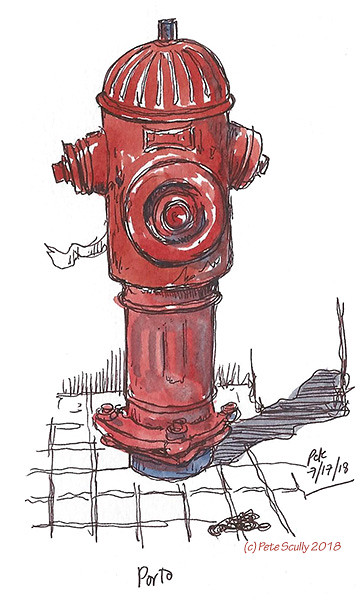
Porto Hydrant
This little red one was at Rua Chã, near the Cathedral and not far from my hotel. Now I must tell you that the little scribble in front of the hydrant, that was dog poo. No, I’m not saying there was a lot of dog poo in Porto because there wasn’t, it’s not like Charleroi in the 90s. What I’m saying is that if you have dog poo in your sketch make sure you keep it in the drawing. This is a pretty standard hydrant for Porto, though the big bulky silver ones were common as well.

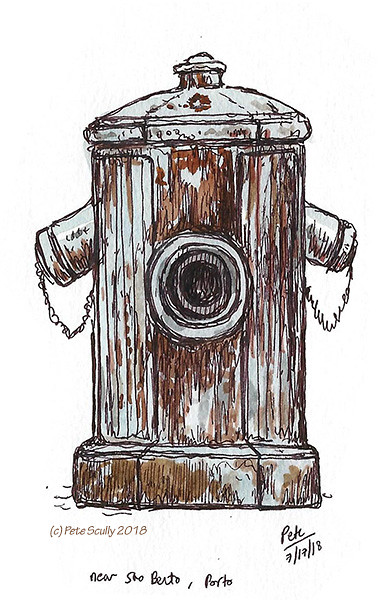
Porto Hydrant
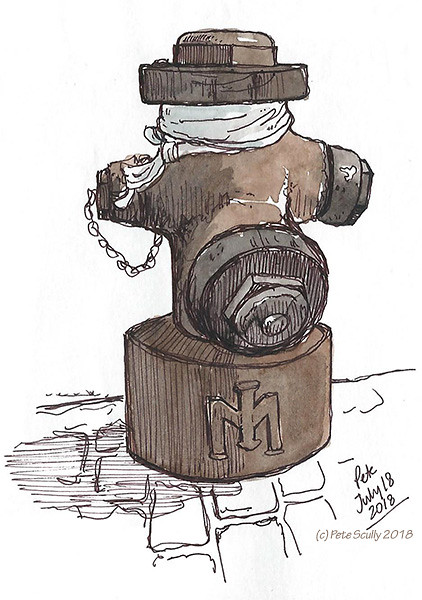
This model was very exciting, not only to me but to everyone else who was excited to see unusual fire hydrants on my behalf. I opted to draw a really rusty version, which was across the street from the Sao Bento station. Rusty hydrants are beautiful, and give off that used-universe vibe. They would look great in Mos Eisley.

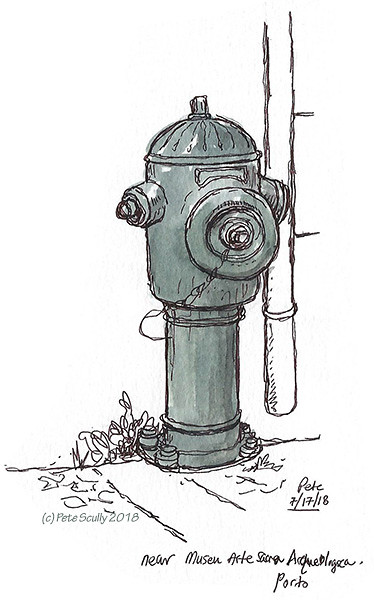
Porto Hydrant
Now this little oxidized beauty was on a very steep street next to the Igreja Dos Grilos (and the Museu de Arte Sacra e Arqueologia according to the sign I read), but I didn’t go further down that mazy street as I was getting a little lost, so climbed back up. It’s similar to the first one but not painted red.

Porto Hydrant
On my second evening in Porto I got a bit lost (to say the least) trying to find my hotel, which as it turns out was at the top of a very steep hill with a few different routes to get up there, none of them particularly great. I stopped for a rest at one point when I saw this little hydrant in an alley in Ribeira, looking like it had been blindfolded and abandoned. It reminded me a bit of a young Scott Summers. There was wine bar just opposite. It took me 45 minutes to walk back to the hotel in the end (well I will stop to sketch hydrants). Perhaps I should have called a cab, but I’m an explorer after all and I need to sue my own two feet (my two very tired feet, those Porto hills are a nightmare).

Porto Hydrant
IMG_8480
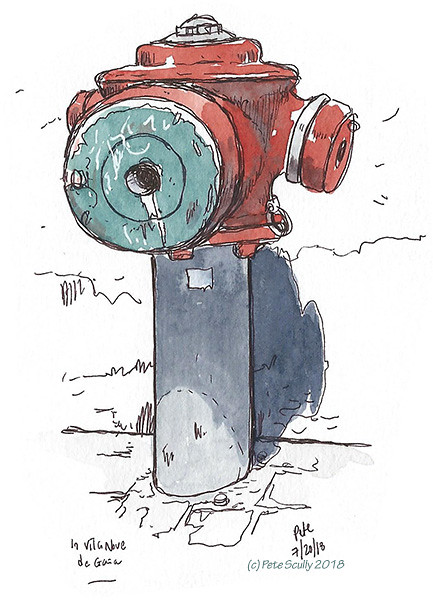
Ooh now this was an exciting find. I was over in Vila Nova de Gaia, which is on the other side of the Douro river. Technically not really Porto any more but it totally is. I crossed the enormous Ponte Luiz II bridge via the road at the top, and after sketching the view of the river I tried to find my way down. That wasn’t easy. I’m sure there is an easier way down than the long steep quiet path that I took, but I found this hydrant painted in bright pink which I just had to sketch.

Porto Hydrant
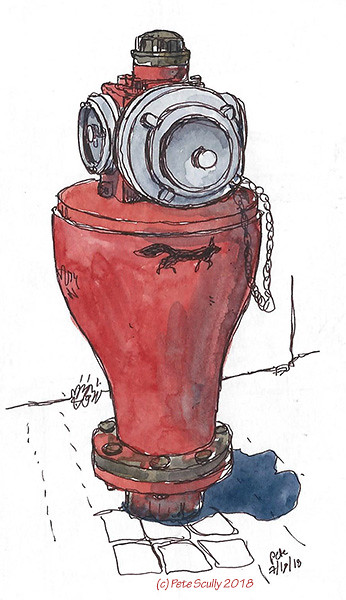
Now this model is one that usually have a big plastic lid on it. I sketched ones like this in Lisbon, years ago. They do look a bit like overturned wine bottles. This one had no lid however, and I was drawn to it because someone had stenciled a picture of a fox onto it. I had seen this fox all over Porto, on the side of buildings and fences, sprayed onto the cobblestones on the ground, and now here on a hydrant. I did not figure out the fox’s significance (because I never actually asked anyone, surprise surprise). The Portuguese word for ‘fox’ is ‘raposa’. I don’t know what the word for ‘do some deeper research’ is though. This one was found next to the Palacio da Bolsa, on Rua Ferreira Borges.

Porto Hydrant
This is another one from Vila Nova de Gaia which I sketched on the way down the mountain, same model as the pink one you may remember from a couple of paragraphs back. I never saw this model on the other side of the river, which doesn’t mean they don’t have it, just that I never saw it.

Porto Hydrant
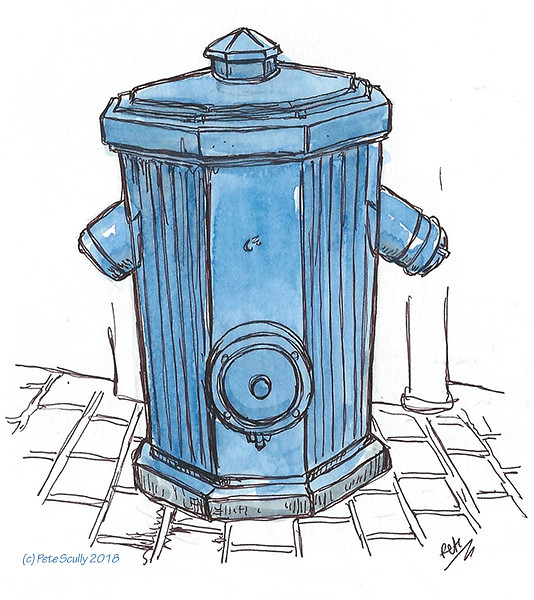
This bright blue version of the second one is found on Rua das Flores, in Ribeira. OR it was Rua Mouzinho da Silva. I can’t remember. Maybe it was neither. It was very blue though.

Porto Hydrant
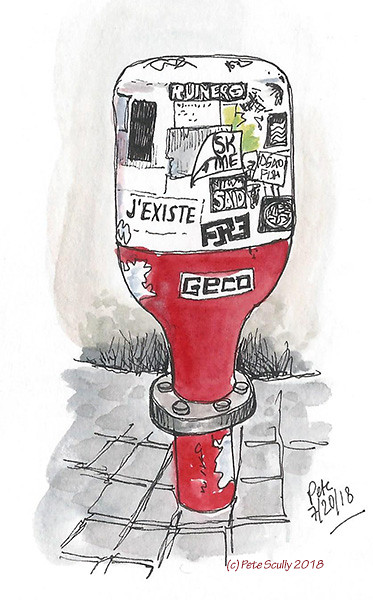
Now THIS one was on Rua Mouzinho da Silva. That is a main street that goes from Sao Bento downhill into the Jardim do Infante Dom Henrique. Henry the Navigator, as he was known. I should have had a similar nickname, for the amount of times I got lost in Porto. This one I am calling ‘J’Existe’ because of the sticker on the top. This as you can see is one of those ones that is covered up with a nice Kinder-Egg style lid.

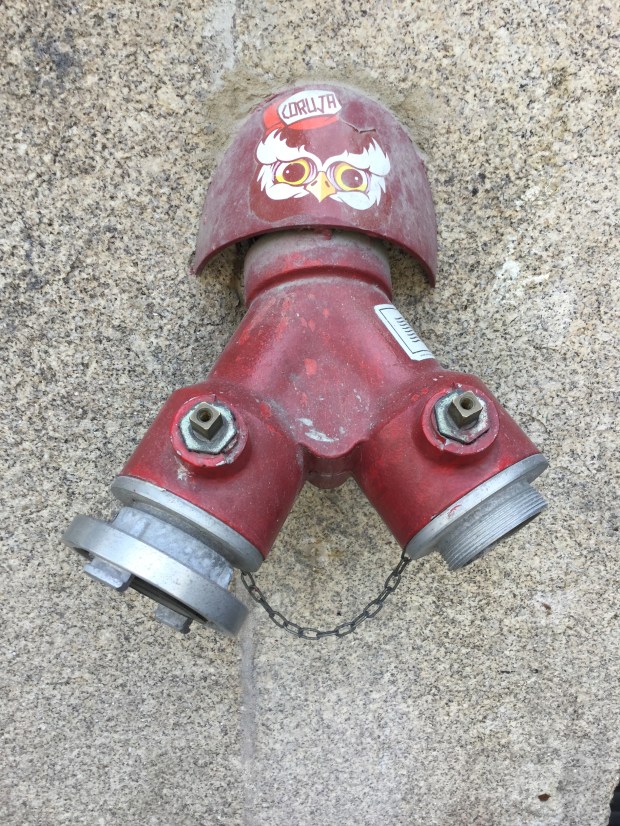
And there you have it, my Porto hydrant sketchers. I’ll post the Lisbon ones separately. But finally, I didn’t draw this one but it made me laugh anyway, because of the owl sticker, and because it looks a bit strange. IMG_8616

PS I originally titled this post ‘Porto Hydrants’ but changed it to ‘Porto Pumps’ to match my blog theme of ‘Porto + P-Word’. Editorial consistency!