seven dials

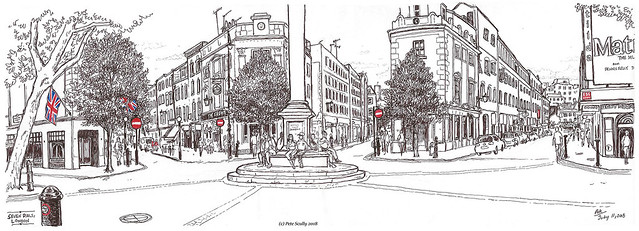
Seven Dials, London
Another panorama intended for colouring in but ultimately left as is, due to running our of time. This is the last one for London, then I have another post from elsewhere in England, and then it’s Davis all the way. It was the day of the England v Croatia semi-final in the World Cup. The evening before we were in Stratford-upon-Avon, watching France eliminate Belgium, and when we got back to London I took the tube down to central London for some last minute sketching and shopping, ahead of our trip to the Iberian Peninsula. This is Seven Dials, which is a junction of seven narrow streets located between Shaftesbury Avenue and Covent Garden. It’s one of my favourite spots in London, being right by the London Graphic Centre (where I stopped by for some replacement paint half-pans). That’s one of my favourite shops in London. The other is just around the corner, Stanfords, the cartographers and travel book store. I love a map. Ironically I get lost quite often. I think I see maps like art, beautiful objects of winder and magic that I just can’t understand nor explain. I always get there in the end, even if takes a long time. Seven Dials in London reminds of Seven Dials in Brighton (aka London-by-the-Sea), where in the early hours of one New Years Day a couple of decades ago I got terribly lost trying to find my way back to the indistinguishable house I was supposed to be looking for where my companions were staying. Brighton I thought is an easier place to navigate because there are only three directions – North, East and West, with South just being The English Channel. Haha, you foolish boy. I could not remember the name of the street I was supposed to be on, just that it was one of the ones going off of Seven Dials. Hours of walking around each of the ‘Dials’. I did have a mobile phone (this was 2000, well 2001 by that point) but it didn’t work very well and I may have been out of pay-as-you-go credit. I found it eventually, and forever have an amusing Brighton anecdote to tell.

But back to Brighton-by-the-Land (David Devant reference), I stood here sketching a panorama as people walked by, many heading to the pub to start drinking ahead of cheering on England. A lot of people, I noticed, were wearing yellow clothes. Yellows skirts, trousers, shirts, the occasional hat. I don’t think this signified anything, and certainly has nothing to do with the football. Perhaps yellow is ‘in’ this year. I don’t know fashion, but once thing I do remember about living in London, people would say, “oh green is ‘in’ this year,” or similar. “Brown is the new Black.” Football shirt fashion I understand, but real clothes, well I just wear navy blue and black mostly. Anyway I did notice this trend of wearing yellow, but I didn’t add anyone to my sketch in a yellow blouse or anything, so forget I mentioned it. The only colour I added, well you can see for yourself. The Union flag stands out. England were in the semi-final, and while it’s been a few decades since this was the flag waved at England games, it still seemed nice to include it.

I went home to watch the game with my family. England lost to Croatia. That’s that, then.

By the way, you might be interested in seeing the last such sketch I did in this neighbourhood, four years ago at the end of Monmouth Street, looking toward Seven Dials, below. This is one of my favourite sketches I have done of London.

monmouth and neal streets sm

Ok and one more for luck, this is a sketch of Seven Dials I did a few years ago around Christmas-time. At least in this one you can see the top of the coloumn. London can be beautiful sometimes.

seven dials

back from outer space

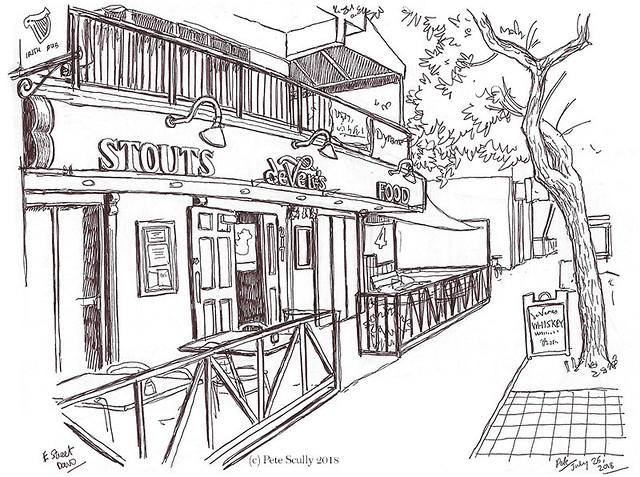
De Veres July 2018
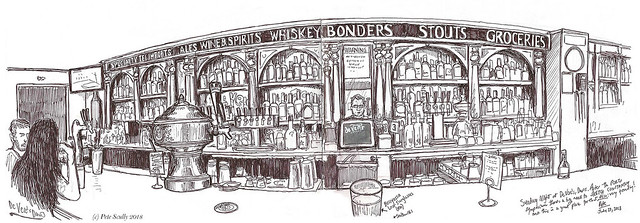
After I got back from Portugal, I had a hectic week (few weeks really) trying to settle back in. Busy work, busy life, jet lag, waking up at 3am every day, and the insatiable urge to just KEEP ON SKETCHING. It’s hard to explain the urge to draw stuff all the time. It’s probably less hard to explain coming back from a place like Porto where everything is a sketch waiting to happen, to Davis, which as we have seen over the past decade or so is worthy of a few sketches itself, but Porto it ain’t. You can only beat the team you’re playing, as they say, and since coming back I have ramped up my sketching of Davis once more after a relatively uninspired and fallow period. I’ve sketched almost everything I’ve wanted to sketch, so it comes down to sketching some of the old favourites just to keep the pen working, so one evening I popped once more to my local pub De Vere’s, always a nice place to hang out, and flexed the old ink muscles. This sort of drawing is about observing lots of detail, tackling interior perspective, and having a nice cold beer while you’re at it (the weather was so hot this summer). What’s more, I drew the pub from the outside a few days before: see below.
De Veres July 2018

And as you can see, I also drew a Davis fire hydrant. These finished off my Seawhite sketchbook so that it was completed in July.
hydrant E & 3rd

Now, I have a few more London sketches (and accompanying stories) to post, and then a bunch of new Davis panoramas I’ve been doing, but in the meantime I think I’m going to go out on this fine Saturday and do some more. I also need to get on setting the dates for the next few Let’s Draw Davis sketchcrawls so stay tuned for those. My recent sketching travels has filled me with a new sketching-energy I want to share.

goldbeaters

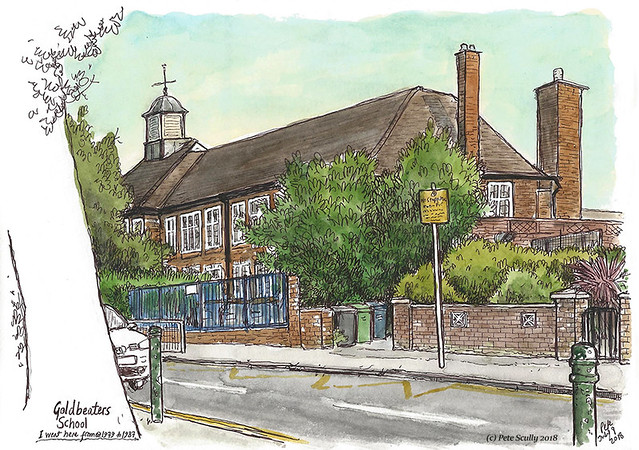
Goldbeaters School
After the Spain and Portugal sketches, I’ll step back a few more weeks to the England part of the trip, for this post at least. This is Goldbeaters School in Burnt Oak, sketched early in the morning when I was awake with the jetlag and wanted to go for a little walk to see what had changed in my old home town. Burnt Oak, for those of you not familiar, is in the northern reaches of London, the second to last stop on the Edgware branch of the Northern Line, and it is is where I am from. Burnt Oak has changed a lot for sure but I’ll always be from there, and since my family still lives there I will keep going back. Another change this time, the Tesco on Burnt Oak Broadway has closed down. I really don’t know why they would do that (I really do, though: to build expensive flats). That was a shame, because it means now there is no Tesco in Burnt Oak, and Burnt Oak is where Tesco actually had its first store, in 1929. I will miss Tesco in Burnt Oak. I remember going shopping there with my mum as a little kid, she’d bump into her friend Lyn and they’d talk for half an hour, the Indian ladies on the checkout were always very nice to me, then we’d pop into the Stag next door to say hello to my nan, go into John Ford across the street to buy sewing materials, stopping by the greengrocers on the Watling to get five pound of of potatoes, and I’d maybe get a Slush Puppy from ToniBells on the way home. Yeah I hated being dragged around shops as a kid actually, I just wanted to go to Vipins and look at pens and pencils. And don’t get me started on being dragged around shoe shops in Brent Cross, to this day I can’t spend more than a minute in a shoe shop without saying “are we done yet?”.
Anyway enough childhood reminiscences. Well maybe some more. This is Goldbeaters School. Where is that name from? Much of Burnt Oak was built on the old Goldbeaters Farm, which goes back to the 14th Century. I attended Goldbeaters from the nursery (1979?), through the infants (1980-83) and through the juniors (1983-1987), before going off to big school at Edgware. I loved Goldbeaters. I’m so glad it’s still there, looking not very different from the day I left, from the outside at least. My mum went there too, back when it was a secondary (‘senior’) school. My oldest friend Terry, who lives in Japan now, that’s where I met him (though we only swapped football stickers, we actually became friends after we both left for Edgware), and his mum also went there (not at the same time obviously). My next door neighbour Tasha went there, we would walk to school together, her mum would pick us up, we’d walk through the park and play on the swings on the way home. Years later her kids went there too, and she worked there. Yet none of my siblings went there, they went either to Barnfield School (next to Silkstream Park) or the Annunciation (same street as Goldbeaters, but that school is for Catholics, and I’m not a Catholic). My old Goldbeaters friends, I hold such affection for to this day, though I’ve not seen many of them since then: Ricky, Daniel, Lee Glenn, Carl, Wayne, Lee Fickling, Hartman, Duggan (who is sadly no longer with us). And many others. We were very international too, with families from all over the world, all backgrounds. My old teachers, Mr Winston, Mrs Baldwin, Ms Welsh. Ok, ok, we can all do this, draw a picture of the school we went to and remember our old teachers and friends, and that is always tedious to read. Ok then here’s a few more memories that pop up randomly about Goldbeaters from the 1980s. Those outside toilets which were just the worst, basically a metallic gutter behind a wall. Football stickers on the playground when someone would knock them in the air and shout ‘scramble’!! Buying those buttery biscuits for 2p at break-time.  Singing “All Fings Brite and Byoootiful” in morning assembly. The noise in the lunch hall getting so bad that the dinner ladies would bang a massive metal spoon on the table and shout “SHUT-UP!!!” and it would go silent, for a few minutes. In fact that lunch hall (which was also the gym)… the terrible ‘mashed potato’ which was white and powdery and tasteless, the peas which are actually the reason I don’t eat peas to this day, bringing a packed lunch of pork pie, yoghurt and sandwich and not being allowed to go out an play until I’d eaten up the whole pork pie, horrible jelly and all (I don’t eat pork today either, I’m seeing a pattern emerge). Mr Bunster attempting to teach us to sing “Little Donkey”. Kids vomiting on the playground, and instead of cleaning it up the school would cover up the sick with sand. Grazing your knee on the concrete playground and going to the medical office where Mrs Lyons or Mrs Eftychou would douse a piece of cotton wool with a stinging antiseptic and hold it against the wound. Carl Sanderson making us always play ‘Hammer House of Horror’ (I always wanted to play ‘Star Wars’). Getting to be the one who rang The Bell for Home Time. Being on the team that beat our local rivals Woodcroft School in the ‘Panda Competition’, a quiz organized by the local police. Winning a borough-wide pottery competition for a ceramic butterfly I made. Drawing, drawing, drawing all the time, being known as the kid who draws all the time and holds his pen in a funny way. I could go on, but I won’t. I’m surprised I remember so much.

last night in lisbon

Lisbon Drinks sm
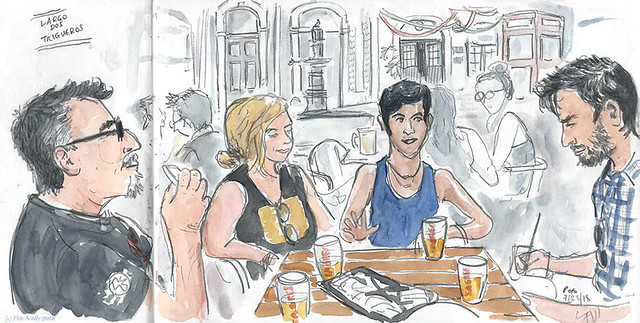
On my final night in Portugal, after a day of easy sketching and peaceful wandering, I met up with Lisbon-based sketchers Pedro Loureiro and Silvio Menendez, along with Genine Carvalehiro and her girlfriend Sara, at Rossio in the heart of town. The locals took us over to a place called Eduardino, (“Ginjinha Sem Rival”) which was a tiny little hole in the wall that serves little plastic glasses of a drink called ‘ginjinha’. Now I think I had seen Rick Steves drink a ginjinha maybe, but I had no idea what it was. It’s a Lisbon specialty, a cherry-based liqueur that people will often have on their way out somewhere, good for the health, and comes in two ways – “with” or “without”. That is, with a cherry or without a cherry. I had it with; it was delicious. I drew the little ginjinha bar below, but not on site, I did this from a photo I took, as we were on our way out to explore another part of central Lisbon. We found a little café in a courtyard overlooking part of the city, and had some beers and cheeses. I sketched my very nice company, we talked about the various symposia we had been to (I had forgotten Genine also went to Lisbon 2011, she was in one of the workshops I took; such a long time ago now!). This was up at Largo dos Trigueras (above).
Lisbon Ginjinha sm
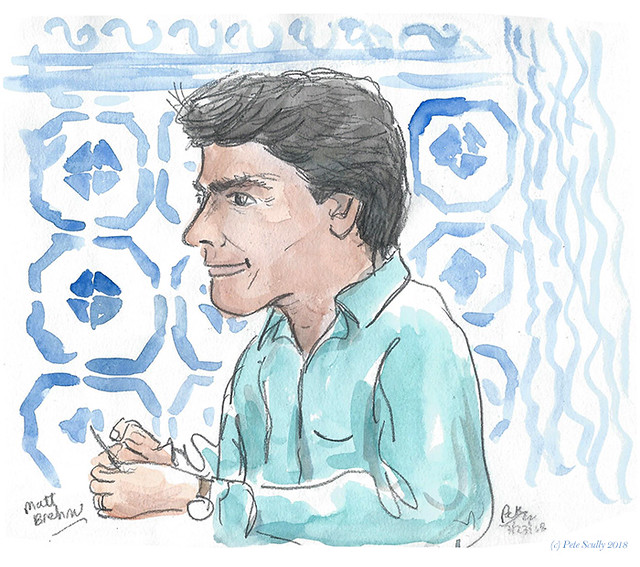
After drinks we went looking for a place for dinner, and bumped into Matt Brehm, who was waiting for Liz Steel and Suhita Shirodkar, so we combined our urban sketching parties and went to a little traditional Lisbon restaurant for food and wine and more fun conversations. I sketched Matt (whose workshop called “the Light of Lisbon” I had taken in 2011 in that very neighbourhood), and also the restaurant owner who served us. We ate until late, talked past and future symposia, about how much Urban Sketchers has grown, about all the new people we’ve all met in that time. I must say, I have been a little bit of a reculse of late, as far as the sketching community goes – I didn’t even tell people I was going to Porto, just in case I couldn’t make it – so it was nice to catch up with old friends from around the world. Now next year, Amsterdam, I do need to promise myself that I will let other people know and actually try to make connections ahead of time; I might go first to Belgium and finally sketch with some of the Belge sketchers I know. Being social can actually be quite a good thing.
Lisbon Matt Brehm sm
Lisbon Restaurant Man SM
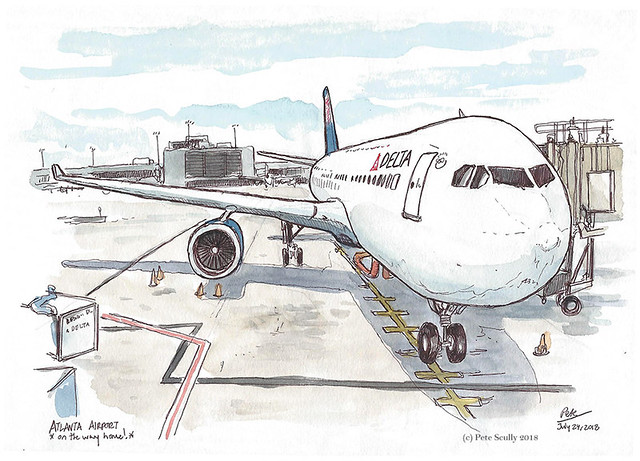
Anyway we all said adeus and then I went back to the hotel, for I had an early start the next day. A cab to the airport, then a plane to Atlanta, and another plane to Sacramento. I sketched a plane at Atlanta airport while I had my layover. It was a long, long, long day, and I was exhausted. Three weeks away, and it takes more than getting over jetlag to recover. My mind itself was still over in Europe for at least a week or two afterwards. I think I just have permanent wanderlust. Until the next time!
Atlanta Airport

lisbon and her histories

Lisbon Street tiles sm
I intended on waking up early, as I like to do when I travel, and wander Lisbon’s streets in the dawn light, try to find a little bakery with amazing delicious pastries. However my bed was just too comfortable, so I stayed there. It was the last full day of my three-week trip before I would be flying back to America. I’d been to London, Warwick/Stratford-upon-Avon, Madrid, Toledo, Porto, and Lisbon. I was overdue a long lie-in. But I had a Lisbon to sketch, so eventually I dragged myself out from the comfy covers and headed towards Alfama. I walked through the long grid system of Baixa, which owes its layout to the massive rebuilding of Lisbon after its devastating earthquake in 1755. That earthquake really was devastating – it is estimated to have been between 8.5 and 9 on the Richter scale, and resulted in the deaths of anywhere between 30,000 to 40,000 people in Lisbon alone, most of whom died in the resulting firestorm and tsunami caused by the quake. Lisbon was rebuilt, but the Baixa area is sometimes called Baixa Pombalina, after the Marquis of Pombal who led the reconstruction and was responsible for a more earthquake resistant architecture. Now I didn’t end up do any sketching around here, except for the man above, a workman repairing some of the mosaic pavement tiles. So I also drew some of the various mosaic pavements I came across in Lisbon. This style is ubiquitously Portuguese, black and white square tiles, often laid out in intricate patterns, a feature especially common in Lisbon but also found in far-flung former Portuguese colonies, like Brazil and Macau.
Lisbon Se Cathedral sm
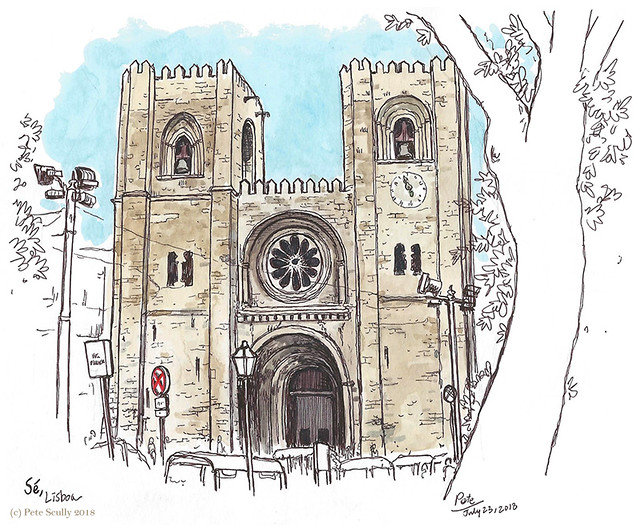
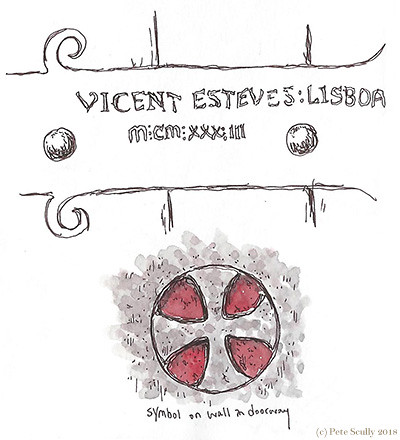
I passed into the Alfama district, which I did not visit back in 2011, and headed up to the cathedral, the Sé. You’ll remember that the cathedral in Porto was also called the Sé. IT is related to the English word ‘See’, as in the ‘Holy See’. Do you see? Anyway it shares some similarities (or “Sé-milarities”, eh) with the Sé in Porto, well I think they look alike, I don’t care what you sé. Anyway I sketched outside next to a statue of a famous actor (I’ve never heard of him) and walked around inside. It turns out the proper name is Santa Maria Maior de Lisboa and it dates back to 1147, when the city was retaken from the Moors. Actually the cathedral was built on the site of the city’s largest mosque. The doors were interesting, and as you can see from the inscription on the metal part, they date I think from 1933, made by a bloke called Vicent Esteves, aka Vince Stevens, old Vinnie Steves. I am assuming the doors are from 1933, that is, for all I know the cathedral was built then and the whole of Lisbon was built then too. In the post-truth era people might believe this. There was another symbol in the masonry on the wall, a circle with a greek cross, although it might be the view you see when being thrown down a well by four radishes.
Lisbon Se Cathedral details sm
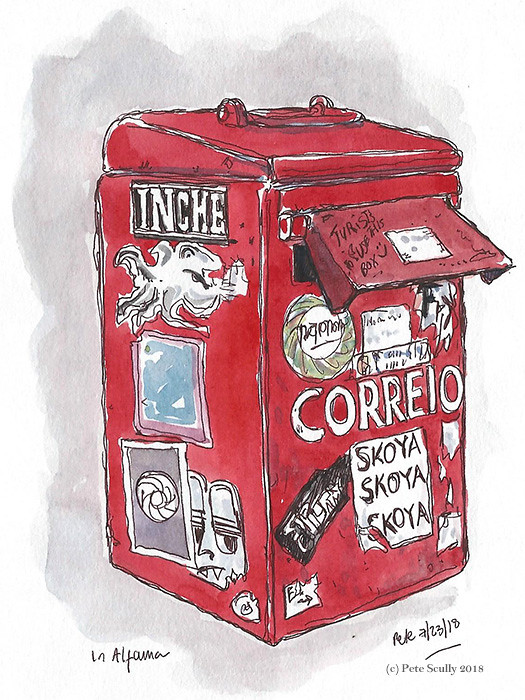
Ok enough cathedral based silliness. So I started walking around Alfama, an old windy-street hilly part of town with red rooftops and twisty alleys. Then I stopped and ate some sardines for lunch, the classic Lisbon food, I had forgotten how many bones are in those. I found this post-box, next to a similar looking blue one. I only drew the red one. Speaking of the post, can I just point out that I sent a postcard home from Spain and thus far it has not arrived, but we received the postcard I sent from Porto already so that’s 1-0 to Portugal in the postcard wars. Well, last year we sent a card from the Vatican City State which got here super fast, but thirteen months later we are still waiting for the Italian postcard from Rome.
Lisbon Postbox in Alfama sm
I liked walking around Alfama. There’s so much history around here, it’s hard to believe Lisbon was only built in 1933. Only joking. Actually much of this neighbourhood was apparently spared widespread destruction in the 1755 quake. This was the stronghold of the Moors, but they don’t live there any moor. (Travels with me is an endless series of admittedly excellent puns) Alfama the name is itself Moorish deriving from the Arabic “al-hamma”, which means thermal baths or fountains. Before them, the Visigoths. Before the Visigoths, the Suebi, the Alans (“Ah-Ha!”) and the Vandals (such as our old pal Vinnie Stevens), and before them of course were the Romans, when Lisbon was known as ‘Olisipo’. And before the Romans, it was the Celts who lived here. The area around the Castelo de São Jorge was (it is thought) home to a Celtic fortification, and archaeological excavations even suggest a Phoenician trading post here dating back to around 1200 BC. And before the Phoenicians, there were the Oestrimni, and the Beaker people, the old Bell Beaker culture. And before them, the Neanderthals, living around the Tagus estuary 30,000 years ago or so. I could go on but I’m just not sure which dinosaurs exactly had nesting sites in the Alfama area so perhaps we’ll just carry on our story from here.
Lisbon Alfama Street sm
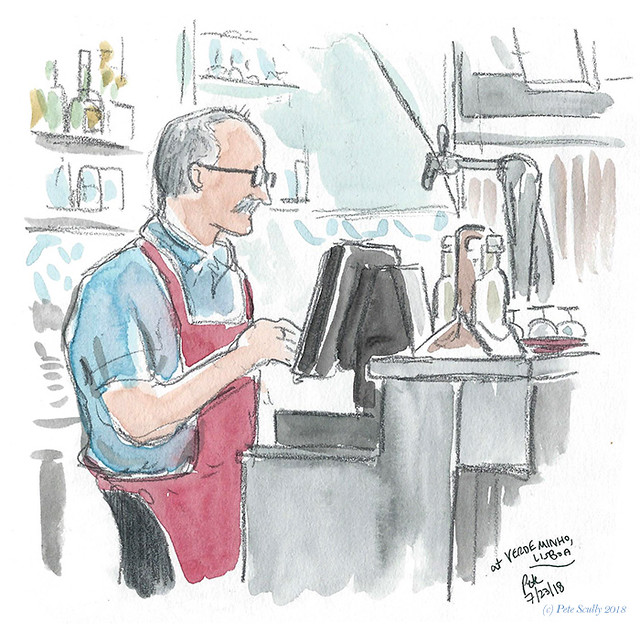
This scene was drawn near the Castelo, in the winding maze of streets around the castle hill. As I was drawing, I (again) bumped into fellow urban sketcher Genine Carvalheira, with her girlfriend. She may have thought I was just one of many Pete clones dotted around Lisbon with sketchbooks (I wish I had access to that sort of technology, can you imagine how many sketches I would get done?). It was a hot afternoon and I stood in the shade.
Lisbon Alfama View sm

And here is the view from the shady leafy gardens of the Miradouro de Santa Luzia. Those red rooftops of Alfama, that blue Tagus river, it was a gorgeous day in a gorgeous – and very historic – city.

a return to lisbon

Lisbon view from Santa Justa sm
I left Porto on a fast train bound for Lisbon. I was last in Lisbon in 2011, when I remember a city with steep hills and amazing vistas. After Porto, Lisbon’s ‘hills’ felt like gentle mild inclines. Seriously, no more huffing and puffing, the flat streets of Baixa were a joy to walk along. I checked into my hotel (which was beautiful; I stopped into the incredible bar for a mojito before heading out to sketch and could have stayed all day), before heading towards Chiado, the area upon a hill which is where much of the 2011 Symposium took place. It took barely ten minutes to get up there, skipping up the hill effortlessly. I even found a couple of shortcuts (there’s a shop with an elevator from the Baixa level that opens up again at a higher-up street in Chiado). One way I could have gone up is the Elevador Santa Justa, a tall neo-gothic tower that provides easy access up the hill. Well, you have to wait in line, so I didn’t do that (I’m so impatient). It took me no time at all to reach the top level on foot by just walking up the hill, and when I did I walked out on to the top of the structure, paid a couple of euros to climb the narrow iron spiral staircase to the viewing platform (acrophobes may not like this bit), and then sketched the view from above. I did not do this in 2011, but remembered a panorama sketching workshop (Simo Capecchi held it) that was here. I didn’t draw a two-page spread, as there was no time with the slowly burning evening light, but I did sketch as many of the rooftops and the Castelo as I could. Lisbon is so lovely.

Lisbon P Camoes sm

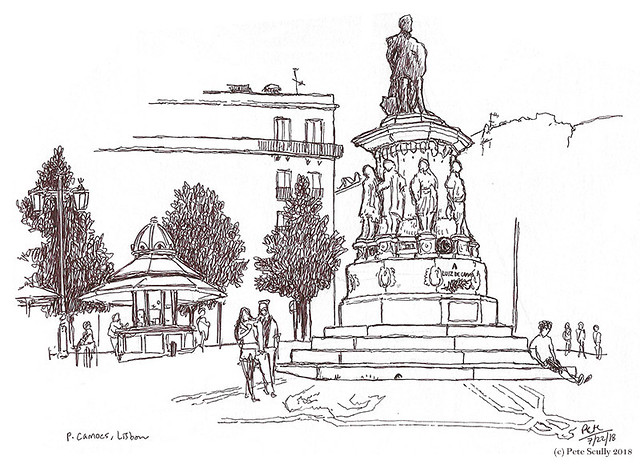
I wandered about Chiado, not really heading into Bairro Alto this time, but stopped to sketch as daylight turned to night-time at the Largo de Camões. I took a workshop sketching here with Nina Johansson in 2011. While sketching, I bumped into Genine Carvalheira and Andy Reddout, who had been in Porto as well and were at the late dinner with us the evening before. I stopped sketching when it got a bit dark (and I was a bit hungry, and also getting a bit cold). Yep, the breeze was coming in so I dashed back down the hill to the hotel to get my jumper, stopping in H&M on the way to buy a shirt (shops stay open very late in Lisbon on a Sunday), then grabbing a bite to eat and coming right back up here. I’d never have done that in Porto, it was too steep. Pat on back to me for choosing a good hotel location in Lisbon (I was near Rossio).

Lisbon A Brasileira sm

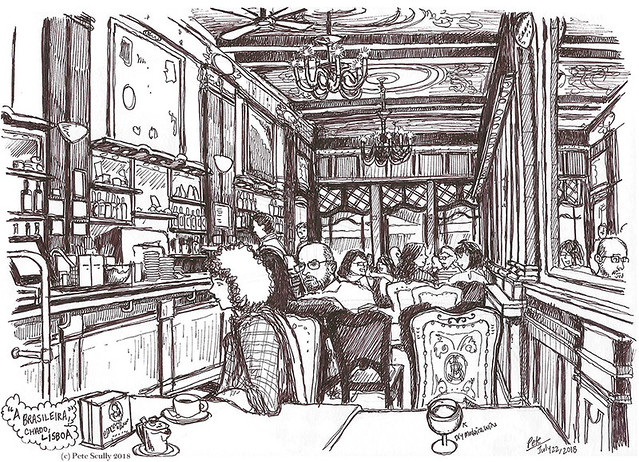
I came back up the hill because I really wanted to sketch the Cafe A Brasileira. My enduring memory of this place was late on the Saturday night of the Lisbon Symposium, sketching in here after dinner with Paul Wang and Liz Steel and some other sketchers, while more USk folk came in and out, having a few portrait duels, before heading back to the hostel at around 1:30am to try and sleep before an early morning bus to the airport. I did sketch the interior back then as well – see below for the 2011 version!

cafe a brasileira

While I sketched I tried a Madeira wine, which was nice, bit sweet and dessert-y, and I switched to a cold beer after that before heading back to bed. I am going to do about two or three more posts about Lisbon, then post some Davis sketches, and then go back in time to the England sketches, and then back to more Davis sketches. Oh and there will be a lot of Lisbon fire hydrants in the next post.

porto party

Symposium people
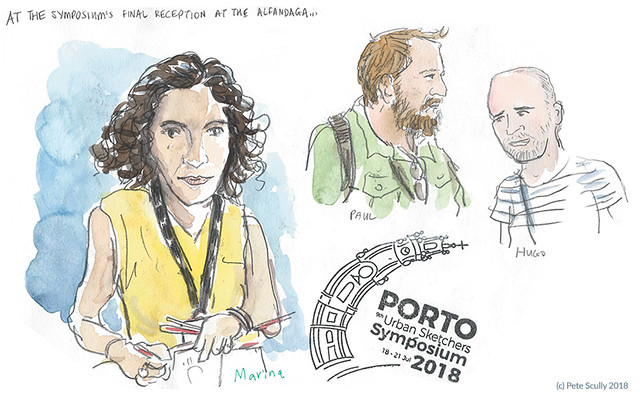
And so here are some sketches from the final evening of the Porto Symposium. On these final get-togethers we usually spend a lot of time chatting and sketching, often speaking to people we may have not had a chance to see yet (easily done in this 800-large event), before going to dinner very late and generally feeling exhausted. Some wine was also drunk. Above, I sketched Marina Grechanik, from Israel, who this year was one of the symposium correspondents and another old urban sketchers friend whose work I’ve admired for years. She has a very creative and playful style (she appeared in my last book, on people sketching) so we drew each other in a portrait duel. I do love portrait duels and wish I could do more of them, I didn’t do enough of them in Porto.  Also on this page are Paul Heaston (who of course I know and have followed for years, but didn’t meet until 2016) and Hugo Costa, from Porto, who I’d not met before but whose work is awesome.

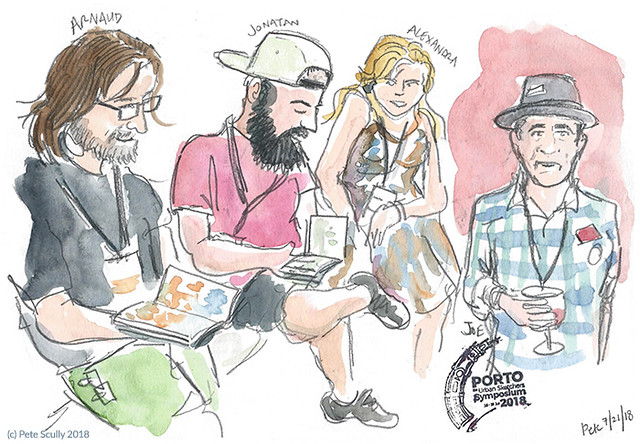
Below are Arnaud De Meyer, from Luxembourg, who I met in Manchester 2016. I really like his sketching work (especially his two page spreads), and really hope to sketch with the Luxembourg group some day; two sketchers I do not know but were from Germany, Jonatan and Alexandra; and Joe Bean, who I had the pleasure of meeting at a London sketchcrawl in 2016 and whose work I also really admire (in particular his in-construction sketches of Headingley Stadium in Leeds).
Symposium People
Below are a couple of sketchers I also met in Manchester 2016, Peter Dutka (UK) and Tine Klein (Switzerland), and though they both had colourful outfits I had didn’t have time to add paint while I stood with them. They both had amazing sketchbooks though, I spent some time looking through them, very productive and creative.
Symposium people
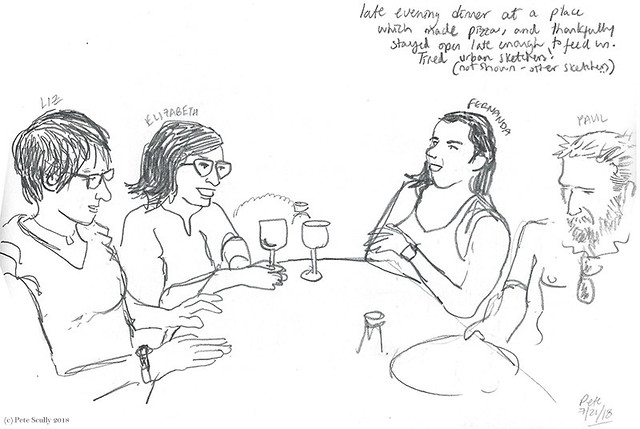
And below, the only other sketch I did, of a very tried and hungry group of urban sketchers – Liz Steel (Australia), Elizabeth Alley (USA), Fernanda Vaz de Campo (Brazil), and once more Paul Heaston (USA). Behind us were several more who I did not sketch. We had tried in vain to get dinner but it was late – late night dinner is less of a thing in Porto, this isn’t Madrid – but we found one place willing to serve us cheese pizza. The waitresses were for some reason very interested in my sketchbook. It was a fun evening, and I can’t wait to see evertyone again in Amsterdam! (Though I did see both Liz and Genine (unseen, at the table behind) in Lisbon a couple of days later).
Dinner after the Symposium
Oh yes, Amsterdam – I didn’t mention, but that is the location of the next Urban Sketching Symposium. Far fewer hilly streets there than Porto! I really hope to go to that one. Next time, I will actually tell people I am going, make connections ahead of time, and I’d also like to spend a bit of time in Belgium first, catching up with old places, meeting sketching friends, before the craziness of the Symposium.
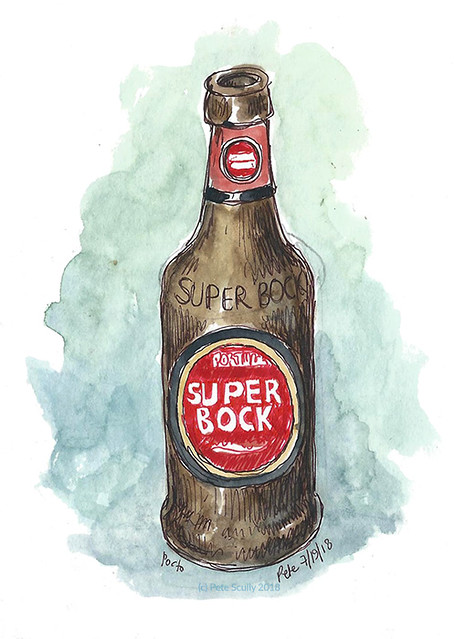
Super Bock
Oh, and one last thing – this is Super Bock. It’s one of two beers you see everywhere in Portugal (the other being Sagres). This is one of the most Portuguese things to sketch. I hope you have enjoyed this trip through Porto with me, I hope I have managed to show some of my enjoyment of this city, but I didn’t see it all and would love to come back some day. I know some friends in England who would love it there. Adeus, Porto!

IMG_8459-smaller

porto panoramic

Porto view from Vila Nova de Gaia

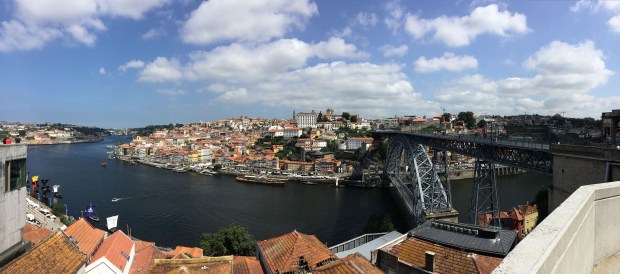
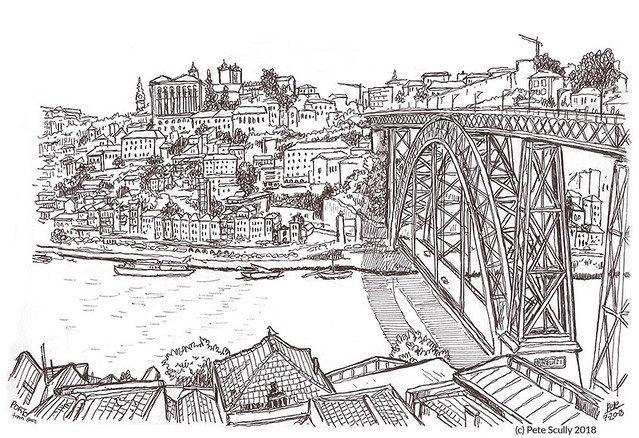
Picture postcard Porto. Pretty, panoramic, picturesque. I could go on. I think I’m most happy with the sketch above, of all the stuff I drew in Porto, this is the postcard scene. It was my free, non-workshop day, no obligations to be anywhere. I slept in a bit longer than I had intended (until almost 9), but my feet were happy for the extra rest. On this day I was heading over the river for the first time to Vila Nova de Gaia. I was interested to explore Gaia, and looking back I wish I had explored more but you sacrifice some wandering time for sketching time, and I really like sketching. The scene above took two full hours, as I added the paint on site (instead of the old colour-in-later thing), and it was beautiful there. I was under the shade of a tree, on a solo bench, and the weather was beautiful, sunny and warm but breezy. Views like this are there to be enjoyed.

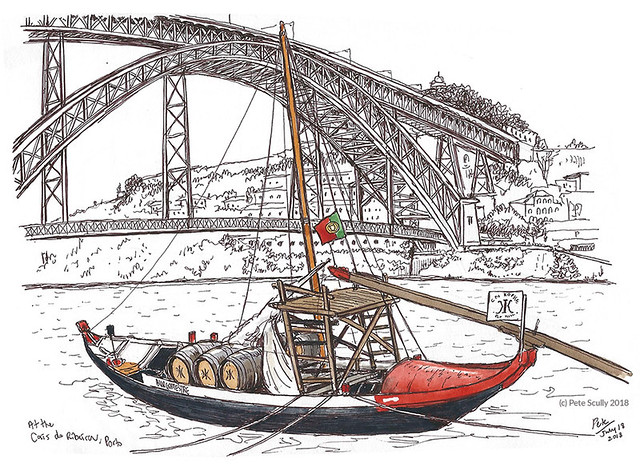
So Vila Nova de Gaia. First of all, the boat – there are lots of these old boats along the banks of the Douro, loaded with barrels, each belonging to one of the many Porto wineries that dot the shores of Gaia. Most have English names and origins, as mentioned in my last post, and in fact these boats have a race up the river each year. It’s called the ‘Douro Rabelo Port Wine Boat Regatta’, which may not be easy to say after a few glasses of Sandeman Tawny. the ‘Rabelo’ is what these little boats are called. They are used to transport wine to Porto from the Douro valley. They’re flat bottomed, and that long piece of wood at the back (the ‘little tail’; that’s what ‘rabela’ means in Portuguese) is used to steer it.

Porto view from Vila Nova de Gaia

I drew the one above first, and intended to colour this one in but the wind on top of the hillside got the better of me. It’s a long way up. I had crossed the Ponte Luiz I bridge via the top, sensibly. My plan was originally to cross over here, go down to the riverside, sketch there, look at wineries, come back up and get the metro to the Dragao Stadium, home of FC Porto. I never did that last bit, because I was moving a lot more slowly, what with sketching these complicated detailed scenes. But what fun!! I never get to draw scenes like this back in Davis. Those bridges in the Arboretum just aren’t the same. I must say though, if there is a quick way down to the riverbank I didn’t find it, I took a long way, walking down a steep winding path. That’s why I never went back that way, but crossed the river at the base of the bridge instead (and then took an even steeper trek up the hill in Ribeira).

Now Vila Nova de Gaia has an interesting history, aside from being where the wineries sell their Port. First of all, it is actually a separate city from Porto itself. The hydrants look a bit different for one thing. Now this settlement existed in Roman times where it was known as Cale, or Portus Cale. Yes, it’s from this that we get the name ‘Portugal’, which was originally the large county around this area which expanded during the Reconquest of the middle ages to what we now know as Portugal. The port area was on the other side of the river, now called Porto (or ‘O Porto’, the port).

Cais do Ribeiro, Porto

Here is another rabela, this one moored on the Ribeira side of the Douro. I love drawing that bridge. This was done a couple of days before, during the Sketchwalk (in which I didn’t really take part as a group activity – there were a lot of people – and missed the final group photo, comme d’habitude eh). I did have to rush back to the Alfandega though for the opening reception of the Symposium.

Porto panorama sm

Now this final drawing I am showing also took a couple of hours, and is themed like the others in the it shows the river Douro and the Ponte Luiz I bridge, but this one is even more panoramic, being one of those double-page spreads I like. Click on the image to get a closer view. I really enjoyed sketching this, though I was standing when I did. Before I began I actually did try to sit at a cafe to rest and have a beer while I got started, but the waiter actually refused to serve me when he saw I had a sketchbook. “Are you going to paint here all afternoon?” he said gruffly. “Well I’m going to draw for about half an hour while I have that beer, yes.” “It is not allowed!” he responded with a mean look. “Fair enough,” I said, I mean there were only a few tables on a very narrow strip and I chose the one with the best view, but this Portuguese Basil Fawlty did irk me a little, I was a paying customer, and didn’t intend on being there for long; I had somewhere to be, and I wanted to sit down and have a cold Super Bock. I’m sure he had had many, many, many others doing the same and it irritated him. So I stood around the corner, where there were other sketchers, and I drew for about half an hour, and then went off to see Gabi’s demo, and then came back to draw the rest for about an hour and a half. I never got to finish the colour, and I do intend on adding it, at some point, but for now I’m leaving it as it is. Just imagine the colourful scene. The sound of seagulls, the chatter of tourists, the silent concentration of sketchers, and of course, the completely irritating sound of street musicians, playing ‘Besame Mucho’ over and over and over again. There are a lot of street musicians – you know how much I love those – and they all seem to play Besame Mucho way too much. There was one though that turned up while I was sketching this who wasn’t actually that bad – he didn’t play Besame bloody Mucho anyway – but then he started playing Oasis songs, but really, really slowly for some reason. “stop Crying Your Heart Out” took about eight minutes, as he warbled on “Hooooowwwwllld Oooowwwwooonnnn,” like a tortured coyote. I don’t think this was exactly Fado, but I can understand Saudade a bit more now, the feeling of sadness after listening to these terrible musicians all day long. Maybe that’s why the wait said it wasn’t allowed, maybe he was warning me of the bad music, like it was for my own good. Ok, I’m exaggerating my own grumpiness for amusing effect (that’s my story). Standing and sketching big detailed scenes is one of the things that makes me most happy, and puts me in a ridiculously good mood despite bad street musicians and grouchy moustachioed waiters. I chatted to some other sketchers I had never met when I was done, and then went off to Ribeira square to meet all the other sketchers for Drink’n’Draw.

One more post of Porto sketches to go! So this is the Penultimate Porto Pictures Post.

porto practicum

Simo workshop, Porto
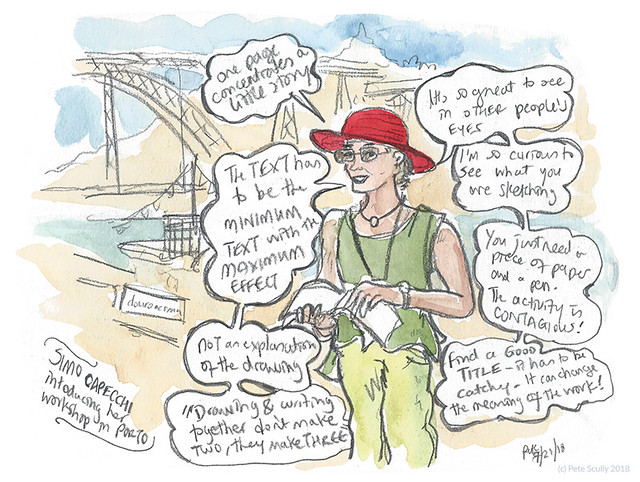
The second and final workshop I took was with Simonetta (Simo) Capecchi, from Naples. I met Simo at the 2010 Portland symposium, and took one of her workshops there (actually at that one I think I may have wandered off and lost track of time, if I recall), oops. I was super excited to take this one though, as I love Simo’s work and her ideas, and this workshop was called “One Page Says It All: A Reportage on Porto Wine”. Simo does a lot of reportage sketching for a travel magazine called “Dove” (it’s in Italian), so she has a lot of experience in commissions for travel reportages. The point of this workshop was to create a page about Porto wine – think of an angle, map out your page, and think up a catchy title. There wasn’t a lot of time to do a ton of research, so it was mostly looking through windows, mooching around the wineries (or their info stands and gift shops) at quick pace, browsing leaflets in the tourist office. Most of the time is spent sketching, but the text had to be important. I sketched Simo above, before we took the little ferryboat over the Douro to our location in Vila Nova de Gaia. I liked the phrase “drawing and writing together don’t make two, they make three.” It’s so true.
Simo workshop, Porto
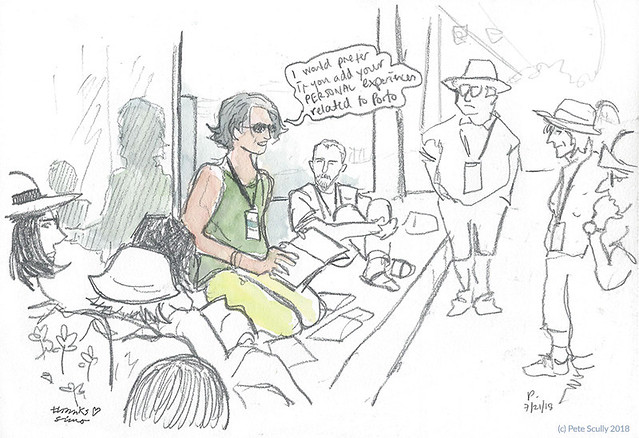
Here, Simo shows us some of her own reportage work, offering advice on how we can construct our pages. Some of the results of the various sketchers were very good, some highly detailed and well thought out, others a little more carefree, I think I fell into the latter a little. My page is below. It’s drawn in the Clairefontaine sketchbook that came in our symposium goody bags. I focused on the old English names of all the Port wineries – many of them were founded by English vintners several hundred years ago (and Anglo-Portuguese relations do go back many centuries, to their alliance back in the middle ages, the longest standing alliance between nations). I rushed the title though, quickly adding it in just before the show and tell: “A Glass of Old England” (I then added “In Old Porto” and immediately regretted it). I didn’t like the title though. I should have called it “Going Out For An English” in reference to that classic Goodness Gracious Me sketch. I really enjoyed this workshop, Simo is a very interesting storyteller and has always been an inspiration to me, and going over the river and thinking about Porto wine was a very pleasant way to spend a morning.

IMG_9265
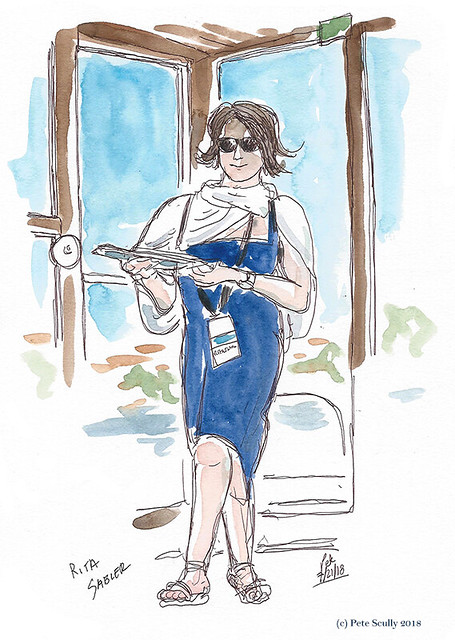
Below, sketched on the ferryboat back over the river, is my friend Rita Sabler, who was one of the official correspondents for the Porto symposium. She had been sketching and reporting on our workshop. You can read her daily reports, along with those of the other two correspondents Paulo Mendes and Marina Grechanik, on the Urban Sketchers website.
Rita Sabler

And finally, here is the sketch of Sandeman’s without all the writing and stuff around it. Those cable-cars above are part of the Teleferico de Gaia. I did not ride these but would have liked to, if I’d given myself the time.

Sandeman Porto

All this reportaging, you would have thought I’d have topped it off with a nice glass of tawny. Instead, I got myself something unusual: a gelato made from Port wine. It was actually delicious.

IMG_8610

porto polyrhythmic

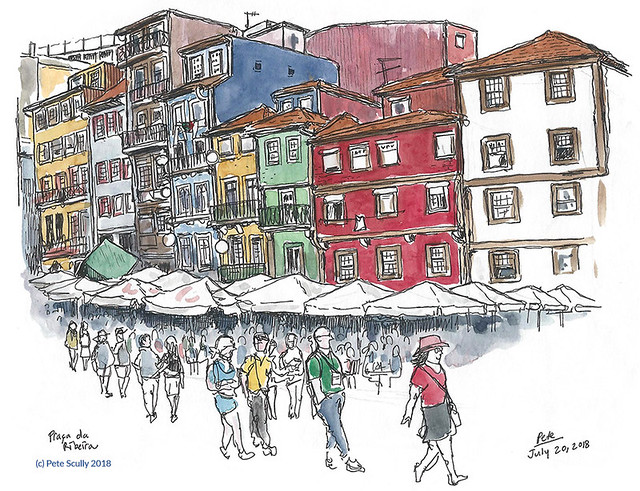
Praca Ribeira
“Polyrhythmic” – being made of two or more rhythms at the same time. I think that is a good describer for many great cities, but is certainly true of Porto. I am not quite at the end of posting my Porto sketches, but have divided them out so certain ones will post together. I think with these ones, they were ones that I didn’t necessarily categorize, but looking at them together they do have a certain joined-up difference. Above, the Praça Ribeira, down near the Douro. This was where the nightly Drink’n’Draw was held, and there are so many sketches of this colourful little spot.

Miragaia hillside, Porto
This scene here is of the hillside of Miragaia, as seen from the long riverside street of Alfandega. Another scene sketched by many, as it was right by the Symposium location. It was an overcast day, so the colours were more muted. I never explored this area, which appears more labyrinthine and a little ramshackle. And of course, there is a tiled church in there. That’s the Antiga Capela e Hospital Do Espirito Santo, Google Maps tells me. I would have liked to have drawn even more, along the whole riverfront. I walked along it a lot of times (or ran along it, rushing to get to a demo or workshop on time).

Porto view from Se

This is the view from the Terreiro da Sé, next to the cathedral, looking out over the rooftops. I was really attracted to this group of colourful houses, many of them tiled, but the one on the far right (not a great phrase that, these days) is called the ‘Varanda de Fado’. I think they play a lot of Fado there. I don’t know though, because I never went to find out, in the evenings. Funnily enough, I didn’t manage to seek out any Fado in Portugal. I know I should have, but I never had the opportunity. I felt a little strange asking where the Fado was, like I was too much of a tourist, afraid of getting rolled eyes and shaking heads, like if a tourist to London asked me how to find the bowler hat shops. So, I pretty much missed out on the Fado scene. Perhaps next time.

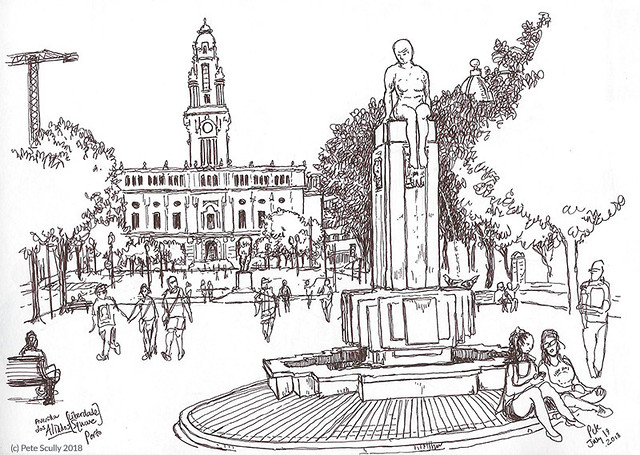
Aliados, Porto

The scene above is of Liberdade Square / Avenida dos Aliados, which is the big main thoroughfare of Porto. It’s fairly long, sloping uphill slightly towards the tall white tower of the town hall. This was sketched during daytime, but I came along here on a Friday night on the way home to the hotel. It was a bit bizarre, it seemed to be full of teenagers, huge gangs of them, mostly young ladies dressed as if going to nightclubs and lads barely on the right side of shaving, but not doing much more than hanging around in the street in large groups talking and drinking and smoking. Perhaps they all were going on to nightclubs, I have no idea the habits of young people of Porto, or perhaps this just is what the young people do these days. Been along time since I was that young. anyway I popped into McDonalds, which was packed (mostly with more of these well-dressed youths). They had chandeliers (McDonalds, not the youths). Ordering at McDonalds in Europe these days is done on big touchscreens now, they aren’t really a thing over here in California yet, not sure why. Probably because we are still mostly about Drive-Thru when it comes to McDonalds. My wife says that this touchscreen ordering system would not work at McDonalds in America, but most Americans I know are quite familiar with touchscreens by now so I think it would. Except at a Drive-Thru, unless you had really long arms, or maybe the screens could move closer to the window. McDonalds, get on that idea, you are welcome.

O Porto Statue
This statue was on that same square. I don’t know who it is, but the statue is called “O Porto”, which is probably like “Oh Canada”. The man with the spear has a dragon on his head. From behind, he looks like Loki. “I am Burdened with Glorious Purpose!”
Torre Medieval Reboleira, Porto

Above is a building which I believed to be called the Torre Medieval da Reboleira, but which Google Maps now tells me is something else. No I think this might be not one but two churches, the Igreja Monumento de Sao Francisco on the right and the Igreja dos Terceiros de Sao Francisco behind it. Well, at least this is a couple more churches for my church count (this might put them ahead of the hydrants now). I had two attempts at drawing this, both times I ran out of time and had to go elsewhere, so I left it. I’m going to need to cross out that incorrect name in the sketchbook now though, aren’t I.

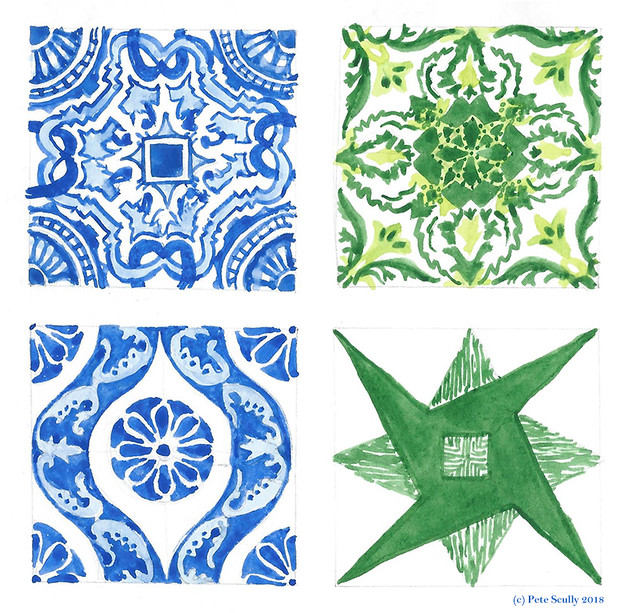
Porto Tiles

And finally, well I had to draw some of the tiles didn’t I. Seriously, Porto is chock full of houses decorated with these colourful ceramic tiles, usually in blue and white. There are so many different patterns. I remember seeing a lot in Lisbon, but nothing like Porto. If Porto is known for anything, it is this.

About three more Porto posts to go! Then we move on to Lisbon.