tunnel records and trad’r sam

4 Star - Tunnel Records SF 092424 sm

Part Two of my day in the Clement Street /Geary Street area of San Francisco, about seventeen or so blocks further towards the ocean and the rolling fog. I was looking for the 4 Star theater, on the corner of 23rd, which shows older films and which unfortunately I had not given myself time to watch anything, but on this day they were showing My Neighbour Totoro (always a favourite), Toy Story 3 (good but I prefer 2), and North by Northwest (which I have never seen but I think involves a small plane and a man running away). I was here to look around the attached record store, Tunnel Records, which is in a little nook of the cinema. It is not the main shop of Tunnel Records, that one is somewhere else in San Francisco, another area I have not yet been to. It was not open when I got there, which gave me some time to draw the building. I stood opposite and looked up Clement, listening to another Jarvis Cocker interview, I can’t get enough of his soft Sheffield accent. I left the details of the other side of the street a bit sparse, sometimes that is all you need to get the message across, and all I had time for, this was not a ‘finish later’ sketch as so many seem to end up as these days, I just wanted to draw what stood out to me in those moments. The record store opened, and I went in to have a long browse. It’s something I don’t do any more, and I can’t remember how or why I do it, but once you start you can’t really stop and have to look at all the racks, alphabetically, in case something pops out that makes you think oh wait, now that I might like. There was one other person in there browsing too. I realized he was a few racks ahead of me, but browsing each rack one by one, same as I was, though more slowly. Was I not paying enough attention to what I was browsing? Either way, I knew at some point I would catch up, and would either have to go around to the next rack and quite obviously miss out the one he was looking at, or what, start looking at the same rack? You can’t do that. I would try to slow down by stopping and pulling out something interesting, to look at as if I could hear the music coming from the sleeve. I would nod and pull that expression people pull with their mouths when they want to show silent respect for something, you know the one, but I was just faking it really. In the end, I caught up. Instead of skipping to the next rack over, I decided to pretend that I needed to look at my phone suddenly, and then went to look at some t-shirts. I am not sure why I was acting like I was in some kind of play. I went and looked at the soundtracks section (like, why would I be looking there), and then after the other man, who was probably in some play of his own, moved to a different genre, I went back and looked through the alphabetical racks again but this time, in an unexpected move, in reverse order, starting at Z. I ended up not buying anything, despite being tempted by an Al Green album, because I didn’t fancy carrying a record around with me while sketching, and I didn’t really need it. I gave a little smile and raise of the eyebrows to the shop clerk as I left vie the movie theatre’s main entrance, and went off to draw a massive Russian church.

Holy Virgin Cathedral SF 092824 sm

It’s pretty hard to miss as you go up Geary, yet it’s not one of the famous San Francisco sights. The Holy Virgin Cathedral “Joy Of All Who Sorrow” has tall, shiny golden onion domes that probably look even shiner in the sun, let alone on this foggy day. It’s a Russian Orthodox church; there have been Russian communities in the San Francisco area for over 200 years. This is the largest Russian Orthodox Cathedral outside Russia, and was completed in 1965. I sketched it from across the street, adding in the metallic gold paint when I got home (you can’t tell here but the page is actually quite shiny). I popped inside, but only to peek through the door, I wasn’t sure if I could walk around and have a look. It was very ornate looking, and even though there wasn’t a service going on I felt a little bit like I was out of place, and I didn’t want to unwittingly break any rules. The Church Etiquette and FAQs pages of their website are quite interesting, full of extremely clear and specific instructions as to how you must behave. If your phone goes off: “You should answer the call (accept it), but do not start speaking until you have stepped away (outside or in the narthex). Walk out of the church quietly and calmly. Do not sprint/dash out of the church when this happens. Make the caller wait.” They are thoroughly disgusted at people leaving lipstick marks on icons, which is fair enough frankly and not something I was in danger of doing; as for clothes, shirts must have collars and be buttoned up, though you’re ok to loosen the top button if you have to, and don’t ever wear a t-shirt saying “This Bud’s For You!” I imagined there must have been a very specific incident involving a t-shirt with that phrase on it. I was wearing a Red Star Paris football shirt, which was probably a big nyet-nyet, and the big red Star on the badge may have been confusing, so I didn’t take any chances, and just peeked through the door. I tried to teach myself Russian when I was a kid, I didn’t get further than a few phrases, but I learned the Cyrillic alphabet and so I was enthusiastically reading the signs outside and trying to figure them out. I think it was in Old Church Slavonic, which would have blown my teenage self’s mind to see in person.

Trad'r Sam Geary SF 092824 sm

I stood outside the cathedral though to sketch my last destination on this day in the city, Trad’r Sam, an old tiki-themed bar that’s been around since 1937. It is not fancy, but is a real San Francisco legend I had read about on a list of historic San Francisco bars, since I have it as my mission to go and draw them all. I was already quite tired by this point, so when I drew the exterior and that big green sign, I went in through the saloon doors (am I misremembering that now?) and ordered a Lava Flow cocktail. I sent my wife (who loves a historic tiki bar) a picture of my drink; she was in Disneyland and had just ordered a Lava Flow ice cream at the same time, coincidentally. It was a pretty popular place on a Saturday afternoon and started filling with locals. The bar itself is a big horseshoe, my favourite type of bar set-up, and the barman was friendly.  I chatted with some of the others sat at the bar, got comfy and finished off one of my sketches. I decided I didn’t have the energy to draw the bar itself, this time, but enjoyed the mood. I tried a Mango Mai Tai, and wow it was really good. I think it was really strong as well because I started feeling a bit drunk already; maybe that was the lack of a proper lunch mixed with looking at all that orthodox religious architecture and old pop records. I had to explain to the barman who Red Star Paris were; not the team I support, I just like their kits and the fact they aren’t PSG. He’d heard of Red Star Belgrade, and hearing I was from London he asked who my team was, giving me a fist bump and an acknowledgement of how good Sonny is when I told him. I talked to a couple who lived about a block away and gave me some good tips for other old local bars in this area, they are now on my visit and sketch list. It was a good place to wind down the day, and I had a beer to finish off, alas not an Anchor Steam which was always my SF drink, but eventually I had to get myself back to Davis, a long long journey from this part of town. I took the 38 bus back, got the Amtrak bus to Emeryville, took the Capitol Corridor train to Davis, and then had to walk back from the station up to north Davis, four hours later. I slept hard that night, but got up next day to watch Spurs batter Man United 3-0 away. A good weekend.

the towers of westminster

westminster cathedral 061424

This is Westminster Cathedral. No not Westminster Abbey, this one is a little further up Victoria Street, free to go inside, and according to the priest I spoke to a few years ago they have the best bacon sandwiches in London down in their cafe. Well, I’m neither a catholic nor do I eat bacon, but this is one of my favourite buildings in London. It’s often overlooked, not as old or famous as its big Church of England brother down the road, but it’s a spectacular sight, especially on a sunshiny day like that day. Well a London cloudy sunshiny day, my favourite type of day. We had just taken my mum on an Afternoon Tea bus ride around London, one of those ones bedecked in flowers and pretty colours where you sit at little tables upstairs and enjoy tea, cakes and even some sparkling wine, while being driven around the streets of the capital. The staff were very friendly, though it wasn’t a guided tour, but they sure filled us up with tea and sandwiches, while playing the usual Abba style music over the speakers. I had an idea, there should be a bus where the theme is cockney singalongs. I would love to be the tour guide on that bus. When we got back to Victoria station, we took a walk around to Westminster Cathedral. I actually first heard of it when I was a kid and my mum went there with the local Catholic church (the Annunciation) to meet Cardinal Basil Hume. It was many years before I went inside myself, but it’s really grand inside, with some glittering mosaic tiled ceilings in the adjoining chapels. I sketched it five years ago, on a rainy day when I actually took the elevator up that tower to enjoy the view. This time I stood in a similar position on the street opposite, not rainy this time, and the colours really popped. Victoria is so much more modern and shiny than it used to be, so many new big buildings I would not recognize, but they reflect the cathedral well. It was designed by the architect John Francis Bentley in a neo-Byzantine style with no steel frame, and opened in 1903. It was Friday afternoon, I went off after this for a walk around London before meeting up with my friend to watch Scotland lose to Germany in the first game of the Euros. As I write, I’m not quite over England losing to Spain in the last game of the Euros. Football, I don’t want to talk about it.

by the River Thames 061124

On a completely different day, when I was still quite lagged of the jet, we took a long walk along the Thames, my favourite river. I mean, it’s not like I have a bunch of other rivers that I’m ranking, it’s only the Thames that means anything to me. The Sacramento river? Please, I have to go to Sacramento for it. The Liffey? Yeah it’s ok, for the amount of times I’ve been to Dublin in my adult life (twice!). The Sambre in Charleroi? I used to avoid it when I lived there in case monsters came out of it covered in grease. No, I only really know the Thames, and I love that river so much. On this day we walked from down beyond Tower Bridge all the way to Hungerford Bridge, and my jetlagged head was thinking it needed a nap by that point, but as we took a rest before getting on the tube, I did a quick sketch of Big Ben, and the Houses of Parliament. (You have to say that in the voice that bellows “He-Man! And the Masters of the Universe…”). The South Bank is a must-do in London. Personally a big fan of it on very cold bright mornings, or misty evenings in November. Not a huge fan of that time I got stuck over there on a freezing cold snowy night in February in about 1996, when right after crossing over the river, the bridges and tube stations all got closed due to a terrorist bomb going off accidentally over in Fleet Street. Took me ages to get back over the river that night. I do remember one time coming down here when I was about 16 or 17 and drawing by the Thames, I drew pretty much this exact scene from this same place. This was long before the London Eye and all the river buses. There were a lot of homeless on the South Bank in those days, especially under Waterloo Bridge, and one guy who was from Liverpool started chatting to me while I was sketching, and we had a long conversation, he told me about how he’d ended up where he is, and that gave me a different perspective. I gave him the drawing I had done, and he was nearly in tears. I was poor as hell myself and couldn’t even afford to give 50p for a cup of tea, but he did appreciate that drawing, and the chat. I remember drawing another one (which I think I gave to my godmother) but this view does always remind me of that moment, decades ago.

london coliseum 061424

Finally, another tower, this time it’s the Coliseum Theatre on St. Martin’s Lane. I drew this on the same day as Westminster Cathedral, having arrived in the busy Leicester Square area with some time before meeting my friend James. Interestingly enough, the last time I drew Westminster Cathedral, I went over and drew St. Martin’s Lane right afterwards; coincidence? I don’t believe in coincidences, detective. The evening before, we had spent a wonderful evening in the Coliseum Theatre watching the current production of Spirited Away, adapted from the animated Miyazaki masterpiece. It was not a cheap, but I could not miss out on seeing it, and my son and I are both big Studio Ghibli fans. It did not disappoint! The theatre itself is an incredible place, it’s worth seeing something there just to be in the space. The puppetry, the performance, the music, the staging especially, it was all done so well, and it was all in Japanese! It’s a theatre company from Tokyo bringing the original show to London, so the actors are all Japanese. I have only ever watched Spirited Away in English (I did try to get a head start by watching it in Japanese on the flight over) but since I used to do sessions on ‘performing in a language the audience does not understand’ back when I was a drama student acting in German or French, I was interested to see how their acting and physical performance would tell the story; I wasn’t disappointed (although to be fair, I know the story). Nevertheless there were subtitles, displayed out of the way above the action as glowing words through the green foliage around the stage. I loved all the costumes too, especially of the various spirits, but like the film it really did transport me somewhere else for a while. If you get a chance, I recommend seeing it. Good theatre is well worth it.

Edinburgh Old Town

Edinburgh St Giles Cathedral

“Auld Reekie”, that is Edinburgh’s nickname. Back about four or five hundred years ago, the old walled city had little room to grow, so the buildings got very very tall – many still are. All these homes and all these chimneys gave out a lot of smoke, blanketing Edinburgh in thick smog, so locals would call it Auld Reekie – that’s ‘Old Smokey’ in the Scots tongue. A bit like the way London was referred to as The Smoke (I don’t know if people still call it that; perhaps it’s The Vape these days). I always thought Auld Reekie referred to the smell, like when something reeks, and it seems it was a smelly place, but no more than many cities. People would throw their toilet water out of those tall windows into the narrow streets shouting the phrase “Gardyloo!” which came from the French “garde à l’eau”, ‘watch out for the water’. By water we mean of course wee. I mean, listen I’d love to time travel, but I’d die of some vile disease within half an hour of time travelling back then, it sounds disgusting. I had all this history in mind (and in my ears thanks to the podcast I was listening to) when I got up early and went out to sketch this part of Old Town. I hadn’t slept that well, the apartment was nice but very warm, and the fan that was on had given me a dry mouth, and irritated my allergies so my nose was starting to run again. It was raining lightly. I walked up to the cathedral of St. Giles, which is the High Kirk of Edinburgh, to get my cathedral drawing in. I love to draw a cathedral, and this one has a very crown-like spire. Technically it is not a cathedral, not any more, not since 1689, when the Church of Scotland, which is Presbyterian, gave up having bishops, and therefore cathedrals. It’s still allowed to be called one though, because, what you gonnae do about it pal. It does date back to about 1184, long before they started calling it cathedral, and much later this was the church of John Knox, the big figure in the Scottish Reformation – I also drew his house, which will be in a later post (plus I think his brother Hard ran a school?) It started to rain while I was drawing this, so I stood a bit closer to the wall in an attempt to stay dry. That worked for a while, until it didn’t. I did most of it, then scarpered into one of the many alleys that branch off of the Royal Mile.

Edinburgh Advocates Close

If you’ve been to Edinburgh you’ll know the sort of alley I mean. Through archways in many of the terraced buildings, you suddenly find yourself in a long passage that doesn’t just go through to another street, but down (or up) steps into a whole new level. Edinburgh’s old town is very hilly, many of the streets have to curve around to get over the steepness (“stepth?” That should be a word, I’m inventing it). These narrow portals cut through the town providing short cuts to those fit enough to brave the steep staircases, and they can also provide sudden photogenic vistas across the city. One such alley with a magnificent view is Advocates Close. We went through there on our first evening in Edinburgh and waited in line (I mean, not a long line) to take a photo looking down at the Sir Walter Scott Monument. On this morning when it started raining, I ducked into this now empty alley – save for the odd passer by with an umbrella – to draw the view myself. It was still before breakfast, and this sketch illustrated an aspect of Edinburgh any visitor would get to know. I listened to more Stories of Scotland, telling me about Greyfriars Kirkyard, which we would visit on a ghost hunting tour the next evening. When I was done here, I picked up some delicious cannoli from a little bakery on Jeffrey Street and headed back to wake everyone up, for a day of touristing.

Edinb Heart of Midlothian

This above is another thing found on the Royal Mile, which I only outlined while passing in the rain, but drew later on at the flat. The Heart of Midlothian is a mosaic made of cobblestones that marks where the Old Tolbooth once stood, outside St. Giles Cathedral. The Old Tolbooth was a big medieval building whose jail was a dreadful place by all accounts, and many executions took place there. Heart of Midlothian football club – Hearts – is named after this landmark. Sir Walter Scott (he of the aforementioned big monument) wrote a book called The Heart of Midlothian, referring to the Old Tolbooth. Apparently there is a tradition of spitting on the heart, either for good luck or to show disgust at all the executions that this place hosted. I decided against gobbing on the street, though I’m sure worse happens during the Fringe Festival.

Edinburgh Castle 062323

Later that day, we were able to get tickets to go into Edinburgh Castle. Tip for tourists – if you ever go to Edinburgh and want to go to the castle, get those pre-booked tickets in advance because they will sell out fast. The castle was a hike uphill, past all the cashmere shops and whisky shops and shops where you can buy little cuddly Highland Coo or Nessie toys, but the view was great. We got the self-guided audio-tour, which in respect wasn’t as interesting as I’d have hoped (they rarely are, I never like standing there listening to those little plastic radios, when I could read a small sign much more quickly – in fact the small signs they did have often included QR codes to hear someone talking in Gaelic for example, on your phone). We explored the castle in depth, it was enjoyable, and interesting to see the room where James the Sixth / First was born. He was the Stuart King that was on the Scottish throne when Elizabeth I died and he was invited to also be the King of England, uniting the monarchies but not the countries, we were still a century away from the United Kingdom. So he was James VI in Scotland, and James I in England. There was a big queue to get inside this building to see the Crown Jewels, so my wife and son decided to do that while I decided to stay outside and sketch, having seen enough Crown Jewels at King Charlie’s Coronation. I did notice on the shiny plate above the door dating from 1993, two swords and the official royal cypher of Queen Elizabeth II, that is “ER”. Er… where’s the “II”? It should be “EIIR”. You all know this if you spent any time in Britain during the Queen’s funeral, or any time at all in the past seventy years. Except this is Scotland, and they didn’t have an Elizabeth I, so she can’t be Elizabeth II here, right? That’s apparently the case, I hadn’t even considered it. I noticed that a lot of postboxes don’t have the royal cypher on them either, just the crown of Scotland – except older pillar boxes did have a royal cypher, such as those of George V for example. From what I can tell it was down to what has been called the “Pillar Box War”, which was a dispute in Scotland as to whether Elizabeth II could style herself II in Scotland or not. There was a legal challenge, and in the end they decided it was Royal Prerogative for the Queen to bally-well call herself she bally-well liked. Still after a bunch of pillar boxes were vandalized, tarred, hammered, even blown up, Royal Mail decided in Scotland that new post boxes would just have the crown of Scotland on them and not any EIIR. I don’t know what will happen for King Charles III, but as all Kings Charles came after the union of the crowns (it was James VI/I who named his son something completely new, that being Charles I, ingeniously getting around the confusing numbering system). I don’t know what happened during the reigns of William III and William IV, since Scotland didn’t have a William I or II,  but perhaps in those days they were too worried about people throwing piss out of their windows to care much. I bet King William V won’t get his initials on the postboxes though.

Bonjour Bayeux

Bayeux Cathedral, France
We spent a few nights staying in the little city of Bayeux, a good base to explore Normandy. There are a lot of places in Normandy we didn’t get to that we’d like to have seen – Rouen, Honfleur, Giverny, I mean it’s a big place – but for what we were going to see Bayeux was perfect, especially being so very close to the D-Day Beaches. For me though Bayeux was the place for the thing I’ve wanted to see forever, the Bayeux Tapestry. It did not disappoint! It has its own museum, and while we went when it was early and not yet too crowded, the line has to keep moving along it. It’s long – about 70 metres – and while I’ve learned about it for many years there’s nothing like the experience of seeing it all in one go, and constantly moving along, with the commentary in the headphones explaining it, made it feel like watching a long comic strip, a cartoon about the Norman Invasion of England. And it was funny, too. There were a lot of willies. The inventiveness and use of colours is incredible, and the sense of movement you get in the horses and the battle scenes is something a few modern movie directors could learn from. The Bayeux Tapestry was made sometime in the 1070s with the Conquest still fresh, is of course, neither a tapestry (it’s an embroidery) nor from Bayeux (Made In England, by Nuns in Barking and Canterbury, likely under the instruction of Odo, the Bishop of Bayeux and Earl of Kent) but so what, as Macca would say, it’s the bloody Bayeux Tapestry, it sold, shut up. It wasn’t about Peace and Love though. A brilliant piece of Norman propaganda, perhaps, but as I said to my wife, for me this is like going to see the US Declaration if Independence or something (but in reverse, I guess), 1066 being such a crucial moment in British history and in the history of the English language. If it wasn’t for William the Bastard getting all Conqueror on our medieval asses, we’d probably be speaking a language much closer to Dutch and German than the way it looks today. Either way, the gist of the story is that the Normans totally stitched up the Anglo-Saxons.

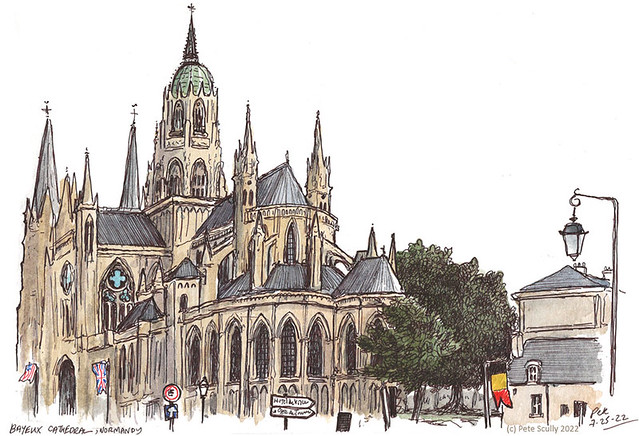
The Bayeux Tapestry used to be kept in the cathedral but isn’t any more. The Cathédrale Notre-Dame de Bayeux (above) is pretty massive and as in many French towns you can orient yourself by looking up and seeing where the spire is, and it’s visible for miles around. While we didn’t get a chance to go inside, I did sketch it on one of my morning walks, though it started to rain so I finished it off inside. It was consecrated in 1077 with William the Conqueror there, so it fits into the timeline of the Tapestry. It was supposed to be here that William got his promise from Harold that he would support him to be King after Edward the Confessor died, starting that whole thing. The little courtyard in front of the cathedral’s main entrance is very pretty, I stood at the rear a little way down the hill where the view was pretty magnificent. Even when looking at this, I keep thinking, I must go and get a pain aux amandes for breakfast.
Bayeux rue st Martin and rue Franche

The narrow street we stayed on, Rue Saint-Patrice, was full of little shops (many closed on both Sunday and Monday, when we were there) and many very old looking buildings. I don’t recall what this building was called, on the corner of Rue Franche, but I drew it on my evening walk after we had eaten dinner and had a busy day touristing somewhere else. There are flags lining the streets in Bayeux. I love a timber-frame building, it’s like a puzzle when drawing to make sure you get all the bits in the right place, but a little personality goes a long way and you don’t want too many straight lines. The weather was nice, the sky had dappled clouds and of course the sun set so much later, so after this I went further into town and drew another scene, below. This pretty postcard view is across the little river Aure, that trickles through Bayeux with the Cathedral in the background. Every evening we would take a walk down this way, and around the corner we ate some nice Norman food at a restaurant, though on one evening I walked up to a little store about a mile up the road (the supermarket in the centre-ville being already closed) to buy some dinner supplies, and was brought back to living in France years ago, standing in line in a small shop for about 20 minutes and then carrying heavy bags up and down streets and up a narrow staircase, it was like going back 20 years. I really liked Bayeux, and my family loved it, we had no ‘Bayeux remorse’. Bit quiet, but a good base to explore.

Bayeux river view

And of course, I drew a hydrant! More Normandy sketches to come…

Bayeux hydrant

“thou Scheldt not pass”

Antwerp Steen sm

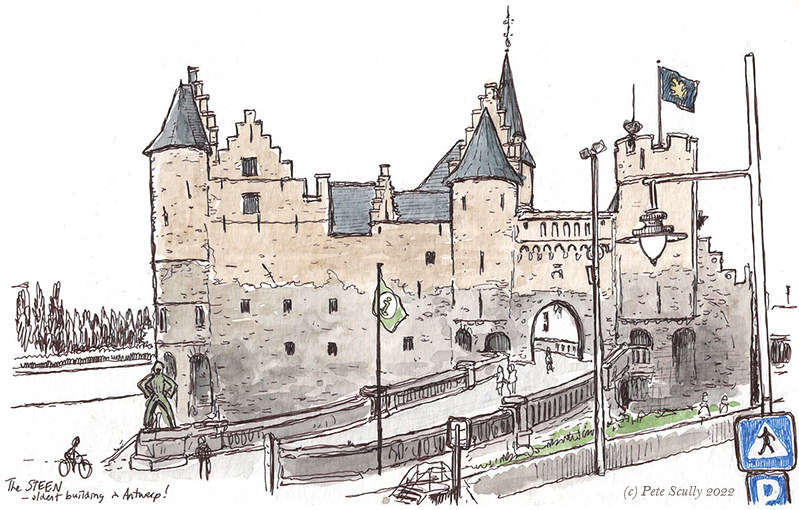
I weaved through the streets of Antwerp heading for the river Scheldt, to use that brilliant “thou Scheldt not pass” line I had thought of in my previous post. I might use that as a title for this blog post. I headed for Het Steen, the little castle on the banks of the wide river that is the oldest building in Antwerp. It dates from the early 1200s, and means “The Rock” (though “Steen” is a pretty common word for a stone castle in Dutch). There was a castle on this spot right back in the 9th century Carolingian period. It has a decent tourist information office in there now, where I bought some chocolates for my son (little chocolate hands from Antwerp). I had a good spot to sketch from across the busy street, up some stairs, but it was starting to spit so I sketched quickly. You know I love a street sign, so I made sure to include the blue crosswalk sign in the bottom right corner. Some people might think no, you leave those out, takes away from the historic castle, but I say thee nay, give me modern metal street signs and old medieval buildings any day. Back on my 1998 train tour of Europe I became a little bit obsessed with crosswalk signs, because they were a little different in every country. I liked the German ones in particular, wearing the little hat, as do the ones in the Czech Republic which look a bit like spies. I would always get obsessed with things like that.

Antwerp Lange Wapper sm

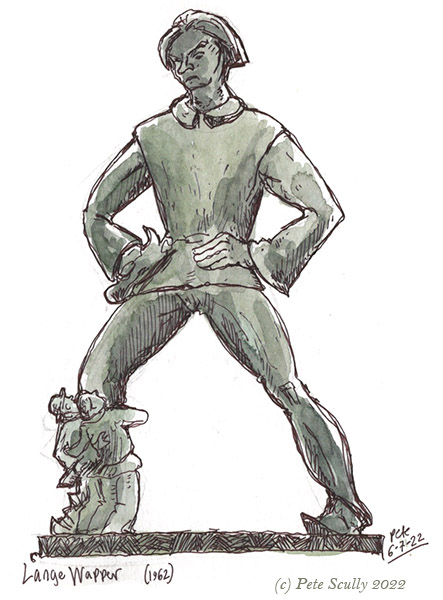
I tell you what, they can’t get enough of those Flemish giants here in Antwerp. This is a statue of a big lad called Lange Wapper. It’s right outside Het Steen, and shows Lange Wapper doing that Tory-party conference stance and looking down on two smaller people, crotch out, threatening them with his Lange Wapper (I’m so glad he is clothed, unlike Silvius Brabo). Lange Wapper is a Flemish folk tale, about a boy who started out as a bit of parsley and cabbage and then became a bit of a trickster. He apparently saved an old woman who had been thrown into the river Scheldt by a gang, and the old woman gave him the ability to shape-shift, for example turning into a massive giant who could leap between towns. He got into all sorts of antics; he would probably be cancelled now. He is kind of like a bogeyman figure of Antwerp. This statue was put there in the early 1960s.

Antwerp hydrant 2 sm

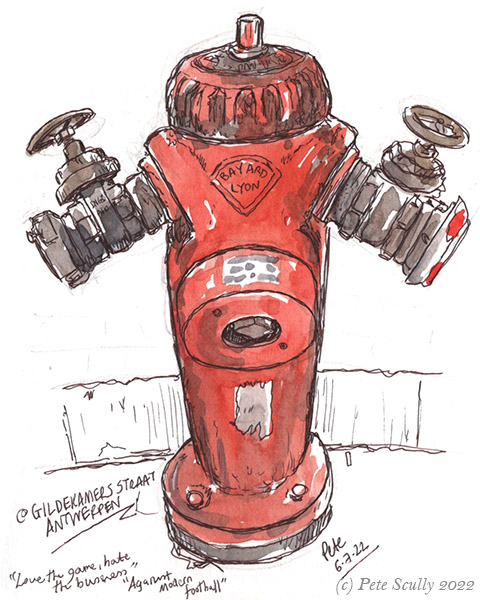
Not far from here I found another hydrant I needed to draw. This one had a peculiar sticker that said “Love the game, hate the business” and “Against modern football!” on it, which must really make the firemen think. Haha, a fire hydrant talking about sportswashing, the irony. Anyway I drew this down a fairly quiet street. Those few drops of rain I felt over at Het Steen were coming back, we were definitely going to get wet today. It’s good to keep adding new city fire hydrants to my big collection.

Antwerp Kathedraal sm

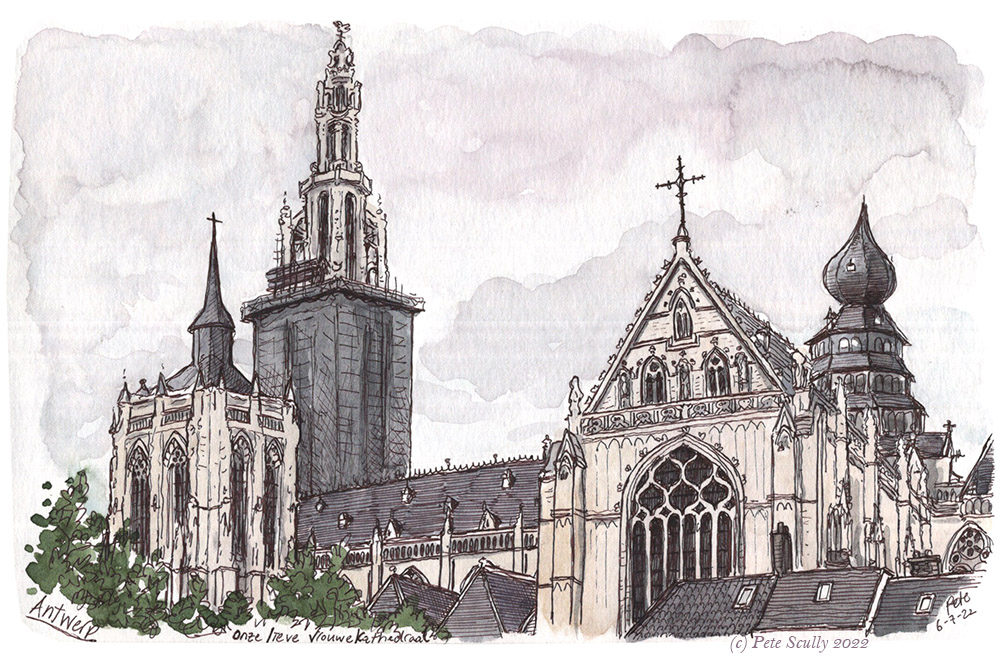
This is the Onze Lieve Vrouwe Kathedraal, in the heart of Antwerp. As well as fire hydrants, and crosswalk signs, I am obsessed with drawing cathedrals, though one subject generally takes a lot longer than the other. I drew this one looking upwards from a standing spot, all the benches in that particular square having been taken, and those clouds were pretty ominous. I did about 75% of it and finished the rest later when I was sitting down not craning my neck. The hours of the day were moving along quicker than those clouds, and I wanted to go and sit inside somewhere before getting the train back to Brussels, and have another hearty Belgian beer. I had a place in mind, but it would be a walk to get there. It took a while, but I beat the incoming rainstorm by bare minutes.

VTDF #4: Amiens

04 Amiens

Stage 4 of the Virtual Tour de France finds us in the northern city of AMIENS, on the river (and department) Somme. It is difficult to say the name ‘Somme’ without thinking of the historic atrocity of the 1916 Battle of the Somme, in World War I. Three million soldiers fought in that battle, with over a million wounded or killed. Amiens is right in the heart of World War 1 country, and itself saw a 1918 battle that ended in an Allied victory. World War II didn’t exactly pass it by either, with another Battle of Amiens in 1940 when Germany took the town, and later on pretty heavy bombardment by the Allies in 1944 before it was liberated. There were wars and sieges and sackings here in the many centuries before, but Amiens and the Somme are inescapably linked with the awful World Wars.

This is a nice view though, down by the river, looking up at the cathedral. I could imagine coming here and eating lunch by the Somme, before driving on to another town for a bit more history. I found out recently that an ancestor of mine from Dublin fought in World War 1 and was wounded in a gas attack at Loos, not far from Lens. I saw my great-great grandfather’s photo (his name was James Higgins, as was his father, and his son who I think also fought in that war?) and he had the most amazing bushy “General Melchett” moustache. He wasn’t a general though, just a regular soldier. I also saw a postcard he sent home to his wife (my great-great granny) in Dublin from Loos before the battle took place. Fascinating stuff, I never knew he even existed until recently. I never inherited the moustache. It was a big handlebar one with two pointy tails, that reminds me a bit of the Red Bull logo, or two rats fighting. I would not know how to take care of an amazing moustache like that, I would probably get it in my soup, this is why I shave. I only briefly had a moustache, though it was part of a goatee, and that was for a few months in the 90s and that my friend is where for most people goatees should have stayed. Funnily enough I never saw anyone in France with that classic French moustache, the one with the twirly sides, that all cartoon French people have (along with the beret and the onions and the baguette), but I have seen many hipster people in America wear that ‘tache. I couldn’t pull it off.

There does appear what looks like a lifesize Subbuteo figure standing in the river, to the left there. I think it is called “L’Homme sur sa bouée” (“The man on his buoy”). It seems that it’s common for the people of the town to dress him up, put t-shirts on him and so on. He is the work of German sculptor Stephan Balkenhol and was originally installed there in 1993, but being made of wood and manhandled by so many locals it degraded a fair bit over the years and was replaced in 2019 by the artist, this time in aluminium. Or maybe it is still wood but now painted in aluminium, it’s hard to tell. L’Homme sur sa bouée has become a bit of local celebrity in Amiens. There are two other similar statues by the same artist placed nearby against the walls of buildings that the man in the river is looking at. If I ever got to Amiens I will look out for them all. 

After Amiens we leave Picardy behind and head into another part of France famous for its role in World War II: Normandy. So join me on the Road to Rouen. 

Dublin part 1: This Is Your Liffey

Dublin GPO sm
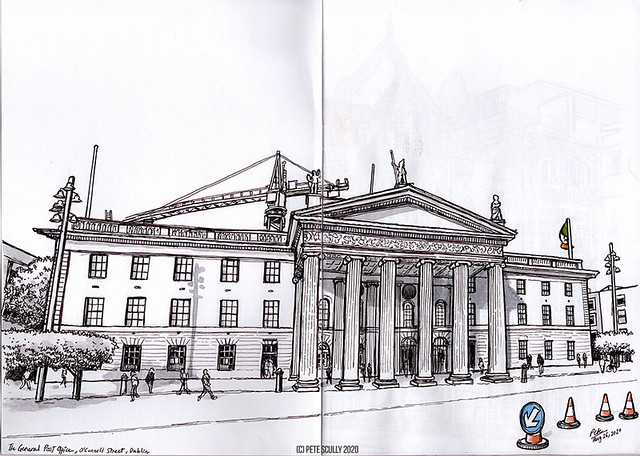
Earlier this year during the first months of the pandemic, Sheltering-In-Place, I decided that since there was no travel back to Britain this year I would do a virtual tour of the island, and that was a fun and enlightening journey. I wanted to do another virtual tour, maybe of France, but the thought of it overwhelmed me a bit (the planning, fitting all the places into a certain number of pages, and pretty much everywhere in France is sketchworthy) so I picked up a much thinner sketchbook a mate gave me last year from Dublin and decided to do a shorter virtual tour around Ireland. This quickly became limited to just Dublin (there are only fifteen spreads in the book) as the paper was very thin, too thin for watercolour, and I knew I’d need to add a bit more paint to the Irish countryside. Well, mostly green, and probably grey for the sky. But a trip around Dublin, well that sounded pretty grand. My mate who gave me the book was in the process of moving to Dublin while I drew this, so I was thinking of him at the time, but also of my own family history, most of whom came from Dublin, from my grandparents’ generation backwards (3 from Dublin, 1 from Belfast). I still have loads of family in Dublin, the vast majority I’ve never met or know anything about, except for my great aunt and a couple of my mum’s cousins I met when I was a kid. I only just recently learned about the family beyond my nan’s generation, when my sister dug a bit further, finding out some very interesting things about great-great-grandfathers with big General Melchett moustaches. Nothing too exciting, just regular Dubliners going back years. We just didn’t really know much though, people didn’t talk about the past. It was a fun bit of discovery, but Anyway, let’s start this Dublin journey off with that most important of Dublin buildings, above: the GPO, or General Post Office, on O’Connell Street. The first time I came to Dublin in 1988 this was one of the first places we came to (right before going to eat at Beshoffs, which I’ll never forget because I poured sugar all over my chips and got upset). I knew about the 1916 Easter Rising – hard not to, I was brought up on the rebel music – and this was the epicentre, the headquarters of the rebellion it was here that Pádraic Pearse read out the Proclamation of the Irish Republic. So, a good place to start, but we had a lot of city to cover, in no particular direction. So let’s set off around Baile Átha Cliath.

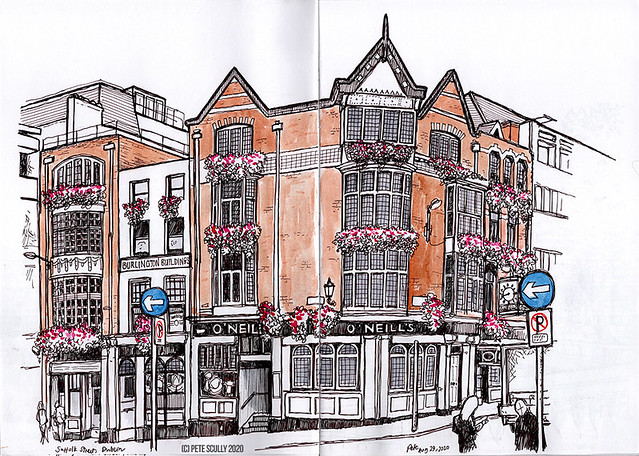
Dublin O'Neills sm We move down across the Liffey to the corner of Suffolk Street, Church Street and St.Andrew’s Street, to the huge O’Neill’s pub. I’ve never been here but I like the look of the building. This was the page that convinced me I wouldn’t be adding paint to any other pages (though I gave it a go one more time). You’ve got to draw pubs in Dublin. If I should come back I’d mostly be doing that. In fact I’d go when it is most likely to rain so I’d have an excuse to go to more pubs. I hear the rainy season is shorter than people say though, it’s only from August to July. (I got no problem recycling jokes from my London tour bus days, feel free to use that for whatever city, Manchester, Portland, Brussels). This one is near the Molly Mallone statue. Molly Mallone wheeled a wheelbarrow through streets of all different widths selling coppers with muscles from Hawaii Five-O. 

Dublin Four Courts sm Here is the river Liffey, with the Four Courts along the north bank. The river isn’t green, it just appears like that in with the trees reflected in it. It’s not been dyed like that one in Chicago does on St.Patrick’s Day (is it Chicago, I don’t know, or care). Also, it’s just green paint on thin paper. The Liffey (An Life in Irish) flows from the Wicklow Mountains, curves around a bit and ends up in Dublin Bay. Dublin is centred on the Liffey and has some lovely bridges, the most famous being the Ha’penny Bridge, the iron footbridge which I did not bother drawing because it’s difficult and I couldn’t be bothered. I’ll draw it in person maybe if I go there unless it’s raining in which case I shall be in the pub drawing people playing bodhrans. Last time we were in Dublin my wife twisted her ankle on it. The bridge you can see is called the O’Donovan Rossa Bridge which is from the 18th century. I remember a fountain/statue that used to be on O’Connell Street called the Anna Livia which represented the female embodiment of the River Liffey, my great-aunt told me they called it the Floozie in the Jacuzzi. It’s moved somewhere else now. 

Dublin Christchurch sm And this is Christ Church Cathedral. We stayed in an apart-hotel near here last time we were in Dublin, six years ago, and went to the Dublinia exhibit located in the big section to the left. That was a lot of fun, learning about Dublin’s Viking history in particular. There’s a lot of Viking in Irish history, my great-uncle Albert Scully used to tell me that the Scullys had Viking origins, but I don’t think he really knew, but it would explain why I read so much Hagar The Horrible when I was a kid I guess. I did love Hagar. Sorry, Hägar. And Helga, and Hamlet, and Lucky Eddie. They did that advert for Skol on TV where they’re all singing Skol-Skol-Skol-Skol but Lucky Eddie doesn’t know the words. That might be where the Scully name really comes from, people singing Skol-Skol-Skol. Skol is actually from the Danish for Cheers, skål, though in fact the beer originated in Scotland. This is really off topic now. By the way I am aware that ‘Scully’ bears zero relation to ‘Skol’ but it doesn’t stop Americans mispronouncing my name to sound like Skol, or mis-spelling my name with a k despite seeing my name spelled with a c literally all the time. It comes from “O Scolaidhe” meaning “scholar”, and like so many Irish names has one of those nice little shields you can get on keyrings in gift shops all over Ireland. My family names are pretty common Irish names: Scully, Higgins, O’Donnell, McIlwaine (that’s the branch from Belfast), plus there’s Barrys and Kennedys and Crokes and Byrnes and more in my siblings and cousins families, plus who knows what. I do remember going to Rock of Cashel (the ancient seat of the Kings of Ireland) when I was 12 and being stunned to find so many graves bearing the name of Scully, along with the big Scully Cross, which is more of a pillar these days, because the top of it was blasted off when struck by lightning in the year of my birth. Moral: don’t make a Scully cross?

Join me next time for part two of my virtual Dublin tour, when we visit another pub, a publisher, a campus, and I dunno, another pub.  

(52) Scarborough, (53) Whitby, and (54) Durham)

GB 52-54 sm

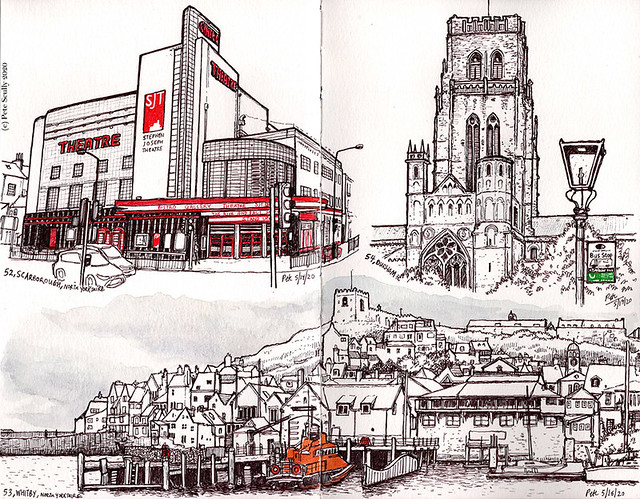
Right, let’s go into the North Riding, and along the North Sea coast. First up is Scarborough. I have been to Scarborough a number of times, on a long six hour bus journey from London (passing through York, Stamford Bridge, Driffield, Bridlignton, and Filey). Scarborough is a popular seaside town with a big old hotel, a castle, two beaches, a vibrant town centre, and great views from the cliffs (which famously eroded dropping another hotel into the sea years ago). I used to go out with someone who spent some time studying here over two decades ago, but I also considered coming to study drama here as well, having previously worked at Asda with someone who did the same. It’s a big town for drama, and lots of well known drama people have lived here. Sir Alan Ayckbourn, the great playwright, was the artistic director here at the Stephen Joseph Theatre for a long time. This theatre, named after its founder, was the first ‘theatre-in-the-round’ in England. I do like a theatre-in-the-round (though my favourite one was, er, White Hart Lane). Other entertainment people involved with Scarborough, well, Winner (ugh) made one film here and then there’s Saville (massive ugh), he lived here too, I remember seeing his house. This was back in the late 90s and people there would still say, yeah he’s a right creep. They weren’t wrong. I do like Scarborough though, and I wish I had been sketching loads back then, because it’s a classic sketchable coastal town, but I wasn’t. I recall during the daytime when I’d be by myself walking about the coastline and learning lines for whatever play I was doing at university at the time (usually something in German), and listening to David Devant. The wind coming in off the coast can really drive through you though, so it’s nice to reach the chip shop and get some delicious chips in gravy. Scarborough was the subject of a song called “Scarborough Fair”, which goes something like “Are you going to Scarborough Fair, they have the Big Wheel and the Twister and the Waltzers there, You can get candy floss stuck in your hair, And with an air gun you can win a teddy bear.” It’s an old folk song. Anne Brontë is buried in Scarborough. The Brontës were from Yorkshire and wrote books, though I have not read them. I think they are about dinosaurs but they might not be. One of them has a character called “Heathcliff” which let’s face it is what happens when you can’t think of a name and you just look around, there’s the heath, oh there’s a cliff, that’ll do. Other characters are Doorwall, Tablechair and Fieldpond. I haven’t read the books so I might not be completely accurate there.

As you go up the coast there is a nice little town called Robin Hood’s Bay, though I didn’t draw it on this virtual trip. I remember eating some delicious scampi there. Robin Hood may well have come here for scampi too, but the story goes that he beat up a bunch of French pirates here. I wonder how French pirates pronounced the Pirate word “Arrrr”? “Yeau-eau-eau, chevre mes timbres!” Ok that’s enough. On this trip I was headed straight for the town of Whitby, lots of peoples’ favourite spot on the northern coast. When I think of Whitby I think of the Synod of Whitby, where they determined the date of Easter many centuries ago. Nah, I think of Dracula. In Bram Stoker’s book Dracula, in which an ancient supernatural from Transylvania being spends a great deal of time trying to broker a property deal in London while turning into great wolf-like beast, a bat, and for some reason some mist. I mean, you do what you can to get the deal you want, who among us has not turned into mist when trying to get a bank loan. Anyway the vampire gets on a Russian ship with loads of boxes of mud and lands in Whitby, getting into all sorts of shenanigans up at the ruins of the Abbey, on top of that big cliff. Strange thing about vampires, not being allowed to cross running water and not being able to come inside without an invitation. Whitby has a beautiful harbour, I can imagine being here on a cold October evening as the rain is blowing in, heading into a warm pub, eating some delicious fish and writing ghost stories in a journal. With everybody else there doing the same. The town is probably full of goths looking for vampire stories, which is fine too. In fact when I was at school I actually wrote and performed an eight-song musical for the drama part of my expressive arts class called “Dracula AD 1992”. That one took place in Essex at the ‘Alucard Motel’. Anyway, I enjoyed drawing Whitby and look forward to some day going and drawing the real thing. I’ll bring a cape, and maybe an umbrella and a wooden stake.

I remember a joke someone told me when I was a kid. Where does the Pink Panther live? Durham, Durham, Durham Durham Durham Durham Durhaaaam… I think you have to do the Pink Panther music in your head to get it, and to know where Durham is (or that it exists) which when I was a kid, I didn’t. In fact I thought it was in Ireland, because people say “County Durham”, and you only say that for counties in Ireland, like County Wicklow or County Clare, you don’t say for example “County Suffolk” or “County Leicestershire”.  Anyway I never thought the joke was funny (it’s certainly no dead parrot polygon joke), and it’s filed away with the one about Batman being told it’s dinner time. So, time to visit Durham. Durham has one of the most dramatic cathedrals in the country, high up on a hill overlooking the river Wear that curves like a race-track around the historic town centre. I’ve wanted to go and draw that ever since I studied Anglo-Saxon literature and we did the poem about Durham. This actual cathedral building came later than that poem but the words were still very illustrative. This was St Cuthbert’s city. We are very much in old Northumbria now, far away from the southern kingdoms of Wessex and Kent. Northumbria was an important kingdom in the Anglo-Saxon times, with centres of great learning and scholarly activities, most notably at Lindisfarne with our man Bede. Despite sounding like one of the “softies” from the Beano, Cuthbert was one of the most important monastic figures in northern Britain in the Early Middle Ages and is considered the patron saint of Northumbria. A couple of centuries after his death, his relics were brought from his original burial site at Lindisfarne where he was Bishop to find a new spot (there was a cow involved apparently) on a perch overlooking the Wear, and that’s where Durham and its cathedral were founded. The cathedral building that is there now dates back to the end of the 11th century and the time of William the Conqueror, who we have met a couple of times on this story already (beating Harry at Hastings and chasing Hereward the Woke out of Ely). William was a bastard (he was called William the Bastard before the Conqueror URL became available) and especially in the north, where he undertook the Harrying of the North, though we should have called it the Williaming of the North since Harry had been beaten in 1066; bloody leaders blaming and naming their own actions on their predecessors, good job we don’t have leaders like that now eh. But the legacy of cathedrals like this is quite a tick on the plus side, because it is really gorgeous. I would love to do a cathedral tour of England, fill an entire sketchbook, bigger size, with cathedral drawings.

Next up, we are reaching the top of England, and heading into the other great cities of the North-East: Newcastle and Sunderland. I’m starting to get dizzy.

(44) Chester, and (45) Liverpool

GB 44-45 sm
Continuing the virtual tour through North-West England now, with one place I’ve never been to, and another place I have not been too in a really long time. As I wind my way through England I am going through the emotions that I went through when I drew all of this. Now at this stage in the virtual journey, in the real world the living-room flood had happened and I’d relocated upstairs; I only just moved my desk downstairs again, much to the annoyance of my cat Whiskers who has gotten very comfortable spending his afternoons on the downstairs desk chair. Now he tries to push me off at around 2pm so he can get his usual nap in. In the virtual world, I was still passing through each virtual street, with so many places “temporarily closed”, the image of a country in limbo. My relationship with England waxes and wanes in my absence, as it did when I lived there, some days I just think nope, place drives me nuts, other days I miss it terribly, even missing places I have never stepped foot. Often I just miss the Cadbury’s chocolate and the Jaffa Cakes, and silly things like the meal deal sandwiches at Tesco Metro. I don’t know, it makes me feel sad sometimes, especially during this whole thing. Anyway.

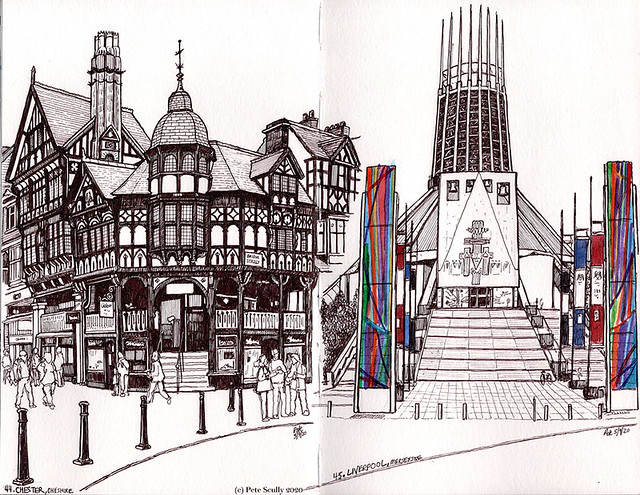
So, first stop on this spread is the city of Chester, in Cheshire. This might be my favourite drawing in the whole damn book. I love nothing more than drawing timber-framed buildings, and the whole of downtown Chester (“downtown”, I’m so American now, I’m going to forget what a Jaffa Cake is) is filled with this sort of architecture. I should draw a whole book just of timber-framed buildings. I am sure there must be lots of sketchers in Chester, busy drawing these all the time, but if they aren’t called “Chester Drawers” I’d be really disappointed. While there are medieval buildings in Chester, most of these ones such as this are from the 19th Century’s “Black and White Revival”; this one was built by one of its great proponents, T. M. Lockwood. I bet his friends called him “Trademark”. I don’t know much else about Chester, except that it has a zoo, and that I think my nan lived there years ago before she lived in London, I remember my mum telling me (I might not have been listening, for all I know she was telling me about her chest of drawers). It’s funny visiting places where ancestors lived (even if it was only for a short time and might actually have been me mishearing a story about a chest of drawers). Chester is actually Roman though, the imperial city of “Deva”. On AA road maps in the UK (at least ones I used to read) the Roman name of the city would be listed underneath the modern name on a map, usually in small caps. While it is interesting for someone like me to know that Chester was once DEVA, York was once EBORACUM, St. Alban’s was once VERULAMIUM, I’m not sure why it’s important to the motorist trying to find their way from the A41. Unless the AA are expecting the Romans to return someday.

Speaking of the AA, the next stop is Liverpool. That is a reference to the joke, who do you call when your car breaks down in Liverpool? The “AA, Calm Down”.  That is a reference to a Harry Enfield sketch about Scousers, which itself was a parody of characters from Liverpool-based soap Brookside, which I’m not ashamed to say was one of my favourite shows years ago. The Liverpool accent is probably my favourite English accent, much better than my own one. Years ago when I spent a year in Provence I directed a university play, an adaptation of The Lion, The Witch and The Wardrobe, and my flatmate Emma who is from Liverpool played one of the “Scouse Squirrels”. Every time a Davis squirrel gets all aggressive with me on campus now I hear the Scouse Squirrels voice in my head. Liverpool is most famous for the Beatles, who I love, and also loads of old comedians like Jimmy Tarbuck, and of course Cilla Black, singer and beloved TV presenter. I visited Liverpool a couple of times when Iw as a kid, while we holidayed in nearby Southport, the last time being back in 1989. That was a long time ago! At that time, local football teams Liverpool and Everton were trading league titles (although in that year Arsenal won it, though Liverpool got the FA Cup; it was also the year of Hillsborough). We did all the tourist stuff, went to the Beatles museum (I remember getting a cool Beatles badge that I actually gave to a girl a few years later), took a ferry across the Mersey, went to the Albert Dock and saw the floating weather map from This Morning (although I’ve since heard about the weather man from that map; ughhh, glad he’s in jail), and visited one of Liverpool’s TWO cathedrals. We didn’t go to the big Anglican cathedral, which was designed by Giles Gilbert Scott (he of the phone box, Waterloo Bridge and Bankside Power Station, aka Tate Modern); shame as that one is massive; we could see it across the city. But probably because my mum had become a Catholic in the 80s we went to Liverpool Metropolitan Cathedral, the modern triangular spikey looking building which I actually thought was totally brilliant. I really like this odd looking church, built in the 1960s, because on the inside the colourful light is beautiful. It reminds me of the Jedi Temple. Liverpool has a very Irish heritage; it’s not surprising given how close it is, but this was where a lot of Irish immigrants landed in the 19ths century during the Famine, many settling and many leaving Liverpool on a big boat to America. Lots of the Irish songs I learned as a kid were about this very thing. I never expected I would end up in America myself. Actually the reason we would come to Liverpool is because, as I mentioned, we were holidaying in Southport at the Pontins resort, which hosted an annual Irish Festival in the 1980s, so we always had a lot of traditional Irish music on in our house. I’d like to come back to Liverpool, come sketching, maybe visit my old flatmate Emma, not seen her in nearly two decades. I expect it has changed a lot since 1989. The football team just became league champions for the first time since 1990. There aren’t as many Beatles any more, but a lot more Beatles monuments. I assume there is still a ferry across the Mersey, though I expect people take hoverboards or flying cars now or something (in 1989 I imagined they would be by 2020). Mostly I would come just to hear the accent.

Next up, we turn north up to Blackpool, before taking in some Lancashire countryside and crossing the Pennines into Yorkshire. We’re right up north now.

(39) Lincoln, (40) Nottingham), and (41) Sheffield

GB 39-41 sm
Onwards through great Britain we go. Last time out we were in Skegness, Lincolnshire, and that’s a big country so I decided to stick around. I really want to visit Lincoln some day, to draw the big cathedral. I would love to do a real tour of all of England’s cathedrals, but them into a big book. On this virtual trip however I couldn’t get a great view, but you can see it poking its head out from over that scaffolding in the panorama at the top of the spread. Lincoln of course is the name of one of the great American presidents, Honest Abe Lincoln, wearer of tall hats. The city does date back to the Romans, Lindum Colonia, though that grew from an older Iron Age settlement. The Cathedral was, believe it or not, the Tallest Building In The World for about 200 years in the Middle Ages, but the really tall spire that gave them that title fell down a long time ago and they never bothered putting it back.

Next up is Nottingham. I used to wonder a lot about Nottingham when I was a kid. Obviously I always associated it with Robin Hood, but I would read road maps of Britain before going to bed at night (and Europe too; I was really into travelling in my head) and Nottingham would pop out as a place that wasn’t far from all the other places in England. Now it makes me think of that film “This Is England”. So while virtually wandering Nottingham, I found a big old pub called “Rose of England” covered in England flags, so I decided to draw that. I needed somewhere with lots of England flags, since I drew a pub in Cardiff covered in Welsh flags. I never found a pub covered in Scotland flags, but ah well, maybe if Street View goes around Glasgow during the next football World Cup they’ll find some. Oh, ok, maybe not the World Cup, er, maybe the Rugby Six Nations. Anyway Nottingham is also the place where Brian Clough, one of the greatest football managers of all, worked as the gaffer of Nottingham Forest, leading them to two European Cups, one Football League Title, and a helluva lotta League Cups. I am a big fan of Cloughie and his funny ways, especially all the stories his former players would tell about him. but of course with Nottingham we have to think about one man only – the Sheriff of Nottingham. Oh, and Robin Hood. The Sheriff was played by one of my favourite actors of all time, Rickman. Rickman’s voice was perfect, nasal and dismissive. Anyway enough of Nottingham, time to move slightly further north into South Yorkshire, and to the Steel City.

Sheffield is big, and has an important history. This is where our knives and forks were made, the steel industry here being world-famous. In sporting terms, the oldest professional club is Sheffield FC, while the two other bigger clubs have a long history in the game, Sheffield Wednesday and Sheffield United (who are the “Blades”). I used to watch the Snooker World Championships every May on TV which take place at the Crucible in Sheffield. One of my favourite bands, Pulp, are famous Sheffielders, as is the singer’s namesake Joe Cocker. There’s something intrinsically normal and unpretentious about Sheffield, and I’d like to walk about its neighbourhoods one day with a sketchbook. I drew the quite modern looking Winter Gardens entrance on my virtual tour. But despite all of this, whenever I think of Sheffield, I get flashbacks of nightmares I had for years because of one TV miniseries that came out in 1984: “Threads”. If you haven’t heard of Threads, it was a dramatization of a nuclear attack seen through the eyes of local people in Sheffield. It was so realistic, it scared the absolute living bejeezus out of me. The woman peeing herself in the street. The white flash melting milkbottles and people. I was only eight and the Cold War was very much a thing and something I worried about a lot, I had that book “When The Wind Blows” and I remember “Protect and Survive”, the government information advising us to paint the windows white and take the doors off their hinges. So yeah, if I think of Sheffield I think of when it was blown away in Threads.

And on that bleak note, we will move into the Peak District and continue westwards on the virtual Great Britain tour, and take our minds off of fictitious 1980s nuclear wars that still wake me up in the night.