On my brief trip back to England I went to Barnstaple in north Devon, with my mum and sister to see my uncle Billy and his family. It had been a long time since I was in Devon; my 16 year old cousin Jade was still a newborn, which gives you an idea how long ago it was. I did go for a little walk on the Saturday afternoon to do a couple of sketches (also to have some amazing chips in gravy, so tasty). I stood at the busy intersection near the bridge over the wide river Taw and drew the scene above, the Barnstaple Museum, with the clock tower outside. Barnstaple is quite a busy town, and has a pretty bustling town centre on a Saturday afternoon. I have to say, coming from California, and coming from a suburb in north London, it was nice being in a town which has all the shops. Our hotel was right opposite a great toy shop too, they had a lot of Lego, as well as loads of model railways. As I say, it has been a long time since I was in Devon, and one of the things I love about the southwest are the hills in the background. I remember going camping in Devon when I was 16, and the scenery just brings me back. The English countryside really is beautiful. I’ve never really spent a lot of time in the country and the smaller towns and cities, always being in London; I’d love to tour the UK with a sketchbook like that Richard Bell book my cousin Dawn got me a few years ago), but living our here I’ll never get time. You can see the hilly backdrop behind the building below as well, I forget the name of that building (if only there was a way I could instantly look that up on the device I am typing this), but also visible is the Long Bridge over the Taw. I got up very early in the mornings to walk around town and along the river, cold damp February mornings. In those early mornings, you still had a few local lads out from the night before, singing, slurring, bit of scrapping. It was actually raining when I drew the one below, and I had to stop when it started getting heavy. I like the colour of the stone they use for these old buildings down here. Barnstaple itself goes back to Anglo-Saxon times and there is an interesting mosaic near where I drew this, at Queen Anne’s Walk, showing the whole history of the place, vikings, pirates, traders and raiders.

Tag: england
the convent at the top of orange hill

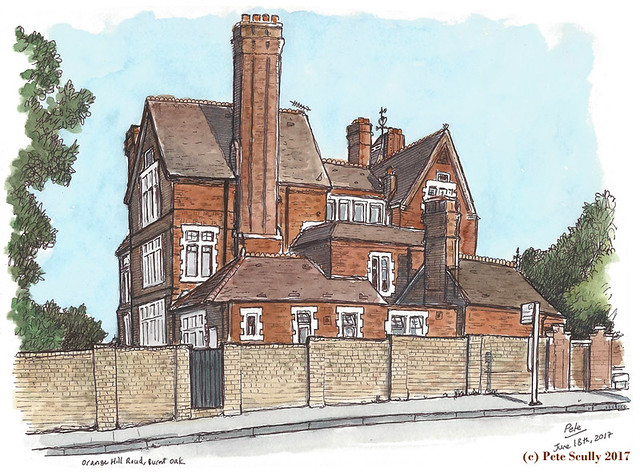
This is another very early morning sketch from back home in Burnt Oak. It was Father’s Day, and I was up super early so went out for a walk in the early morning June sunlight, when hardly anyone was around. The light was golden and heavy, rising beyond the Mill Hill end of Abbots Road, while I stopped at the Orange Hill end and drew one of the more impressive local buildings, the old Orange Hill Convent. Look at that chimney! That is a serious chimney. I remember the nuns, coming up and down to Burnt Oak, and I was told I had to greet them with a “Hello Sister” (not “Hello Nun” as I had been doing up to that point). Many years ago this was next to St.James’s School, the local Catholic school that I never went to (what with not being a Catholic), but would have been handy (being only two minutes from home; my actual school Edgware was a much further walk, and I did it daily – and slowly, as my old teachers will attest). My younger sister did go there, but only after it had relocated to Grahame Park. I remember friends of my older sister though who did go the St. James’s (my older sister by the way went to Orange Hill, just around the corner, which is also no longer there), they used to talk about St.James’s purely in terms of their terror at the nuns next door, Oh the nuns, so strict, the nuns! Which I never believed, having only met the nice sweet nuns going up and down the street, and saying “Hello Sister” to them, and they would say “oh hello young man” back. But then, I wasn’t a Catholic. Pupils at St. James’s wore uniforms of two different colours – black and grey for the boys, green and yellow for the girls. It’s funny living in the US now and high school kids not wearing uniforms. We could always tell where kids were from by their uniforms (which was exactly the point, I think, for when kids from different schools got into trouble, as was not uncommon – trashing a McDonalds, running rampage on a bus, throwing things (or people) into people’s gardens – then the head of that school could be contacted and the boys or girls would get into trouble and very pointed words would be had at the school assembly next day. Yeah this happened a lot at Edgware (not by me of course). Our uniforms were blue, white and maroon. Our rivals at Mill Hill Country High had similar uniforms but had cherry red instead of maroon. There was one Catholic girls school who were kitted out all in purple, in Finchley if I recall, and were nicknamed locally “the Purple Virgins”. Not by me, of course. I always loved how tall and imposing this building was, on those dark early evenings when the rain was lashing down it would appear like a haunted mansion out of the gloom. I do remember as a kid though, my friends and I would go to the field behind it, next to the Watling Community Centre, to get conkers from the big horse chestnut tree. We’d look around for those big green spiky balls, peeling them open to find a huge shiny conker inside. Now I know this sounds like something that mawkish sentimentalists will post on groups on Facebook, oh remember when all we had was conkers, not like now where it’s all video games and obesity and violent crime (you know, the sort of Facebook post with a comment thread that quickly turns xenophobic, regardless of the original subject), but this is in fact true, we did go and get conkers from a big tree just behind the convent. I was a pretty innocent kid, it has to be said. It was all football stickers and conkers. And video games to be fair, my brother and I spent a lot of time playing Donkey Kong. I did go to karate class a couple of times in the building next to this, but I gave it up because there was another boy from my school, who I think fancied himself as a bully, in the karate class one time when I was 11 or 12 and he just spent the entire time laughing at me from behind and making disparaging comments. He then followed me down Orange Hill trying to talk to me, not in a particularly menacing way, but I didn’t want to talk to him, and I knew that next day at school he would basically have all his cronies humiliate me for attempting to do karate. So I never went back, which was a bit of a shame. Kids eh. I would probably have been rubbish at karate anyway, but I do think of that when I see that wall in front of the convent. Here I go again, memory lane. Well the school building is gone, replaced by houses and flats, I don’t know if the chestnut tree is still there but I doubt kids are picking its conkers, in these days of violent obese video crime games, and it’s probably too late for me to go back and try my luck at karate now, but the outline of this old Convent still stands out at the top of the hill like always. And finally, I sketched it!
early morning back yard sketches
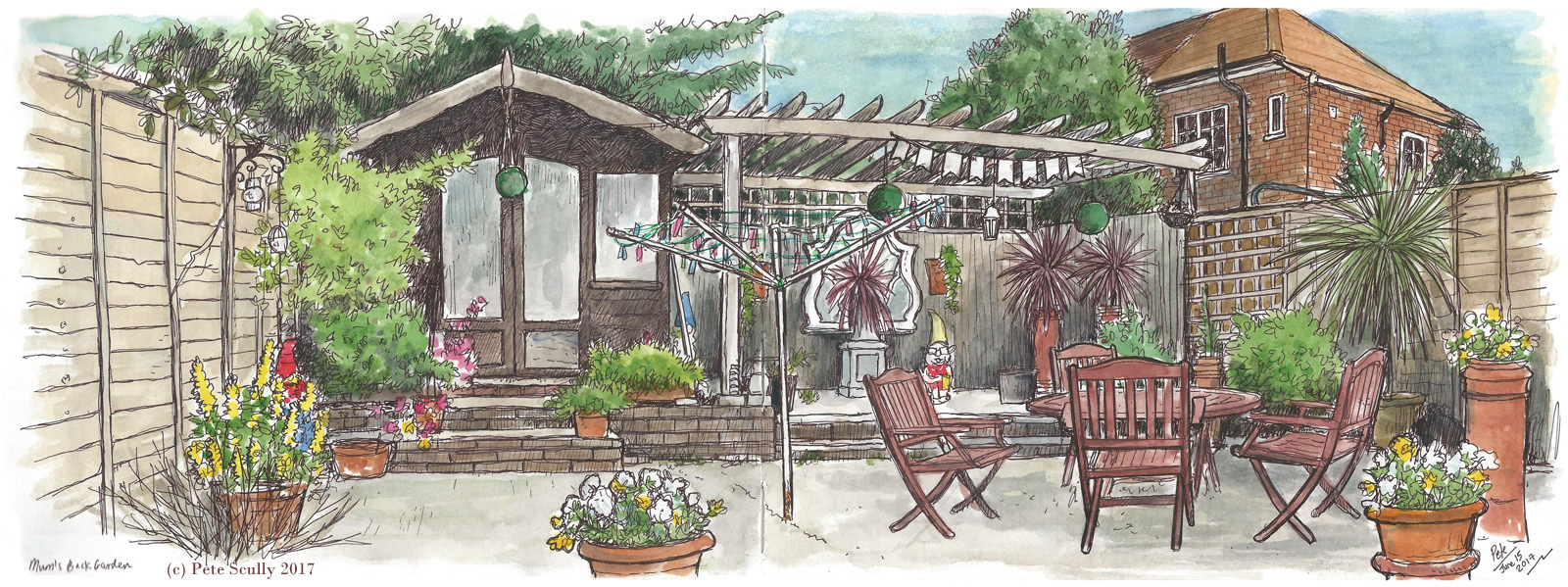
Travelling through hyperspace ain’t like dusting crops. Nor is travelling across the Atlantic. So no matter how late I stay up on the arrival day, when I am a little delirious and over-exhausted from the long overnight flight, especially one delayed by over 3 hours sat on the runway at Oakland, no matter how tired I am, I’ll still wake up at like 2am and find it impossible to return to the land of the sleeping. Also the sun comes up super early in Britain in the summer, and those birds in the Norwich Walk trees do love an early morning sing-song. When I was a kid I’d stay up all night and wait for that early dawn light, those early songbirds, and sometimes I would go for a run, enjoying the world when no people were about. Well these days I’m more likely to draw the world at that time, and so I sat in my mum’s kitchen and drew the back yard. The sky’s a funny colour but it really was a bit like that. I listened to podcasts about football, language, British history and Thor (“The Lightning and the Storm”, all about Walt Simonson’s epic run on the Thor comic, look it up, it’s a great podcast) until it was time for people to wake up and have breakfast. I always love that first morning back home. I’ve lived a quarter of my life in America now, but this to me will always be home. Click on the image for a closer view. When I showed my mum the first thing she said, “oh no you drew my washing line, I should have taken it down!” Whereas I as the urban sketcher, that is the first thing I drew, it’s to me the most interesting thing to draw. “At least you didn’t draw that old bucket,” she said. “Whaaa? I forgot the old bucket! No!!!” I totally would have drawn the bucket too, if I had space on the page, but it was just “off-screen”. I did draw the gnomes though, and I don’t really like those.
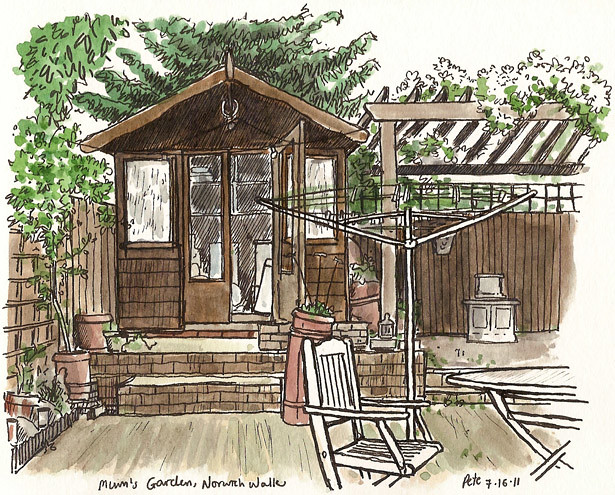
Here are a couple of other early-morning sketches of my mum’s back garden from previous visits back home, the top one being in 2011, the bottom one being 2007. Both feature the washing line. The bottom one (from ten years ago!) is a little sad to me now, as it shows my old tortoise, Tatty, who we had since I was about 6 or 7, but sadly died since that sketch.
war! what is it good for? (absolutely sketching)

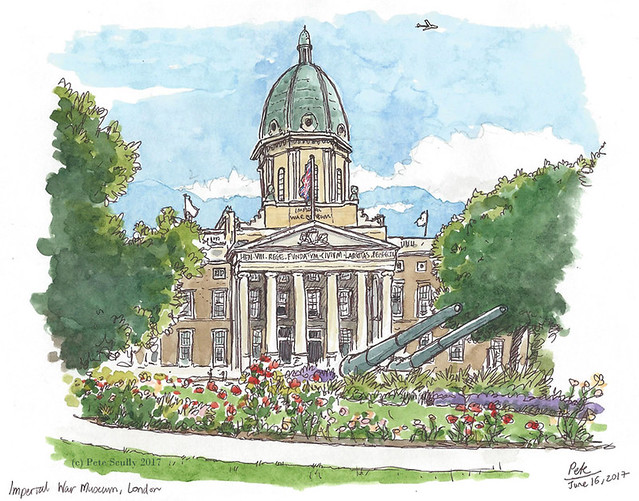
Last month we went back over to London for a few days ahead of our week in Italy, spending time with family and seeing friends. The London visits are more frequent than they used to be, but always seem shorter, never enough time to see everyone we want to see, go everywhere we want to go. We always pack a lot in though, and this time wanted to see some places we’d never been to. One of those was the Imperial War Museum. It’s in Lambeth, and had never appealed that much to me for some reason (because I’m a pacifist peacenik?) which is crazy because I love history, I love seeing old planes and tanks and uniforms and armoury, and I love old London buildings such as this one, which has an interesting history as the old Bethlem psychiatric hospital – aka ‘Bedlam’ (not the original Bedlam location mind you but still, interestingly historical). The grounds are lovely, and there were a lot of people out sketching as well which is always nice to see. I drew the scene above while my family were resting in the cafe.

I didn’t do a ton of sketching in there – there is a lot to see, and my son was getting tired (World War I was a lot to take in!) but I did draw this Sopwith 2F.1 Camel. The Sopwith Camel was one of the most iconic early fighter planes for the Allies in World War I. Just imagine Lord Flashheart whizzing around in one of these before landing sausage-side and shouting “woof” a lot. (I really miss Rik Mayall!) I didn’t get much further than World War II, so I would like to go back there some day with the sketchbook. Definitely worth a visit. After this, we walked the short distance to the South Bank and along the Thames.
Mancunian Street Sketchers

Two weeks ago, I attended the 7th Urban Sketching Symposium in Manchester, in the north of England. I went as a “Workshop Pass Holder”, which is the full access pass, though of course there are so many workshops and activities there is really only time to do a few, but I certainly packed a lot in. I had never been to Manchester before, and had no idea what to expect. It was pretty awesome actually, lots of sketchable buildings, lots of old pubs, and yes, it rained almost every day. Well you’re not doing Manchester properly if you don’t get rained on a bit.
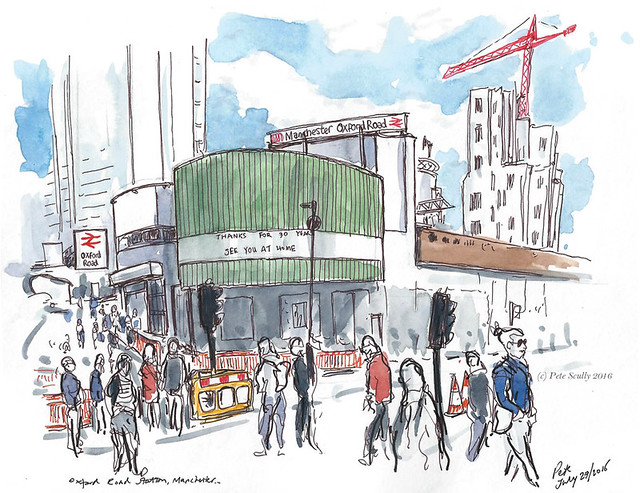
When I first arrived, I checked into my apartment at the Atrium on Princess Street, did a bit of shopping at Sainsburys Local,and then sketched the magnificent Palace Hotel, above. I had intended on colouring it in but when I was finally done, I preferred it like this. Also, I needed to go and check in at the Symposium venue, the Manchester School of Art. I enjoyed sketching this; I stood beside a group of Jehovah’s Witnesses and I chatted to one of them, a nice chap who told me about his passion for photography, but that he hadn’t done any drawing in quite a while. I told him that Manchester was about to be flooded with hundreds of people out drawing the streets, sketchers from all over the world. As yet I had not seen a single one, but as I thought about that, I bumped into Vincent Desplanche, a prolific French sketcher who I met last year in Strasbourg. I stood with him and sketched the Oxford Road station and this curving picture house on the corner of the street. I was moved by the words on the sign which read, “Thanks for 30 years…see you at home.” To see old cinemas closing down like this, beloved old buildings falling into disuse by the swift steely march of modern times, and with that big crane in the background, and the touching, sad sentiment of “see you at home” obviously being some reference to the fact people don’t go and watch films any more, they stream them all nowadays, sitting on their armchairs and microwaving popcorn, where is the community, where is the shared cultural experience, oh then someone pointed out to me that “home” meant “HOME”, not “home”. “HOME” is a big new arts, theatre and film complex just down the street, and I guess the cinema was just moving there. Well. Now I know. So much for my poignant image, people streaming by on their way “home”.
Here is a map I added to my sketchbook. I will be documenting my time at the Symposium in a less ‘chronological’ and more ‘themed’ type of way, with a post for each of the workshops I attended, including what I learnt and a bit about the instructor, as well as the social gatherings, sketches of pubs, and other miscellany. I will probably post these all over the next week or so, but will also be posting current sketches as well. Oh, and the football season is about to begin so expect some new football kit posts too. I’ll also do a couple of posts about the exciting upcoming projects coming from me this Fall. I will also ramble on about some nonsense you don’t care about, make a few terrible puns, and explain why proper north-of-England chips in gravy is the best food ever.

the end of the railway

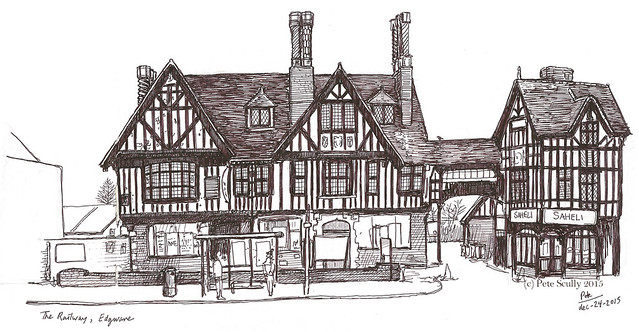
This is – or was – the Railway in Edgware, north London. For those of you unfamiliar with where Edgware is, look at the tube map, and look up at the top, it’s there at the end of the Northern Line. No, not that end, that’s High Barnet, the other end. There we are, just past Burnt Oak. I was born in Edgware Hospital (which is more Burnt Oak), and went to Edgware School, both my sisters have lived in Edgware at some point (one in an actual haunted flat), and it’s where we go when we go shopping in real shops, or at least used to. Edgware was that place which was a bit more upmarket than Burnt Oak, I always looked up to it. Again, that was the tube map, you had to look up to see it. I used to walk to school, down Deansbrook, through the alley into Fairfield, through the other back alley into Station Road, right next to this building here, the Railway. It looked like something from the Middle Ages (it was built in 1936 in neo-Tudor style, I was clearly a history idiot) (I wasn’t by the way, I was actually really good at history) (and I never ever thought this was medieval, and would have probably laughed at anyone who said it looked like it) (I wasn’t very good at history A-level though, it was all ‘the nazis’ and ‘the 1848 revolution’ and that sort of thing, I struggled with the reading, actually I know for a fact my Edgware School history teachers thought I was a ‘history idiot’ and they pointed it out) (in the end I got a Masters degree from King’s in Medieval English and you can’t do that if you’re a history idiot). So, this is a neo-Tudor building. “Neo-Tudor?” Sounds like a Stuart-era political thug. I read this description of this building somewhere but I think it’s more mock-Tudor. (History idiot) So…this is a Mock Tudor building, and was once a great pub called the Railway Tavern. No wait, it was the Railway Hotel, not the Railway Tavern (that was up Hale Lane I think? History idiot). Let’s start again.
The Railway Hotel was built in 1936 and is not, I repeat not a Listed Building. My source of this information comes from random local people telling me that back home, and they are never wrong about such things. The side part of it apparently is Listed, but the main part isn’t. I don’t know if it was ever an actual Hotel, and the Railway it refers to is really just the Tube line – back in the 30s Edgware was this glamourous place referred to as ‘Metro-land’, the new world opened up by the expansion of the London Underground. Big buildings such as this were built in the Mock-Tudor style in these burgeoning and now-connected suburbs almost as if to emphasize the ‘rural’ appeal of these now less than rural areas. Edgware itself goes back centuries (Middle Ages! Yes!) and is on the historic and vital Roman Road of Watling Street (actually called Edgware Road from here to central London; you’ve seen Edgware Road on the tube map, it is miles away). There are some genuinely historic buildings here, one around the corner being an old tavern that the famed highwayman Dick Turpin is rumoured to have stayed at. Right across the street from the Railway is St.Margaret’s Church, whose tower dates from the 15th century, with the building dating from the 18th century. And while it’s not particularly historic, George Michael’s dad used to own a restaurant a few doors down from here called Mr. Jack’s. The Railway Tavern may not be so old, but it is beloved locally. I remember the pub being a nice, warm place, friendlier than many other more raucous pubs nearby, with a lovely carvery restaurant upstairs. I remember going to that restaurant for my friend Terry’s 18th birthday, all those years ago. Some nice memories here.
I don’t remember when it actually closed. Was it before I left for America or after? I remember writing a blog post in 2006 on my first trip back from the States lamenting the passing of two of my favourite spots in Edgware, Music Stop the guitar shop and Loppylugs the record shop. I was sad that Edgware was changing so much, and it struck a chord, because somehow people from all over the world – well, from Edgware but living all over the world – were commenting with their memories of Edgware, of the school, of the old cinema and the record shops, that general old nostalgia thing we all do when we get online. You’ve seen it, the old nostalgia thing, you know what I’m talking about, “Like if you had one of these space hoppers”, “retweet if you remember what a flake in an ice cream is”, “share if you remember Daz Ultra” that sort of thing. The Railway must have been still open, or I would have mentioned that as well. It has been closed for some time now, with no chance of reopening. These days pubs close, and that is that. So many old pubs are falling by the wayside, not profitable in these modern times, once great centres of community (ah remember that, it was great when everyone was drunk, Retweet if you Like). Remember the Pub, the old Rub-a-Dub-Dub? All gawn now mate, all gawn and never comin’ back.
Who knows what will happen to the Railway. I’m sure someone does; I was old it would be knocked down to make way for a big block of flats. These statements are usually correct, but I’ve learned to proceed carefully (as they are often book-ended with statements like “too expensive for the locals, they’re going to give them free to all the asylum seekers,” a phrase I have actually heard said). The truth is that land is owned by someone, usually someone less concerned with building communities and more concerned with building profits. There was last year a pub in Kilburn, the Carlton Tavern, that was illegally demolished a week before it was due to be a listed building (knocked down with all the tenants’ possessions inside and against the orders of the council), because the landowners CLTX, a company based in Tel Aviv, wanted it out of the way. Well, didn’t Westminster Council only go and order CLTX to rebuild the Carlton Tavern brick by brick within the next 18 months! A victory for the old pubs, perhaps, but we’ll see if it happens. I intend to sketch the site some day, maybe on the next trip. I wonder if a hundred years ago the Edgware locals will probably have lamented the loss of all their lovely green space, demolished so that houses can be built, along with these ugly mock-Tudor pub buildings (“Mock-Tudor?” they would say, “Medieval more like!”). The world keeps on turning…
christmas in south ken

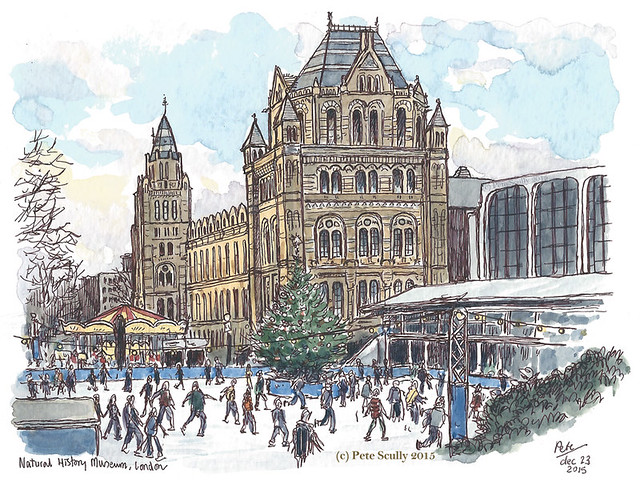
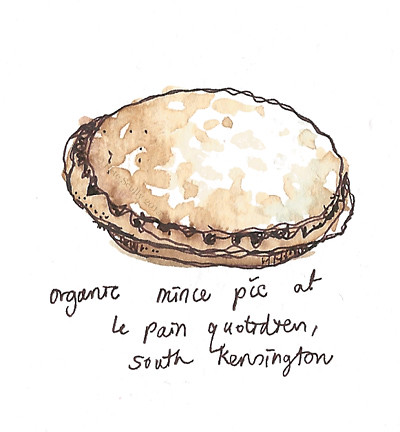
There are a few places in the world that are very special to me, and this is one of them – the Natural History Museum in South Kensington, London. I came here just before Christmas with my family to see the dinosaurs (Dippy the Diplodocus is still taking pride of place in the main hall, but will soon be replaced with a whale skeleton). I used to come here when I was a child to see the dinosaurs (Dippy was my favourite), when my older sister used to bring me here as a four-year-old so that I could argue with the staff about vertebrae (I never understood that story either). I was a total dinosaur nut, and I even still have a few of my old dinosaur books from my youth. Those dinosaur illustrations enthralled me, and the long hard-to-pronounce names were fascinating to me. This place is more than just dinosaurs of course, and within its walls it keeps a massive collection of specimens from all periods of natural history – around 80 million specimens in all, mostly housed in the Darwin Centre. This is an unbelievably important place. But back to the dinosaurs, the term ‘dinosaur’ was coined by Dr. Richard Owen, who eventually helped to found the Natural History Museum. This building was opened in 1881, and is one of the jewels of London. And importantly, it is free to go in.My son’s not as into dinosaurs as I was, he kind of likes them, but he really likes rocks and minerals, so he enjoyed that. After we were done and had played a few games of Top Trumps in the cafe, we went and had lunch in South Kensington (it’s so nice there, so civilized, and I had an organic mince pie which is very posh of me), I went back to use up the rest of the daylight sketching the ice rink and Christmas tree in front of the museum. In London in December it starts getting dark at about half past three, though this was an unseasonably mild day with some clear sky. The scene before the museum is so festive, I might make it into a Christmas card next year. You’d probably not catch me ice skating though.

On the banks of my own lovely Lea (or Lee)

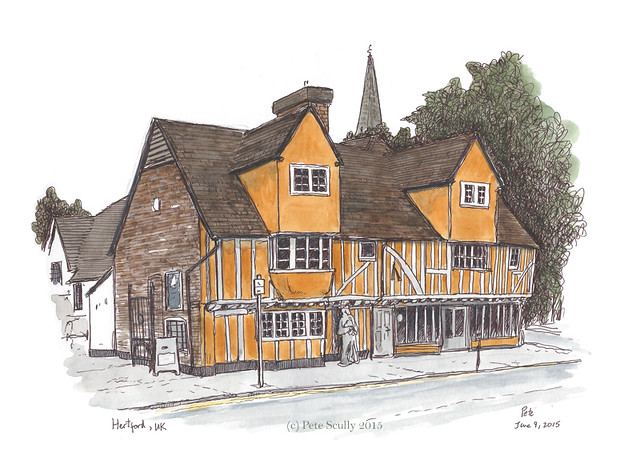
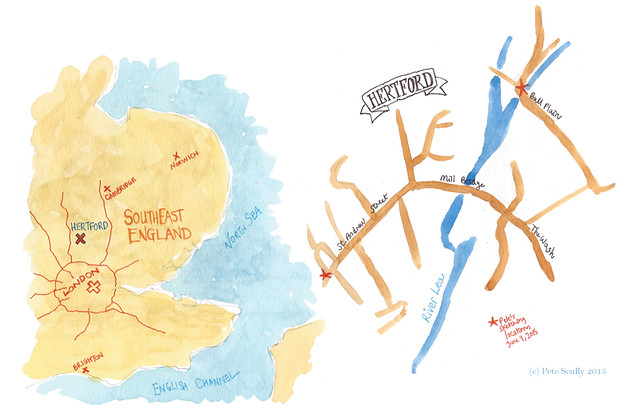
This is Hertford, which is (conveniently) in Hertfordshire, England. Despite being only up the road from where I grew up in north London, I had never been there, and it is very nice. It sits on the river Lea (or Lee, depending on the map you read; mine always called it ‘Lea (or Lee)’), and has an old brewery there called McMullen’s, whose name is everywhere (and whose beer is very nice). We were going up to visit Knebworth House, not too far away from here, but we got all the way there and discovered that it was closed during the week. So instead, we drove down to Hertford, and walked about a little while. there is a castle, but not a big one, with a nice little park. There were, we noticed, a lot of pubs and a lot of barber shops. I really liked the orange building below, and so I sketched it, its timber frames giving me an opportunity to practice for my upcoming trip to Strasbourg. The scene above though is of the River Lea (or Lee), with a row of lovely terraced houses on its banks and an old pub called the Old Barge. I just had to stop and sketch. I added the colour when I got home. It was very peaceful. I always forget about the River Lea (or Lee), which actually runs through north London before meeting up with the Thames at Bow Creek.

Here is a map of where it is. After this, we were going to drive to the village of Ware, but we decided to drive home and relax on the couch with a cup of tea, watching Countdown. So a pretty ideal day if you ask me!

the kingmaker’s castle

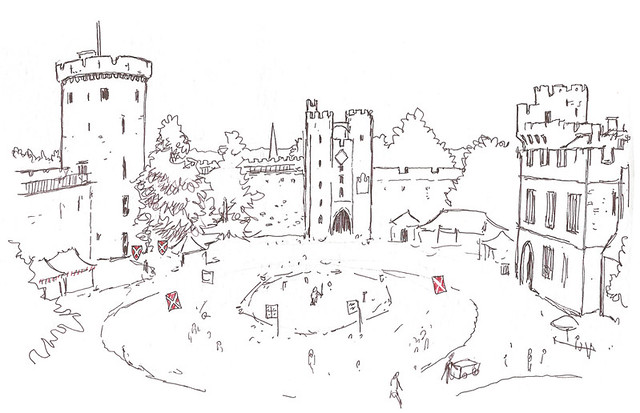
I went somewhere I have never been this summer. I’ve never been to warwick. Never been to the Cotswolds. Stratford-upon-Avon, none of them, and I never even thought abut it until a couple of days before going there when my Mum said, I’ve got an idea, how about going to Warwick? Warwick, I thought, that’s in like the Midlands somewhere I think, oh yeah Warwick the Kingmaker, he had a castle I think. My years of studying maps of the UK and reading British history was not wasted then. I quickly saw that it was a bloody great idea, and it really was. I never see much of England, ever, usually if I go somewhere when I’m back in London I go abroad to the foreign lands where they speak foreign. I forget how lovely Britain and its countryside beyond the M25 can be. We used to go all over when I was a kid, Mum or Dad would drive us to lots of places around the country, Cornwall or Norfolk or Lancashire, and to be honest when I became an adult my interest in visiting different parts of Britain kind of fell away in a kind of “well they’re not going anywhere” kind of way. Warwick hadn’t even occurred to me, but let me tell you I’m glad it occurred to my Mum because it was great. Warwick Castle was one of the best castles I’ve ever been to – still pretty complete, full of rolling ramparts and sweeping towers, but also highly touristy with lots of swordplay medieval action going on – yeah, I LOVE that stuff! I sketched the towers above while we watched a falconry display.
And I did some archery. There I am look (a French shirt with an English longbow) getting my best Hawkeye on, bro. I was pretty good too, hit the yellow target many times, and didn’t hit a single caravan unlike the last time twenty odd years ago. Doesn’t half work your arm muscles though, but then so does standing around with a sketchbook. This was one of several little activities set up for kids and bigger kids, another was teaching young kids how to best use a sword. My Mum said, oh you’d get so bored standing doing that all day wouldn’t you. I’m like, eh, dressing up like a knight, playing with swords all day and teaching kids how to knock the stuffing out of dummies? That sounds like great fun!
We watched some pretty intense jousting down in the meadow by the river, before settling down to watch a display of medieval weaponry and warcraft. Yeah, I love it, all those swords and axes. Well actually I decided to have a little wander up some steps to the higher towers first, and sketched very quickly the scene below as the crowds (you can’t see them) gathered for the fighting demonstration. I didn’t add much detail to this one but here it is anyway.

Now a bit of history. Warwick Castle is about a thousand years old, with William the Conqueror building a motte and bailey fort shortly after the Norman invasion upon an existing Anglo-Saxon burh. That’s an old fortified settlement the English used to create to protect against Danish invaders. London was a burh once too, in the days of Alfred the Great, Lundenburh. The burh of Warwick was located near the old Roman road, the Fosse Way, which was really handy, making this a vital position. William gave Warwick to one of his Norman henchmen, Henry de Beaumont, who became Warwick’s first Earl. In 1260 the castle had a major upgrade when they decided stone walls might be better than the old wooden ones. Simon de Montfort came and conquered it in 1264, but the castle soon passed into the Beauchamp family, and eventually passed to the Nevilles. The most famous of the Neville family was probably Richard, known as the “Kingmaker”, which sounds like a really cool
name for an old pistol, but was actually a fairly bogstandard indie band from the early 1990s. No, he was important during the Wars of the Roses, but died in the Battle of Barnet (again, probably a reference to early 1990s indie bands’ haircuts). His daughter Anne married Richard III, who actually took possession of the castle and made a number of significant improvements, yet ironically did not think to build the car park less than twenty minutes walk from the castle. Funny how karma works, eh Richard. There’s Richard the Third on the right. I didn’t sketch him, but I did do his famous “Now…” speech from the Shakespeare play, “Now something something something”Other stuff happened down the centuries, withstood a siege in the Civil War, Capability Brown came and did some landscape gardening, Canaletto came and did a painting, and then finally I came along and did a little bit of archery, that pretty much brings us up to date. More history lessons next time!

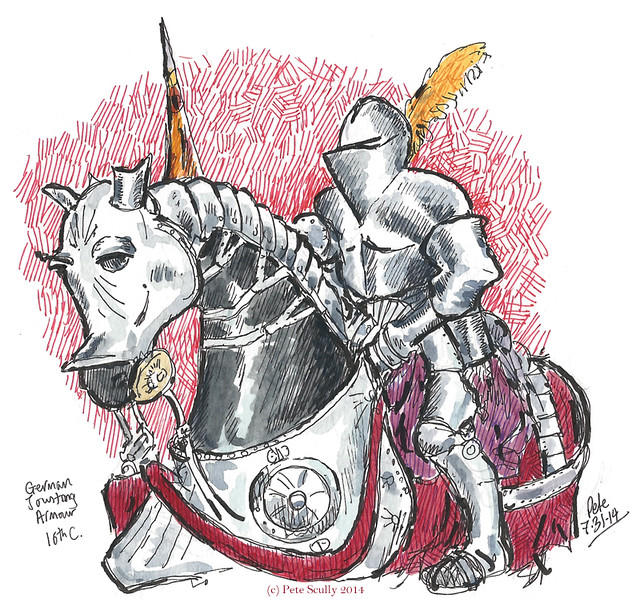
We went into the armoury to wait for a tour. What actually happened next was that the sky decided to turn into an unbelievable storm, nringing a downpour so heavy that almost everybody in the castle grounds tried to squeeze into the same room as me. No tour, then. Convenient timing. It gave me an opportunity to do a little more sketching, so I sketched the antique firearms above, including the long-barreled 18th century Blunderbuss. “You homo sapiens and yer guns.” The rain did not let up, so I sketched the armour of a jousting knight on horseback. This only took me fifteen minutes. I sketched really quickly, while my Mum went looking around the Royal Weekend Party rooms.

The rain stopped in time for the long walk back to the car park, and time for some much-longed-for fish and chips on the way to the hotel, in the nearby village of Barford. Yeah, Warwick is really nice. Good suggestion, Mum!
st albans cathedral

Continuing the theme of Roman and Saxon England, here is the impressive Cathedral at St. Albans, in Hertfordshire, just outside London. St. Albans is a lovely little city (and despite its size it is a city, not a mere town – it has a cathedral, so it’s a city), which despite being pretty close by to where I grew up in Burnt Oak, north London, I have only been to twice, this being the second time. I came to see the amazing cathedral once again. Now once upon a time St.Albans was a Roman city called Verulamum, and it was in this city that a man called Alban was executed in the late third or early 4th century by those Romans who at the time were persecuting Christians. Alban’s head was cut off, and he subsequently became Britain’s first Christian martyr. “A what?” they all said at the time. Apparently when Alban’s head was chopped off the executioner’s eyes fell out, which seems a little far-fetched to me. I’m very cynical as you know. It is believed that the cathedral (formerly abbey) stands on the spot where St. Alban was beheaded, being established as a monastery by the Mercian King Offa (he of the Dyke) in the 8th century. He’s one of my favourite Anglo-Saxon kings, a contemporary of Charlemagne, and a very persuasive man; as they said at the time he was “an Offa you can’t refuse”.
After exploring inside, we sat out in the sunshine, and my family patiently waited while I sketched. It’s not every day I get to sketch cathedrals, especially ones like this.