
Here’s one from Davis. To say I’ve been busy lately is an understatement. Yeah yeah we’re all busy, aren’t we, but I’ve been excessively busier than usual and my email inbox overfloweth too, so I’m trying to catch up there. I’ve not been sketching as much. I’m told that it is “Inktober”, but I’ve only just realised that it’s “OCTober”. October… yet the hot, hot weather has not gone away, not yet. However on one particularly galling day I just had to find a quiet spot at lunchtime and sketch. Admittedly the bus terminal at the UC Davis Silo isn’t exactly a quiet spot but I was too exhausted to go searching for somewhere more serene, and I didn’t want to sketch the Arboretum. I sat at a bus-stop and listened to my iPod (in fact I’ve been listening to “Rachel and Miles X-plain the X-Men”, a really fun and informative podcast about the X-Men universe). This is the back of Haring Hall, UC Davis, and well, that’s about it really. One of those lunchtimes where I just needed to sketch something different, though in Davis, I often feel like I’ve sketched everything.
Tag: drawing
it’s been seventeen years since i set foot in dublin

(Click on image to get a bigger view) And now a return to posting, with something very special. While I was back in the UK, my family and I took a little jaunt across the Irish Sea to Dublin, capital of the Republic of Ireland. In case you were unsure. This was a big deal for me; my whole family is of Irish origin, with many of them being either from Dublin o having lived there, and the Irish thing was a big part of growing up in my corner of north London, in my family and community. I grew up around all forms of Irish music from the Wolfe Tones to, er, Daniel O’Donnell. I own a lot of Ireland football shirts, and a few Celtic ones too. I like my lemonade red. However, I’ve not been back to Ireland in a really long time. Seventeen years in fact, so I have long been overdue a visit. I have been told how much the place had changed in the past couple of decades, with the influx of money and the housing boom (and the subsequent recession), and they even have motorways there now. I wasn’t sure what to expect with Dublin, and my mum, who came with us, hadn’t been to Dublin in even longer. We were then very pleased to see that, yes lots of things had modernized and there were way more people and traffic than years ago, but it was still very much Dublin, there’s no changing that! One evening, my mum and I got fish and chips from a local chip shop, where a group of kids, aged about nine or ten, just started chatting away to us all friendly like about this and that, as if they’d known us for years; that was the Dublin I remember! It was my wife’s first ever trip to Ireland, and my son’s as well, in fact the trip there was all his idea. We stayed near the Liffey not far from Christchurch, it was nice talking with my mum about various great-grandparents that lived not far from there; we of course do still have a lot of family in Dublin but haven’t seen them in decades, wouldn’t know them now. We did a lot of walking about, there were crowds, but it was just nice to be back in Ireland after all these years. My mum and I joked about the characters that used to go up and down O’Connell Street years ago, long gone now. On the first night though, everyone was exhausted, so by myself I walked a block around the corner to the Brazen Head pub to do my first pub sketch in Ireland – my one and only sketch in Dublin, as it happened. It was a lovely place, too.
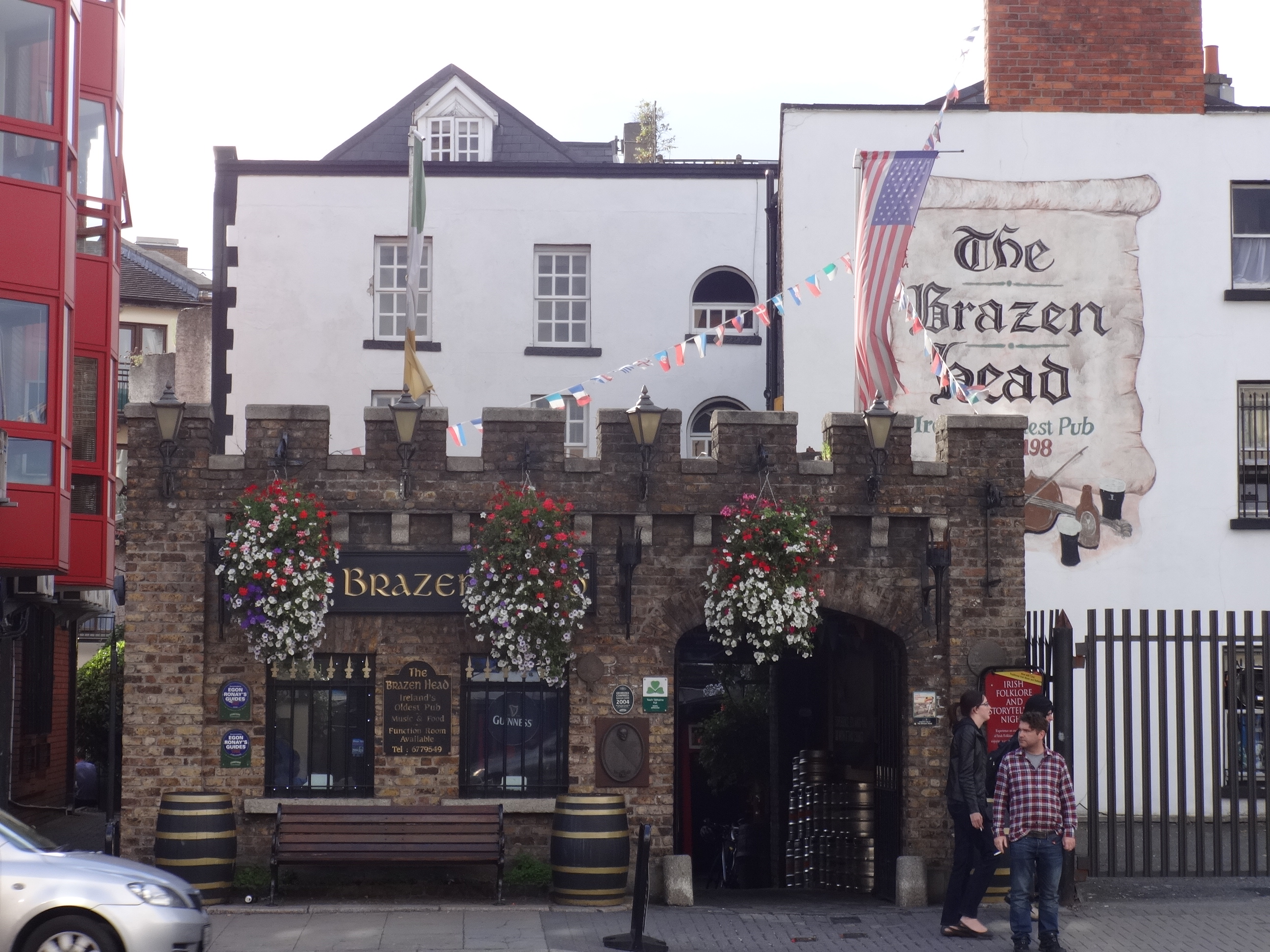
The Brazen Head proudly calls itself “Ireland’s Oldest Inn”, established in 1198. It has a pretty good claim too, and I’m basing that on at least one person saying so, so it must be true. The present building is from 1754 and the pub is referred to as far back as 1613 but it was built on the site of a tavern dating from 1198, apparently. It is said that Irish heroes Robert Emmet, Wolfe Tone, Daniel O’Connell and Michael Collins drank here (not at the same time necessarily), as well as literary figures such as James Joyce and Brendan Behan. Ah, I know this type of factoid from my London tour-guide days, the old ‘Dickens used to drink there’ story; Dickens drank everywhere, there was barely a pub he didn’t sink a pint in. I believe a lot of people came here though, and it is still popular – it was filled with a good mix of tourists and locals. I sat and sketched one of the bars (there are several bar-rooms) from a little table opposite. Live music wafted in from the bar-room next-door to this, There was an enormous amount to draw – for some reason there were a large amount of souvenirs from U.S. police departments (I can’t think of the connection between American police departments and the Irish). I had an Irish cider, which, given that my stomach was feeling very unusual all day, turned out to be a pretty bad idea. I finished up my intensely detailed sketch without adding any paint and wandered home (an apartment a block away) along the Liffey, feeling pretty sick. And I wondered, warmly, how many of my forebears stumbled along this very river feeling this very way (presumably after more than a single pint). I wonder how many of them were sketchers?

It feels weird that this ended up being my only sketch in Ireland, having waited all these years to come back, but it was a pretty busy family trip, we rushed here and there about Dublin and took the train down to the beach at Bray, and then flew back to London. I did go back to the Brazen Head the second night we were there with my wife to watch some of the live Irish music, a bunch of guys surrounded by tourists sat on bar-couches playing traditional music. Sure, the sort you get in Irish-themed pubs everywhere, but this was in your actual Ireland and that was good enough. This was a brief trip, but it was really nice to be back. And I even stocked up on my favourite chocolate bar, Cadbury’s Tiffin. Erin go Bragh!
we need to talk about camden
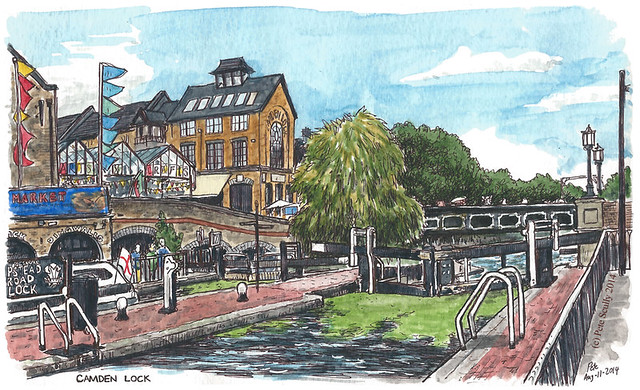
Camden Town, ladies and gentleman. There’s no way to properly describe Camden, it’s just Camden. It’s grimy and tacky and great, and vibrant and awful and touristy and local and rough and everything, it is Camden and can be everything at once. Everyone in north London has their own Camden I think. I for one have a lot of personal history around here, nights out, days about, the odd gig, too many night buses, a good few birthdays, and of course my stag party. I haven’t sketched much around here, so I wanted to do a bit while I was back. I chose the Regents Canal, specifically Camden Lock, well Hampstead Road Lock. I stood, with the sun shining, and sketched the lock, as far as I could. I didn’t do any colour except the red cross of the flag. The clouds were rolling in, oh big black clouds, scary looking but not enough to stop me. And then, whoah, massive thunderstorm, super heavy rain – good job I got the ink done, because this rain was stupendous. People dashing about like mad things, and I took shelter in a doorway. When I added the colour later I left it as the luscious N1 summer blue sky, pre-tempest.

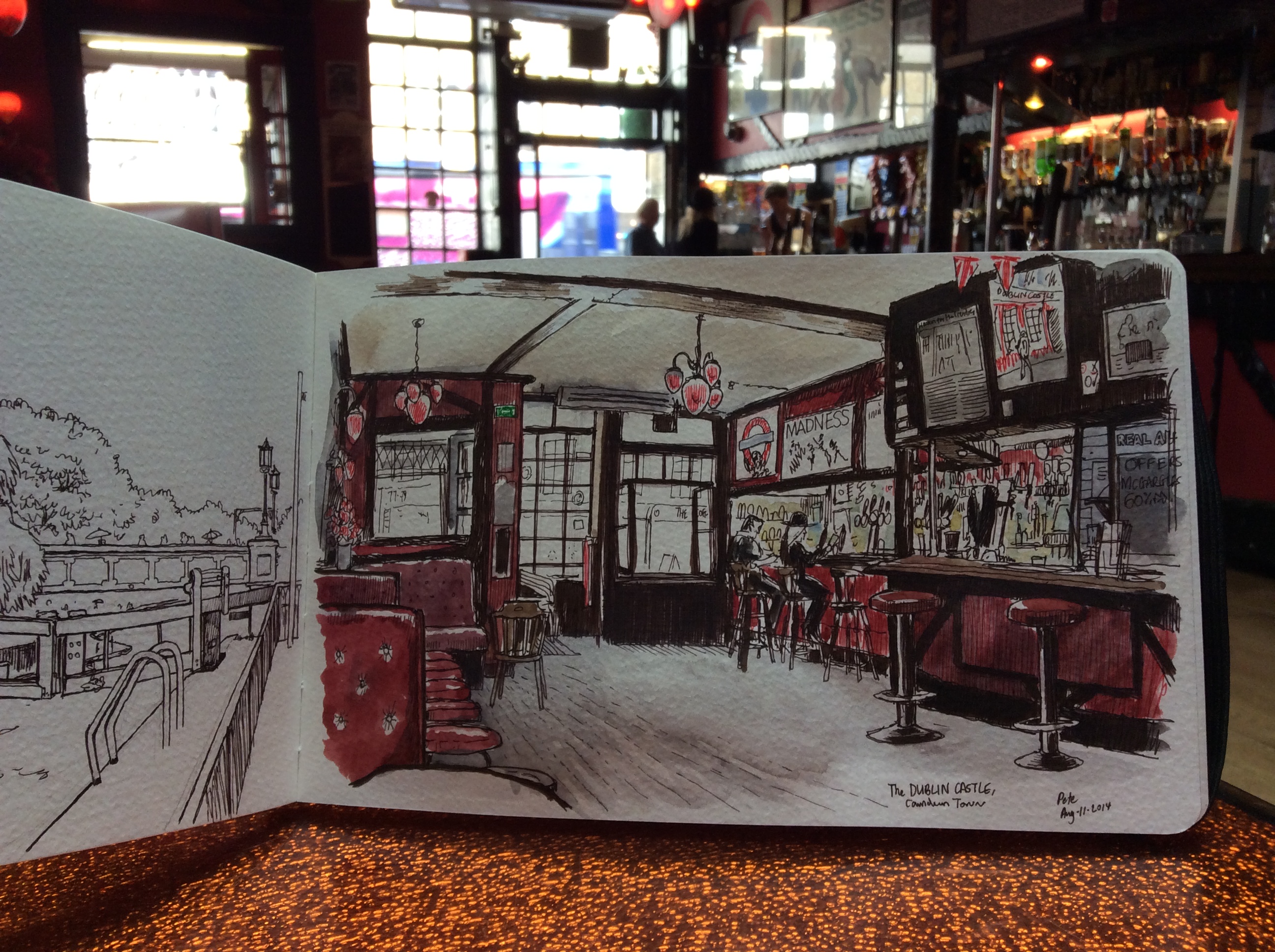
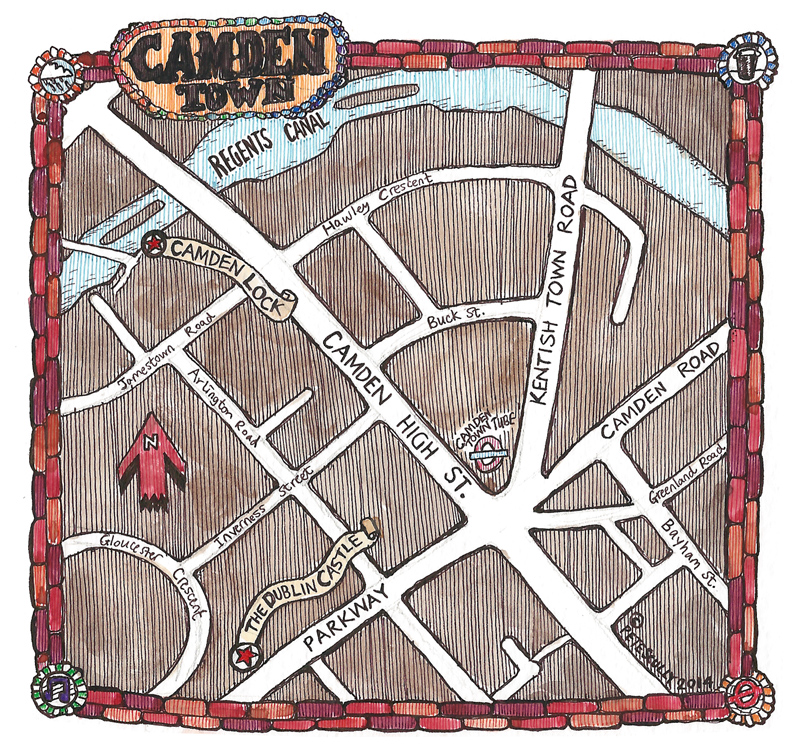
This is the Dublin Castle pub on Parkway, Camden Town. It is approximately 1994. No no, wait, it’s 2014, I got confused there. It’s easy to get confused, it hasn’t changed in the slightest. Well, maybe the price of beer. Anyway, I arrived soaking wet, having run through the rainstorm from Camden Lock (see the handy map below to figure out my route), to see if this old haunt had gone the way of the so many London pubs – gentrified, sanitized, or worse, closed. Thankfully it was still the same, though being the daytime it was practically empty. I got a beer (actually wasn’t expensive, for London) and sat and sketched the red interior. As I was sketching the big ‘Madness’ poster, I heard a guy talking to a woman at the bar whose voice was familiar, and it was in fact Suggs himself, the Madness singer. Now he does have a long association with this pub and this area (here’s his ode to the area) but still it was fun seeing him in there, briefly, especially as I was drawing his poster (he’s on the tube-sign one next to it too). Oh, this old place, many evenings were spent in here, back in the 90s and early 00s. Playing the Who on the jukebox. Talking Serbian poetry with students from Belgrade. Watching very serious unheard-of bands while surrounded by record company band-scouts. Getting my drink knocked vertically across the bar by bouncers steaming past quickly to conclude a fight. Dancing to Anarchy in the UK while my friend Tel threw up in the toilets. Yep, there’s a lot of social history in a place like this. I sketched here until the sun came out, before heading back to Burnt Oak for dinner.
And here’s the map…
2014 art auction at the pence
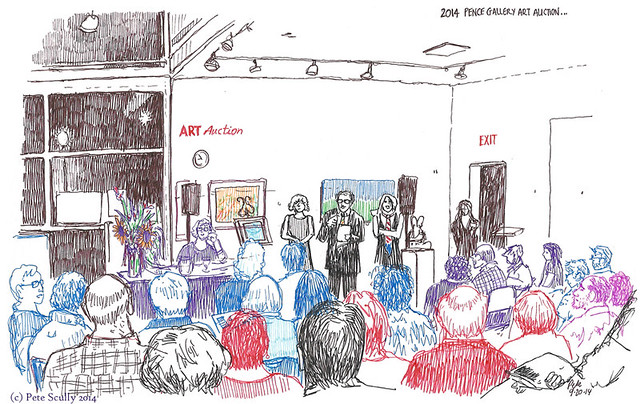
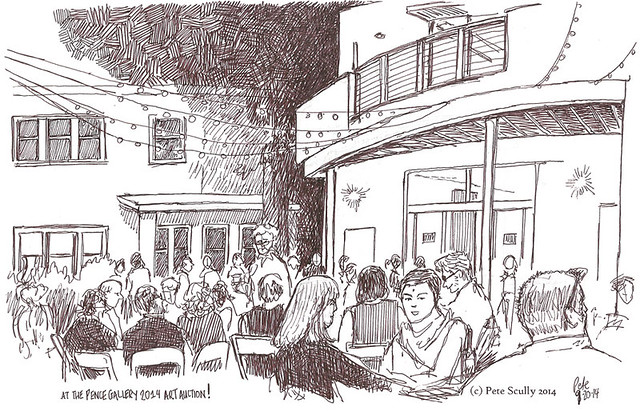
Last week I was fortunate enough to be invited to the Pence Gallery’s annual art Auction, as one of the contributing artists. The wealth of amazing work on display was amazing, as always. The Pence is a great place and they work tirelessly to promote excellence in local art. I met a lot of nice people there, and really enjoyed watching the auction. I sketched at the back, stood next to the dessert table (wow, amazing chocolates!). The auctioneer is very humourous, and very god at getting the crowd to buy art (though every time he said “going once, going twice,” I really wanted to say “c’mon baby don’t be cold as ice…”) This is the third year in a row I’ve sketched it, and I think I’ve captured it now. Below, the view from the patio outside. A very warm night, people talking, art-lovers buying, music playing. One of my favourite spots in Davis. Oh, and both my pieces sold! I honestly hadn’t expected them to this time (I’ve sold my pieces in the previous three years) so I was pretty buoyed, and went home pretty happy. I had been coaching my son’s U7 soccer team (the Red Foxes) that afternoon, it had been a good game, so all in all a pretty nice Saturday. Many thanks to Natalie Nelson and the good people at the Pence for inviting me to take part and attend this very fun event.
at the westminster bridge
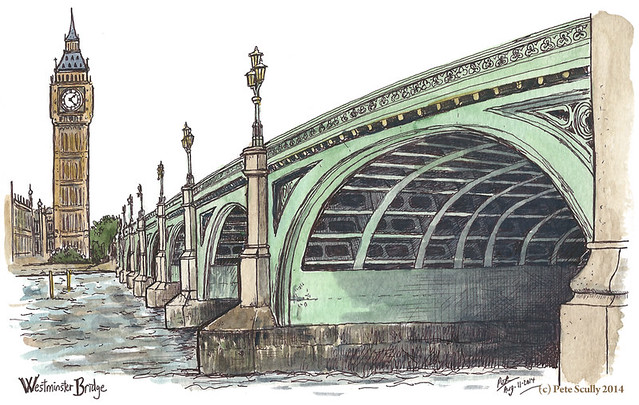
Westminster Bridge, crossing the River Thames. As I started sketching this, the rain came down, so I moved into the little tunnel next to the bridge (which I had never seen before; is it new?) and sketched from there. Eventually the rain stopped. Then started again, then stopped. It was one of those days. There is a very famous clock tower on the other side of the river. I like bridges. I even bought a book about bridges while I was back. In fact I spent a lot of time in bookshops in London. Bookshops are the best. Anyway, I had planned to sketch a lot more bridges in London but you know it is. Maybe that is the next sketchcrawl I organize? Those curves were not easy to capture with absolute mathematical perfection while stood against the wall in a damp tunnel with wet people shuffling by. But here it is, Westminster Bridge, painted green because the seat in the House of Commons are green (Lambeth Bridge further down is red because the House of Lords has red seats). It was opened in 1862 and Wordsworth wrote a sonnet about it.
deep down in the borough
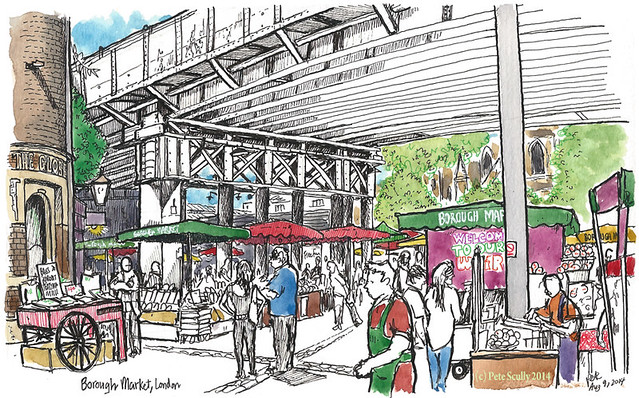
Borough Market is great. It may be one of my favourite markets. On this one Saturday morning, I took the train down to London Bridge station and marched right over to my favourite sandwich stand, lovely chicken served by the same guy with the amiable smile. You always get a lollipop too, well I do anyway. But as I now like sketching iconic markets (hey this is still a new thing, but after Barcelona’s La Boqueria last year, San Francisco’ Ferry Building and of course, er, Davis Farmer’s Market, I needed to sketch the market under the railway arches, with all its goats-cheese middle-class craft-beer tourist-trail glory. I stood and sketched the scene above, next to the Globe pub. There’s been a market here, on and off, since the eleventh century (not really surprising in the least given that London Bridge and the gates of the City and all the docks and the Pool of London were like, right there). Apparently it was abolished in the 1750s by an Act of Parliament due to ‘traffic congestion’ which let’s face it Borough Market, don’t make things up. Cars weren’t even invented for another hundred and fifty years, so stick to the facts, Borough Market. Anyway it came back and thrives today, a fun and colourful spot to be on a Saturday morning. I had a few hours to sketch before heading off to take my son to his first Spurs game at White Hart Lane.

I sketched the scene above from stoney Street, right on the other side of the market. It was pretty crowded as I walked through. That huge great big triangular glass tower is the Shard, tallest builidn gin Europe. One of those buildings you look at in its development phase and its like, oooh, hmmm yeah, yeah that’s different, and then when its built its like, “take a photo from this angle! Ooh and this angle! Ooooh and this old church in it as well, juxtaposition of the old and the new!” (By the way, never, ever utter that phrase in my presence, ever.) And now it’s like, er, London did you see this thing? You do know you can’t just get rid of it when you’re bored of it? It’s like a big glass Orthanc, or whatever that tower was called in Mordor, ‘Eduard Balladur’ or something. Or maybe the Ministry of Truth. It dominates proceedings. Look London its things like this that become symbols of the city in the long run. Is this what London is now? A big, sharp glass behemoth standing high above everything else like an oligarch’s shiny fantasy? I wouldn’t be surprised if the sides actually turn into a V-style TV screen so that some benevolent rich dictator can tell us how happy we are, how contented we are, and to destroy Emmanuel Goldstein. Yeah, not sure I like the Shard all that much, but we have it now. We need another, somewhere else in London, just as a counterweight. But I do like Borough Market.

And here is the late-night hand-drawn map. The odd thick lines are traintracks, isn’t it obvious, and I foolishly decided to add some buildings before deciding that was quite pointless. Anyway, this shows where I sketched. I had a job interview down here once, about a decade ago, at the Institute of Linguists. I wished I’d gotten it, because I always wanted to be coming down here every day (I had been working in Finchley, nice place but this was nearer to the Thames) . I never did, and then I moved to America. Ok, enough life story. More London sketches to come.
boltz in the dark
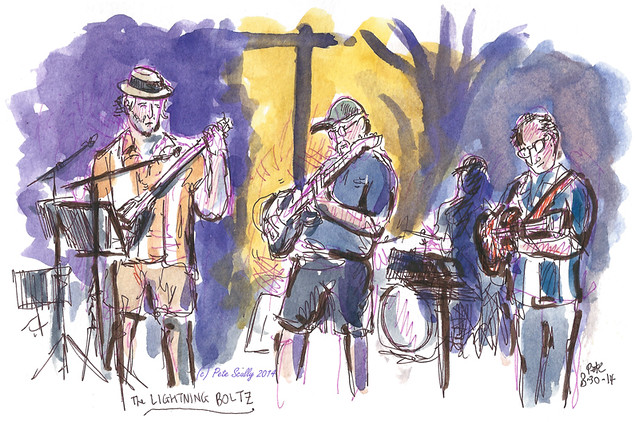
Since returning from London – and I have plenty more sketches yet to post – my sketching regularity has fallen off somewhat. This often happens after a big trip, but I’ve also been filling my lunchtimes reading Marvel comics (Marvel Unlimited, dudes), and the rest of my time coaching my son’s soccer team, which also includes planning training, designing the team badge, making stickers, creating a record of the kits worn by all the other teams, and all of that fun stuff. After London, sketching more panoramas of 2nd Street just doesn’t hold the same appeal right now. However, I did get out of the house one evening to go down to Art-Is-Davis on D Street for a special party hosted by the resident artists there, to mark the end of their time at the artist’s co-operative. I was invited by one of them, my friend and fellow artist Dori Marshall, and I got to speak to many Davis artists I hadn’t met in a while, and some I was meeting for the first time. It was a nice evening, and there was a band outside in the little courtyard behind the building. the band were called the Lightning Boltz, and they were really good. I’ve said it before I do love to have live music when I’m sketching, it adds to the whole rhythm. It was also extremely dark – I sketched this in almost total darkness, in a shadow next to the building. I couldn’t really tell one colour from the next so it was guesswork, but pretty informed guesswork (I know which paint is where in my paintbox after all). This didn’t take me long, a couple of songs at most. The band liked it when I showed it to them afterwards, but I realised the guy in the middle has a quite different beard than I drew! Well, that’s my eyesight in the dark.
solid old oak
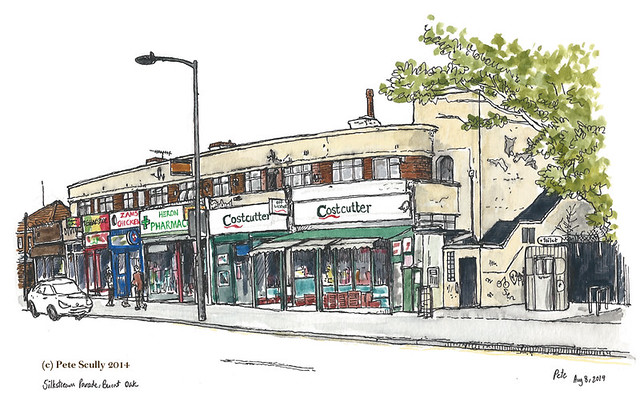
I always intend to sketch more Burnt Oak whenever I’m back home but I never quite get around to it. And I should – the old place keeps changing in small, and sometimes pretty big, ways. Since my last trip, at least one of the historic focal points of the area has closed down, probably for good: the Bald Faced Stag, the old pub on Burnt Oak Broadway. Love it or loathe it (and it was often pretty loathed), the Stag played a big part in many of our lives as Burnt Oakers, and it just doesn’t feel right that it’s no longer there. What then is left of old Burnt Oak? Rather a lot, B.O. fans, rather a lot. I did a quick solo-sketchcrawl one afternoon, starting with the distinctive buildings of Silkstream Parade, above. This is between the Library and the Station, and to many of us these were the shops you went to when you went Up The Road. The old newsagents on the corner, at one time called Magson’s but I don’t recall its previous name, was replaced by Costcutter’s many years ago, but you can still see the long-disused cigarette vending machine on the side of the building. Heron Pharmacy is still there, unchanged in decades. Zam’s chicken is where Toni’s used to be, an old ice cream and sweetshop, I remember showing my Mexico 86 sticker album the Italian guy Toni who ran the place and him telling me all about the Italy players. Whenever I think of Paolo Rossi I think of Very Cherry Slush Puppies (remember them? You remember them). The kebab shop is also long gone, that had one of the most often broken windows in the whole of England I recall. There used to be a butchers shop here too, and was there a greengrocer’s? Was that the whole set? Tanning salon now. Anyway that’s enough “How We Used To Live”, any more of that and I may as well start every blog post with “Who remembers Penny Sweets, remember them eh, Kola Kubes eh, not like that any more eh”).
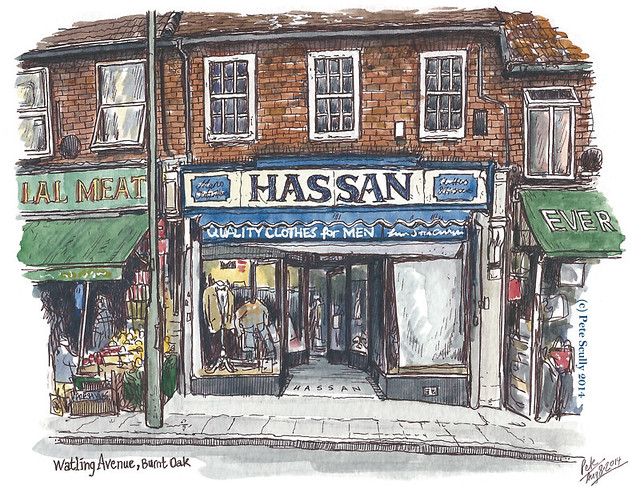
I moved up Watling Avenue to Hassan, which has been there since before I was a kid, unchanged. They don’t make shop signs like that any more, it’s all primary colour plastics now, but Hassan has class, gilded edges which of course my sketch doesn’t really show. Not being much of a clothes shopper, and this being a clothes shop for Men (my Mum, not being a Man, never dragged me through this shop as a kid, unlike John Ford and other Burnt Oak shops), I’ve never ever been inside Hassan’s. I know people who do, people who live far from Burnt Oak and come out of their way to go there. Personally I just love that it is there, still there. So now I’ve finally sketched it. I stood opposite outside a closed-down cafe on the corner of Gaskarth Road. Cafes, eh, remember cafes? Don’t get cafes any more, it’s all Starbucks these days, etc.
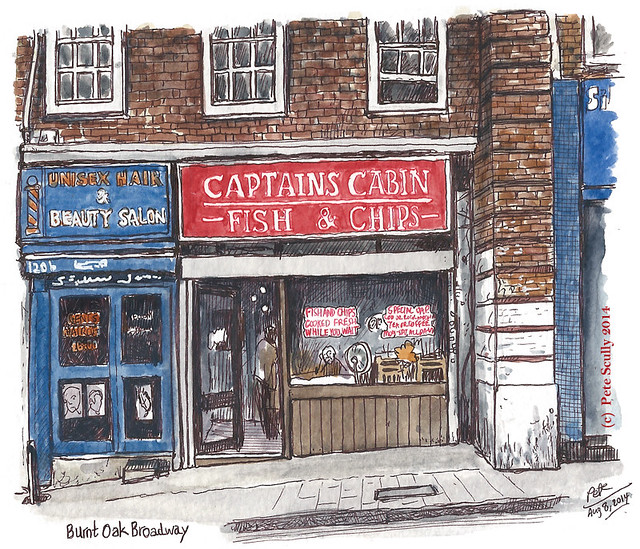
Sketching across Watling Avenue wasn’t too difficult. As busy a street as it is, it’s pretty narrow. Burnt Oak Broadway on the other hand is much wider, so when I sketched the old fish and chip shop the Captain’s Cabin I had to squint a lot more. Burnt Oak Broadway is what we call this part of Edgware Road, itself part of the ancient (and I mean ancient) Watling Street, the long straight road built by the Romans linking Londinium with the north-western reaches of Britannia. It’s from Watling Street that Watling Avenue gets its name, and in fact the name Burnt Oak is a reference to the old Roman custom of burning an oak tree to mark the boundaries between places, or so we were told at school. See, my town got some history, bro. This chip shop is pretty much the only one in ‘downtown’ Burnt Oak (to use an Americanism) left from the Olden Days (“who remembers fish’n’chips, eh, vinegar, chip butties, eh, it’s all piri-piri cappuccinos now”). I do remember there was a Kentucky Fried Chicken next door when I was a kid (remember those? No seriously, you don’t get them any more, all KFC now) and a Barclay’s Bank on the corner which got turned into an amusement arcade, not sure how amusing it really is though, maybe it amused NatWest across the street. The Captain’s Cabin is still there, the sign is different from when I was a kid, so I sketched it. Personally I used to get my chips from the Golden Fry down the Watling, where they had the Space Invaders games my brother used to play (“Who remembers Space Invaders, eh? Don’t get that any more, it’s all Minecraft and Halo and Words With Friends now”). Captain’s Cabin for me was always that bit further to walk for the same thing, but I still always liked their chips.

And here is a map of Burnt Oak, you don’t get maps like this any more, it’s all iPhones now, but it was with maps just like this that I managed to navigate my way around town when I was a kid. No not really. I just wanted to draw a bit more of a fun treasure-island-style map (and yes I know north is in the wrong direction, I’m not working for the Ordnance Survey or nothing) for my home town (and yes Burnt Oak is not an actual ‘town’, just a small nook in the expanse of London, an offshoot of Edgware really, but Burnt Oakers everywhere, even those who have long since emigrated to the far-flung corners of the world, we know that it is its own place, our home town, but once you start getting too sentimental it’s only one step away from “Who remembers bus passes, remember bus passes eh, get on a bus and go somewhere yeah, can’t do that now eh”). I do love to sketch the place though, to capture it for old time’s sake, because by golly it changes fast. But…not that fast.
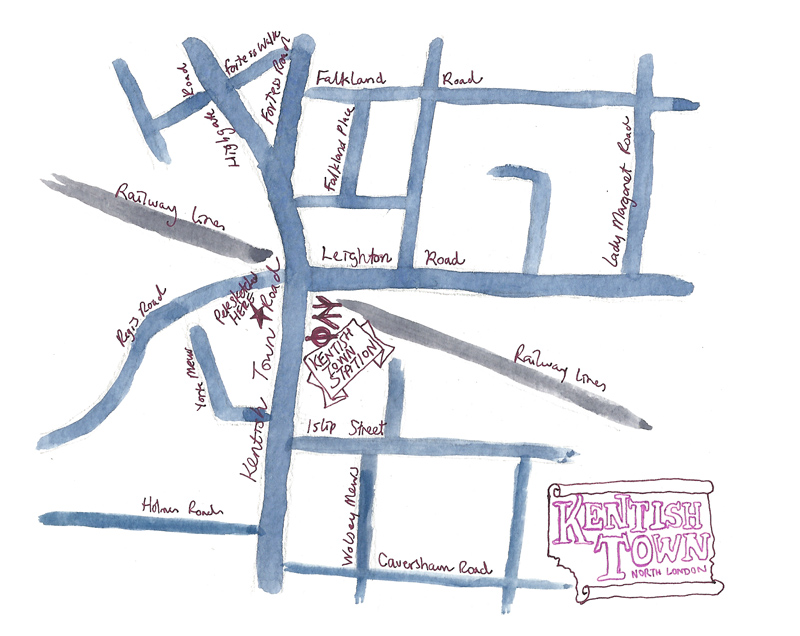
up kentish town

This is Kentish Town station, in north London. I came here when I was meeting up with my friend James one evening, and stood outside a curry house opposite sketching as buses and cars trundled up Kentish Town Road towards Tufnell Park and the Archway. There are a lot of old tube stations that look like this, with the dark ox-blood red glazed terracotta tiles and the typical arches, and one day I swear I would love to sketch them all (hint hint London Transport, a fun book commission?), though I hurried through this one a bit, not drawing the whole length of the building (it would make a really good panorama…) and added the colour when I got home. It was designed by Leslie Green, who built many of the iconic London Underground stations over a century ago, and is on the High Barnet branch of the Northern Line. It’s a pretty interesting place, Kentish Town, and this was my first time here in years, other than passing through. Though in fact I did end up passing through, ending up meeting my friend in nearby Camden Town, where we swapped world cup football stickers.
sketching wrens’ city…part two
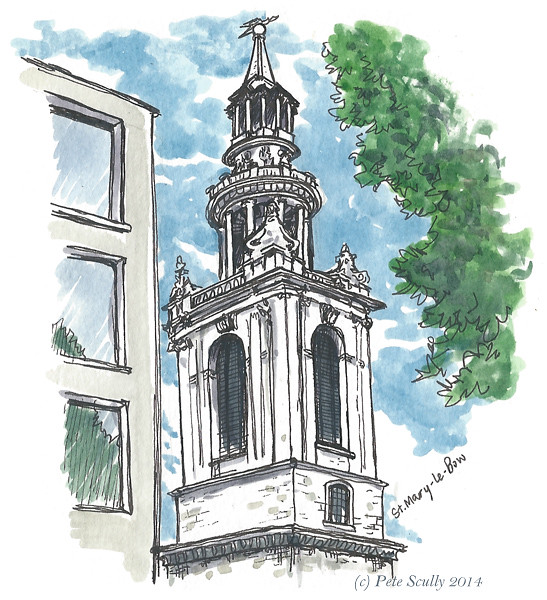
The Wren sketchcrawl continued… we had a lot of sketchers from all over on this sketchcrawl, and after finishing St. Stephen Walbrook I bumped into international-travelling urban sketcher Sue Pownall, and we walked over to St. Mary-le-Bow on Cheapside. The approach to this old church up the narrow Bow Lane is lovely, although the buildings are now modern you can just use a bit of imagination to fly back through the centuries and picture the narrow timber-framed houses leaning into each other over dirty streets, the sound of the Bow Bells echoing through the dark, bustling lanes. Yes, this is the church of the Bow Bells; the tradition is that a Cockney, a true Cockney, was born within the sound of the Bow Bells (and not Bow in East London as many wrongly believe), that is, within London. Cockney is synonymous with all Londoners now, London being much bigger than in Dick Whittington’s day, though of course he famously heard them from up on Highgate Hill, calling him back to his destiny as London’s Lord Mayor. You know the story. There’s a statue of his cat on Highgate Hill, near Whittington Hospital, but that’s far from here. The Bow Bells were important to London not because of fanciful stories and cockney categorization, but because in the middle ages these were the bells that rung to sound the curfew, and the closing of the city gates. If they rang and you were outside the city, you spent a night sleeping in the filthy gutters of Southwark or Finsbury. These days you can just get a Night Bus, and it’s a similar experience.
Those bells and the old church of St.Mary-le-Bow were burnt to the ground in the Great Fire of 1666, so Sir Christopher of course got to work building a new church, this one above. Well, kind of – it was destroyed again by the Nazis in the Blitz, but rebuilt after the War. I just drew the spire, time being of the essence, but it was a nice little courtyard to be sat in.
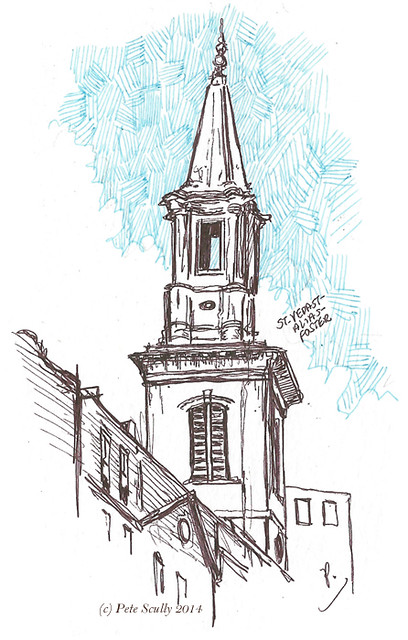
Before going to sketch St.Paul’s (I had this huge panorama in mind…didn’t quite make it) I wandered about to find a less well-known Wren church. I headed to St.Vedast-alias-Foster, up in Foster Lane, mostly because I liked its unusual name. when I got there, the staff were bustling about, preparing for a wedding. Though it looks like Just Another Wren Church (™) from the outside, the inside is quite spectacular, with a beautiful ceiling and a polished hall filled with light. The friendly suited man at the door welcomed me in to look around, and I asked him a bout the history of the church and its unusual name. Apparently in the middle ages this part of London was popular with Flemish immigrants from Arras in northern France, whose patron saint was St. Vedast (from the Latin name Vedastus; in Norman French and Flemish he was St. Vaast). This was corrupted into English as ‘Foster’, hence Foster Lane, and so the church is called ‘alias-Foster’ as a result. He showed me around the lovely courtyard, and said that a sketcher would love to sketch in there, and showed me the history of the parish churches associated with this one, many now combined (the ‘United Parishes’), including one church called St. Mary Aldermanbury which was badly damaged in World War II, and then closed down, with its remains being shipping across the Atlantic for rebuilding in Fulton, Missouri, significantly the place where Winston Churchill made his famous ‘Iron Curtain’ speech in 1946. All historied-up, I went out into the street and found a spot to sketch the tower. I kept it brief, because my next building was so much bigger than all of the others (probably put together).

The plan was for a panorama, but I couldn’t decide on a good view, at least not from up close. Besides, the day was pressing on and I wanted to be done before our final meet-up at 4pm. So I stood across the front entrance from St. Paul’s Cathedral, as traffic and tourists rumbled by, and sketched in traditional London grey. It was actually a very sunny day, one of the more pleasant London afternoons. I remember those sorts of afternoons from when I was a teenager, wandering central London’s streets on a late Saturday afternoon, falling in love with the city. In those days St. Paul’s was much greyer, dirtied with decades of pollution and urban grime, but in recent years the grand old cathedral has been cleaned up significantly, and now sparkles white as if new-born. This is Wren’s masterpiece, but its significance to London is much older. For many, St. Paul’s is London. There has been a cathedral dedicated to St. Paul’s on this site, the top of Ludgate Hill (King Lud being an old figure of pre-Roman British legend who may or may not be related to the name of London itself), since St. Augustine brought Christianity to the Angles and Saxons. Not much is known about the early cathedrals, until the fourth incarnation, a huge Gothic cathedral, was built in the twelfth century. That was one of the largest buildings in Europe, but alas, along came the Great Fire of 1666 and in a matter of days it was gone. Along came Wren. As I’ve mentioned before, he had plans to rebuild London including St. Paul’s on his drawing board for several years before the convenient fire, and for London’s landmark cathedral he wanted not another towering spire but a large Romanesque dome, technologically advanced and rivaling the greatest buildings in Christendom. The wooden model of his first design is still on display, but it looks rather different from the final buiding. This was late seventeenth-century England, not a time to make your premier church look, well, too Catholic. It was shaped like a Greek cross, and the nave was not long enough; it just didn’t look English. Wren went back to the drawing board, and in the end built the Cathedral we have today. It’s hard to think of more ‘London’ building than this. During the darkest days of World War II, when bombs flattened everything around it, the dome of St. Paul’s stood untouched, a symbol of hope for a city devastated. The ‘people’s church’ this was, and probably because of that, it was here that Prince Charles married Lady Diana in 1981 rather than at the traditional Westminster Abbey.

So it was here that we finished out sketchcrawl, and our journey through Wren’s City. Those of us who were left gathered by the steps of St. Paul’s to look at each others’ sketchbooks. I met some great sketchers for the first time, and reconnected with sketchers I have met with before. I can’t tell for certain (because I didn’t take photos of everyone’s books) but I’m pretty certain that as a group we covered most of the Wren churches from my map on this day. Here are some photos from the end meeting; you can see some more on my Flickr set Sketching Wren’s City.
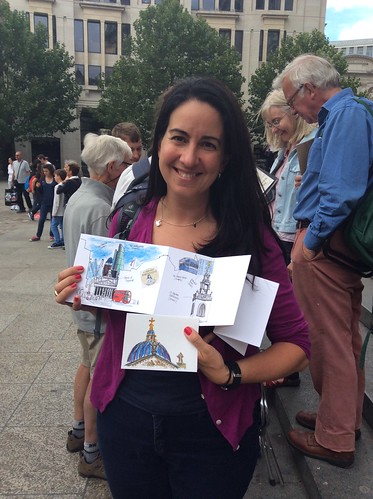
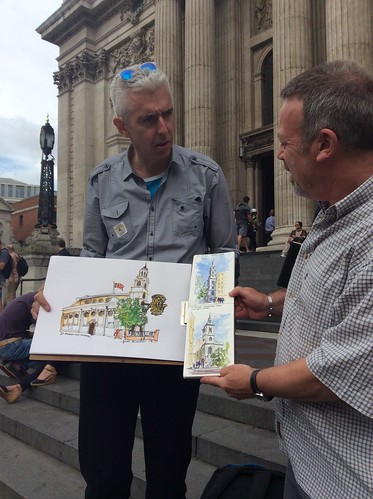

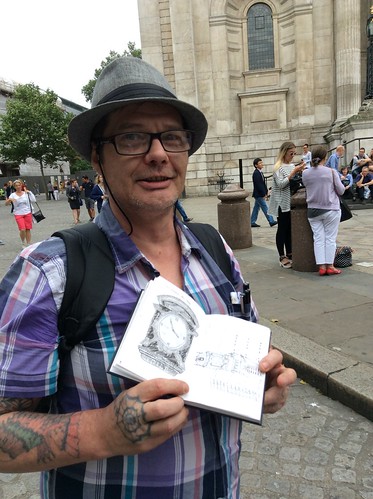
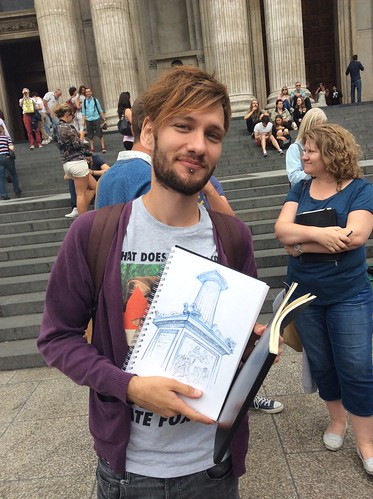
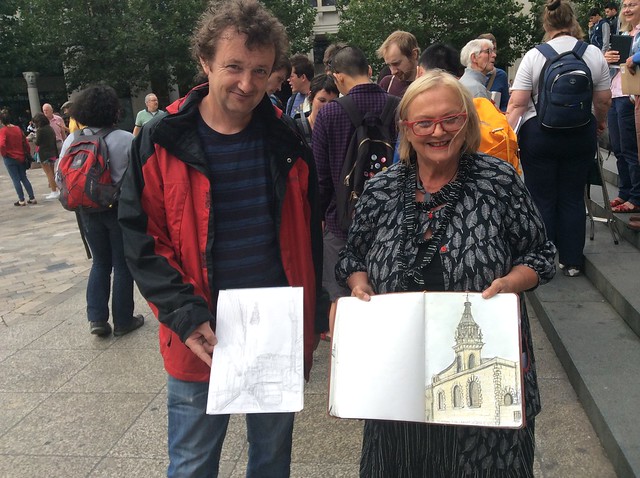
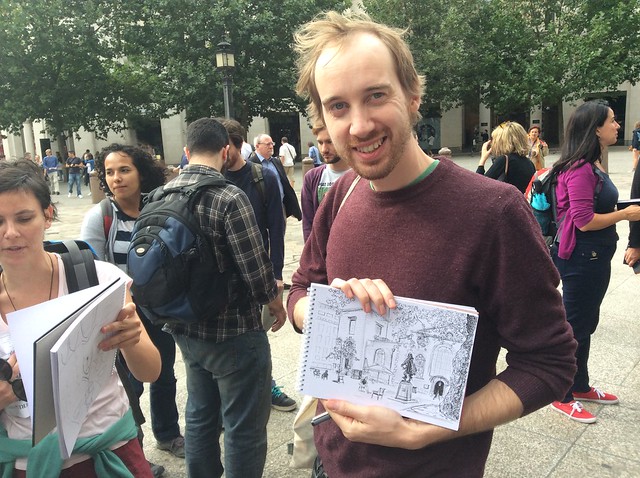
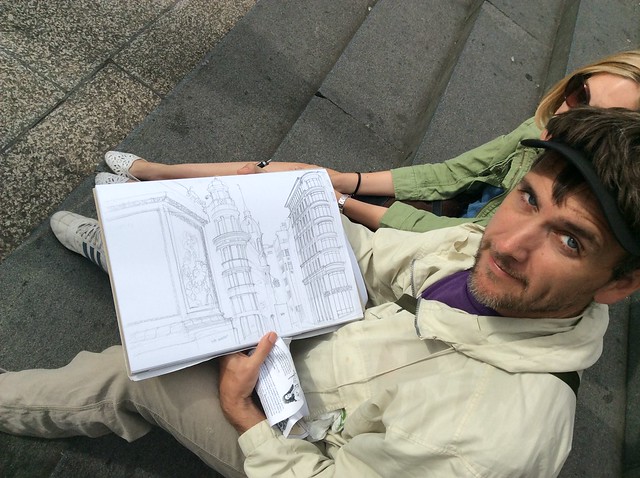
And here is the final group shot…spot the sketchers you know!

Everyone that came and made it to the end got a little sticker that said “I Sketched Wren’s City”. I like making stickers. If you’re interested in following our steps and sketching Sir Christopher’s City, click here to download the little guide and map I handed out on the day: Wren’s London booklet (pdf)
After this, we reconvened at a pub on Fleet Street called The Old Bell, which, by the way, was built by Christopher Wren. Who else! To those of you who came along, it was brilliant to meet you and see all of your lovely work. See you next year! (For…”Dickens’s London”? “Coren’s Cricklewood”? “Pete’s Burnt Oak?”)
 petescully