sense and serenissima

Fondamenta del Piovan Venice sm

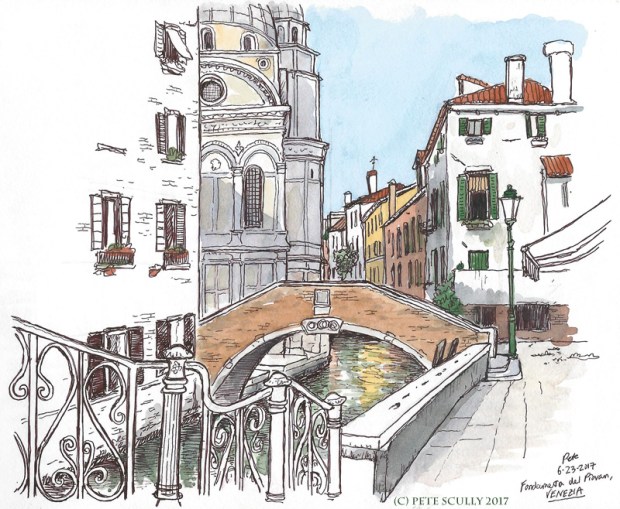
I wonder what my Venice ‘limit’ is? How long could I be in Venice before I got bored by the bridges, confounded by the canals, tired of the tourists, frustrated by the flooding, and hounded by the humidity? Maybe never, and maybe always? Maybe all of that is the charm of Venice, and maybe it is something I don’t notice when by myself but becomes more prominent when with others? It’s hard to tell. I’ll always love Venice, always be amazed by its very existence and history, that is is an eternally crumbling yet living and breathing beauty? I could spend a long time there wandering and sketching, but even Venice would end up feeling small and familiar. Other cities may not be as pound-for-pound beautiful, but may have a more lasting attraction – Paris, for example. Over the course of three days however Venice is magnificent and divine, and every scene is a potential watercolour. The morning light in Venice beats everywhere I have ever been. The sketch above was done on my second morning in Venice, while wandering about the narrow paths of the sestiere of Cannaregio, looking for a specific spot which I knew to be nearby the place we stayed in 2003. I found it – the shiny marble church known as Chiesa di Santa Maria dei Miracoli, which I remembered to be surrounded by cats the first time I saw it. There were no cats this time. I sat on the steps of a bridge on the Fondamenta del Piovan and sketched the above scene, painting the colourful reflection in the soft morning light, before wandering back to the apartment, Venetian breakfast pastries in hand.
Grand Canal Venice sm

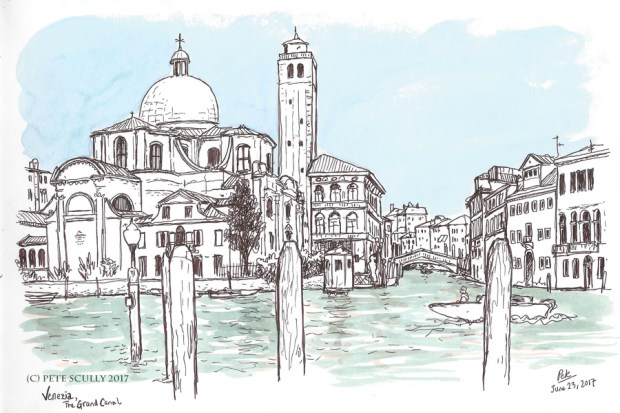
Later that day, we had a morning and afternoon of slow wandering around the two sestieri on the other side of the Grand Canal, San Polo and Santa Croce. We took a traghetto over, looking for the natural history museum, but spent ages getting lost among the alleys and courtyards. This was a much more residential area than I had expected, and while we were lost (because we were a bit lost, we never found that museum) my son watched local kids playing football in the small squares (though he was a bit shy to join in). I did get one sketch done, looking for a route to the Grand Canal, sketching the magnificently domed Chiesa di San Geremia across the wide turquoise canal. Scenes like this make Venice feel like a made-up city, a pretend place, but it’s very real, and boatmen moored up bringing their goods onto the fondamenta. This was actually my last sketch in Venice and tired feet were not looking forward to the journey back to England, but we were all ready to come back by that point. Venice is beautiful and fun, as is Rome, but there is a lot of walking. Our next vacation will involve a little more beach and pool.  Rio de S Fosca Venice sm
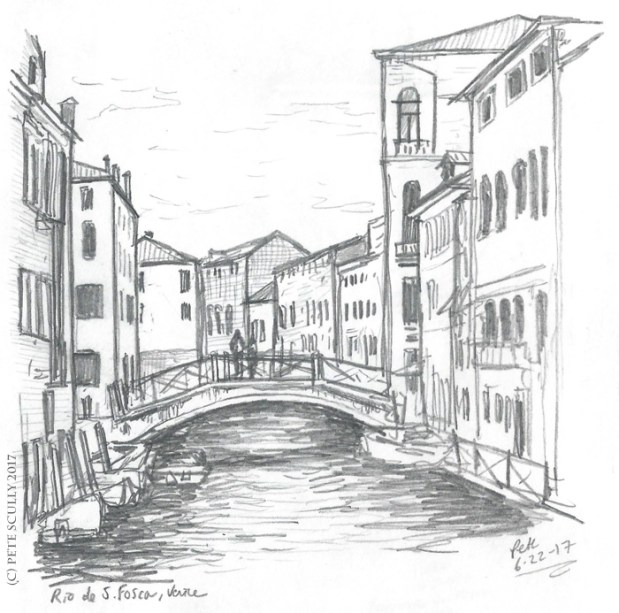
One last sketch though, a quick pencil sketch of the Rio de S. Fosca, in Cannaregio, drawn quickly the evening before, after dinner. I didn’t want to be out sketching after dark so drew this as the sun set and went back to settle into the apartment with thoughts of future Italian trips in my head. Next time, Florence, Tuscany, and maybe the Italian Lakes. I’d like to visit the Ligurian coast, all the way down to the Cinqueterre. Genoa has always sounded interesting to me, and Bologna. Naples scares me a bit, but I had a pen-pal from Naples when I was about 13 (we never met, but she would write to me all about the south of Italy, and I’d write back all about London). Similarly, Sicily always seemed wild and distant, but I would love to explore its villages and coastal towns. I don’t know; I want to go everywhere, I guess. At least we were able to go to Rome and Venice, and that was worth it. Arrivederci Italia. Ciao!

“The Romans? I’m all forum!”

Colosseum and Arch of Constantine sm
A couple of days before our trip to Italy, we went to the Museum of London. London’s history was always a great interest to me, the story of one of the world’s greatest cities, from the chaos of the Blitz, the Restoration period of Plague, Fire and Rebirth, the medieval city of tightly packed lanes and Bow-Bells, the Anglo-Saxon settlement of Lundenwic, right back to its origins as the Roman city of Londinium Augusta (and even farther back, into the area’s British past). Outside the Museum of London we marvelled at a decent stretch of the old London Wall, built by the Romans to surround Londinium, a piece of the Ancient World that we can see and feel. It’s an impressive history. And then we went to Rome. Suddenly I felt like Americans often do when going from New York to London. Right, now this is old. Two days after looking in wonder and imagination at a segment of the Wall of Londinium we were standing inside THE COLOSSEUM. It is a surreal experience, stepping back into big history. Rome is not insignificant in any sense. What have the Romans ever done for us? Rome is the father of London. They built our first London Bridge. So as a Londoner, as with many cities with Roman origins, coming here to Ancient Rome I felt a connection, and a sense of coming from the provinces to the capital.

IMG_3172.JPG

The most breathtaking site of all, of course, was the Colosseum. I first saw it from the plane, this huge oval amphitheatre, testament to the Roman love of spectacle, entertainment, power. Definitely power. There are species of animal that were brought to near-extinction by their use in the gladiatorial arena over the course of a millennium. It was a hot day when we went, but the crowds were not as impossible as we had imagined. Booking your tickets ahead of time makes a huge difference too. There is not a lot of shade in the main open area of the Colosseum, but in the passageways leading in, and in the areas with the history on display, it is much cooler around the old stones. I drew some old marbles (below). I didn’t sketch the inside of the Colosseum itself, due to time, sunlight, people, but I did draw it when we got outside. The sketch at the top of this post was done in the bare shade of a tree – there is not much shade in the grounds around the Colosseum either. That sketch includes the Arch of Constantine – oh, nice arch, wonder what it is, I said. This arch inspired the Arc de Triomphe in Paris, Marble Arch in London, and the Siegestor in Munich, so it’s kind of important. As I sketched I noticed a car nearby with a couple of people taking notes and making reports. Undercover police, for sure, keeping an eye out for anything out of the ordinary. There were a fair number of cops on patrol, and the road leading up to the Colosseum was blocked by a couple of armoured vehicles, positioned to prevent a random vehicle speeding towards it. There were a lot of those around the main sites and piazzas in Rome, which was reassuring. You always have to be watchful and mindful everywhere, always, but I felt quite safe in Rome.
Colosseum Marbles sm
After an exhausting and thirsty walk around the Colosseum, gladiatorial spectacles swimming through our imaginations, we had lunch and then walked over to the Forum. The grounds of the Forum are huge, filled with ruins and rubble and centuries of stories. We didn’t stay too long, for my son’s feet were starting to get Rome-fatigue, but I did a quick sketch of this structure that reminded me of cricket stumps. Owzat! This place bowled me over, hitting me for six, and I don’t know any other cricket terms so we’ll leave it at that. We wanted to visit the Palatine Hill, but the day was getting away from us, and we had an appointment to go to the Gladiator School, which was a short and expensive (yeah, we were ripped off) taxi ride from the Colosseum (and again, future Rome visitors, don’t bother with the Gladiator School, it was a waste of time and a waste of money). The Forum though, that is somewhere I want to return to, with a sketchbook (and a lot of sunscreen).
Roman Forum sm
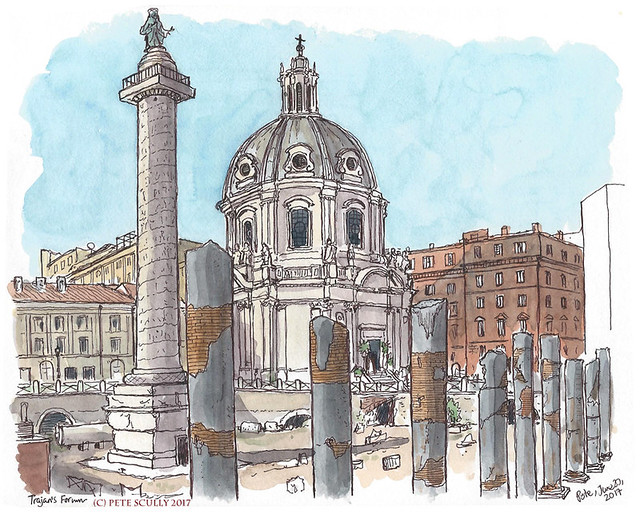
I did walk back down to this area the next day though, while la famiglia rested up at the apartment. I wanted to draw Trajan’s Column, standing above the ruins of the ancient Trajan’s Forum. Emperor Trajan was one of the greatest of all Roman leaders, being one of the Five Good Emperors (that would be a good name for a soul band). Under Trajan, the Roman Empire reached its greatest extent. It was his son Hadrian, also a Good Emperor, who decided to start building walls around it such as the one in the north of Britannia. Trajan’s Column dates from about 113 AD and is decorated in a spiraling relief  of Trajan’s victories against the Dacians (I do not know how many times I said the crap joke “phew, that’s a relief” while in Rome but it was a lot, it was definitely a lot). The statue on top is of St. Peter; the statue of Trajan that used to be on top was lost in the Middle Ages (bloody Time Bandits). The large dome behind is of the church called “Chiesa Santissimo Nome di Maria al Foro Traiano”. This took the best part of two hours to sketch; I kept stopping and speaking to those people who come up and try to sell you little trinkets and stuff, or going to watch the marching army band outside the huge Il Vittoriano, which was opposite, across the Via dei Fori Imperiali.
Trajan's Forum sm

Sketching Wren’s London – 2016

wren's city sticker
On Sunday July 24, a lot of us gathered outside St.Paul’s, and then dispersed and sketched Christopher Wren’s London. It’s the second time I have run a Wren-themed sketchcrawl, and the fourth themed ‘crawl I have hosted in London since 2012. I’m already thinking of themes for next year! As in the past, I created special handouts which included a hand-drawn map showing all of the Wren churches (and other buildings) within the City boundaries. There are a couple of Wren’s City churches not showing, only because I didn’t stretch the map far enough north, and of course it shows none that are outside the Square Mile; perhaps we’ll sketch all of those next time! Here is the map:

Sketching Wren's London Booklet MAP

We started at 10:30am outside St. Paul’s, and I gave a little historical introduction (see this photo by James Hobbs!) talking about London leading up to 1666, starting with the beheading of Charles I, which many English people believed had brought a curse upon them, manifesting in the year of the beast, 1666. That was the year of the Great Fire of London; I won’t tell the whole story here, you had to be there. We were joined by a good number of people from around the world who were in England for the Symposium, including my Portland sketcher friend Kalina Wilson (Geminica). I met a lot of great new people that day too, as well as old friends. It was very international – in addition to the UK and the US, we had sketchers from Singapore, Hong Kong, Italy, France, Pakistan, Luxembourg, China, This was day two of London’s Urban Sketching pre-Symposium, and it was a little cooler, and a lot calmer than the previous day in Trafalgar Square. I do like the City on a weekend.

Temple Bar

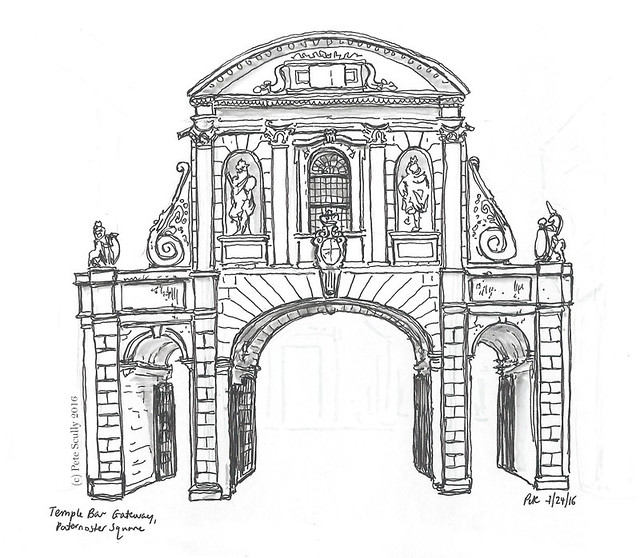
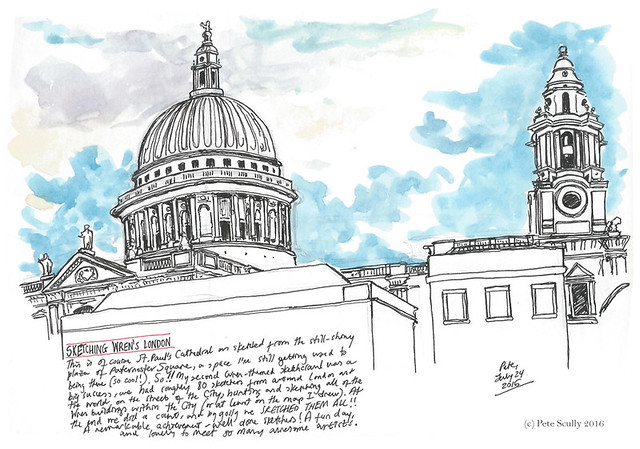
In 2014, I sketched seven Wren buildings in one day, and my ambition was to sketch more. However, you sketch what you can sketch, and I’m pleased to say I at least matched my previous haul. I did use more pencil while sketching than usual, something I am doing more. First off though I sketched the Temple Bar gateway in pen. This was originally down at Fleet Street at the entrance to the City but removed many decades ago, only to sit languishing in Theobolds Park near Cheshunt. It was restored and placed next to St. Paul’s just over a decade ago, forming the entrance to Paternoster Square. It was from that still-shining-new plaza that I sketched St. Paul’s itself. I have always struggled with the great domed cathedral from this angle but that’s ok, you have to draw St. Paul’s.

St Pauls Cathedral

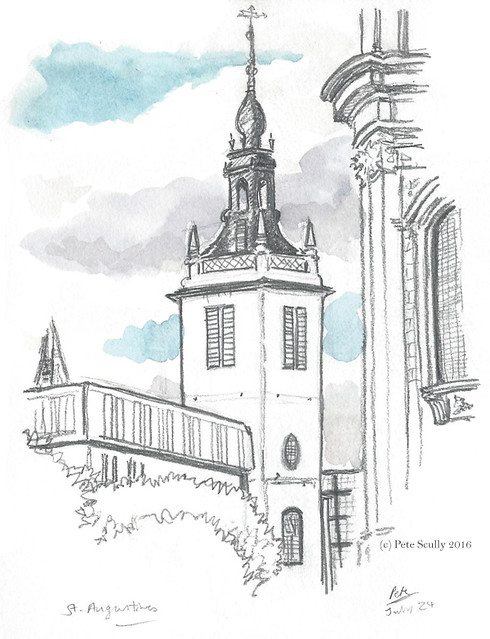
Next up, a couple of neighbours to St. Paul’s. First of all, St. Augustine’s Watling Street, largely destroyed in the Blitz. I sketched this in pencil from the gardens of St. Paul’s churchyard while talking to my old friend from high school, Joan Uloth (check out her Instagram) and Beliza Mendes from Luxembourg. I really want to sketch Luxembourg, I met more Luxembourg sketchers in Manchester.
St Augustines
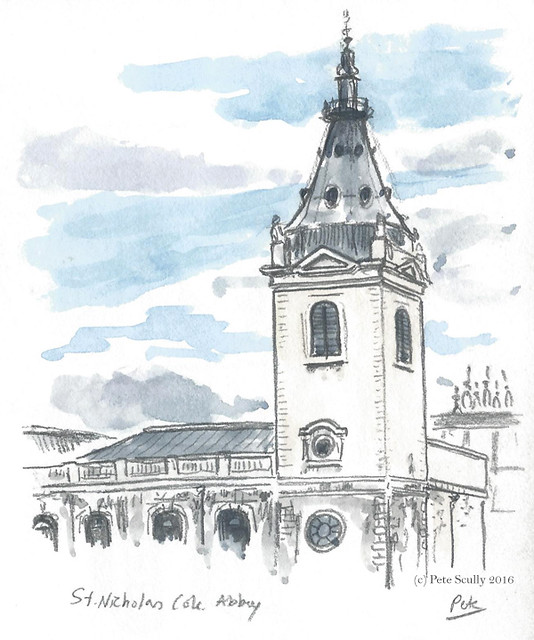
Then I sketched St. Nicholas Cole Abbey, which is visible across the street (now that the building that was in the way has been demolished, that is).
St Nicholas Cole Abbey

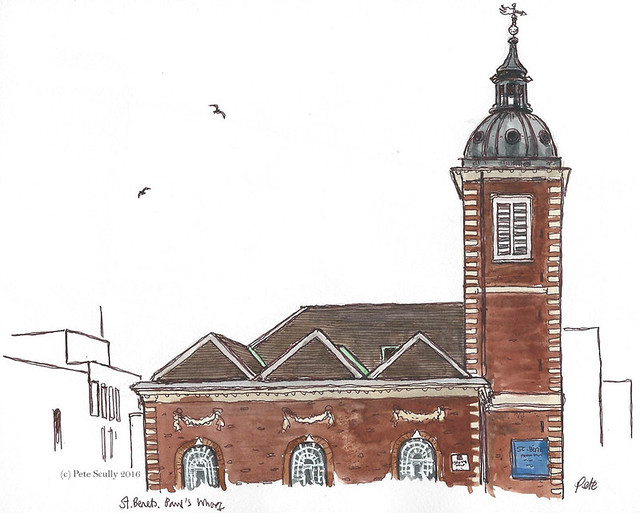
This one was sketched across a busy street, St. Benet’s Paul’s Wharf, the church where they hold the sermons in Welsh.

St Benets Paul's Wharf

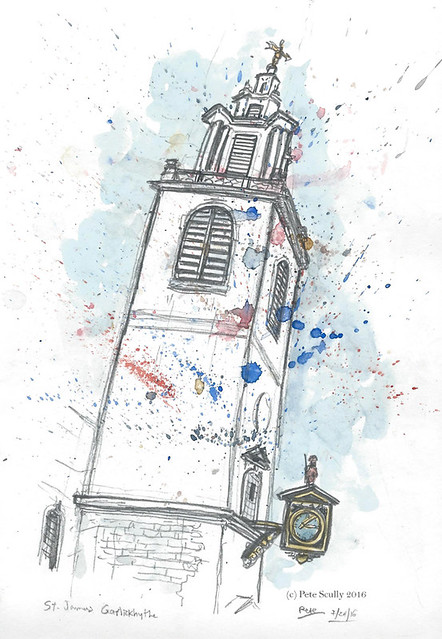
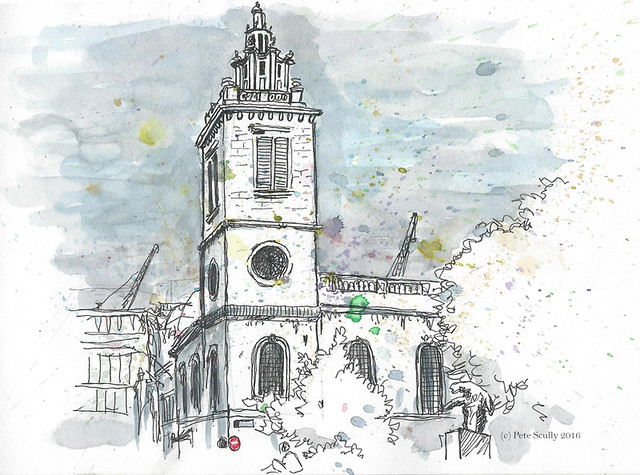
Ok this next one was sketched from an angle and with the very loud and quite chaotic bells ringing. St. James Garlickhythe (haunted by “Jimmy Garlick” who sounds like an old washed up musician from the early 70s). I did the old paint splatter thing because the great Tia Boon Sim from Singapore was on the sketchcrawl and I’ve always been inspired by her paint-splatter styles. It seemed appropriate given the noise of the bells!

St James Garlickhythe

My final sketch was of the neighbour to St. James, which is St. Michael Paternoster Royal. What I loved about this crawl was that wherever I went there would always be at least one or two other sketchers there busy plugging away. This by the way is the church where legendary (but historically very real) Mayor Dick Whittington (he of the cat and the pantomime) was buried. Nobody knows where his grave is now though, but while Wren’s tomb says “Look Around You” I presume Whittington’s tomb says “Look Behind You”.
St Michael Paternoster Royal

And then we met up at The Monument, to look at each other’s sketchbooks. Of all the people that made it to the finish (and quite a few did not; I checked the number of maps given out and I think we had around 80 participants total), we got together and I read out the names of each Wren building, asking sketchers to raise hands if they had sketched it.

You’ll never guess – we sketched ALL OF THEM. Every single one! Great job, London sketchers!!!

Here are a few photos from the end. You can see more at Urban Sketchers London (JAmes Hobbs has posted a nice set “In Wren’s Footsteps“) and on this Flickr set “Sketching Wren’s London“.

Afterwards several of us went to a pub near Borough Market for a post-sketchcrawl-pint. I sketched two sketchers, Rachel and Jimmy…

jimmy and rachel

And here is the final group photo at the base of Wren’s Monument to the Great Fire! Can’t wait to sketch with Urban Sketchers London again in the near future. So nice to meet so many new sketching friends.

IMG_0611

Oh, and everyone got a sticker!

sketchcrawl in trafalgar square

Trafalgar Square

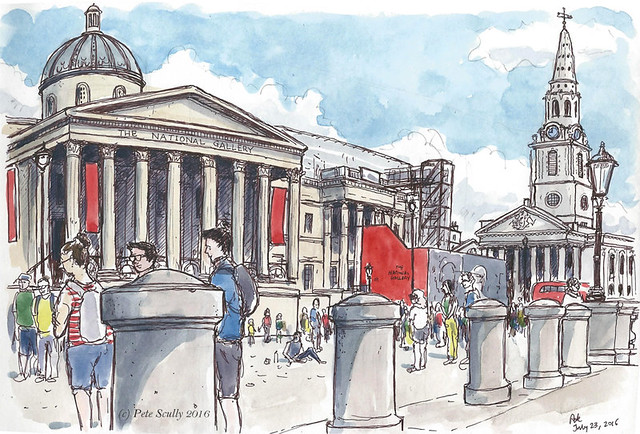
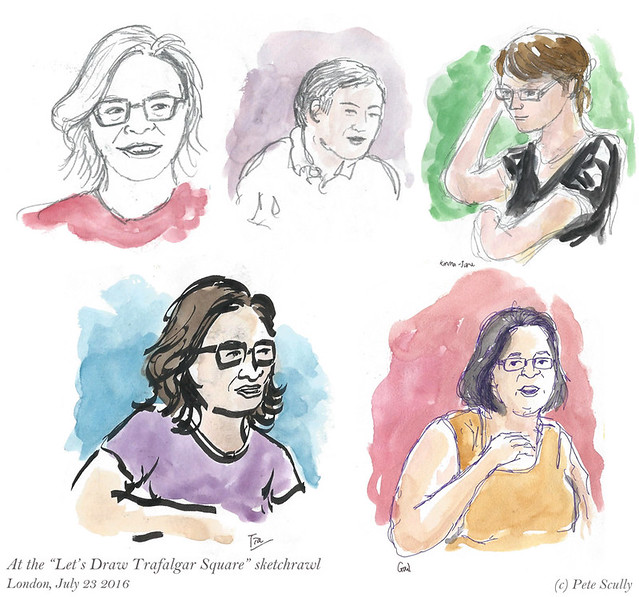
On Saturday July 23 I went along to the “Let’s Draw Trafalgar Square” sketchcrawl organized by members of Urban Sketchers London. It was a hot, sweaty day, and the Square was filled with people: tourists, buskers, and people playing Pokemon Go. By the way I love how Pokemon Go is the latest Thing-To-Be-Annoyed-At among the moaning classes, just the mention of the words ‘Pokemon’ and ‘Go’ automatically bring forth  well-rehearsed stories of people walking in front of buses or just not looking up from their phones in the street, neither of which were things that ever happened before people started catching Porygons and Spearows just a few weeks ago. I bet if you had a referendum to ban people playing Pokemon Go you’d get more than half the population saying “Gotta ban em all!” Just let them be, grandad. Anyway, as I sat and sketched the National Gallery and the church of St. Martin-in-the-Fields, a man on an unusual bike in front of me beckoned tourists to have a go and try to win ten quid from him. I didn’t sketch him. I did speak to a few tourists, giving directions and talking about the sketchcrawl. The crowds really did start getting a bit much, but I look at this stretch of pedestrianized goodness and I still remember how much of a coughing traffic mess it used to be. That right there is where I would get my Night Bus back to Burnt Oak in the wee hours of a Sunday morning, twenty years ago. It’s so much better now.

Charles I statue, Charing Cross

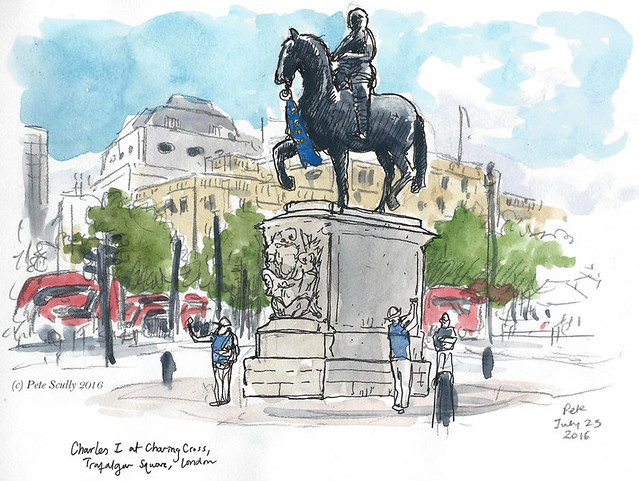
We met up at half-time by the column of the Grand Old Duke Of York, and the sketchcrawl’s numbers had swelled to include many more of the international sketchers who would soon go up to Manchester, including a large contingent from Singapore. So great to see so many familiar faces, such as Tia Boom Sim (Singapore), Omar Jaramillo (Berlin) and James Oses (London), and also meet many new ones I had only ever known from following online, such as Stephanie Bower (Seattle), Patrick Ng (Singapore) and Emma-Jane Rosenberg (Ely), and many others. Above though is not the Duke of York, rather this is King Charles I. He is holding a European flag, which is either a pro-Europe protest or the opposite, depending on your views of Charles, I guess. Look at all those Boris Buses milling about in the background there. The interior temperature of those buses was on that particular day hot enough to fry an egg (but to do that you needs to brexit first). No, I didn’t get it either. This statue by the way is the middle of London – all distances from London are measured from this spot. Charles was the shortest English king (well, the shortest adult English king). After his head was chopped off, just down the street from here, he was considerably shorter. Ok that is your history lesson done now. I sketched this while squashed against a wall next to Tesco Metro, itself a highly squashed experience, stood with paints balanced on elbow, while a large number of anti-Mugabe protesters from Zimbabwe paraded past, while tourists waved selfie-sticks in front of them, and absolutely nobody was playing Pokemon Go. Samuel Johnson said a couple of centuries ago that the full tide of human existence is at Charing Cross, and he wasn’t wrong. I bet he would have hated Pokemon Go though. Imagine his face when you asked whether Jigglypuff, Blastoise, and Lickitung are in his dictionary! It would have caused him terrible pericombobulations.

palace theatre London

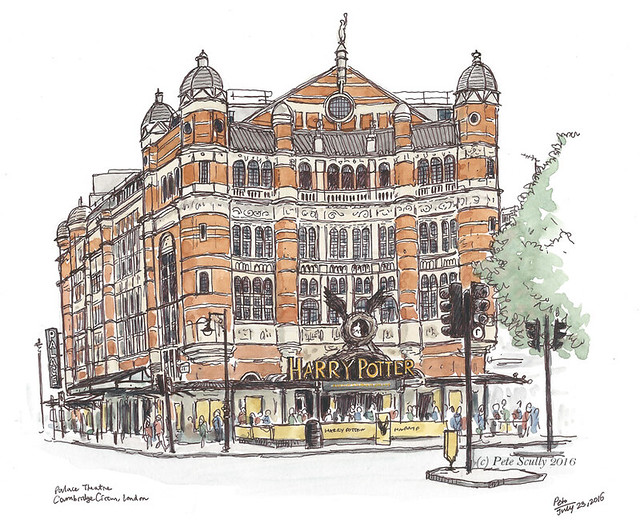
I had to leave the Trafalgar-Squarea (tourists! This is a real term used by actual Londoners by the way so you should definitely say it next time you are there) and escape to the slightly less busy area of Cambridge Circus. Still a busy bustling Bedlam, but I was able to find a spot next to a pub and sketch the Palace Theatre, where currently they are showing the play about Harry Potter, call “The Cursed Child”. I just read the expensive hard-bound script, and I can reveal it is pretty good, and probably makes more a hell of a lot sense watching it on stage. Tickets are sold out for the next century and a half, and it’s in two parts, for some reason (I think the reason rhymes with the words “bunny bunny bunny”). I have wanted to sketch this theatre for ages, so the Potter connection gave me a good reason too (for example if I sell this sketch, then the reason may well rhyme with “honey honey honey”). I remember when Les Mis ran here for about six hundred years, or something. I sketched for an hour and added the colour at home, as I had to run down to St. Martin’s for the final meeting of the sketchcrawl, where everyone puts their books on the ground and looks down at them. It was a fun event and I am glad I went, a good sketching first day back in London, and I spent a good bit of time catching up and chatting with my fellow sketchers afterwards in the cafe in the crypt beneath St. Martin’s. By the way that cafe is the place to go when it is hot outside and you want a lukewarm fizzy drink. I did some sketching of the sketchers…

Sketchcrawl Sketchers sm

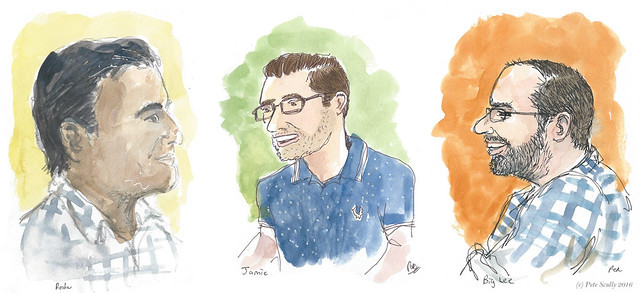
And afterwards I met my friend Roshan, and we went for dinner, then out for a nice relaxed beer in Covent Garden, being joined by other friends Lee and Jamie. I sketched them too. A couple siting next to us kooed over eagerly at my book while sketching, it seemed like they thought they might be next in the book, but alas my sketching energy needed conserving for the next day, when I would be sketching Wren’s London. Nice segue there into the next post, huh!

Roshan Jamie Lee

fifth street on a sunday morning

5th St Panorama July 2016 sm

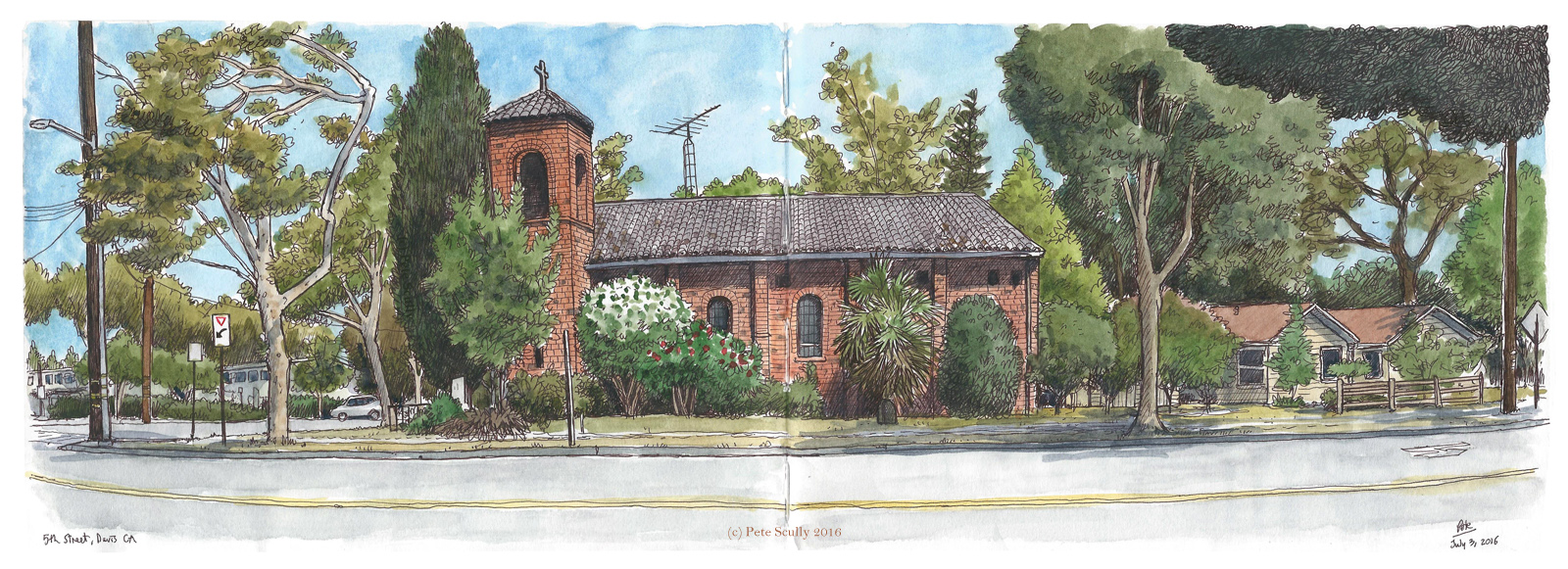
Carrying on the series of street panoramas going from 1st, 2nd, 3rd, 4th and now 5th. This is Newman Chapel on Fifth Street, Davis, on the corner of C Street. I have drawn it before, a few times. But it is nice so it is always worth drawing again. If you live in Davis and are at a loss for something to draw, just come and draw Newman Chapel, it’s small and simple but pretty, and the light is usually good. I sat opposite on a nice Sunday morning on Independence Day weekend (it was the 3rd) (by the way I hope you had a fun Independence Day everyone in America! I just want to know, why do you have to have fireworks on a date when the sun goes down so much later than on the rest of the year? Could you not have declared Independence in, I don’t know, mid-October, or some time in April?* Then you can have fireworks at a decent hour and tired kids can get to bed a bit earlier, I’m just saying, it’s just a suggestion America, it’s too late now but any other countries wanting to declare independence should probably consider this. Just think of the children, the sleepy children!) (Actually I bet Jefferson and co did take the daylight thing into consideration, thinking “well, we don’t have electric lights and stuff so let’s have Independence Day on a day when people can celebrate in as much daylight as possible, yes that makes a lot of sense actually, and schools are out so kids can stay up as long as they want, what is a firework anyway,” that’s what Jefferson and co thought. It’s worth pointing out that schools are indeed out over here by this point, unlike in Britain, which I’m sure factored in the whole Independence thing too, “we’ll finish school when we want!” I’m sure the politically powerful Summer Camp Lobby had a say in matters as well, arguing for longer summers. I’m digressing well off topic here but can I just say, summers off school are very long over here and figuring out what to do with the kids all summer can sometimes be a challenge. We watched the fireworks in Davis from the Green Belt with all the other families in our neighbourhood, all the kids running around in the dark with their glow sticks, it was like a rave for very small tired people. The firework display itself was at Community Park, just opposite, but we avoided the throng of people over there who went to listen to live music and a poetry reading by the Davis Poet Laureate before the big firework s went off, staying in our little Green Belt park. It’s a very family atmosphere. Davis is a very family town.

This was sketched in the Seawhite of Brighton sketchbook #4, all ink done on site and coloured in later when I got home (after going for food and drink at some friends’ house).

*I just need to point out that in fact Independence Day should have been in April, it was signed 7/4/1776 right, which technically should be the 7th of April (think of Oliver Stone’s famous film ‘Born of the Seventh of April’), meaning you could have had fireworks after dinner and then got the kids to bed and still had time to watch a movie, but for some reason it isn’t. That’s fine, I totally prefer July anyway.

st clement dane

St Clement Dane
The last sketch from London. I was there for two weeks, but I didn’t sketch as much
as usual. Perhaps on my next trip I will get more done – the International Urban Sketching Symposium this year will be held in Manchester and I do hope I can go. Early-bird Registration opens on January 30 ($415 though, may have to sell a few drawings first!) If I do go, I will try to organize another themed sketchcrawl in London on the weekend before, maybe on the Sunday. We will see. London Urban Sketchers are holding one on the Saturday before (they like to set out the year’s “Let’s Draw…” sketchcrawls in advance), so I’ll try not to clash. I do like a themed sketchcrawl, and back in 2014 I did organize one called “Sketching Wren’s City”, which went from the Monument down to St. Paul’s, taking in as many of Christopher Wren’s buildings (mostly churches) as possible. I provided everyone with a hand-drawn map and lots of information; it was immense fun, and we topped it off with a visit to the Old Bell Tavern on Fleet Street – also designed by Wren.You can see the sketches I did, and find out more about the sketchcrawl here.

One Wren church we did not make it to (being just outside the City borders) is this one, St. Clement Dane. I used to pass by here every day when studying at King’s College, and it’s in an amazing location, on a traffic island at the intersection of Strand and Aldwych, just where the traffic turns to down towards Temple Station and the Embankment. Further down Strand behind me is another church on a traffic island, St. Mary-le-Strand, known to taxi-drivers as “Mary-in-the-way”. St. Clement Dane’s is more famous – its bells regularly play out the tune to “Oranges and Lemons”, after the nursery rhyme that mentions St. Clement’s, although it’s possible that the church in the rhyme is actually st. Clement Eastcheap. St. Clement Dane dates back to Anglo-Saxon times, and though the ‘Dane’ part of the name also dates back this far, it’s not exactly certain why, though this church was located at the very edge of the ‘Danelaw’, the large swathe of England ruled by the Danes. The current building, designed by Wren in the 1680s, was gutted by bombs in World War Two and restored in the 1950s. The large statue in front is William Ewart Gladstone, the former Prime Minister. Behind him are two more statues, of prominent Royal Air Force chiefs Hugh Dowding and Arthur “Bomber” Harris (unseen). This church has long had connections to the RAF, and contains many memorials to fallen airmen. Behind the church is a statue of Dr. Samuel Johnson, writer of the first English dictionary, who lived nearby off of Fleet Street. And just visible behind St. Clement’s are the Royal Courts of Justice.

I stood on the edge of the traffic island and sketched, as the day started drifting away. Days are so short in London winter-time, and I had to get back for dinner. Goodbye London, until next time.

final stretch of the year

C St panorama dec31 2013 sm

This was the very last bit of urban sketching I did in 2013. I went down to C Street and sketched this frat house, with the Davis Community Church on the corner of 4th St, in the very clear blue sky weather. Well, I say weather. This is the Land that Weather Forgot. The first New Year’s Eve I ever spent here, there was a massive rainstorm, and whole swathes of the local area were flooded. I remember cycling to the edge of town on New Year’s Day to look at what were effectively new lakes where fields used to be. I was so new to town I just expected it to always be like that. Well, it isn’t. It didn’t rain very much in 2013, barely at all. Lately the weather has just been well, nothing. Not even cloudy. It’s not like I want ice storms and tornadoes or anything, but it feels like whoever is in charge of weather here left it on one setting and then went missing. Anyway… 2013 is over, and here’s the last panorama. This frat house is new, built only recently. It replaces a very similar looking frat house, one much older that was demolished last year. That building was well known among former Davis students, a fairly grotty place by many accounts, but much loved and one of the oldest (perhaps the oldest) building in town. Well this one i here now, overlooking Central Park, and it catches the afternoon shadows in the same way so finally it’s in a Scully sketchbook. I like a panorama. Below are the two halves of it, larger so you can see them better.

C St panorama dec31 2013 LEFT
C St panorama dec31 2013 RIGHT

under dreaming spires

Barcelona Cathedral

This is Barcelona Cathedral. Not the Gaudí one you’ve all heard of (and not the Camp Nou, which is also a kind of cathedral, of sorts), but the Cathedral of the Holy Cross and Saint Eulalia, built between the 13th and 15th centuries in the old town. The neo-Gothic façade wasn’t built until the 19th Century,  so all in all this makes the Sagrada Familia seem like a rush job. These sort of epic buildings take time. It’s all quite stunning. This was on a warm Saturday afternoon, and I was on my way to the final sketchcrawl meeting at the end of the Urban Sketching Symposium. This took me less than an hour of quite rapid sketching, which for all the details I was quite impressed with. I added the colour later on, as I had to get a move on. I do wish I’d had time to go inside, I understand the interior is quite lovely. I sat in the shade to sketch this. I love sketching a cathedral. Cathedrals, pubs and fire hydrants, that’s me.

all good things

newman chapel, davis
Unlike back home, Good Friday is not usually a day off for me here in the United States. Easter Monday continues not to be. But this year it was, because it also fell on Cesar Chavez Day, and for that equally good day, my stressfully busy week is shortened so I can sleep in a bit, pop to the shops to get frustrated at how little decent Easter chocolate there is, get my hair cut really short, and of course take the time to sit on the sidewalk for a couple of hours and draw something. This is Newman Chapel on 5th and C, Davis, which I have sketched before from different angles. I’m not a religious man as you know, but I like having Good Friday off. Any holiday that is on a Friday is good in my book.