The Theatre of the Thames

London South Bank 081525

More from last August in London. It was a lovely day down by the Thames, one of those perfect weather days, not too hot, nice river breeze, sunshine with a few wispy clouds. We were going to have a family day out down here, watch some theatre, eat some dinner, walk down the river. I came down a little early to get some sketching in, and drew the view over to St. Paul’s and the City. That skyline has changed so much since I left 20 years ago. I had bought tickets for The Merry Wives of Windsor at the Shakespeare’s Globe Theatre, in the seated areas rather than standing in the groundling spots, and I got the comfy cushion too. Those seats are a lot more than the standing sections, but I thought, well it’s important to support the London theatre scene. I did donate to the Globe during the pandemic when they were closed, they were posting full performances online and they were fantastic. To my shame I had never been to see a play at the Globe, in all those years since it opened. I’ve been to the gift shop loads of times. I remember when the Globe opened, as I was a drama student at Queen Mary at the time, and I wondered if it would get confusing that there is another theatre called The Globe down by Shaftesbury Avenue (that was subsequently renamed The Gielgud). Our ‘Places In Performance’ class taught by Richard Schoch (he is a published Shakespeare expert; he also recently wrote a very well-received book about Sondheim) did a tour of the new Globe, and some of the faculty at Queen Mary were part of the Friends of the Globe. I remember trying to walk there from north of the River and thinking, we could really use another bridge here you know, a pedestrian bridge nearby to St. Paul’s; a couple of years later we got the Millennium Bridge. I remember the tour, learning about Sam Wanamaker, the American actor (and Zoë Wanamaker’s father) who was the driving force behind the idea to rebuild the Globe right here in Southwark, but who did not live to see it finished. Yet in the twenty-seven years since my visit, I never ever saw a play there, until now!

Globe in pencil 081525

I selected our seats carefully, considering how the sun might move in this afternoon play, but obviously I completely miscalculated that because for the first half we were baking in the sun. Note to self, evening performances next time! It was great though, the performances were fun, I couldn’t tell if everyone was really following it but the costumes and physical humour was top notch. I did try a quick sketch before the show started (above) but didn’t draw during the show. I would like to do a proper sketch of the Globe’s interior some day, I’ve drawn the outside as few times.

This was not the only theatre I saw while I was back – I booked tickets to see My Neighbour Totoro at the Gillian Lynne Theatre on Drury Lane, a stage adaptation of one of our favourite animated Miyazaki films. It was without doubt one of the best things I have ever seen, so good that I immediately booked tickets to see it again when I got home. It was that good, especially how all the live music was performed. Looking at the program I realized that the director was Phelim McDermott, who co-founded Improbable Theatre Co, and I’d forgotten that name until that moment. I had seen his production of Shockheaded Peter many years ago at the Battersea Arts Centre, in about 2000 or 2001, and it erupted my imagination; some of the style of Totoro rang a bell with me. There were some elements of my own production of The Lion, The Witch and The Wardrobe in Aix-en-Provence in 2002 that were definitely inspired by that show. As a former drama student I don’t actually go to the theatre very much at all, so to go several times in one trip felt like making up for lost time. I even bought cheap five quid groundling tickets for Twelfth Night at the Globe a couple of weeks later, after my trip to Poland and Berlin, but ended up going sketching instead. I must go and see some more theatre though, and make more of an effort to see more in London.

Thames skyline 081525

Sometimes the best theatre is out on the streets though eh. Ooh, cheesy and not actually true. No, the streets is not the same as the theatre which takes a lot of effort in writing, acting, costumes, lighting, front of house; no, just standing on the streets and looking at things is not the same. The view above is quite a theatrical backdrop though. But nevertheless I do just that, I like to fill the sketchbooks with the stories of the world I see, and that is all my own story, my own theatre. I have often thought about the interaction between theatre/performance and urban sketching. As urban sketchers we ourselves might not see ourselves as performers but in a real sense we are. The act of standing on a street and observing makes us the ‘watched by C’ part of the Peter Brook equation of “A plays B watched by C” (that’s a very rough and probably inaccurate summarizing of his ‘Empty Space’ idea but I learned this in the first term of my drama degree, and that was in 1997 and I barely understood anything about theatre then, and probably even less now, but this ideas we discussed stuck with me, that everything can be boiled down to performance in some way). If I decide to observe and describe the scene in my sketchbook, I then become both observer (C) and performer (A), while the scene I am sketching becomes (B), the thing I am performing. I am starting to see why we drank so much at university now. That confusing calculus aside, the urban sketcher themself becomes a performer and attracts observation from people passing by, or sketched by other sketchers (A performs B watched by C who becomes A making the original A become B who is also performing another B which is also A; I’m surprised I didn’t get a D for that class). So we urban sketchers are performing in the act of drawing, and also in the act of sharing online with our fellow sketchers, who are the audience who then hopefully become inspired to keep sketching themselves. The thing I think about most though is that urban sketching, perhaps unlike more fine art styles, is an accessible art form that people feel more of a connection to when they see it. This is the everyday world as seen by the people living in it, who draw it because it’s there with the tools they have. I was always more interested in the basic idea of theatre as a storytelling device, one that anyone can take part in. I appreciate amazing acting, and the incredible hard work that goes into it, but it never interested me personally as much as the storytelling itself. We learned about interactive and forum theatre and the work of Boal, and I was very interested in Brecht. I look through the hundreds of posts each day that my fellow urban sketchers across the world are posting (that is, as much as the dreaded algorithms allow), and in very small and very big ways we are telling the story of the world we live in. It’s not necessarily in big determined narratives or five act structured entertainments but it’s all theatre of a sort, storytelling is at the heart of it, even if you don’t realize you are telling a story. I think a lot about this and try to get this small idea across in the sketchcrawls I organize. As with the interactive theatre work we did it’s all about accessibility and inclusiveness (in those first sketching events I ran, I brought along extra art materials and mini sketchbooks for people who saw us and might want to start sketching themselves) and what tools you have to tell your story with, that’s how I approach urban sketching. Or maybe, as with so many things with me, it’s just another excuse to draw.

The scene above, of the 2025 version of the City of London skyline, was drawn before the sun started setting, stood by Hay’s Galleria while people around me enjoyed an evening pint by the Thames. That skyline has changed so much in the 20 years since I left my home city, it’s unrecognizable. After this, my wife and I decided to walk down the Thames, and we walked and walked all the way to Charing Cross Station, for some reason. It was a really long way, and the South Bank was busy, really busy. London’s great, the Thames is my favourite, but it can be long and exhausting, just like some Shakespeare. Or some blog posts.

Friday night by the Thames

Globe Bankside 063023 sm

We definitely had to sleep in after getting back in the wee hours from Scotland. Exhausted, not feeling too well, and probably having withdrawals from all the Irn Bru and Tunnocks Teacakes, I didn’t have a lot of energy. However I had planned to go down into central London to attend the London Urban Sketchers Friday evening sketching meetup at Bankside, and despite my headache, I’m glad I did. It was cooler by the Thames, with a nice river breeze. I got there a bit too late for the start, so I just got my sketchbook out and started. As you can probably tell, this is Shakespeare’s Globe Theatre, with the tall tower of Tate Modern in the background. There were a lot of tourists about, enjoying the last day of June next to my favourite river. It was extremely relaxing for me to get down here and into my sketchbook. People lined up to see the latest show at the Globe; I really wish I’d had the forethought to book tickets to see something there, as I’ve never actually seen a play there, even though it opened while I was a drama student twenty-odd years ago. I remember our Places of Performance class did visit the Globe in about 1998 or 1999, when it was still a new addition to London, for a tour. During the early part of the pandemic, our family would watch full plays provided by the Globe online for small donations, filmed in the preceding years, since they were closed back in 2020 and we had no idea what would happen. So I love the Globe, but still have yet to go there properly. Some day.

Mudlarkers by the Thames 063023 sm

I have also never been mudlarking by the Thames. The tides were low that evening, so there were quite a few people down there looking around in the silty mud and stones, looking for whatever the old Thames has dredged up. People find things that are centuries old. I sketched them in my little Fabriano, looking down from the Embankment, and then sat on the steps leading down to the River. A couple of hours later, the water was already way back up there (I presume everyone got back up before that?). The Thames is a tidal river, at London anyway, due to its proximity to the Thames Estuary which is where it meets the North Sea. So the river goes right up and down a couple of times each day.

Thames View, London

The London Urban Sketchers met up again outside the Tate to look at each others sketchbooks. It wasn’t a huge crowd this evening, but I gather that the monthly “Let’s Draw London” sketchcrawl attendances have been so big that they have started holding them twice per month in the same location. These smaller evening events are bonus meet-ups for the summertime. I spoke to a few familiar faces, and looked through sketchbooks of some newer sketchers, and remembered how much I always enjoyed this part of urban sketching. I’d not organized or even attended a sketchcrawl in Davis or anywhere for quite a long time, so it was great to get to meet the sketchers again. I resolved to start organizing more in Davis again (and I just held one this past weekend, in fact, on a very hot mid-August morning). When we were done, I was not quite done yet. I stood beneath the Millennium Bridge (to all those tour guides who still insist that Londoners call it the ‘Wobbly Bridge’, no they don’t, do they. They did back in 2000 when it opened, and when it wobbled so much that all the high-end architects involved in its design were stumped and they closed it, but then they fixed the wobble and reopened it in early 2002. Nobody is still calling it the wobbly bridge except tour guides telling a story. And I used to be one of them, but that was in 2000 when  it was actually still wobbling) . Anyway, I drew that ever-changing City of London skyline again. Every time I return, it looks different. The top of Tower 42 was decked in Pride colours. I forget the names of all these towers now, the walky-talky, the big spinach, the witch’s watering can, the flake, I honestly cant keep up with all the silly names. Call them what you want. Call the Millennium Bridge ‘the Wobbly Bridge’ if you like, it doesn’t really matter. That’s the great thing about London, names just spring up out of nothing, sometimes they stick, sometimes they don’t. Even the Thames gets a name change when flowing through Oxford, where they call it the Isis, though maybe in more hushed tones than before.

Morph Shakespeare, Bankside

And finally, Morph. This year in London there are loads of statues of Morph, painted in a million different ways, and this one outside the Globe was as you’d expect painted to look like William Shakespeare. For those who for some reason have no idea who Morph is, Morph was a little plasticine stop-motion animated character created by Peter Lord, and appeared on the TV shows of the late Tony Hart, every kids favourite fatherly TV art figure (quickly checks online, we still think he’s ok right, no scandals there yeah? Phew, he’s fine. You never know when it comes to our 70s and 80s kids TV heroes in Britain). Tony Hart was also the only person we knew of who was named after three body parts. Morph was a national treasure though, even though he could only speak in little sounds, and he had a friend called Chas and this little brush that would follow them round like a dog. Oh, and he had a super power where he would turn himself into a kind of cylindrical tube of plasticine and ‘morph’ his way through the solid wood of a table. Having sketched Morph, the sun was finally down over the Thames, so I got a very crowded tube back home.

don’t you know you might find a better place to play

Living Room 053020 sm
Well the living room is all back to normal now I suppose and people are starting to go outside again, places are starting to slowly open up once more, and 2020 is starting to settle down into – no, no, this just in, 2020 is still a diabolical disco of dumpster fires mixed up with a party of poopy diapers dancing around a carnival of crap. 24 hour mental anguish, thy name is 2020. I’ve been feeling the weight of the world lately, the missing life in this bleak year. I can’t take any more news, or opinions, or anger, or politics, or lack-of-context-and-nuance-this-person-has-said-this-one-thing-so-scorch-them-from-the-earth, or this disease, this bloody disease, still racking up the numbers and not caring one jot about the angers and opinions of us puny humans. And the second half of the year will bring an election upon us, so no more watching TV shows with advert breaks in our house. But, small but important comforts – we have our living room back, and we can lie on the couch avoiding the news and turning off social media (ha! as if) and watching Shakespeare and HGTV and the Bundesliga. Football, football, football. The Premier League is finally back next week too, to give my mind a rest from all the real chaos and anger in the world, though speaking of which when is Tottenham’s Amazon show coming out? That will be a feast, though probably painful for such an avid Spurs fan as myself, given the season we’ve had. Formula 1 is coming back too, and not soon enough. I have watched so many old races. I rewatched the 1998 Belgian Grand Prix last week, oooh I had forgotten how crashorrific that race was, but also that they could just jump in the spare car and carry on! I miss watching F1 in the 90s though, I was well into it then. I’ve enjoyed the Shakespeare too, I’ve decided I want to build a Lego version of the Globe and put on little animated versions of the plays. I really liked the Globe’s production of the Merry Wives of Windsor, the silly performances really working with the crowd, and I watched the Donmar’s Coriolanus with Tom Hiddleston, that was good, though I admit I never finished it because it was long and I wasn’t really into it, I just really enjoyed the staging and the occasional Hiddleston histrionics. I cant wait for all the plays and movies and everything about this lockdown period, the COVID age, the Coronavirus times. I’m kidding, I definitely am not looking forward to those things. I’m also not looking really forward to the many ways they will restage Shakespeare as set during the time of lockdown, though you could have some fun with it. Shelter-In-Place-Shakespeare, the Social Distancing versions. The Merry Wife of Windsor, The One Gentleman of Verona, Romeo, and Juliet (staged as two separate plays – actually that might work really well) etc etc and so on. It’s not limited to Shakespeare. There’s Six Characters In Search of a Zoom Host (Pirandelli), Abigail’s Google Hangout (Leigh), the Caucasian Social Distancing Chalk Circle (Brecht, I’m stretching that one a bit, but he was into his Verfremdungstechnik so he’s fine with a bit of distancing) and of course Six Degrees of Separation (Guare, which speaks for itself). It’s not just with Shakespeare that I’ve been getting through this time, I’ve also been running a lot more than usual. It helps when I’ve got a head full of news, when the world seems too much, running and running and running is a good way to shake it off. And if you think “hey that’s very healthy of you,” I’m here to tell you that donuts are a good way as well.
My son's bedroom 052820
And here’s my son’s room, it’s very much a not-quite-teenage boy’s room, it’s also where he’s been doing all of his distance-learning schooling (until this week – he just left elementary school and will start middle school at the end of summer, in person we hope) Sure his room is not exactly tidy, but it’s considerably less messy than my room at the same age. I think at that age I may have still been sharing with my brother, who had on and off times of living at home (he’s ten years older than me). I remember we had bunkbeds and he would come home at all hours and he’d be sat on my bed playing Donkey Kong. He and my uncle would play tricks on me, such as holding my arm down the side of the bed and writing rude words all over it and sending me downstairs, haha. I remember he used to kick the bottom of my bed from below for a laugh, until one time it actually collapsed in on top of him, and that was a laugh, I still bring that one up. Fun times! One time I thought I’d play a trick on him and set up a trap above the bedroom door, I placed some empty bottles (plastic, not glass) above the door so that when he opened it they would all fall on his head. The problem is, he didn’t come home that night, I think he crashed at a mate’s gaff, and so my mum came in in the morning to wake me up, the bottles fell on her and broke her glasses. Whoops! As you can imagine I was in big, big trouble. I think the neighbours were woken up by the shouting, I mean the neighbours in the neighbouring counties. My brother laughed so much when he found out, he still brings that one up. Fun times! I used to draw that bedroom too, years ago. I wonder if I can find any old drawings from back then, probably. Well, these are the last ones of the house I’ll be doing for a while, now I can sketch outside when I need to. Thing is, I don’t know that I have missed sketching Davis much. I’ve drawn it so much already. Who am I kidding, I say that all the time and yet I always find things to draw! So in the next few posts, I’ll show some of the Davis sketches I did in the earlier part of 2020 before we were all ordered home. I miss the old outside world, as it was. But at least we have the living room back.

a couch! a couch! my kingdom for a couch!

Living Room is Back
Well after the flood thing we finally got a new floor and repaired walls and a return of the living room. Good opportunity to move a few things around. I’ve since put shelves back next to the telly and the coffee table back in the middle, I’m going to get a new dining table and have a think about the desk situation. Meanwhile cat furniture is being moved about, our poor cats just want the living space back. Our cat Sawyer was sick again, and had just come back that day from another stint in the hospital, needing lots of rest and recuperation. I celebrated getting both the couch and the cat back by watching some Shakespeare online – I’ve been enjoying the Globe Theatre’s productions aired on YouTube, so I thought I’d watch The Winter’s Tale. Unfortunately I wasn’t really into it, and my family thought it was a bit boring, so in my Winter’s Tale discontent I switched on one of my favourite bits of Shakespeare, the Ian McKellen version of Richard III from the mid 90s. Brilliant from start to finish, and I’d forgotten how many names were in that film. A younger Robert Downey Junior playing himself as Rivers, an about-the-same-age-as-ever Jim Broadbent playing himself as Buckingham, and an ageless Maggie Smith playing herself as the Duchess of York. So many more big names. Been years since I saw it. I did take part in a production of Richard III in my first year at university, not acting, I was on the art side of things, I helped with the props and drew maps and took part in making a huge floor for the stage, covered in newspaper clippings. I then helped with the stage management and getting actors’ costumes ready, just doing what I was told. The stage manager was a third year student who was a little bossy – I suppose you had to be – but she really liked yelling at us first years helping out (there was one moment where she did say “you’ll be like this when you’re my age”, though I pointed out I was older than her). She was alright though and the whole production was really well done and a fun experience, though I’ll never forget trying to pull a large wooden table I borrowed from the Territorial Army along with other props all the way down Deansbrook Road, and then I never used it (was I expecting to bring a table with me on the tube across London to Mile End?) I can’t recall the art director’s name now but she was really nice and I loved helping with all of that stuff. I did quite a few other productions at university during my time there but that was the biggest and most properly done. Unlike the version of Caucasian Chalk Circle by Brecht which I co-directed. A very fun experience, all acting in German, but this time it was my turn to be the bossy one. I was at first just playing Azdak the Judge, maybe the best role ever written, and perfect for me. In the first half of the play (before Azdak appears) I decided not to act in other roles but did all of the artwork instead. Since we had very little budget for a set, I took an overhead projector, some sheets of acetate and five coloured pens, and drew out entire sets to be projected behind the actors. I also drew a few people to be extras, moving around alongside the actors, and operated the projector from the front row. It was very Brechtian, I suppose. And then some people would always miss rehearsal, or show up way too late, and so when the director asked me to be co-director I just replaced their small roles with cartoon people projected on stage. It was a chaotic and highly silly play but immense fun and time well spent with some great people. It’s been a really long time since I did anything like stage work, and I’ve often toyed with the idea of getting into it again. but I think not. It takes me forever to set up a stage for a Lego animation, let alone anything bigger. Still, I do have ideas for some Lego animated Shakespeare (that isn’t three hours long) that I would like to do some day, but right now, I’m just enjoying having a new floor, never mind a stage.

My page is my stage. I like to think about the act of urban sketching in relation to performance, both the physical act of being out as part of the urban environment and also the creation of art on the page too. Years ago I would hide away, under the cloak of invisibility, until the first Symposium gave me the confidence to be part of the scene itself, and not worry if people came and looked at what I was doing, but to embrace it. The act of seeing other people out sketching can be a catalyst to go sketching yourself – someone else is doing it, I should not be afraid to do it too. There’s a whole road of ideas I’ve been thinking about on this subject, the crossover between performance/theatre and urban sketching, particularly the relation between community sketching events such as sketchcrawls and interactive theatre. The act of several sketchers positioned around a scene such as a few stalls at the Farmers Market turned those stalls into something else, a performance to be viewed, it doesn’t have to be a scripted performance but we are watching it, and recording it, telling its story through sketches. There’s a lot to unpack and I might get around to writing it all down some day; it was a topic I was going to explore in a talk at the Hong Kong Symposium this year, before that was cancelled, but I’m still developing the ideas. In the meantime, as the local shelter-in-place order starts to draw to a close, I’ll finish drawing around the house and finally get back to sketching outside.

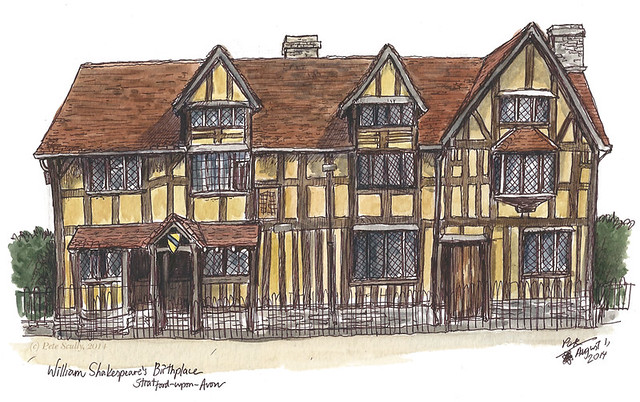
where the bard was born

Shakespeares Birthplace Stratford sm
After the day at Warwick Castle, we drove down through the countryside to Stratford-upon-Avon, a place synonymous with William Shakespeare, because all of the signs in this entire section of England say so. Stratford is a lovely place, in a lovely part of the country. When we got to the house in which Shakespeare was born and grew up, I had to sketch it of course. Yes, I’m a tourist and very proud of it. After this, we drove through the Cotswolds, which are lovely, before driving back to London. So now I’ve been somewhere else I’ve never been before!
me with the house Shakespeare was born in

never hung poison on a fouler toad!

richard III, wyatt auditorium
Last Saturday, I went to see a free production of Shakespeare’s classic play Richard III at the Wyatt Auditorium on the UC Davis campus. I’d never been to this venue before, but since I do enjoy this play and have a particular interest in the historical character of King Richard III, this gave me a great chance to sketch this old building from the inside, and watch some great drama too. This was produced by undergraduates in the UC Davis Theater & Dance department, a company called ‘Shakespeare on a Shoestring’ (‘SOS’), directed by acting professor Bella Merlin, formerly with the National Theatre in London, and Kevin Adamski. When I was a student of drama back in my own university days, I participated in a large production of Richard III, not as an actor but as the props and art assistant. I helped design this vast stage floor composed of newspaper cuttings, I drew maps of battlefields, and I remember having to go to my local Territorial Army center to borrow some militaristic gear from the quartermaster, which included a massive and very heavy wooden table, which – me being without a car or van – I carried by myself for nearly a mile. I had actually intended on bringing it across London on the tube; that never happened. I’m not so daft these days, I hope. This production, however, was a little more spartan – and that is how I like it. The direction was excellent, so even in the rare moments when the acting was less consistent a beat was never lost, and the scenes were almost always compelling. Richard (aka the Duke of Gloucester) himself was excellently played by Ryan Geraghty, every bit the villain Shakespeare’s text intended him to be. The most striking element was the music, inventive percussion provided at dramatic moments by the beating of simple objects, wooden blocks, plastic drums, metal pipes. The play was performed in its entirety, from what I could tell, clocking in at two and a half hours (with a brief interval). Naturally, I sketched.

I hadn’t intended on sketching on the program itself, but it just seemed like the appropriate thing to do, though it wasn’t suited for watercolour, obviously. One problem with sketching a performance, even of a play you know, is that you are never quite sure how long the scene will remain in the position you decide to sketch. Therefore I concentrated most of my time on the theatre itself, with its half-round seating broken by large wooden posts that often obstructed what I could see (there is no getting around that, for almost any spectator). So the scene I chose was the corpse scene between Richard and the widow of the late King, though Richard was actually hidden behind one of those posts for much of it. Therefore when I sketched him, I waited until a later scene when he was giving a more prominent speech to the audience. I drew him again, later in the play, on grey paper – though halfway through this sketch the lights went dark (having been unchanged the entire play) for the ‘ghosts’ scene, so I finished it in the battle scene (adding in his metal fighting stick, and those famous lines). It was a fun finale, with high-tempo percussion over a slow-motion duel between King Richard and Richmond, the future King Henry IV, founder of the Tudor dynasty (I must admit I was rooting for Richard). I can’t wait for the next one, Richard IV!
richard III

Of course, King Rick has been in the news of late, as you may have heard, in quite amazing circumstances. His body was lost for centuries, his true character – of which we mostly know Tudor accounts – lost to myth and dramaturgy, his demise known to us only that he was the last English king to die on the battlefield. That battlefield – Bosworth – was also lost to history, until just a couple of years ago, and last year a skeleton was dug up in an archaeological dig beneath a car park in Leicester, part of a medieval church long since buried. Once it was realised this was the church where the defeated king had been buried, it was an exciting coincidence when a skeleton was found which had the fabled curvature of the spine which Richard was alleged to have (but many believed this to be simply an imagination of the Tudors). This ‘deformity’, as Shakespeare would have us believe, destined him to be the pantomime villain, who would go on the murder his nephews in the Tower. When it was announced recently that, after extensive DNA study, these remains were of the lost King, it proved he did have scoliosis of the spine, making one shoulder appear higher than the other. We were also able to learn more about the manner in which he was killed, where each blow hit his body, and how his face was spared so that they could identify the body to prove that Richard III was dead. They didn’t have DNA mapping or CSI teams back in 1485. After all these centuries however, this enigmatic and controversial figure of English history is really and truly back, and still being talked about. Though Shakespeare’s play is undoubtedly a Tudor fantasy, its contribution to Richard’s legend and legacy is unavoidable,

“And therefore, since I cannot prove a lover,
To entertain these fair well-spoken days,
I am determined to prove a villain
And hate the idle pleasures of these days…” (Richard III, Act 1, Scene 1)