Friday night by the Thames

Globe Bankside 063023 sm

We definitely had to sleep in after getting back in the wee hours from Scotland. Exhausted, not feeling too well, and probably having withdrawals from all the Irn Bru and Tunnocks Teacakes, I didn’t have a lot of energy. However I had planned to go down into central London to attend the London Urban Sketchers Friday evening sketching meetup at Bankside, and despite my headache, I’m glad I did. It was cooler by the Thames, with a nice river breeze. I got there a bit too late for the start, so I just got my sketchbook out and started. As you can probably tell, this is Shakespeare’s Globe Theatre, with the tall tower of Tate Modern in the background. There were a lot of tourists about, enjoying the last day of June next to my favourite river. It was extremely relaxing for me to get down here and into my sketchbook. People lined up to see the latest show at the Globe; I really wish I’d had the forethought to book tickets to see something there, as I’ve never actually seen a play there, even though it opened while I was a drama student twenty-odd years ago. I remember our Places of Performance class did visit the Globe in about 1998 or 1999, when it was still a new addition to London, for a tour. During the early part of the pandemic, our family would watch full plays provided by the Globe online for small donations, filmed in the preceding years, since they were closed back in 2020 and we had no idea what would happen. So I love the Globe, but still have yet to go there properly. Some day.
Mudlarkers by the Thames 063023 sm

I have also never been mudlarking by the Thames. The tides were low that evening, so there were quite a few people down there looking around in the silty mud and stones, looking for whatever the old Thames has dredged up. People find things that are centuries old. I sketched them in my little Fabriano, looking down from the Embankment, and then sat on the steps leading down to the River. A couple of hours later, the water was already way back up there (I presume everyone got back up before that?). The Thames is a tidal river, at London anyway, due to its proximity to the Thames Estuary which is where it meets the North Sea. So the river goes right up and down a couple of times each day.

Thames View, London

The London Urban Sketchers met up again outside the Tate to look at each others sketchbooks. It wasn’t a huge crowd this evening, but I gather that the monthly “Let’s Draw London” sketchcrawl attendances have been so big that they have started holding them twice per month in the same location. These smaller evening events are bonus meet-ups for the summertime. I spoke to a few familiar faces, and looked through sketchbooks of some newer sketchers, and remembered how much I always enjoyed this part of urban sketching. I’d not organized or even attended a sketchcrawl in Davis or anywhere for quite a long time, so it was great to get to meet the sketchers again. I resolved to start organizing more in Davis again (and I just held one this past weekend, in fact, on a very hot mid-August morning). When we were done, I was not quite done yet. I stood beneath the Millennium Bridge (to all those tour guides who still insist that Londoners call it the ‘Wobbly Bridge’, no they don’t, do they. They did back in 2000 when it opened, and when it wobbled so much that all the high-end architects involved in its design were stumped and they closed it, but then they fixed the wobble and reopened it in early 2002. Nobody is still calling it the wobbly bridge except tour guides telling a story. And I used to be one of them, but that was in 2000 when  it was actually still wobbling) . Anyway, I drew that ever-changing City of London skyline again. Every time I return, it looks different. The top of Tower 42 was decked in Pride colours. I forget the names of all these towers now, the walky-talky, the big spinach, the witch’s watering can, the flake, I honestly cant keep up with all the silly names. Call them what you want. Call the Millennium Bridge ‘the Wobbly Bridge’ if you like, it doesn’t really matter. That’s the great thing about London, names just spring up out of nothing, sometimes they stick, sometimes they don’t. Even the Thames gets a name change when flowing through Oxford, where they call it the Isis, though maybe in more hushed tones than before.

Morph Shakespeare, Bankside

And finally, Morph. This year in London there are loads of statues of Morph, painted in a million different ways, and this one outside the Globe was as you’d expect painted to look like William Shakespeare. For those who for some reason have no idea who Morph is, Morph was a little plasticine stop-motion animated character created by Peter Lord, and appeared on the TV shows of the late Tony Hart, every kids favourite fatherly TV art figure (quickly checks online, we still think he’s ok right, no scandals there yeah? Phew, he’s fine. You never know when it comes to our 70s and 80s kids TV heroes in Britain). Tony Hart was also the only person we knew of who was named after three body parts. Morph was a national treasure though, even though he could only speak in little sounds, and he had a friend called Chas and this little brush that would follow them round like a dog. Oh, and he had a super power where he would turn himself into a kind of cylindrical tube of plasticine and ‘morph’ his way through the solid wood of a table. Having sketched Morph, the sun was finally down over the Thames, so I got a very crowded tube back home.

as long as I gaze on, i am in paradise

Waterloo Pano 051623 sm

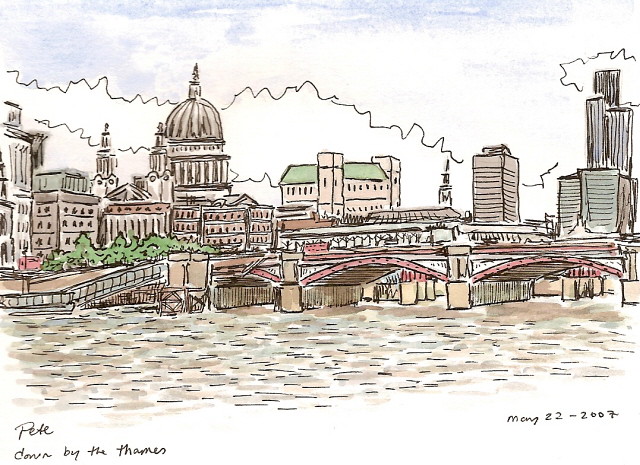
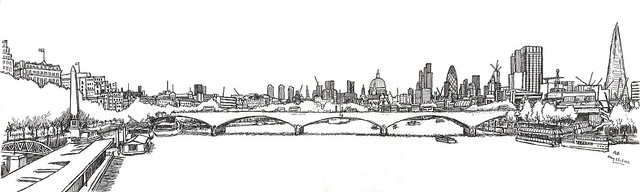
Before heading over to Mile End, I got out at Embankment station and onto Hungerford Bridge. Sorry, I mean the Golden Jubilee Bridge (Hungerford Bridge is just the rail bridge in the middle now, but I still remember the shaky old walkway on the side from years ago, it’s much nicer now). I wanted to start my day with a little bit of my favourite river, and draw this view towards Waterloo Bridge once again. I had intended to add in the blue and white sky, the brownish tinged Thames, but I got too hot standing on the bridge. I went and sat on a bench on the embankment beneath a tree to add it all in, but by that time the moment had passed, and my perspective changed all the colours, (that can happen with reflective objects like a river), and so I went to Mile End instead. But I’m glad I got this sketch done, as it’s been a while. Below are two other panoramic sketches from a similar location (not exactly precise, but same half of the bridge). The colour one is from 2016, the other is from 2012. Well, you can see the difference in the skyline. Obviosuly the bottom one includes the Shard but I didn’t go that far in the other two, but in the City itself, the buildings are all change. When I left London, it was just Tower 42 (the old Nat West Tower) and the Gherkin (Swiss Re as it was called, but it was always the Erotic Gherkin), just to the right of St. Paul’s. Now those are all but invisible from this view. There will probably be more coming, unless the economic downturn means fewer novelty skyscraping, but next time I draw this in about four or five years, we will see. I’ll need better glasses then, my eyes ain’t getting any younger.

Click on any of these sketches for a slightly bigger view, that will save you just moving your face closer to the screen.

The River Thames sm

london pano 2012

VTDF #4: Amiens

04 Amiens

Stage 4 of the Virtual Tour de France finds us in the northern city of AMIENS, on the river (and department) Somme. It is difficult to say the name ‘Somme’ without thinking of the historic atrocity of the 1916 Battle of the Somme, in World War I. Three million soldiers fought in that battle, with over a million wounded or killed. Amiens is right in the heart of World War 1 country, and itself saw a 1918 battle that ended in an Allied victory. World War II didn’t exactly pass it by either, with another Battle of Amiens in 1940 when Germany took the town, and later on pretty heavy bombardment by the Allies in 1944 before it was liberated. There were wars and sieges and sackings here in the many centuries before, but Amiens and the Somme are inescapably linked with the awful World Wars.

This is a nice view though, down by the river, looking up at the cathedral. I could imagine coming here and eating lunch by the Somme, before driving on to another town for a bit more history. I found out recently that an ancestor of mine from Dublin fought in World War 1 and was wounded in a gas attack at Loos, not far from Lens. I saw my great-great grandfather’s photo (his name was James Higgins, as was his father, and his son who I think also fought in that war?) and he had the most amazing bushy “General Melchett” moustache. He wasn’t a general though, just a regular soldier. I also saw a postcard he sent home to his wife (my great-great granny) in Dublin from Loos before the battle took place. Fascinating stuff, I never knew he even existed until recently. I never inherited the moustache. It was a big handlebar one with two pointy tails, that reminds me a bit of the Red Bull logo, or two rats fighting. I would not know how to take care of an amazing moustache like that, I would probably get it in my soup, this is why I shave. I only briefly had a moustache, though it was part of a goatee, and that was for a few months in the 90s and that my friend is where for most people goatees should have stayed. Funnily enough I never saw anyone in France with that classic French moustache, the one with the twirly sides, that all cartoon French people have (along with the beret and the onions and the baguette), but I have seen many hipster people in America wear that ‘tache. I couldn’t pull it off.

There does appear what looks like a lifesize Subbuteo figure standing in the river, to the left there. I think it is called “L’Homme sur sa bouée” (“The man on his buoy”). It seems that it’s common for the people of the town to dress him up, put t-shirts on him and so on. He is the work of German sculptor Stephan Balkenhol and was originally installed there in 1993, but being made of wood and manhandled by so many locals it degraded a fair bit over the years and was replaced in 2019 by the artist, this time in aluminium. Or maybe it is still wood but now painted in aluminium, it’s hard to tell. L’Homme sur sa bouée has become a bit of local celebrity in Amiens. There are two other similar statues by the same artist placed nearby against the walls of buildings that the man in the river is looking at. If I ever got to Amiens I will look out for them all. 

After Amiens we leave Picardy behind and head into another part of France famous for its role in World War II: Normandy. So join me on the Road to Rouen. 

Dublin part 1: This Is Your Liffey

Dublin GPO sm
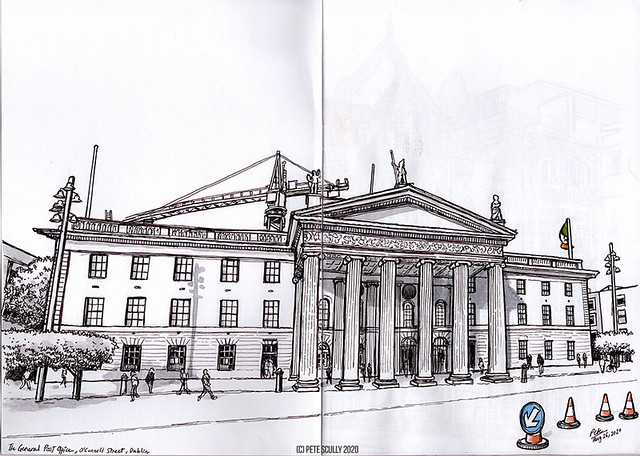
Earlier this year during the first months of the pandemic, Sheltering-In-Place, I decided that since there was no travel back to Britain this year I would do a virtual tour of the island, and that was a fun and enlightening journey. I wanted to do another virtual tour, maybe of France, but the thought of it overwhelmed me a bit (the planning, fitting all the places into a certain number of pages, and pretty much everywhere in France is sketchworthy) so I picked up a much thinner sketchbook a mate gave me last year from Dublin and decided to do a shorter virtual tour around Ireland. This quickly became limited to just Dublin (there are only fifteen spreads in the book) as the paper was very thin, too thin for watercolour, and I knew I’d need to add a bit more paint to the Irish countryside. Well, mostly green, and probably grey for the sky. But a trip around Dublin, well that sounded pretty grand. My mate who gave me the book was in the process of moving to Dublin while I drew this, so I was thinking of him at the time, but also of my own family history, most of whom came from Dublin, from my grandparents’ generation backwards (3 from Dublin, 1 from Belfast). I still have loads of family in Dublin, the vast majority I’ve never met or know anything about, except for my great aunt and a couple of my mum’s cousins I met when I was a kid. I only just recently learned about the family beyond my nan’s generation, when my sister dug a bit further, finding out some very interesting things about great-great-grandfathers with big General Melchett moustaches. Nothing too exciting, just regular Dubliners going back years. We just didn’t really know much though, people didn’t talk about the past. It was a fun bit of discovery, but Anyway, let’s start this Dublin journey off with that most important of Dublin buildings, above: the GPO, or General Post Office, on O’Connell Street. The first time I came to Dublin in 1988 this was one of the first places we came to (right before going to eat at Beshoffs, which I’ll never forget because I poured sugar all over my chips and got upset). I knew about the 1916 Easter Rising – hard not to, I was brought up on the rebel music – and this was the epicentre, the headquarters of the rebellion it was here that Pádraic Pearse read out the Proclamation of the Irish Republic. So, a good place to start, but we had a lot of city to cover, in no particular direction. So let’s set off around Baile Átha Cliath.

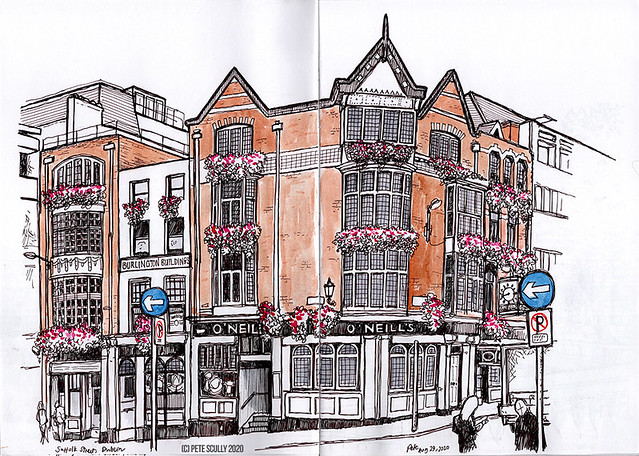
Dublin O'Neills sm We move down across the Liffey to the corner of Suffolk Street, Church Street and St.Andrew’s Street, to the huge O’Neill’s pub. I’ve never been here but I like the look of the building. This was the page that convinced me I wouldn’t be adding paint to any other pages (though I gave it a go one more time). You’ve got to draw pubs in Dublin. If I should come back I’d mostly be doing that. In fact I’d go when it is most likely to rain so I’d have an excuse to go to more pubs. I hear the rainy season is shorter than people say though, it’s only from August to July. (I got no problem recycling jokes from my London tour bus days, feel free to use that for whatever city, Manchester, Portland, Brussels). This one is near the Molly Mallone statue. Molly Mallone wheeled a wheelbarrow through streets of all different widths selling coppers with muscles from Hawaii Five-O. 

Dublin Four Courts sm Here is the river Liffey, with the Four Courts along the north bank. The river isn’t green, it just appears like that in with the trees reflected in it. It’s not been dyed like that one in Chicago does on St.Patrick’s Day (is it Chicago, I don’t know, or care). Also, it’s just green paint on thin paper. The Liffey (An Life in Irish) flows from the Wicklow Mountains, curves around a bit and ends up in Dublin Bay. Dublin is centred on the Liffey and has some lovely bridges, the most famous being the Ha’penny Bridge, the iron footbridge which I did not bother drawing because it’s difficult and I couldn’t be bothered. I’ll draw it in person maybe if I go there unless it’s raining in which case I shall be in the pub drawing people playing bodhrans. Last time we were in Dublin my wife twisted her ankle on it. The bridge you can see is called the O’Donovan Rossa Bridge which is from the 18th century. I remember a fountain/statue that used to be on O’Connell Street called the Anna Livia which represented the female embodiment of the River Liffey, my great-aunt told me they called it the Floozie in the Jacuzzi. It’s moved somewhere else now. 

Dublin Christchurch sm And this is Christ Church Cathedral. We stayed in an apart-hotel near here last time we were in Dublin, six years ago, and went to the Dublinia exhibit located in the big section to the left. That was a lot of fun, learning about Dublin’s Viking history in particular. There’s a lot of Viking in Irish history, my great-uncle Albert Scully used to tell me that the Scullys had Viking origins, but I don’t think he really knew, but it would explain why I read so much Hagar The Horrible when I was a kid I guess. I did love Hagar. Sorry, Hägar. And Helga, and Hamlet, and Lucky Eddie. They did that advert for Skol on TV where they’re all singing Skol-Skol-Skol-Skol but Lucky Eddie doesn’t know the words. That might be where the Scully name really comes from, people singing Skol-Skol-Skol. Skol is actually from the Danish for Cheers, skål, though in fact the beer originated in Scotland. This is really off topic now. By the way I am aware that ‘Scully’ bears zero relation to ‘Skol’ but it doesn’t stop Americans mispronouncing my name to sound like Skol, or mis-spelling my name with a k despite seeing my name spelled with a c literally all the time. It comes from “O Scolaidhe” meaning “scholar”, and like so many Irish names has one of those nice little shields you can get on keyrings in gift shops all over Ireland. My family names are pretty common Irish names: Scully, Higgins, O’Donnell, McIlwaine (that’s the branch from Belfast), plus there’s Barrys and Kennedys and Crokes and Byrnes and more in my siblings and cousins families, plus who knows what. I do remember going to Rock of Cashel (the ancient seat of the Kings of Ireland) when I was 12 and being stunned to find so many graves bearing the name of Scully, along with the big Scully Cross, which is more of a pillar these days, because the top of it was blasted off when struck by lightning in the year of my birth. Moral: don’t make a Scully cross?

Join me next time for part two of my virtual Dublin tour, when we visit another pub, a publisher, a campus, and I dunno, another pub.  

Alleviating All Anxiety of Amsterdam

Amsterdam Dancing Houses sm
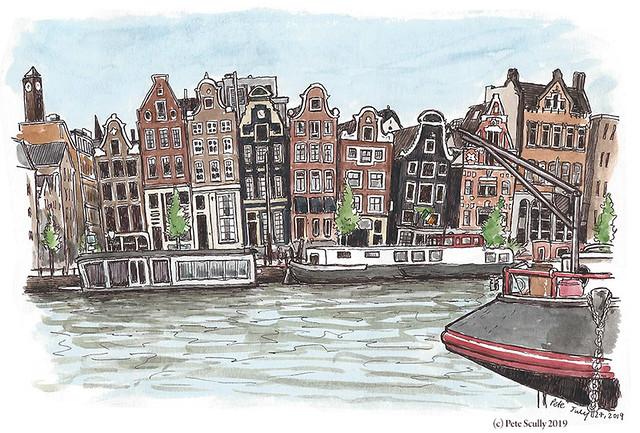
Moving on to the next day and the final day of the Symposium, I woke up Saturday morning definitely feeling the heat exhaustion. I decided to skip my final workshop (I did go and let them know so they wouldn’t be waiting for me) and find a spot to sketch peacefully. I hadn’t yet drawn the dancing houses along the banks of the Amstel from Groenburgwal, so I found a nice bench and drew away. I met another sketcher doing the same. It was quiet, the weekend heat had not yet started cranking up, and my stress-headache was clearing up immediately. I didn’t need to be in a class, stopping and starting and rushing, being “on”, I needed to be in “breathe-in, breathe-out, sketch” mode. It worked. I had met Lapin earlier the morning, and I was going to go and sketch with them (as it turns out he and Gerard and co went to sketch my hotel), but I decided to draw the Dancing Houses. They are impressive. Many houses seem to ‘dance’ in Amsterdam, leaning this way or that – my perspective tip of following the windows to find the vanishing point on the horizon doesn’t work as well here, where the windows follow lines more suited to more Marty Feldman’s binoculars (Young Frankenstein reference). Crooked buildings are fun to draw. By the way I did overhear one sketch instructor scoff at counting the windows on houses in Amsterdam, but counting the windows really helped the composition of each element, and also helps get the scale right. Besides, in Amsterdam they are usually three windows across as a rule. The patchwork nature of the architecture breaks up the monotony you find in many cities, it’s just so fun to draw. Looking back I probably could have had the energy to do some more group sketching and plough on, be a bit more sociable and awake, but mental health came first and I look at this sketch and immediately I feel more relaxed. Breathe in, breathe out, sketch.
Amsterdam Montelbaanstoren sm

I wandered about a bit more, bumping into the occasional sketching friend, I met Nina Johansson (long term urban sketch idol of mine since the beginning) teaching a class nearby here, the tall Montelbaanstoren. It was pretty peaceful over here too, a couple of blocks from my hotel, in fact the workshop I had skipped was being taught close by, but I decided not to join late. I sat by the canal and drew the tower as best I could, with a bike in the foreground. I was going to add full colour, but stopped at the blues, it just felt right for the relaxed mood.

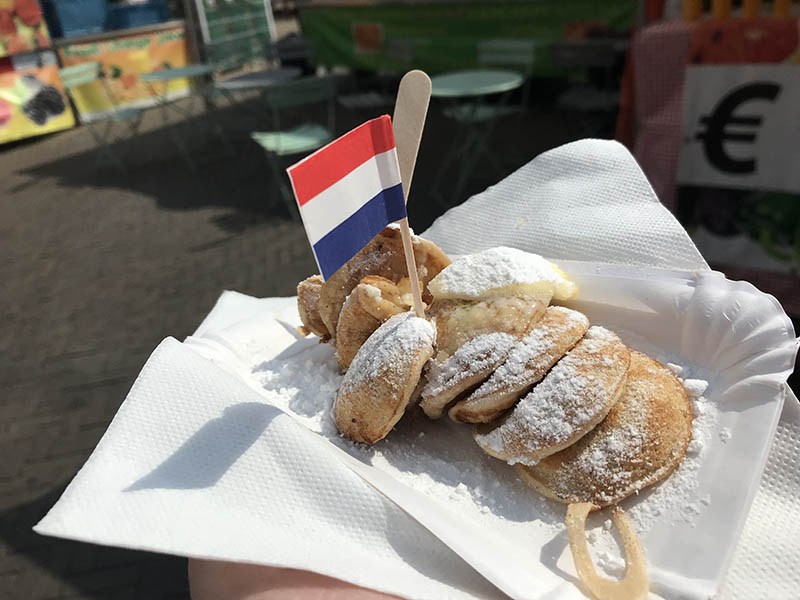
After doing a few sketches of the hotel (I posted those already), I wandered over to Niewmaarkt to enjoy one of my favourite discoveries in Amsterdam – poffertjes. Little mini pancakes, from a friendly guy called Tony Benson. I spoke with Tony and a woman who was with him, we talked about Belgian footballers (maybe because I was wearing my Belgian shirt again), she was really inot Eden Hazard and asked who my favourite Belgian player was (Super Jan Vertonghen obviously!). The poffertjes were small but delicious. I could eat some of those now.

IMG_4288

In the afternoon, there would be another sketchwalk, over near the NEMO center, culminating in a huge group photo (the ones I usually miss at every symposium), and then the final reception over at the Muziekgebouw. I was going to meet up with everyone there, but at the hotel I realized I really needed more rest, not more rushing around in the heat. Here’s how I rested:

656A08CA-1A5D-4FA8-9EEB-17238944DC7E

I also rested by spending an hour or so in the amazing blue-tiled pool in the hotel’s basement, and relaxing in the hot-tub. Best decision I ever made. Matt Brehm was right, you don’t have to draw.
The sketchwalk was nice, and although I turned up too late for any sketching, I did meet up with a lot people I had not seen during the symposium. Many of the local groups got together for their local group photos – I am one of the Californians, but I wasn’t quick enough to get a photo with them. I did at least make the final group photo, but there are so many people in the picture that I obviously can’t be spotted, even with my bright red Belgium 1984 shirt. Actually though, in this photo of the whole group (by Belgian friend and photographer Marc Van Liefferinge) I can be spotted near the middle of the back. Proof I made it there.

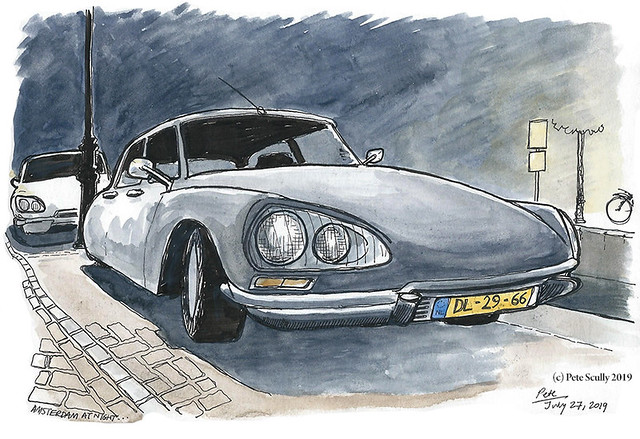
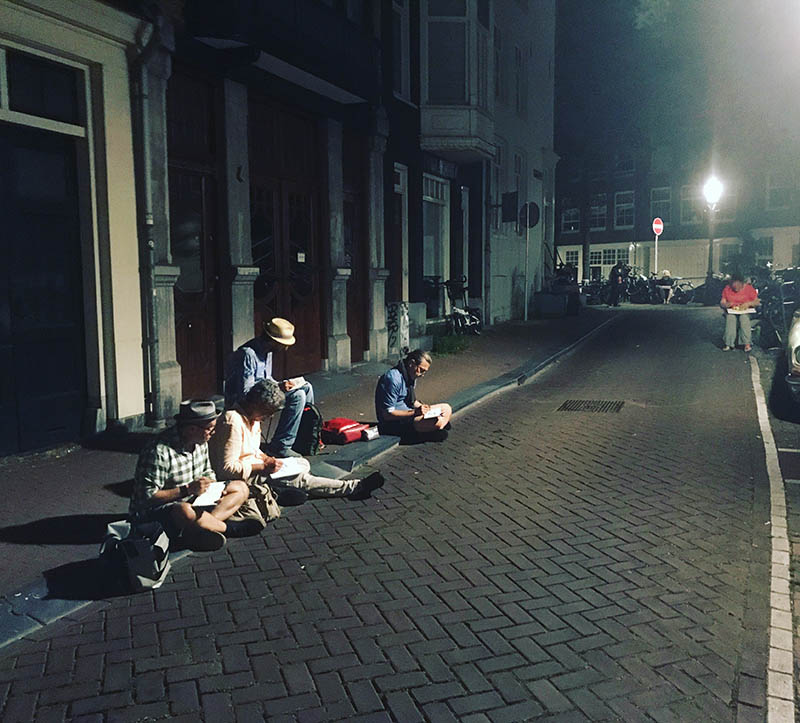
You know what, there are loads of sketches you can find from other symposium attendees, if you go to Flickr and search through the tag “amsterdam symposium“. Of course most people now just bounce them out on Instagram and so on too. There are a LOT of Amsterdam sketches to be found. I went over to the final reception (a very very long walk, I went with Mauro and Fabien, though Fabien stopped on the way for a beer and to wait for Gerard, they were not coming to the reception but actually driving back to Liège that night). At the reception I caught up with all the people I had not spoken to as much so far, such as Gabi, and Liz (we snuck up on Paul Wang and got our annual symposium pic of the three of us, guerilla-style), Elizabeth, James, and of course Rita, and did a little people sketching, but mostly chatting. I also got to meet Danny Gregory for the first time, he was there with all the Sketchbook Skool lot, that’s a big thing now. I had been a chapter in one of his books years ago, the one with my drawing of Vipins ont he cover, and we’d tried to arrange a video interview to go on his website but it was always dinnertime in my house and we never did it, so it was nice to finally meet. (Though I suspect I he didn’t remember who I was). I also met a number of people who I’ve since started following on Instagram, it’s what these whole events are about really. And then in the end, it was the gathering off for dinner, I went off with a big group of the usual sketchers, and we had a great evening. The best bit though was finishing off with some late night or early morning) car sketching. A bunch of us led by Lapin sat in a narrow street by a canal and drew a couple of classic Citroens. This is apparently a tradition at the Clermont Ferrand festival. My habit of sketching fire hydrants at 3am when I travel does not seem so odd now; these are my people. One of though people though, Hugo Costa, nearly fell in the canal when his stool broke – lucky escape! Here’s what I drew, and a photo of some of us sketching in the darkness of Amsterdam.
Amsterdam Night Car Sketching sm

D60DF3F5-1FE9-4E07-8BB3-517B3FDB8025

Now this little fire hydrant I actually drew at night on the first night in Amsterdam, but I’ve saved until now because why not. As for the blog post title, “Alleviating All Anxiety of Amsterdam”, I mean it says it all but seriously I might come back and change all these titles some day.
Amsterdam Hydrant sm

And that was it for another Symposium. I have more Amsterdam sketches to share here, plus a bit more Belgium, a bit of Disneyland Paris, a few from London, and then loads more of Davis, then some from Santa Monica, and Portland again, and Hawaii. But after this long day of relaxful sketching Citroens by lamplight, I had a well-earned lie-in on Sunday. After all the heat, there was a little rain coming, but so were my family.

The South Bank Show

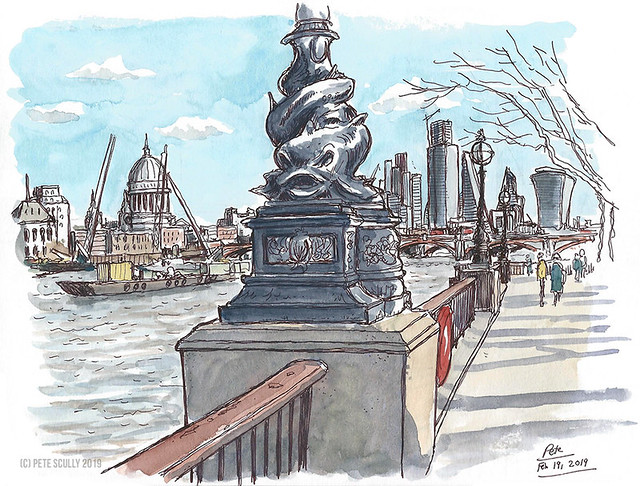
South Bank Feb2019
Every time I go back to London, my family members have grown older, a little bit. With the adults it’s slower, less noticeable, while with the children it’s a much more visible change. I am now the classic “look how tall you are!” uncle. My uncle jokes are also the best uncle jokes in the world. I too have grown; not taller, rather I have encroached into traditional green belt lands. See, uncle jokes. London on the other hand changes faster than I can think. When I left in 2005, the Gherkin (aka ‘the Erotic Gherkin’) was still the new shocking addition to the City’s skyline, pointing like a stubby fishnet bullet at the sky. The older NatWest building still dominated the Square Mile, sufficiently far from the unchanging dome of St. Paul’s (though that too has changed since I left, having been scrubbed of its layer of grey pollution-particles, so much it now gleams as Wren intended). One by one newer buildings started to be approved, all with their pre-approved nicknames: the Heron, the Walkie-Talkie, the Cheesegrater, the Shard, the Dodger’s Kerchief, the Ocelot Spleen, the Snood, and of course the Wizard’s Winkle. I might have made some of those up but you would be hard pressed to figure out which. London’s skyline is starting to resemble less a city and more a manual of Yoga positions. I don’t even know what some of the new ones being built are called (if only there was some way of finding out, some kind of instant source of all global information right at my fingertips!), but change is a good thing, I suppose. I never wanted London to stand still and miss me after I moved away, I wanted London to enjoy its life, meet other buildings, move on.
View from Tate Modern Feb2019

It was a lovely day when I went out sketching on the banks of the Thames. I miss the Thames more than I miss any part of London. I don’t have a Thames here in Davis. I used to come down to the Thames to have a look at it, and contemplate, and be pensive. Sounds stupid now I say it like that. You know like in films and TV shows when the main character has a lot on their mind and they go and look at the Hudson River or stand on the pier at Coney Island (all films and TV shows are set in New York), that was me, coming to the Thames, standing on the South Bank near Waterloo, looking at the Thames. I think I just like watching water move from left to right. Maybe it reminds me of the old Thames Television screen, which would come on just before Rainbow, and I always liked Rainbow. Geoffrey out of rainbow died recently. I met him when I was a kid, at Brentford’s football ground, he drew me a picture of Zippy. It wasn’t a super detailed picture of Zippy but I could tell it was meant to be Zippy. Unless it was meant to be a picture of himself and I misinterpreted it, or a picture of me. Either way, I always wondered what Zippy would be like as a modern-day politician. Yes, it is extremely easy to imagine that isn’t it (it’s even easier to imagine Bungle). When Boris Johnson became Mayor of London years ago I drew a picture of Zippy with Boris Johnson’s hair. A few years later, Johnson and his friend Joanna ‘George’ Lumley, had this crazy idea of building a new bridge across the Thames, right at the spot where I drew the sketch above. It was to be a ‘Garden Bridge’, covered in trees and plants and closed at night and on special corporate events such as when Rod Jane and Freddy would need to perform their Greatest Hits. If I recall, the plan was to build it “up above the streets and houses, everyone can see it smiling over the sky”. Being pedestrian only, it would not alleviate traffic, It would require cutting down scores of trees on the South Bank as well as blocking the view of the city with all its Yoga-position skyscrapers from much of the South Bank and Waterloo Bridge. Change is a good thing I suppose, but this was a change that really didn’t need to happen, at least not right here. When the pedestrian Millennium Bridge was built, it was visually unobtrusive and also in a place that had needed a crossing connecting St Paul’s with the new Tate Modern and Shakespeare’s Globe (I well remember the circuitous routes before). Also, it wobbled, meaning those crafty Cockneys could re-christen it the ‘Wobbly Bridge’, calling it that for many years even after the Wobble had been fixed and the joke had really lost its steam. The Garden Bridge was an expensive vanity project that probably wouldn’t even wobble. In the end, after millions being spent and many Bungles, the Garden Bridge was finally scrapped. I’m glad, and I think Geoffrey would have been glad too.

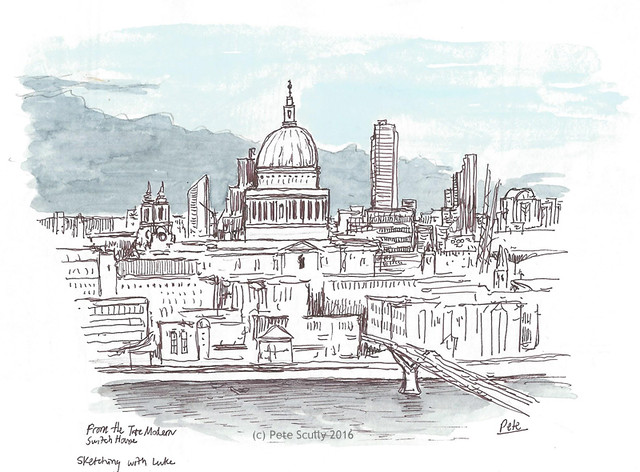
I sat on a bench by the Thames and drew in the sunshine. It’s one of my favourite spots in the whole world, even with the growing metropolis sprouting up across the river. A man stopped to have a look at my sketch, enthusiastically asking me what I do with them. “I colour them in,” I said, and he laughed. People often ask what my sketches are for, which is a fair question, since they could be for sale or to make into postcards or maybe I am out looking for views to dismantle with expensive vanity projects, but the answer is always the same – it’s because I love to draw. I just love drawing, so I have to just keep drawing. This city is worth drawing and drawing and drawing, and then drawing more. This city changes so quickly. After this sketch, I went to the Tate Modern and up to the tenth floor of that new building next door, to sketch the City from above. That is one of my favourite new viewing spots in London, although the crowded elevator means you need to book some additional vacation time if you want to go up there. I decided to colour in only the sky and the river, leaving the city itself uncoloured like in the opening credits of a certain TV show I used to watch as a kid, the large tower of Tate Modern in the foreground. Tate Modern used to be Bankside Power Station, designed by the same guy who made the phone box (I’ve talked about him before). I love listening to tourists talking to each other when visiting London, hearing their enthusiasm for the city. As I looked out over the skycrapers I though about the previous times I had sketched it, and as I sketched I thought that this would be a very good point to include some of those older sketches in this part of the blog post. I hope you have enjoyed this little trip to the South Bank with me. Next time I go back, it will look different again.

take me down to the riverover the thames to cannon street
by the banks of the thamesSt Pauls from Tate Modern
Waterloo panorama
The River Thames

to warwick and stratford

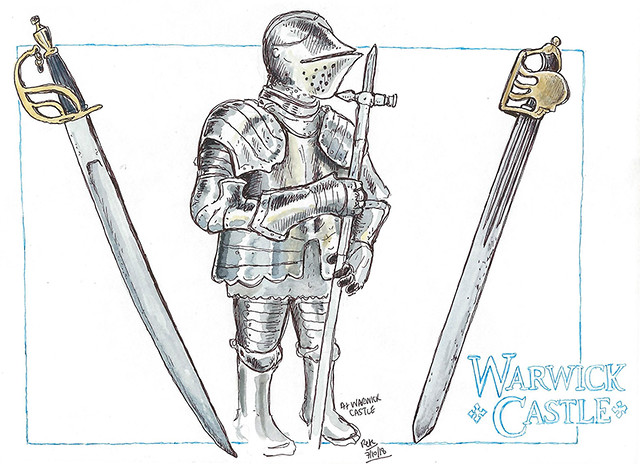
Warwick Castle
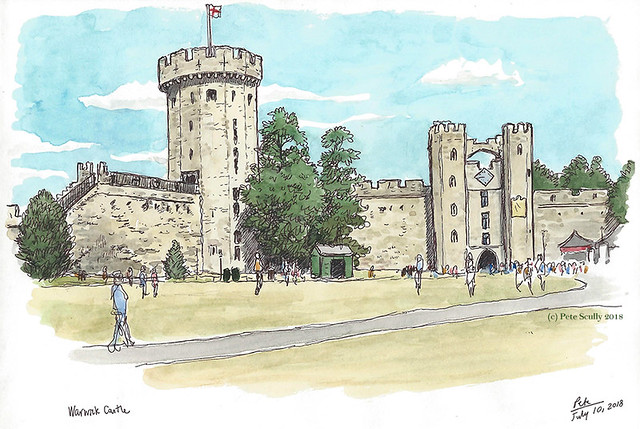
And now for the final part of our recent trip to Europe. I was determined that we’d visit a historic castle, something we don’t have many of here in California (sorry Mr Hearst, Mr Disney, but those ain’t castles). So we hit the motorway (thanks to my mum for driving us) up to Warwick, in central England. I had been there a few years ago, and knew it was a pretty great sight. Warwick Castle is a little theme-y (being owned by Merlin Entertainment now) but as it has a Horrible Histories maze and some fun jousting entertainment that doesn’t matter. Actually, we missed the jousting as it’s not every day (though I did see some four years ago, and it was fun). Warwick Castle is in a beautiful location on the banks of the Avon river, and a historically significant geopolitical spot, being in the middle of the country and therefore an important stronghold for the balance of power. The Earl of Warwick in the late middle ages was known as the ‘Kingmaker’, not without exaggeration. The site of Warwick Castle was founded as a ‘burh’ by the formidable Anglo-Saxon lady Æthelflæd, ruler of Mercia (also ‘Ethelfelda’). She fought against the invading Danes and the Welsh, she was also a daughter of Alfred the Great, and in fact there was a re-enactment of her funeral in June 2018 in nearby Gloucester. When William the Conqueror invaded in 1066, the Normans built a motte-and-bailey castle here on ‘Ethelfleda’s Mound’, and Warwick Castle was subsequently built up over the next few centuries by later lords and earls. The first Earl of Warwick was Henry de Beaumont, from 1088, and the 16th Earl, Richard Neville (who gained the title through marriage to Anne de Beauchamp) was the famed Warwick the Kingmaker, who rose to prominence during the Wars of the Roses before dying at the Battle of Barnet in 1471. There’s a lot more history too, but I was interested in the old armoury. The suit of armour below is actually a child’s armour, likely for ornamental purposes. I sketched the castle above while taking a break with my son, who didn’t want to walk around the dungeons.
Warwick Castle Armoury
We didn’t stay in Warwick, though I’d love to sketch that old city some day. Instead, we stayed the night in Stratford upon Avon at a place called Alveston Manor, a large country house converted into a hotel just a short walk from central Stratford. It was lovely, and I love drawing buildings like that. Stratford is Shakespeare’s town, and they do not ever let you forget it here. We did walk up to see Shakespeare’s birthplace, and walk along the Avon, and I had a huge knickerbocker glory (with extra chocolate) at a local pub. So good.
Stratford Upon Avon Alveston Manor
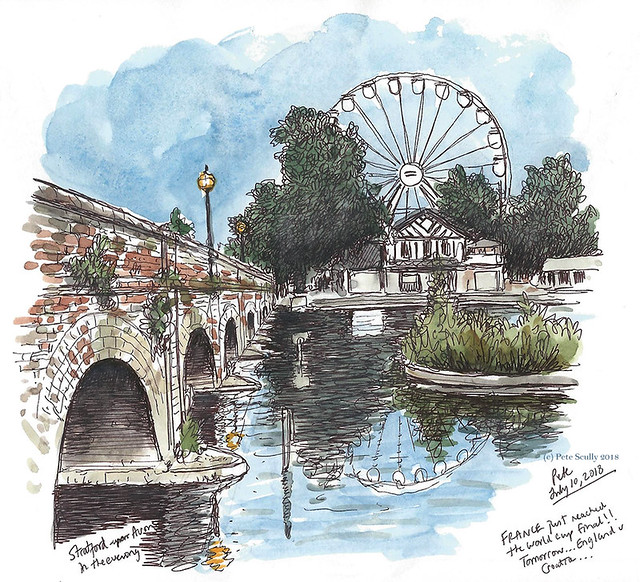
In the evening after watching France knock Belgium out of the World Cup, I walked down to the riverside as the last mid-summer light faded away, and sketched the bridge below. This was around 9:30pm at night. I decided to walk across the other bridge to get back to the hotel, whcih was a mistake. It was a logn bridge along a road with a fairly narrow path for pedestrians, and lots of cobwebs. During the day the cobwebs were quaint. In the evening they were covered with thousands of busy, chubby spiders, loving their little legs and spinning and completely freaking me out. They weren’t dangerous, unlike the ones in my Davis back yard right now, but so many of them moving all around me was pretty much the creepiest thing ever. I ran as quickly as I could, but it was a long bridge. Yeah, I’m not into spiders.
Stratford Upon Avon

porto panoramic

Porto view from Vila Nova de Gaia

Picture postcard Porto. Pretty, panoramic, picturesque. I could go on. I think I’m most happy with the sketch above, of all the stuff I drew in Porto, this is the postcard scene. It was my free, non-workshop day, no obligations to be anywhere. I slept in a bit longer than I had intended (until almost 9), but my feet were happy for the extra rest. On this day I was heading over the river for the first time to Vila Nova de Gaia. I was interested to explore Gaia, and looking back I wish I had explored more but you sacrifice some wandering time for sketching time, and I really like sketching. The scene above took two full hours, as I added the paint on site (instead of the old colour-in-later thing), and it was beautiful there. I was under the shade of a tree, on a solo bench, and the weather was beautiful, sunny and warm but breezy. Views like this are there to be enjoyed.

So Vila Nova de Gaia. First of all, the boat – there are lots of these old boats along the banks of the Douro, loaded with barrels, each belonging to one of the many Porto wineries that dot the shores of Gaia. Most have English names and origins, as mentioned in my last post, and in fact these boats have a race up the river each year. It’s called the ‘Douro Rabelo Port Wine Boat Regatta’, which may not be easy to say after a few glasses of Sandeman Tawny. the ‘Rabelo’ is what these little boats are called. They are used to transport wine to Porto from the Douro valley. They’re flat bottomed, and that long piece of wood at the back (the ‘little tail’; that’s what ‘rabela’ means in Portuguese) is used to steer it.

Porto view from Vila Nova de Gaia

I drew the one above first, and intended to colour this one in but the wind on top of the hillside got the better of me. It’s a long way up. I had crossed the Ponte Luiz I bridge via the top, sensibly. My plan was originally to cross over here, go down to the riverside, sketch there, look at wineries, come back up and get the metro to the Dragao Stadium, home of FC Porto. I never did that last bit, because I was moving a lot more slowly, what with sketching these complicated detailed scenes. But what fun!! I never get to draw scenes like this back in Davis. Those bridges in the Arboretum just aren’t the same. I must say though, if there is a quick way down to the riverbank I didn’t find it, I took a long way, walking down a steep winding path. That’s why I never went back that way, but crossed the river at the base of the bridge instead (and then took an even steeper trek up the hill in Ribeira).

Now Vila Nova de Gaia has an interesting history, aside from being where the wineries sell their Port. First of all, it is actually a separate city from Porto itself. The hydrants look a bit different for one thing. Now this settlement existed in Roman times where it was known as Cale, or Portus Cale. Yes, it’s from this that we get the name ‘Portugal’, which was originally the large county around this area which expanded during the Reconquest of the middle ages to what we now know as Portugal. The port area was on the other side of the river, now called Porto (or ‘O Porto’, the port).

Cais do Ribeiro, Porto

Here is another rabela, this one moored on the Ribeira side of the Douro. I love drawing that bridge. This was done a couple of days before, during the Sketchwalk (in which I didn’t really take part as a group activity – there were a lot of people – and missed the final group photo, comme d’habitude eh). I did have to rush back to the Alfandega though for the opening reception of the Symposium.

Porto panorama sm

Now this final drawing I am showing also took a couple of hours, and is themed like the others in the it shows the river Douro and the Ponte Luiz I bridge, but this one is even more panoramic, being one of those double-page spreads I like. Click on the image to get a closer view. I really enjoyed sketching this, though I was standing when I did. Before I began I actually did try to sit at a cafe to rest and have a beer while I got started, but the waiter actually refused to serve me when he saw I had a sketchbook. “Are you going to paint here all afternoon?” he said gruffly. “Well I’m going to draw for about half an hour while I have that beer, yes.” “It is not allowed!” he responded with a mean look. “Fair enough,” I said, I mean there were only a few tables on a very narrow strip and I chose the one with the best view, but this Portuguese Basil Fawlty did irk me a little, I was a paying customer, and didn’t intend on being there for long; I had somewhere to be, and I wanted to sit down and have a cold Super Bock. I’m sure he had had many, many, many others doing the same and it irritated him. So I stood around the corner, where there were other sketchers, and I drew for about half an hour, and then went off to see Gabi’s demo, and then came back to draw the rest for about an hour and a half. I never got to finish the colour, and I do intend on adding it, at some point, but for now I’m leaving it as it is. Just imagine the colourful scene. The sound of seagulls, the chatter of tourists, the silent concentration of sketchers, and of course, the completely irritating sound of street musicians, playing ‘Besame Mucho’ over and over and over again. There are a lot of street musicians – you know how much I love those – and they all seem to play Besame Mucho way too much. There was one though that turned up while I was sketching this who wasn’t actually that bad – he didn’t play Besame bloody Mucho anyway – but then he started playing Oasis songs, but really, really slowly for some reason. “stop Crying Your Heart Out” took about eight minutes, as he warbled on “Hooooowwwwllld Oooowwwwooonnnn,” like a tortured coyote. I don’t think this was exactly Fado, but I can understand Saudade a bit more now, the feeling of sadness after listening to these terrible musicians all day long. Maybe that’s why the wait said it wasn’t allowed, maybe he was warning me of the bad music, like it was for my own good. Ok, I’m exaggerating my own grumpiness for amusing effect (that’s my story). Standing and sketching big detailed scenes is one of the things that makes me most happy, and puts me in a ridiculously good mood despite bad street musicians and grouchy moustachioed waiters. I chatted to some other sketchers I had never met when I was done, and then went off to Ribeira square to meet all the other sketchers for Drink’n’Draw.

One more post of Porto sketches to go! So this is the Penultimate Porto Pictures Post.

big dome in a little country

The Vatican sm
We didn’t see the Sistine Chapel. We didn’t see the Pope on his balcony. We didn’t look inside St.Peter’s, and we didn’t climb up the Basilica’s massive dome. But the Vatican City State was still pretty great! We walked there from our apartment, crossing the Tiber, my son super excited at the possibility of checking another country off of his list of visited countries, and the smallest recognized one at that. Sorry Sealand! Ok, so before I tell you all about the Vatican, I’m going to say that I promise not to make any puns or word-play jokes, not out of any reverence (careful now, that was nearly one) or respect, but because pope-based puns are just too easy, even for me. I’m not promising but I vill see Vatican do (dammit, promise broken). So, approaching the Vatican, you can always tell how close you are by the number of people coming up to you offering you special deals to beat the line, look at that line, I can help you beat the line. By the time you get up to the little boundary that is the border between Italy and Vatican, it becomes unbearable. You only have to turn your head and look at the big line and someone will notice and pounce, “I can help you beat the line! Don’t you want this special deal?” So many of them. They would not leave us alone. I expected devout Catholics everywhere praying n the street (no idea why I had that impression), but it was mostly aggressive unofficial tour-guides with tricks on getting past the big line. So, what I love about the Vatican – as soon as you reach that frontier, they vanish. Like cursed ghouls they are unable to cross the invisible holy line. It’s incredible actually. Now I’m not religious, I don’t believe in God or any of that stuff, but being able to banish all annoying tour-guide-line-jumping-irritants with one magic line is pretty much magic in my book. So we went into the Vatican City-State, no passports or visas required, but we did not enter the Vatican building itself (if only there was a way to beat that line! Why didn’t I listen?), and I took in the experience by sitting and sketching it. I love to sketch a cathedral, big church, basilica etc when I can, and like, dudes, this is the big one. It is massive. The dome of St. Peter’s! My name-sake. (The ‘r’ is silent in my name, as is the St.) We bought postcards, and sent ourselves a postcard from the little Vatican post-office (and by the way, it arrived very quickly, unlike the one from Venice which I am still waiting for, so score one for Vatican Mail. I was disappointed to see that it wasn’t called the ‘Holy Post’ though). I’d like to go back and see all of it some day, but reserving tickets ahead of time is the way to go. We had a lot more sightseeing in Rome planned, so we moved along.
The Tiber sm

Easy, Tiber. I did come back to the river early the next morning to sketch the view of the Vatican, along with the Pont Sant’Angelo, from the Ponte Umberto I. That bridge you see actually dates from the Roman Empire (it is also known as the Pons Aelius) and was built in 134 AD by Emperor Hadrian. Ok wait what, 134 AD? Rome has a lot of ancient buildings, but a bridge that old?? Remember how I said the Romans built London Bridge? Yeah that one didn’t survive obviously (there is a famous song you may have heard about the problems you get with different building materials, but I don’t know how true to reality the song is given that at one point they suggest building a bridge across a wide river in a major metropolitan centre by using ‘silver and gold’, though to be fair they do concede that the people of London may be inclined to strip the bridge of its valuable metal). Well anyway, back on point, this bridge was also built by the Romans and there it is still, to this day. That is impressive. It leads over to the Castel Sant’Angelo, where the Emperor Hadrian has his tomb. The early June morning light reflecting against the waters of the Tevere was so gentle, serene, despite the buzz of mopeds on the street behind me, and the morning tourists posing for selfies. I miss Rome already. I did throw a coin into the Trevi fountain, which means I will definitely, absolutely return to Rome. By the way I still have more Rome posts so don’t go away. Rome wasn’t sketched in a day.

london’s ancient highway

The River Thames sm
For the first sketch back in London I wanted to draw this stretch of the River Thames again, looking out towards Waterloo Bridge. Last time I sat on Hungerford Bridge (a little bit further toward the middle, drawn to include the then-brand-new Shard) the skyline looked different. New skyscrapers keep popping up, all in fun zany shapes like some ten-year-old invented a futuristic robotopolis. They all have funny names too, the Gherkin, the Cheesegrater, the Walkie-Talkie, the Spaghetti Western, the Cordless Kettle, the Balrog, the Gelfling’s Prophecy, all very silly names. Ok some of those may not exist yet. The oldest structure in this sketch is actually Cleopatra’s Needle, on the left there, at about 3500 years old (placed here in the 19th century). Its twin is in New York, you can apparently use it to teleport between the two cities but they don’t like to tell anyone (see previous posts for feelings about Translatlantic travel). Ancient Egyptians used to smirk at the silly nickname too, also making fun of Thoth’s Sewing Machine, Rameses’s Hat-Stand and Mark Antony’s Hypodermic Syringe, and so on. Anyway, I sat on my uncomfortable little stool (now retired) and sketched for two hours straight, as London in the Summertime started up around me, tourists, day-outers, amblers all looked around and marveled at the view. Now if the proposed mess of a project the Garden Bridge gets built this view will be spoiled. I believe the Bridge would go just beyond Waterloo bridge, but with trees poking out of the top of it the views down river would be compromised somewhat. Not a fan. Might be useful elsewhere, but not there. It’s a folly of Boris and Lumley. We’ll see if it actually gets built. If it does, expect more cranes, more changing views, and more sketches along the ever-changing, ever-constant river. I do love this river.

IMG_0522

Here’s the sketch I did on the same bridge in 2012:
Waterloo panorama