up kentish town

kentish town station
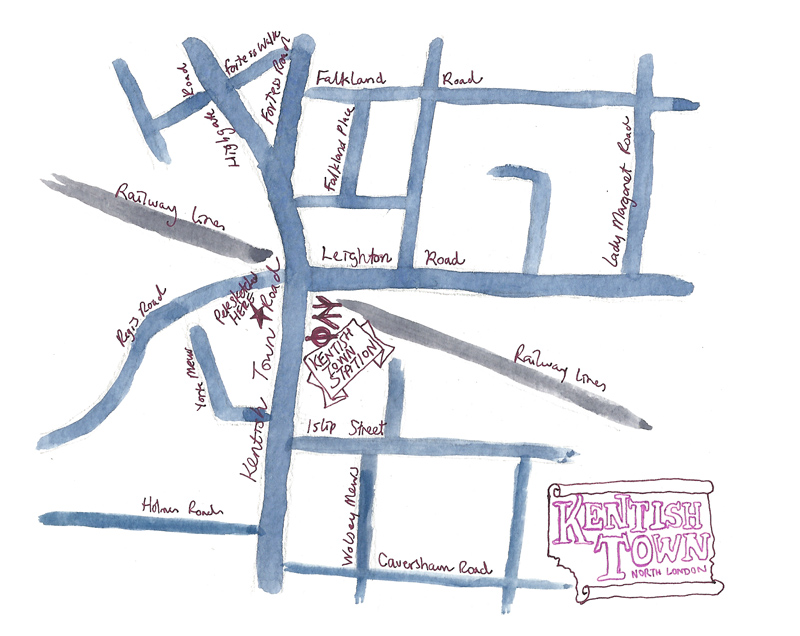
This is Kentish Town station, in north London. I came here when I was meeting up with my friend James one evening, and stood outside a curry house opposite sketching as buses and cars trundled up Kentish Town Road towards Tufnell Park and the Archway. There are a lot of old tube stations that look like this, with the dark ox-blood red glazed terracotta tiles and the typical arches, and one day I swear I would love to sketch them all (hint hint London Transport, a fun book commission?), though I hurried through this one a bit, not drawing the whole length of the building (it would make a really good panorama…) and added the colour when I got home. It was designed by Leslie Green, who built many of the iconic London Underground stations over a century ago, and is on the High Barnet branch of the Northern Line. It’s a pretty interesting place, Kentish Town, and this was my first time here in years, other than passing through. Though in fact I did end up passing through, ending up meeting my friend in nearby Camden Town, where we swapped world cup football stickers.

kentsh town map sm

sketching wrens’ city…part two

St Mary Le Bow sm

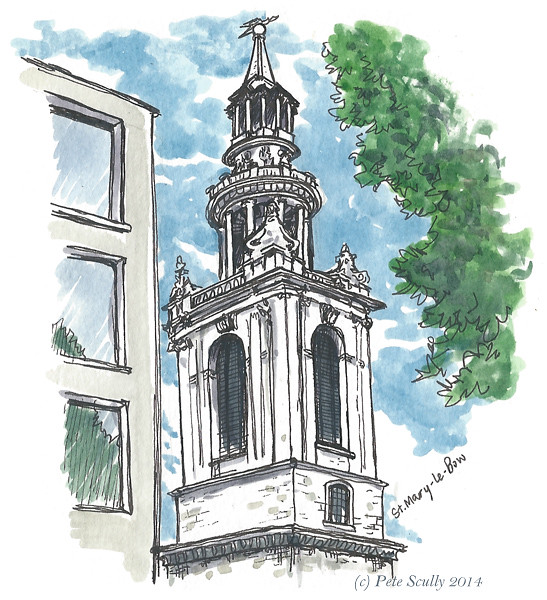
The Wren sketchcrawl continued… we had a lot of sketchers from all over on this sketchcrawl, and after finishing St. Stephen Walbrook I bumped into international-travelling urban sketcher Sue Pownall, and we walked over to St. Mary-le-Bow on Cheapside. The approach to this old church up the narrow Bow Lane is lovely, although the buildings are now modern you can just use a bit of imagination to fly back through the centuries and picture the narrow timber-framed houses leaning into each other over dirty streets, the sound of the Bow Bells echoing through the dark, bustling lanes. Yes, this is the church of the Bow Bells; the tradition is that a Cockney, a true Cockney, was born within the sound of the Bow Bells (and not Bow in East London as many wrongly believe), that is, within London. Cockney is synonymous with all Londoners now, London being much bigger than in Dick Whittington’s day, though of course he famously heard them from up on Highgate Hill, calling him back to his destiny as London’s Lord Mayor. You know the story. There’s a statue of his cat on Highgate Hill, near Whittington Hospital, but that’s far from here. The Bow Bells were important to London not because of fanciful stories and cockney categorization, but because in the middle ages these were the bells that rung to sound the curfew, and the closing of the city gates. If they rang and you were outside the city, you spent a night sleeping in the filthy gutters of Southwark or Finsbury. These days you can just get a Night Bus, and it’s a similar experience.

Those bells and the old church of St.Mary-le-Bow were burnt to the ground in the Great Fire of 1666, so Sir Christopher of course got to work building a new church, this one above. Well, kind of – it was destroyed again by the Nazis in the Blitz, but rebuilt after the War. I just drew the spire, time being of the essence, but it was a nice little courtyard to be sat in.
St Vedast sm

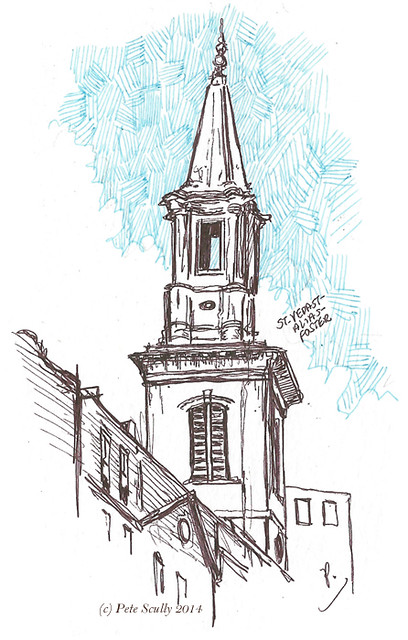
Before going to sketch St.Paul’s (I had this huge panorama in mind…didn’t quite make it) I wandered about to find a less well-known Wren church. I headed to St.Vedast-alias-Foster, up in Foster Lane, mostly because I liked its unusual name. when I got there, the staff were bustling about, preparing for a wedding. Though it looks like Just Another Wren Church (™) from the outside, the inside is quite spectacular, with a beautiful ceiling and a polished hall filled with light. The friendly suited man at the door welcomed me in to look around, and I asked him a bout the history of the church and its unusual name. Apparently in the middle ages this part of London was popular with Flemish immigrants from Arras in northern France, whose patron saint was St. Vedast (from the Latin name Vedastus; in Norman French and Flemish he was St. Vaast). This was corrupted into English as ‘Foster’, hence Foster Lane, and so the church is called ‘alias-Foster’ as a result. He showed me around the lovely courtyard, and said that a sketcher would love to sketch in there, and showed me the history of the parish churches associated with this one, many now combined (the ‘United Parishes’), including one church called St. Mary Aldermanbury which was badly damaged in World War II, and then closed down, with its remains being shipping across the Atlantic for rebuilding in Fulton, Missouri, significantly the place where Winston Churchill made his famous ‘Iron Curtain’ speech in 1946. All historied-up, I went out into the street and found a spot to sketch the tower. I kept it brief, because my next building was so much bigger than all of the others (probably put together).

St Pauls sm

The plan was for a panorama, but I couldn’t decide on a good view, at least not from up close. Besides, the day was pressing on and I wanted to be done before our final meet-up at 4pm. So I stood across the front entrance from St. Paul’s Cathedral, as traffic and tourists rumbled by, and sketched in traditional London grey. It was actually a very sunny day, one of the more pleasant London afternoons. I remember those sorts of afternoons from when I was a teenager, wandering central London’s streets on a late Saturday afternoon, falling in love with the city. In those days St. Paul’s was much greyer, dirtied with decades of pollution and urban grime, but in recent years the grand old cathedral has been cleaned up significantly, and now sparkles white as if new-born. This is Wren’s masterpiece, but its significance to London is much older. For many, St. Paul’s is London. There has been a cathedral dedicated to St. Paul’s on this site, the top of Ludgate Hill (King Lud being an old figure of pre-Roman British legend who may or may not be related to the name of London itself), since St. Augustine brought Christianity to the Angles and Saxons. Not much is known about the early cathedrals, until the fourth incarnation, a huge Gothic cathedral, was built in the twelfth century. That was one of the largest buildings in Europe, but alas, along came the Great Fire of 1666 and in a matter of days it was gone. Along came Wren. As I’ve mentioned before, he had plans to rebuild London including St. Paul’s on his drawing board  for several years before the convenient fire, and for London’s landmark cathedral he wanted not another towering spire but a large Romanesque dome, technologically advanced and rivaling the greatest buildings in Christendom. The wooden model of his first design is still on display, but it looks rather different from the final buiding. This was late seventeenth-century England, not a time to make your premier church look, well, too Catholic. It was shaped like a Greek cross, and the nave was not long enough; it just didn’t look English. Wren went back to the drawing board, and in the end built the Cathedral we have today. It’s hard to think of more ‘London’ building than this. During the darkest days of World War II, when bombs flattened everything around it, the dome of St. Paul’s stood untouched, a symbol of hope for a city devastated. The ‘people’s church’ this was, and probably because of that, it was here that Prince Charles married Lady Diana in 1981 rather than at the traditional Westminster Abbey.

Sketching Wren's City, Aug 2 2014

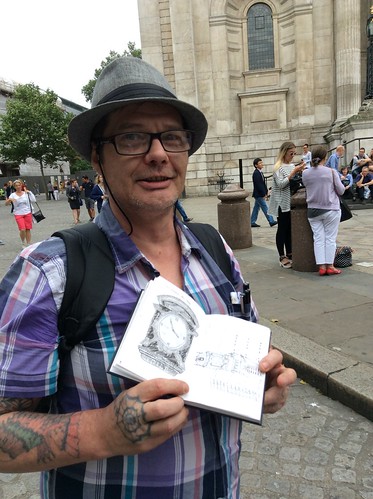
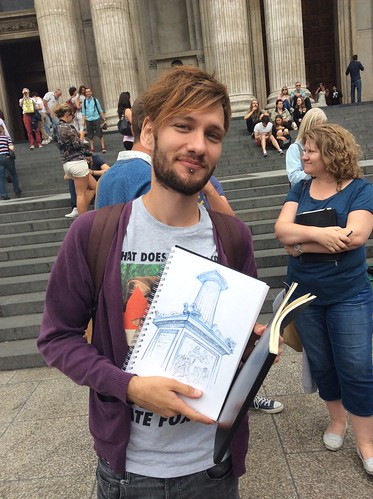
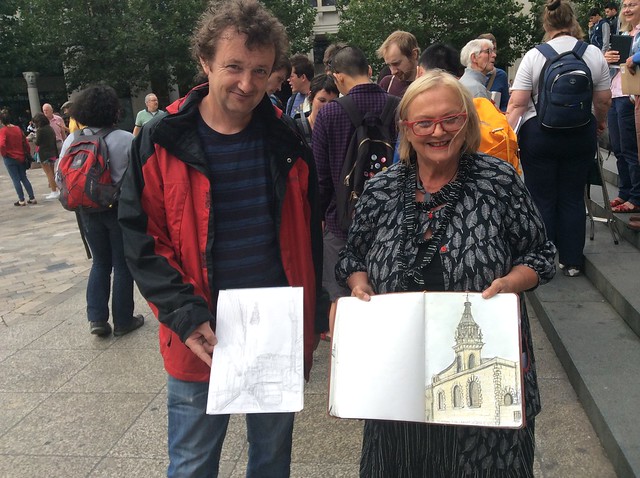
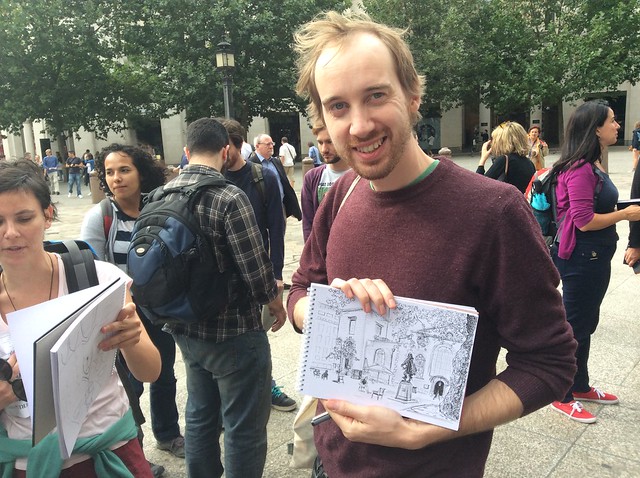
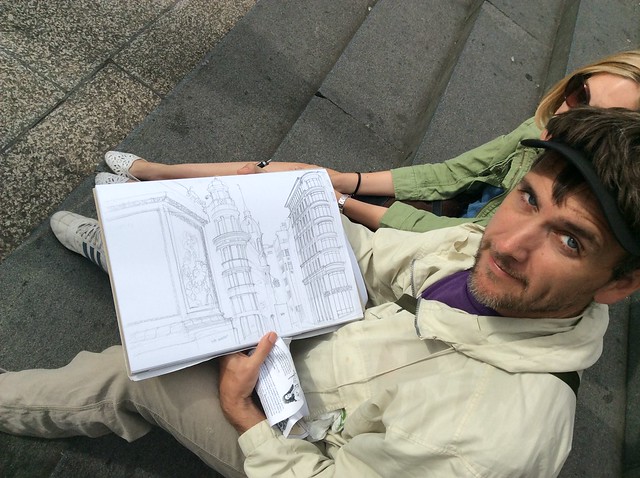
So it was here that we finished out sketchcrawl, and our journey through Wren’s City. Those of us who were left gathered by the steps of St. Paul’s to look at each others’ sketchbooks. I met some great sketchers for the first time, and reconnected with sketchers I have met with before. I can’t tell for certain (because I didn’t take photos of everyone’s books) but I’m pretty certain that as a group we covered most of the Wren churches from my map on this day. Here are some photos from the end meeting; you can see some more on my Flickr set Sketching Wren’s City.
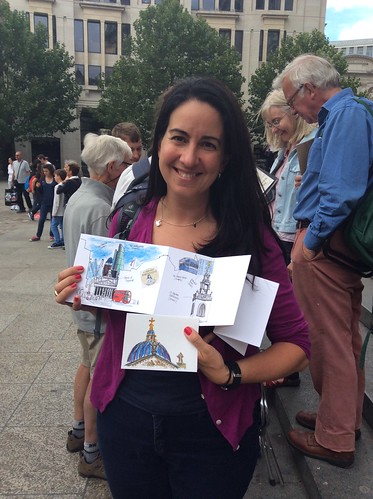
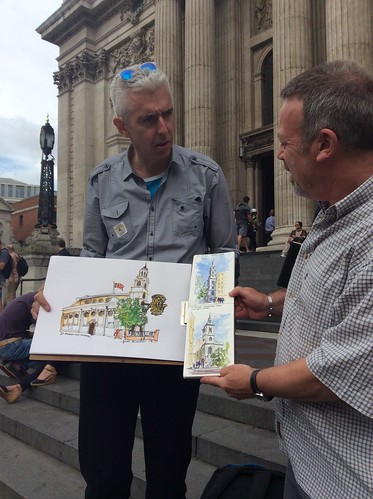
Sketching Wren's City, Aug 2 2014Sketching Wren's City, Aug 2 2014
Sketching Wren's City, Aug 2 2014
Sketching Wren's City, Aug 2 2014Sketching Wren's City, Aug 2 2014
Sketching Wren's City, Aug 2 2014Sketching Wren's City, Aug 2 2014Sketching Wren's City, Aug 2 2014

And here is the final group shot…spot the sketchers you know!

Sketching Wren's City, Aug 2 2014

Everyone that came and made it to the end got a little sticker that said “I Sketched Wren’s City”. I like making stickers. If you’re interested in following our steps and sketching Sir Christopher’s City, click here to download the little guide and map I handed out on the day: Wren’s London booklet (pdf)

After this, we reconvened at a pub on Fleet Street called The Old Bell, which, by the way, was built by Christopher Wren. Who else! To those of you who came along, it was brilliant to meet you and see all of your lovely work. See you next year! (For…”Dickens’s London”? “Coren’s Cricklewood”? “Pete’s Burnt Oak?”)

Urban Sketchers London
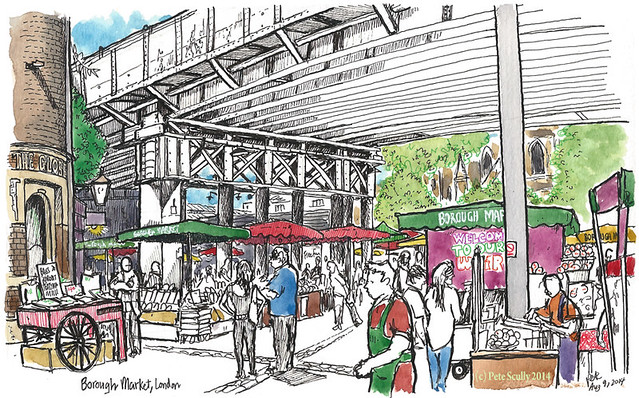
sketching wren’s city…part one

Sketching Wren's CityJust over a month ago I organized a sketchcrawl in London based on a theme I have wanted to sketch for many years. It was titled “Sketching Wren’s City”, and was going to focus on finding and sketching the buildings of the great architect Sir Christopher Wren, that still exist in the City of London today. (Hence Sketching Wren’s City, not Wren’s London – he has some lovely buildings outside the City of London). Christopher Wren, for those of you who may not know, was the man given the task of rebuilding most of London’s churches and many other buildings after the Great Fire of London in 1666. The Great Fire, you say, what’s that? Well in September 1666 a baker called Thomas Faryner in a street called Pudding Lane had the misfortune of having a fire start in his bakery one night, a fire deemed so insignificant that the Lord Mayor, awoken with the news of flames rising above the rooftops, famously said that, well, it could be extinguished by a member of the female persuasion urinating upon the conflagration (he didn’t use those exact words). However, the fire spread, and kept on spreading, and no amount of wee (male or female) was able to make up for the lack of a decent fire-fighting service (if only they had fire hydrants in 1666!). The City of London was destroyed, including the grand old St.Paul’s Cathedral, and a good number of churches. Enter Christopher Wren. He had been redesigning London on a grand scale since, er, before the massive unforeseen and entirely coincidental catastrophe that gave him his big break, and now here was his chance. The people of the City however did not want a grand urban-planned metropolis, they wanted their land in the same place thank you. So London kept its medieval street plan, and Wren got to work on the churches. It was a Wrenaissance, if you will. And that’s where we come in…
Sketching Wren's London Map sm
I decided recently that I would do a sketchcrawl in the City charting a course that could let me sketch as many Wren buildings as possible in one day. Not easy, and it would mean not getting super-detailed (I never got my big panorama), but if I invited other London sketchers, perhaps we could do it, perhaps we could cover them all. I created the map above (click on it for more detail) showing which Wren churches are left – there were more originally, but Father Time and the Luftwaffe trimmed down the numbers somewhat. I gave this map to everyone, as we met up at the Monument, and off we went. I love meeting London’s sketchers!
The Monument sm

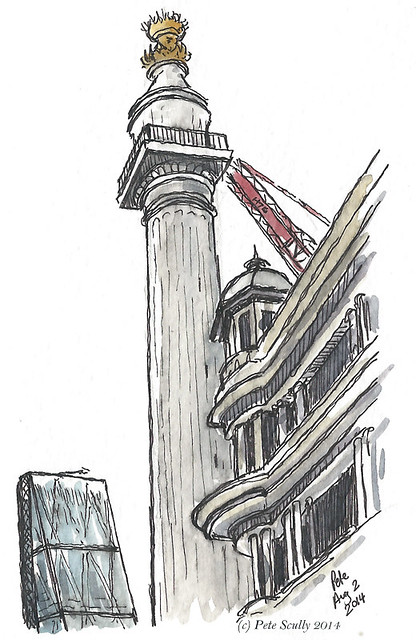
We started out at The Monument to the Great Fire. Built by Wren and topped with a blazing golden ball, if it fell over it would rest exactly where the fire started, which must have made the city planners a little nervous (“Likely to fall over is it then, Chris?”). When it was built it was the tallest column in the world. You can walk up the stairs to the top and look out over the ever-changing skyline. I sketched it quickly, with one of the newer skyscrapers in London behind it, I think it’s called the Cheesegrater, because all of London’s new tower blocks have to have some silly name or other. If the Monument were built now it’d probably be called the Bunsen Burner or something.

St Magnus Martyr sm

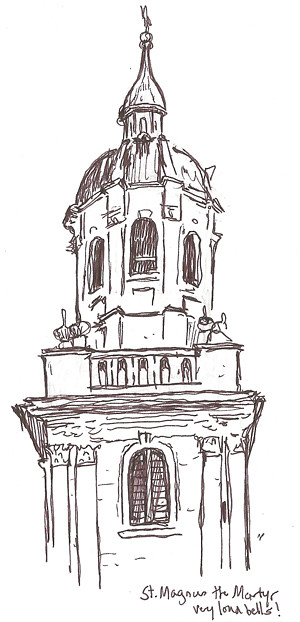
Here is my very quick sketch of the tower of St. Magnus the Martyr, just downhill from the Monument. I recall telling people on my old tours of London that this was London’s most haunted church, but I don’t recall why (probably something to do with ghosts). The bells were very loud and chimed for the longest time, as traffic belted by. St. Magnus used to be right on the River Thames, right by London Bridge itself, its clock being used by ships and bridge traffic for centuries, but as the embankments were built and bridges widened another building has now blocked its riverside view.

St Clement Eastcheap sm

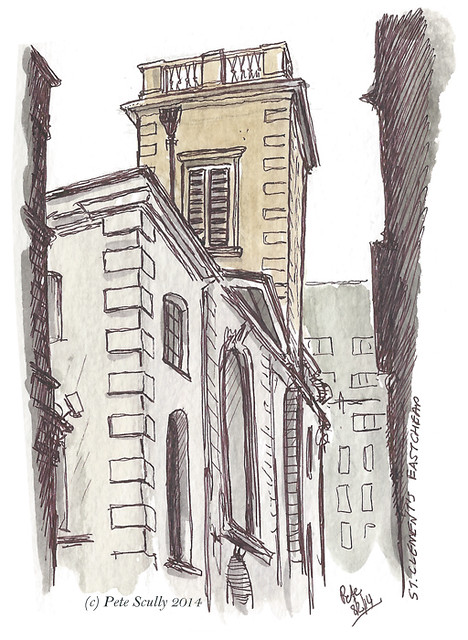
I crossed over the busy traffic junction at King William Street and Cannon Street, and found the rather unassuming St. Clement’s Eastcheap. St. Clement’s…now where do you know that from, ah yes the famous song, “Oranges and Lemons”. This is the St.Clement’s of the song, not St.Clement Dane (the more famous one, located on Strand), and probably so alluded to because of the fruit cargoes offloaded from the riverboats nearby. Or maybe just because it kind of rhymes with lemons. I sketched in an alleyway. It’s not one of the more interesting pieces of Wren architecture. In fact it’s almost as though he couldn’t be bothered at all. “Oranges and lemons, do me a favour, I’ve got fifty-odd churches and a bunsen burner to build,” he was reported to have said, before designing the more handsome and dashing St. Clement Dane. This one is the forgotten little brother.

St Edmunds sm

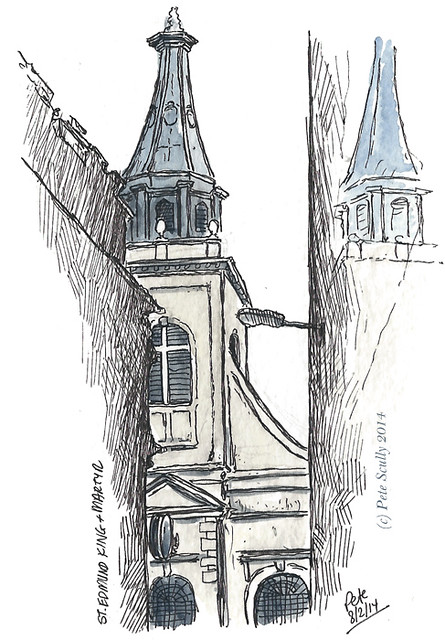
Further down that same alleyway I found the church of St.Edmund, King and Martyr. A lot of Martyrs around here. I have a joke for you, what is King Edmund’s favourite sauce? Martyr Ketchup!     …   Anyway, as you can see I attempted to draw the reflection in one of the shiny buildings, so I hope that’s obvious somehow. Standing on Lombard Street, in the shadow of mightier structures, St. Edmund’s is no longer a practicing parish church but is home to the London Centre for Spirituality.

St Stephen Walbrook sm

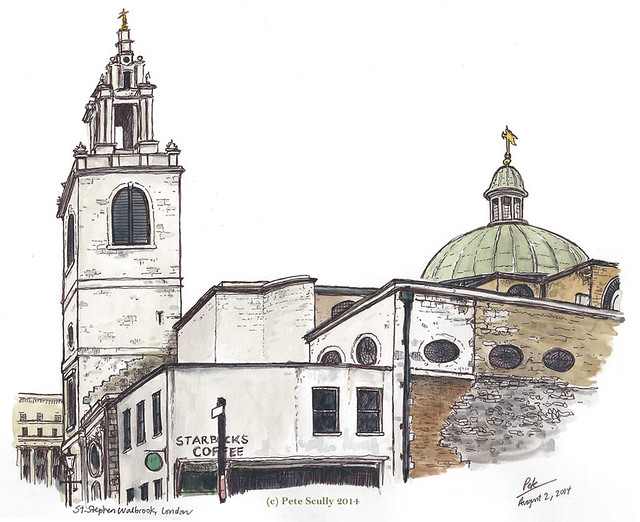
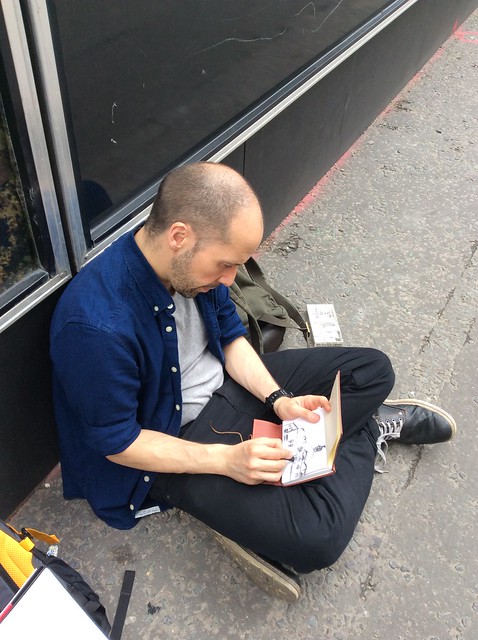
I met my good friend Simon (seen below sketching in messy charcoal), the actor and TV Tsar (no really, watch Houdini on the History Channel this week, he plays the Russian Tsar) and my friend Tamara (herself a stage director and playwright), out sketching with her family, and we sketched the wonderful domed church of St. Stephen Walbrook, one of Wren’s most beautiful churches. Oh, on the inside that is. It was closed this day (doh!) so we made do with sketching its wonderful exterior, Starbucks and all. Still, it was very nice to catch up with old friends and do some sketching. St. Stephen Walbrook by the way was Wren’s dummy-run for St. Paul’s (spoiler alert for part two, St. Paul’s is domed as well) and the inside truly is a delight to behold, ok it’s not the Aya Sophia or anything but it’s still lovely. You’ll have to just imagine it I’m afraid, or maybe I will just sketch it next time.

Sketching Wren's City, Aug 2 2014

Please join me tomorrow for more urban sketches in Part Two: Wren’s Wrevenge…

in the state of denmark street

Denmark St panorama sm

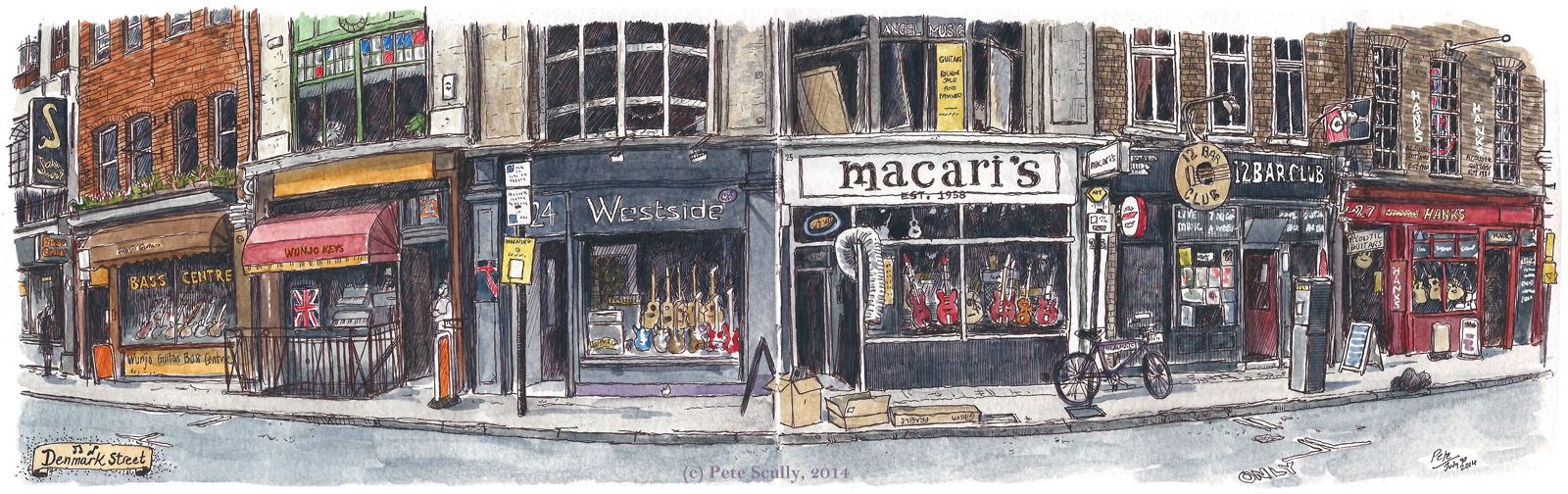
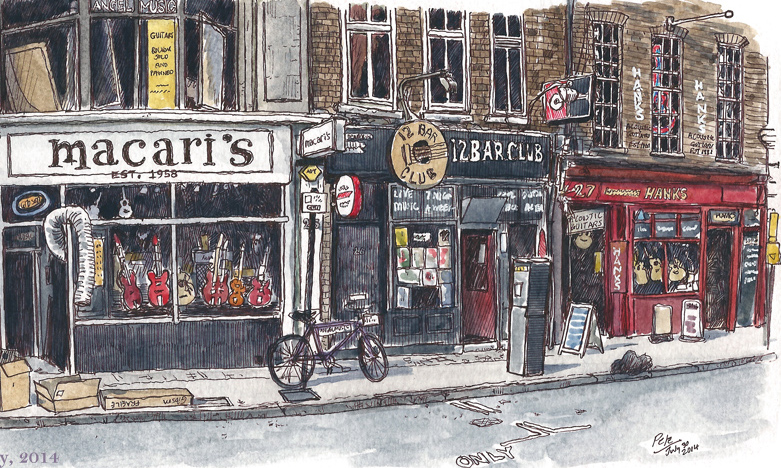
This is Denmark Street, just off of Charing Cross Road in Central London. I sketched it over a period of two and a half hours one Wednesday afternoon, having taken the morning off from sketching (I was up in the loft searching for my old collection of Fighting Fantasy books), and added the rest of the colour later on. Denmark Street is famous within British musical history as our very own ‘Tin Pan Alley’, home of music publishers and recording studios, and later of music stores. There are lots of guitar shops, as well as other instruments of course, and is also home to the famous 12 Bar Club. The Rolling Stones, David Bowie, the Sex Pistols, all are associated with this street in some way (the Pistols actually lived here for a bit). Not only music – the comic shop Forbidden Planet was founded at number 23, where that red awning is in the picture now. It’s around the corner on Shaftesbury Avenue now. This place is steeped with history and it’s a street I have always had a lot of love for, being a bit guitar-obsessed when I was younger (it took me years to actually pluck up the courage to enter one of those stores though, very intimidating to a shy teenager!). I actually bought my current acoustic guitar from Macari’s, though it was from their other branch, on Charing Cross Road, back in 1996.

Denmark St panorama sm L Denmark St panorama sm R

So when I heard that Denmark Street was under threat of demolition, all part of the Crossrail redevelopment that has completely destroyed the junction of Oxford Street and Charing Cross Road, I knew I had to sketch it while it still looked like this. Many of these buildings are ‘listed’, historic buildings of importance. Whether they will be knocked down or just somehow modernised is not clear, what it will mean for the historic character of Tin Pan Alley is also unclear, will the music stores be forced out in favour of latte shops and corporate office space is also not clear, but let’s face it. If Denmark Street loses its character it will be yet another blow to London.
Sketching Denmark St, London

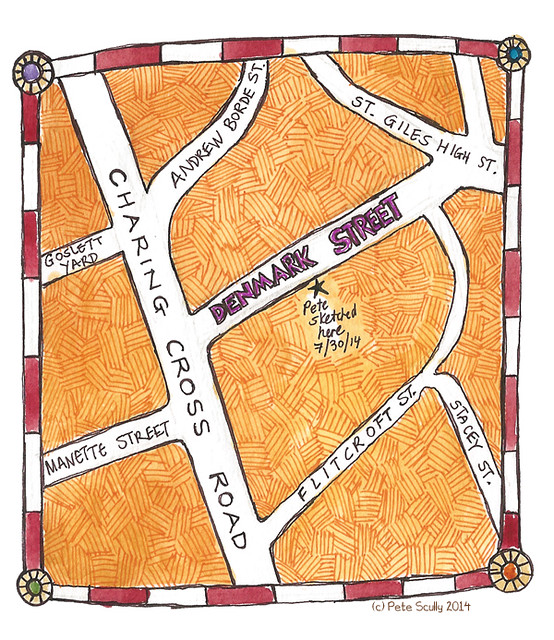
Here’s my sketchbook. I used the watercolour (“art-plus”) Moleskine, with a uni-ball signo um-151 brown-black pen. Oh, and here is a map showing where Denmark Street is.

Denmark St map sm

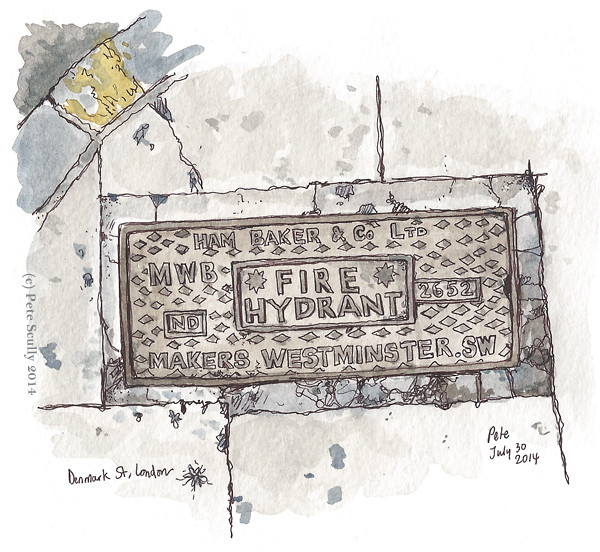
And finally, I thought you might like this. As you may know, I like drawing fire hydrants, mainly because I find them exotic and foreign, for we don’t have them in the UK. Well, actually we do, but they are underground, with metal coverings on the pavement. Here is one I sketched on Denmark Street. So there you have it!

Fire Hydrant in London

the mother of all parliaments

parliament square sm

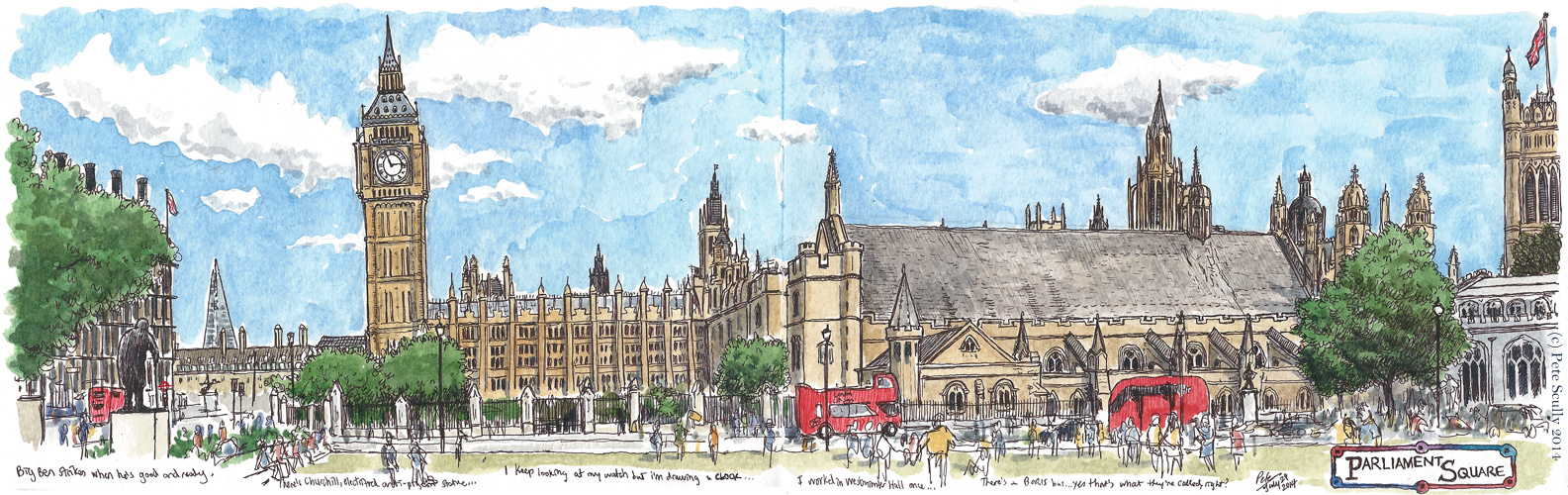
Parliament Square! Click on the image for a closer view. After sketching the Royal Court I went back to Westminster, and stood in Parliament Square to sketch a panorama of the Palace of Westminster, that is, the Houses of Parliament. I know what you’re thinking, I spent a lot of time sketching the tourist attractions this time and not enough time sketching little newsagents or hidden side-streets, but they are all to come, don’t worry. When I passed through the frankly impossible Parliament Square I thought, well why not. There really is a lot of traffic around this square, and not many crossings to get into the middle; it’s never been one of my favourite places. But in the golden sunshine, what a spectacular view! When I was a tour guide I loved the turn into this square, it was almost cinematic with Big Ben (yes I know it’s the bell) and centuries of history unfolding all at once. We’ve had a parliament here since the thirteenth century, though most of the Palace of Westminster – including the Clock Tower (that houses the bell Big Ben), now officially called “Elizabeth Tower”, being renamed in 2012 after the Queen’s Diamond Jubilee –  was built in the 1800s by Sir Charles Barry after the old palace burned to the ground. The oldest part of the building is Westminster Hall, built by King William II (William Rufus) in around 1097. That’s the part with the big sloping roof.

The square is, naturally, a popular place for protest movements. On the left is Parliament Street which leads to Whitehall, many of the British government buildings are located here. Westminster Bridge leads off, over the Thames; in the distance there you can see the Shard, tallest building in Europe. I’ve included the statue of Winston Churchill which, I was told when training as a tour guide, is actually electrified with a low voltage to prevent pigeons from sitting on his head. “We will fight them on the statues.” It’s hidden away a bit but you can just make out the statues of Oliver Cromwell, former Lord Protector, a strange choice for a statue outside Parliament because despite leading Parliamentary forces in defeating the Royalists in the Civil War, he did also shut Parliament down as and when it suited him too. On the right hand side you can just about make out St. Margaret’s Church, the parliamentary church; on my old tour I would joke that it was a place where Tory and Labour MPs would go and pray together but not the Lib-Dems because they haven’t a prayer, tee-hee, well times have changed now haven’t they. This church backs onto Westminster Abbey.

parliament square bigben sm

Here’s a close-up. I worked in Westminster Hall once back in the 90s, serving tea as part of a catering job I was working on (it if I recall rightly a Jewish single’s night organized by the MP Oona King). I remember walking about the amazing building, seeing where William ‘Braveheart’ Wallace was tried before his execution, wandering about the old stone corridors and hearing voices echoing down the stairwells. I went to the toilet, and remember the booming sound of Big Ben making me jump, opening the window and seeing the large clock face right there. I do love this old building.

Here’s a map showing whereabouts I stood. After this, my drawings were done for the day, and I spent the rest of the afternoon mooching around bookstores.

westminster map

the royal court

the royal court theatre
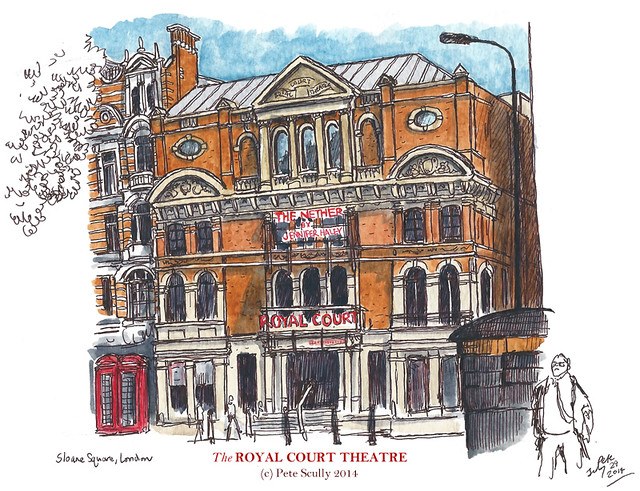
Sloane Square. As a native Burnt Oaker, I feel out of place down here. Oh it’s just a place, like any other, and I’ve been around the world, but part of me thinks ‘Sloane Square’ and thinks ‘the 80s’, fil-o-faxes, champagne, upper classes, butlers, top hats, I don’t know, the rich. My part of North London was the opposite, so this was ‘how the other side lives’. Which is all a bit nonsense in the scheme of things, but it does explain why I don’t go down there very often. Also I live in California and have no reason to make special trips to go to Sloane Square in West London and look at exclusive boutiques or whatever they have down there. However, what they do have is the Royal Court Theatre, and I’ve been there a good few times, and I love it. This is one of the most important theatres in London, it is not one of your big commercial Andrew Lloyd Webber nonsense theatres that you get all over the West End; no, this venue fosters proper writing and has birthed many importnat modern playwrights such as Mark Ravenhill and the late Sarah Kane. They also house the Young Writers Program to develop young theatrical talent. This is a place for new and exciting work. I once saw a play there – I cannot recall the name now – with three actors on a bare sloping stage which utilized rudimentary puppetry and long, long mid-sentence pauses, and I absolutely loved it. It’s a great building also, modern and renovated inside but with a classic Sloane Square exterior. My friend Tamara spent a good few years working there too, so I’ll always think of her when I think of the Royal Court. I stood here for the best part of an hour sketching away, having to stop each time a huge bus hulked into view (I stood by a bus stop so this was often), drawing in the newly opened watercolour Moleskine. I had thought about sketching around Kings Road and all the little Chelsea boutiques, with all the butlers and yuppies and stockbrokers and Dukes with their massive mobile phones and their fil-o-faxes and barbour jackets, but I didn’t want to stand out too much as an oik from the estate, and headed off to Westminster to draw a panorama of Parliament Square.

go west, young man

westminster abbey sm
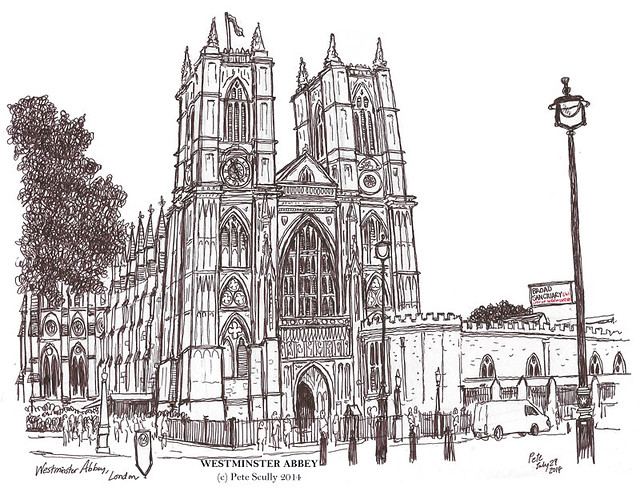
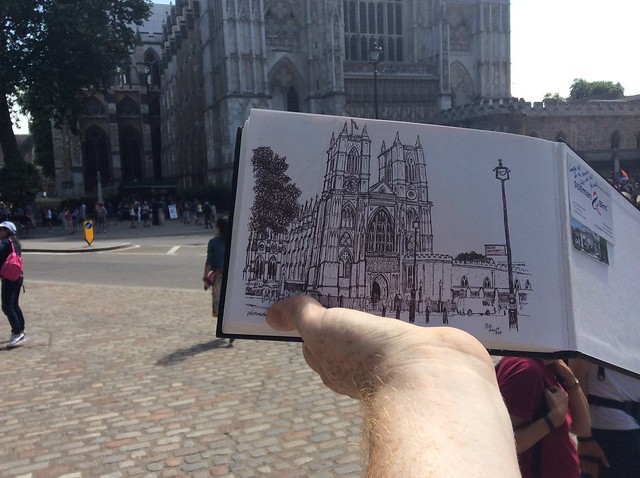
I got on the tube on my second morning in London and went to work – another day of sketching my old city – but without a real plan as to where I would sketch. When I am at a restaurant sometimes I spend ages looking at a menu just to whittle it down to three or four items that I will ultimately decide upon only when asked, on a whim usually (yet I always end up eating the same thing, it’s weird), well sometimes I am like that with the sketching. I had no idea what I wanted to sketch. So I just went where the wind took me. I ended up outside Westminster Abbey, that great spiritual epicentre, the Royal Peculiar, both crowning and final resting place of kings and queens for a millennium. I’ve never ever sketched it, but some recent Spanish sketching visitors to London (that would be Inma Serrano and Miguel Herranz) had sketched it from this very angle and so I was inspired. I love to sketch a cathedral (of course it’s not technically a cathedral, nor is it an abbey, but as I’ve mentioned it’s a Royal Peculiar, direct responsibility of the monarch). I haven’t actually been inside since I was a kid, going to see Poet’s Corner and all that, but I sat across the street amid a crowd of Japanese tourists snapping away with their massive cameras and sketched upwards. It’s a spectacular building. It actually brings me a lot of joy to look at it, knowing its place in English history. This was Edward the Confessor’s church. Admittedly not this particular heap of architecture but it’s been going since his day. Or before, if legends are to be believed, for it was here on what was the Island of Thorney that a simple fisherman had a vision of St. Peter near here, and so in the seventh century an abbey was founded, and apparently the tradition of salmon being given to the Abbey years later was a reference to this incident where a local angler claims he saw a long-dead Pope splashing about in the Thames. William the Conqueror was crowned here, the Norman upstart who fancied himself a king and bloody well became one. And most recently, our latest royal William married Kate Middleton here, at an ungodly hour that meant certain American family members getting up ridiculously early to watch it all on TV. Ah, it’s all spectacle and nonsense, really, but it’s all good fun. This was the last page of my landscape Stillman and Birn ‘Alpha’ sketchbook and what a book it has been. It’s a little larger than my usual size but the paper and the format have been superior, really nice quality, smooth but not too smooth, and takes watercolour very nicely, but really allows for detailed penwork without feeling like I’m chipping away at granite. Of course that is also the uni-ball signo pen I’m using, the old micron pigma was a bit harder work but that’s because I’m tired of nibs that wear down in general. I did originally plan to colour this in, but I liked the pen version so much when I’d finished that I decided against it.

IMG_1177

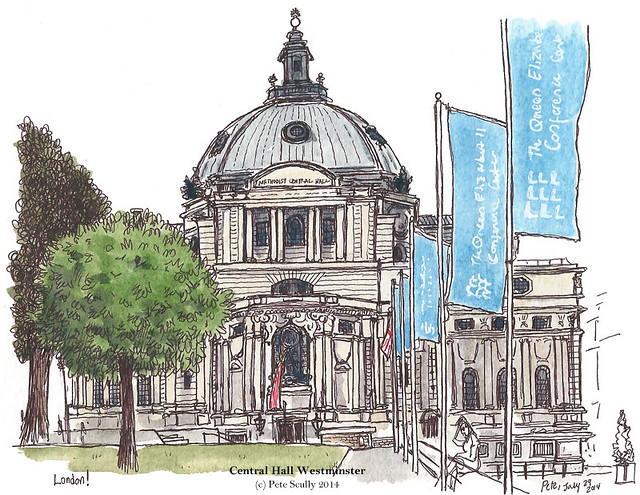
I moved onto the first page of my new sketchbook for the next building. After a year off, I went back to the old favourite, the watercolour Moleskine. This was to be #13 in that particular series. However, as has been pointed out in reviews by fellow urban sketcher and watercolour-Moley fan Liz Steel, the paper in these newer “Art-Plus” Moleys is…different. It isn’t quite the same. Grainier, yes a little, but also different sides of the paper have different textures, like a front and a back, a common feature in lots of watercolour paper but not in the older watercolour Moleskines. Still, I haven’t had too many problems with them and I still love the format and pocket at the back…but somehow it’s not quite the same. By the end of the book I’m sure I’ll be totally used to it and ready for Moley 14…we’ll see!
westminster central hall sm
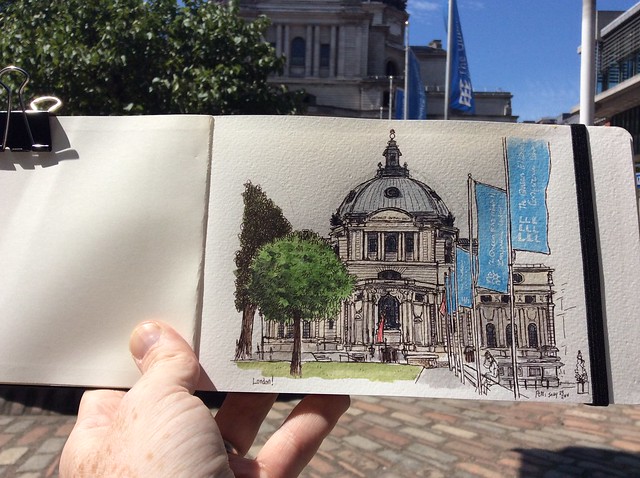
Anyway what I sketched next was the big domed building across the street from Westminster Abbey, known as Methodist Central Hall (or Central Hall Westminster). This took under an hour, paint included, stood in the shade of a tree while local workers lunched. For my next sketch, I jumped on a tube and went down to Sloane Square… to be continued…
IMG_1181

oh so soho

Berwick St panorama sm

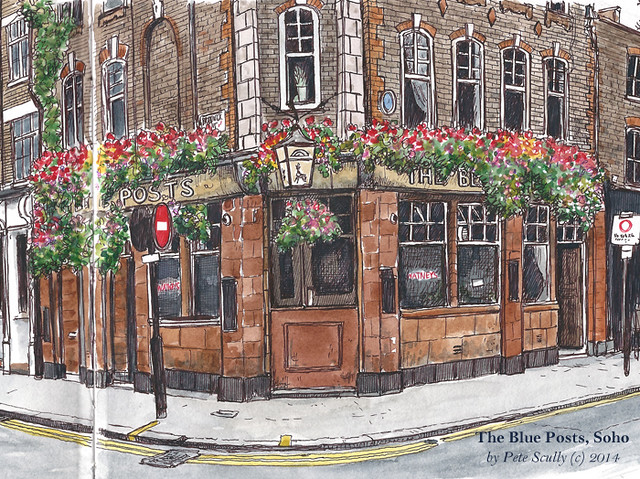
My first two-page street panorama in London! Click on the image to see it in closer detail. This is the intersection of Berwick Street and Broadwick Street, looking down towards Wardour Street in Soho, the heart of London. I have loved Soho since I was a teenager, all its narrow, slightly grimy streets, alleys and shortcuts. I love sketching down there, in this neighbourhood between the Big Streets. Do you know why it’s called Soho? I used to tell people it’s because it is “South of Hoxford Street”, and some people even believed it, but in fact the name comes from an old hunting cry (“So-ho!”, like “Tally-Ho!”). This area in fact used to be a hunting ground in years gone by (yes, yes in some ways it still is, ha ha, very funny). Now, the hunting ground would be bordered by posts which were painted blue, and that is why there are two pubs in Soho called the Blue Posts, one of which is in the middle of the panorama above. Here’s a close-up, below.

blue posts pub, soho

Ok, there’s some history for you. This is on the edge of the Berwick Street Market, which has its origins in the 18th century. Down the end of Broadwick Street on the corner of Wardour Street used to stand a famous old pub, the Intrepid Fox, which for more than 200 years was one of Soho’s best loved drinkers. I knew it as the rocker’s pub, the best in town (along with the more trad-pub but still rocker-heavy Ship across the road) and used to go there many years ago with friends before heading to the Hellfire Club, but alas it eventually closed down, and is now a gourmet burger restaurant. What a shame. The Ship’s still there, unchanged. I think I’ve only been into the Blue Posts once, but this is the second or third time I have drawn the building. I spent two and a half hours standing there on the corner opposite, sketchbook in hand (Stillman and Birn Alpha landscape). Occasionally tourists and passers-by would stop and look, or ask me for directions (“Excuse me,” one Italian guy asked, “where is Soho?” Right here, my friend, right here.)

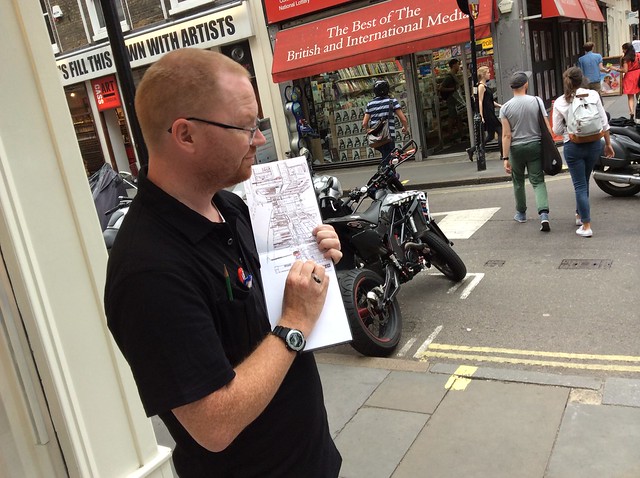
Pete sketching SohoPete sketching Soho

Here I am sketching, in a photo taken by Random Passing Chinese Tourist. And below, the sketchbook-selfie (really? That’s what it’s called?) showing what I was able to do on site. Two and a half hours of penwork. I added all the watercolour when I got home.

Sketching Berwick St

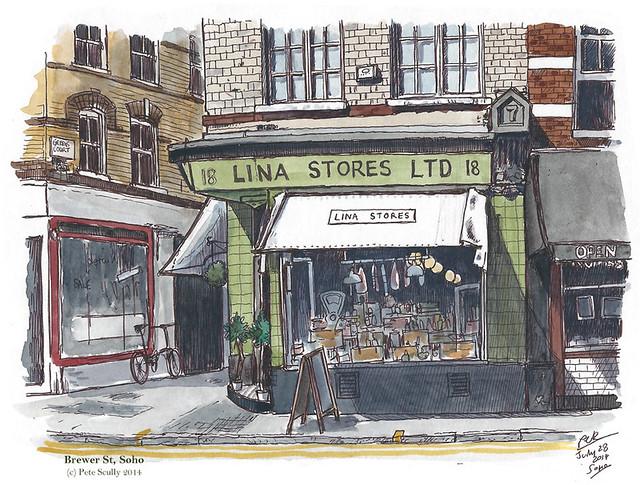
Around the corner, the Soho staple art store Cowling and Wilcox now stands empty, closed after fifty years, though they are still open in other locations. A representative from Cass Arts around the corner was stood outside handing leaflets to people directing them there instead, but I told him I didn’t need one (I had just been to Cass). He didn’t take that for an answer and told me to take the leaflet. No thanks mate, I don’t need one. “Take it anyway,” he insisted. No, I don’t need one. “Take it and throw it away then,” he kept on. I don’t want a leaflet, mate, will you leave me alone. He wouldn’t. “You’d be doing me a favour by taking the leaflet.” He was quite pushy. No mate, please leave me alone. He glared for a while incredulous at the idea that I wouldn’t take a leaflet telling me where a store is that I have just been to but then left it and started bothering other people. That’s Soho for you, but there are sometimes pushier sales-folk on these streets, if you know what I mean. By the way, there is another sketch I did in Soho that afternoon, around the corner on Brewer Street. It’s a cool looking shop called Lina Stores Ltd on the corner of Green’s Court, and I just had to sketch it.

Brewer St, Soho

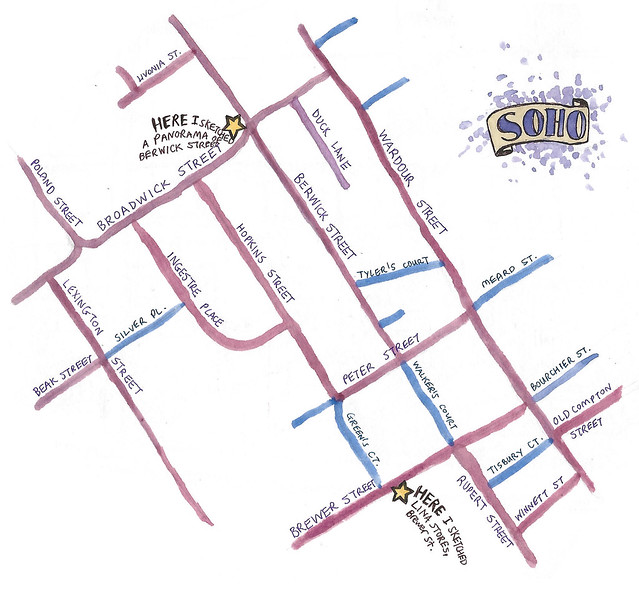
And that was the end of my first day back in London! Here’s a map of Soho showing where these two were sketched. IT doesn’t show the previous two from earlier in the day but well, you can figure them out.

soho map

soho lyrical

The Lyric, Soho
One of the missions I set myself was to draw old pubs in Soho. Pubs…they are a dying breed these days. Remember pubs? they’ll say one day. Pubs were great. So many are closing down, old ones like the Nellie Dean, an old favourite of mine, and those that remain are often modernising, sterilising, losing their uniqueness. I say that, but still I managed to find many great old pubs in London, and people still drink a lot, despite the massive hikes in the price of a pint. Wow, beer is dear now. But for me its the existence of the pub, and the old architecture of the British public house, that I’m drawn to (I actually don’t like a lot of beer in London these days, I prefer the brews of the west coast of America). While back, I did stop by an old favourite, the Ship in Wardour Street, for a great evening. This pub, The Lyric in Great Windmill Street (http://www.lyricsoho.co.uk/), sits on the cusp of Theatreland, and while I’ve never actually been in I have walked by many times wanting to sketch it. So on my first day back I made sure I drew it. I stood opposite on an extremely narrow pavement while delivery vans stopped and started and a local workman, presumably some sort of security guard, I wasn’t sure, stood chatting away on the phone the entire time, joking with his colleague about something called a “jelly cab” whatever that is. He was friendly, and asked if I was an architect, I said no, they work longer hours than me. I did most of the inkwork and some of the paint, but finished off the paintwork later. It is nice taking sketches home to colour in, it gives me more time to sketch other things! Which I promptly did. Anyway I am very pleased with the result and here is another London pub added to my collection. I love Soho.
The Lyric, Soho

and said goodbye to the circus

Piccadilly Circus

I’ve been away for a little while…but now I am back. Jetlagged, with lighter pockets. For just over three weeks I was back in my native city of London to see family and friends, and to feel like a tourist. I even organized a sketchcrawl. I did a LOT of sketching, so I will undoubtedly be scanning and posting for the next month or so, but it’s about time to get started already. On my first morning in London, I awoke bright and early (well it was not quite bright yet), did a panorama sketch of my old street from my old window (to scan and post later), and hopped on a train down to Piccadilly Circus, the crazy traffic and tourist filled pulse in the middle of London. I generally dislike Piccadilly Circus, especially now that there are no big record stores worth going there for, but they do have that big Waterstones bookstore a little further down Piccadilly, and of course they have Lillywhites. That is a huge sports store, to which I primarily go to look at the massive collection of football shirts (you may not know this, but I’m a football shirt nerd, oh you did know? Oh yeah, see all my previous posts this summer…). I got down there early, before it opened, and took a spot outside their big windows to sketch the Angel of Christian Charity, also known as the Shaftesbury Memorial Fountain, but known to Londoners and sign-posts as Eros. I usually avoid this spot due to overcrowding but at this time of the morning it was immeasurably more pleasant. I sketched in a large spiral-bound Stillman and Birn Alpha book, and stood looking towards Regent St and Shaftesbury Avenue. After a while, some police officers showed up, dressed in bright yellow overcoats. They were just hanging around, and then more came. Some photographers also started gathering, and then more police, and then two officers mounted on horseback, all in a jovial mood, all happy to pose with tourists. There must have been over forty police officers there, and they all stood together and said “cheese, guv” and had their photo taken in front of the statue (“Ello, ello, ello, what’s goin’ on Eros then?” I nearly quipped). I had alreayd drawn most of it by then but I did add a couple of coppers for good measure. A young woman from Germany, holidaying in London, stopped and watched me sketch for a while, even sitting down when I crouched over to add the paint. I was in a good mood for my first out-and-about sketch in London, and when I was done I said goodbye to the circus, popped into Lillywhites to look at all the new football shirts, and set off to sketch the narrow dusty streets of Soho.