Monumental

panoramic sketched view from The Monument, London

I went up The Monument. “The Monument? Which Monument? I hear you ask. Aha, The Monument. That’s all Londoners call it, and it has its own tube station called simply ‘Monument’ so that’s that (it joins up with the station called ‘Bank’ which is named after The Bank of England which we never call “The Bank”). I could write a whole book on tube station names, but it’s probably been done, I would only be using it as an excuse to draw pictures. Anyway, the full name of The Monument is actually The Monument To the Great Fire of London, and yes, it is exactly that. And I went up it, for the first time since I was in my teens. I’ve not had much of a reason to go back up there in all these years, and I do muddle up my old your guide stories about it occasionally (no it is not 365 feet high and no it does not grow a foot in leap years, that is St.Paul’s as everyone knows). It was created by Christopher Wren and Robert Hooke as a huge column topped with a shiny golden ball of flames and an observation deck, so people can climb up the narrow spiral stair case (all 311 steps) and look out over the rebuilt city that Wren had created. Well I wanted to go up there and draw. The City keeps on changing, and since the last time I saw that view from that angle was in the early 1990s, it was bound to have changed a bit. The first time I went up I was about 15 or 16, and I remember getting to the top, and finding myself still looking up at buildings, while also being at the top of a very narrow stone column with just some bars stopping me from plummeting. They do say that if The Monument ever fell on its side (presumably at the exactly correct angle) it would hit the spot where the Great Fire began, in Pudding Lane. Since it had never happened, there was no chance of it toppling over, but as I reached the very tight confines of the top, my knees went all “Ossie Ardiles 1981”, and I nearly bottled it. I forced myself to the top platform, and hugged the wall with my back, edging slowly around. There was a German couple up there taking loads of photos oblivious to the height, and I thought, well Pete you better get to work on this sketch. So I whipped out my Fabriano sketchbook and my HB pencil and drew the view as well as I could. The idea was that I’d add in the pen up there, and maybe colour it in later.

Monument View

Another man joined us on the platform and he like me was just edging around the column slowly in a state of terror. “Me too, mate” I said reassuringly. Despite the very sturdy looking barriers, I was convinced that I would drop my pen, and it would plummet down to the streets below, probably taking out someone’s eye and impaling them in the neck, and I would have to get a different pen. So as far as I got with the penwork was drawing Tower Bridge and a couple of other details. It started getting windy, and hello, that was it for me mate. I said Auf Wiedersehen to my brave German friends still taking photos (actually they had left long before so I was basically saying goodbye in German to a pair of American tourists) and went back down that long spiral staircase, hoping that nobody passed me coming back up.

IMG_2318

When I reached the bottom, to my surprise they gave me a certificate that certified that I had climbed all 311 steps of The Monument. That was nice. I then went to buy some new pants. Only joking. It did remind me though of that first time I climbed up here (no certificate in those days, at least not for me) and I said something about Wren being “a nutter” to the attendant, who grumbled a possible agreement, and I had this idea about doing a project where I drew and wrote about all of Wren’s buildings in the city, and it was not until the 2010s that I did something along those lines, when I organized two big Wren-themed sketchcrawls, the first one in 2014 starting at The Monument and ending at St.Paul’s, and the second one in 2016 doing the reverse, culminating in a big group photo outside The Monument after we as a group had drawn every single Wren building in the City, all in one day, an achievement so big I’ve never got around to organizing another London sketchcrawl. Read about that sketchcrawl here. I’m still into Wren though, and I’m glad I went up The Monument. I decided to finish the inking of that drawing over the top of the pencil sketch, using what photos I dared to take as reference, and that’s the complicated panorama sketch at the top of the post. I’m very pleased with that one, click on it for a closer view.
Sketching Wren’s London – 2016

wren's city sticker
On Sunday July 24, a lot of us gathered outside St.Paul’s, and then dispersed and sketched Christopher Wren’s London. It’s the second time I have run a Wren-themed sketchcrawl, and the fourth themed ‘crawl I have hosted in London since 2012. I’m already thinking of themes for next year! As in the past, I created special handouts which included a hand-drawn map showing all of the Wren churches (and other buildings) within the City boundaries. There are a couple of Wren’s City churches not showing, only because I didn’t stretch the map far enough north, and of course it shows none that are outside the Square Mile; perhaps we’ll sketch all of those next time! Here is the map:

Sketching Wren's London Booklet MAP

We started at 10:30am outside St. Paul’s, and I gave a little historical introduction (see this photo by James Hobbs!) talking about London leading up to 1666, starting with the beheading of Charles I, which many English people believed had brought a curse upon them, manifesting in the year of the beast, 1666. That was the year of the Great Fire of London; I won’t tell the whole story here, you had to be there. We were joined by a good number of people from around the world who were in England for the Symposium, including my Portland sketcher friend Kalina Wilson (Geminica). I met a lot of great new people that day too, as well as old friends. It was very international – in addition to the UK and the US, we had sketchers from Singapore, Hong Kong, Italy, France, Pakistan, Luxembourg, China, This was day two of London’s Urban Sketching pre-Symposium, and it was a little cooler, and a lot calmer than the previous day in Trafalgar Square. I do like the City on a weekend.

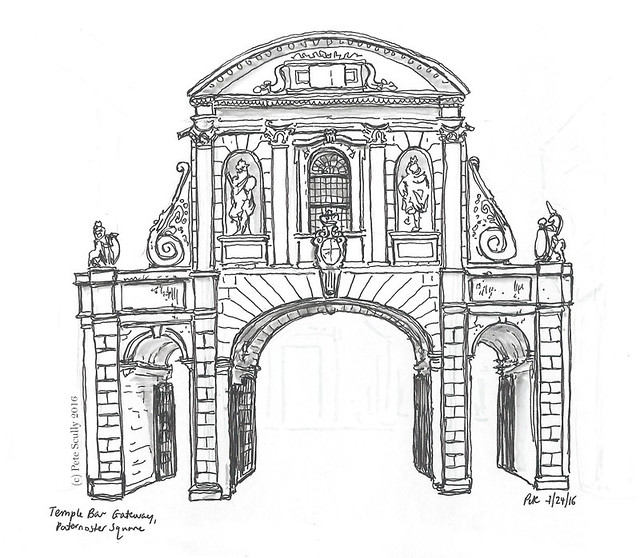
Temple Bar

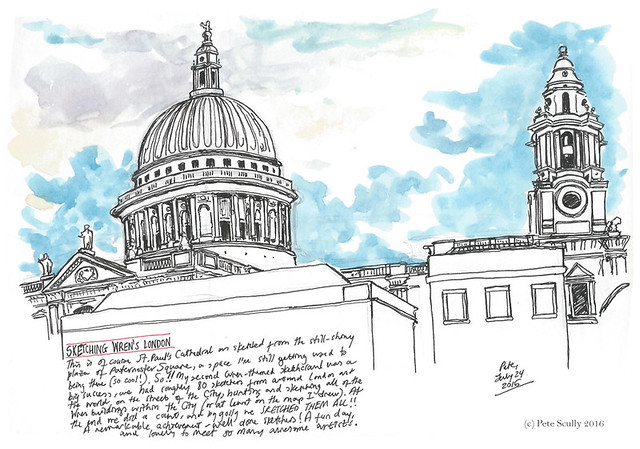
In 2014, I sketched seven Wren buildings in one day, and my ambition was to sketch more. However, you sketch what you can sketch, and I’m pleased to say I at least matched my previous haul. I did use more pencil while sketching than usual, something I am doing more. First off though I sketched the Temple Bar gateway in pen. This was originally down at Fleet Street at the entrance to the City but removed many decades ago, only to sit languishing in Theobolds Park near Cheshunt. It was restored and placed next to St. Paul’s just over a decade ago, forming the entrance to Paternoster Square. It was from that still-shining-new plaza that I sketched St. Paul’s itself. I have always struggled with the great domed cathedral from this angle but that’s ok, you have to draw St. Paul’s.

St Pauls Cathedral

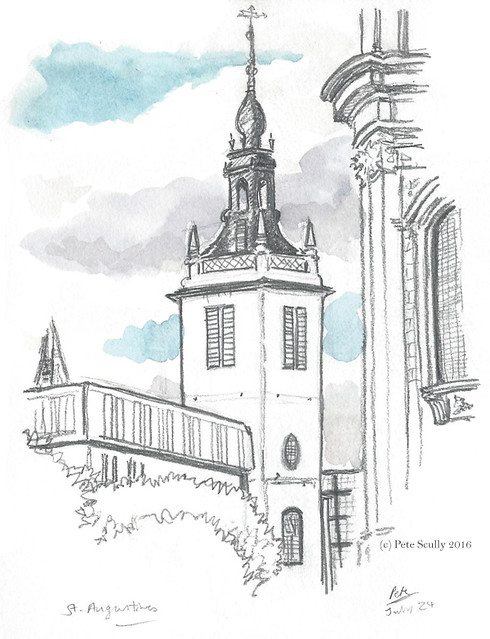
Next up, a couple of neighbours to St. Paul’s. First of all, St. Augustine’s Watling Street, largely destroyed in the Blitz. I sketched this in pencil from the gardens of St. Paul’s churchyard while talking to my old friend from high school, Joan Uloth (check out her Instagram) and Beliza Mendes from Luxembourg. I really want to sketch Luxembourg, I met more Luxembourg sketchers in Manchester.
St Augustines
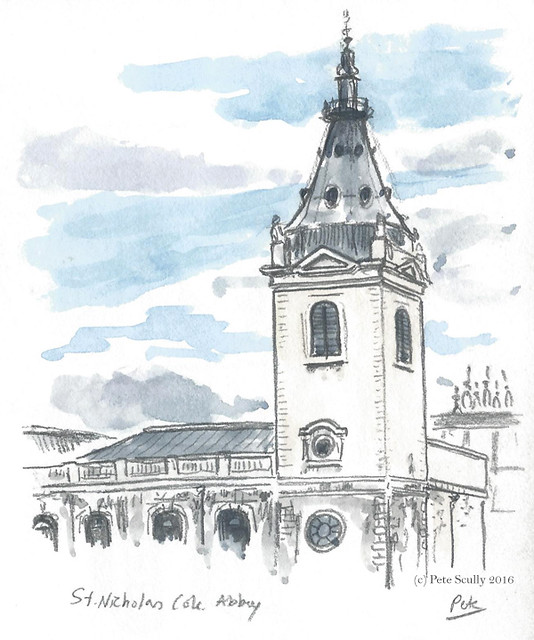
Then I sketched St. Nicholas Cole Abbey, which is visible across the street (now that the building that was in the way has been demolished, that is).
St Nicholas Cole Abbey

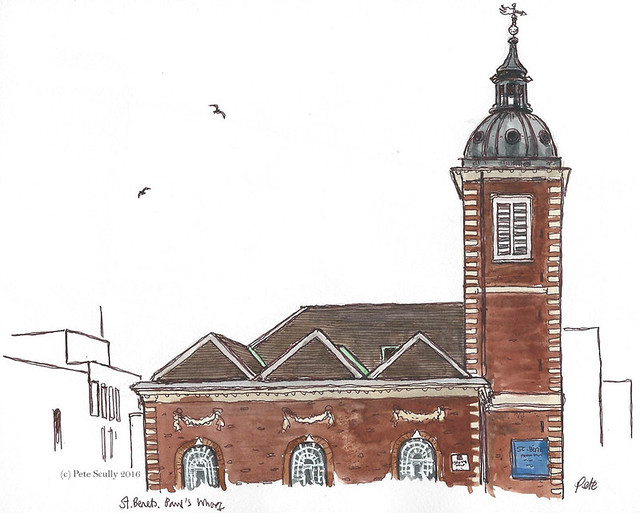
This one was sketched across a busy street, St. Benet’s Paul’s Wharf, the church where they hold the sermons in Welsh.

St Benets Paul's Wharf

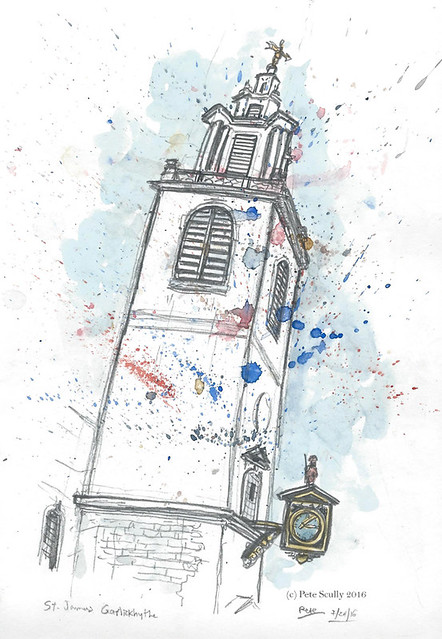
Ok this next one was sketched from an angle and with the very loud and quite chaotic bells ringing. St. James Garlickhythe (haunted by “Jimmy Garlick” who sounds like an old washed up musician from the early 70s). I did the old paint splatter thing because the great Tia Boon Sim from Singapore was on the sketchcrawl and I’ve always been inspired by her paint-splatter styles. It seemed appropriate given the noise of the bells!

St James Garlickhythe

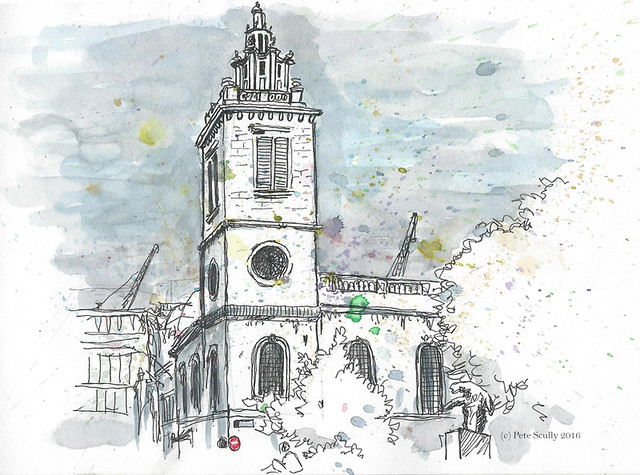
My final sketch was of the neighbour to St. James, which is St. Michael Paternoster Royal. What I loved about this crawl was that wherever I went there would always be at least one or two other sketchers there busy plugging away. This by the way is the church where legendary (but historically very real) Mayor Dick Whittington (he of the cat and the pantomime) was buried. Nobody knows where his grave is now though, but while Wren’s tomb says “Look Around You” I presume Whittington’s tomb says “Look Behind You”.
St Michael Paternoster Royal

And then we met up at The Monument, to look at each other’s sketchbooks. Of all the people that made it to the finish (and quite a few did not; I checked the number of maps given out and I think we had around 80 participants total), we got together and I read out the names of each Wren building, asking sketchers to raise hands if they had sketched it.

You’ll never guess – we sketched ALL OF THEM. Every single one! Great job, London sketchers!!!

Here are a few photos from the end. You can see more at Urban Sketchers London (JAmes Hobbs has posted a nice set “In Wren’s Footsteps“) and on this Flickr set “Sketching Wren’s London“.

Afterwards several of us went to a pub near Borough Market for a post-sketchcrawl-pint. I sketched two sketchers, Rachel and Jimmy…

jimmy and rachel

And here is the final group photo at the base of Wren’s Monument to the Great Fire! Can’t wait to sketch with Urban Sketchers London again in the near future. So nice to meet so many new sketching friends.

IMG_0611

Oh, and everyone got a sticker!

sketching wren’s city…part one

Sketching Wren's CityJust over a month ago I organized a sketchcrawl in London based on a theme I have wanted to sketch for many years. It was titled “Sketching Wren’s City”, and was going to focus on finding and sketching the buildings of the great architect Sir Christopher Wren, that still exist in the City of London today. (Hence Sketching Wren’s City, not Wren’s London – he has some lovely buildings outside the City of London). Christopher Wren, for those of you who may not know, was the man given the task of rebuilding most of London’s churches and many other buildings after the Great Fire of London in 1666. The Great Fire, you say, what’s that? Well in September 1666 a baker called Thomas Faryner in a street called Pudding Lane had the misfortune of having a fire start in his bakery one night, a fire deemed so insignificant that the Lord Mayor, awoken with the news of flames rising above the rooftops, famously said that, well, it could be extinguished by a member of the female persuasion urinating upon the conflagration (he didn’t use those exact words). However, the fire spread, and kept on spreading, and no amount of wee (male or female) was able to make up for the lack of a decent fire-fighting service (if only they had fire hydrants in 1666!). The City of London was destroyed, including the grand old St.Paul’s Cathedral, and a good number of churches. Enter Christopher Wren. He had been redesigning London on a grand scale since, er, before the massive unforeseen and entirely coincidental catastrophe that gave him his big break, and now here was his chance. The people of the City however did not want a grand urban-planned metropolis, they wanted their land in the same place thank you. So London kept its medieval street plan, and Wren got to work on the churches. It was a Wrenaissance, if you will. And that’s where we come in…

Sketching Wren's London Map sm

I decided recently that I would do a sketchcrawl in the City charting a course that could let me sketch as many Wren buildings as possible in one day. Not easy, and it would mean not getting super-detailed (I never got my big panorama), but if I invited other London sketchers, perhaps we could do it, perhaps we could cover them all. I created the map above (click on it for more detail) showing which Wren churches are left – there were more originally, but Father Time and the Luftwaffe trimmed down the numbers somewhat. I gave this map to everyone, as we met up at the Monument, and off we went. I love meeting London’s sketchers!

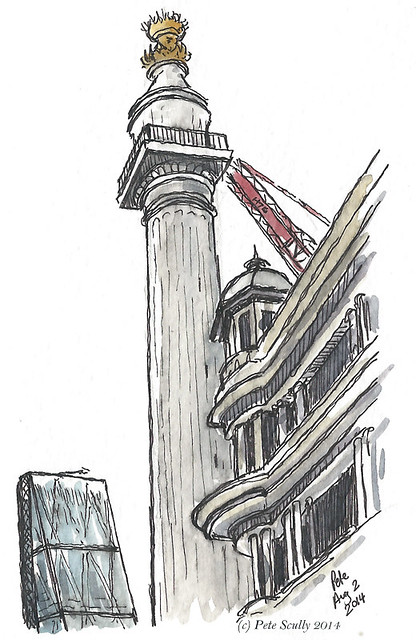
The Monument sm

We started out at The Monument to the Great Fire. Built by Wren and topped with a blazing golden ball, if it fell over it would rest exactly where the fire started, which must have made the city planners a little nervous (“Likely to fall over is it then, Chris?”). When it was built it was the tallest column in the world. You can walk up the stairs to the top and look out over the ever-changing skyline. I sketched it quickly, with one of the newer skyscrapers in London behind it, I think it’s called the Cheesegrater, because all of London’s new tower blocks have to have some silly name or other. If the Monument were built now it’d probably be called the Bunsen Burner or something.

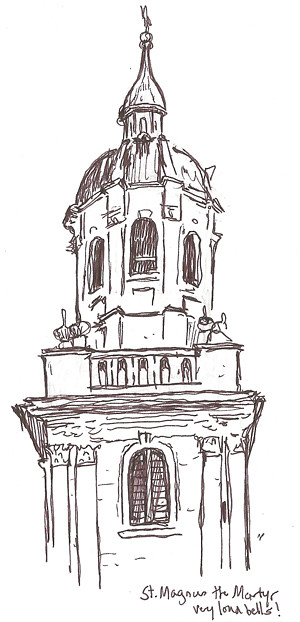
St Magnus Martyr sm

Here is my very quick sketch of the tower of St. Magnus the Martyr, just downhill from the Monument. I recall telling people on my old tours of London that this was London’s most haunted church, but I don’t recall why (probably something to do with ghosts). The bells were very loud and chimed for the longest time, as traffic belted by. St. Magnus used to be right on the River Thames, right by London Bridge itself, its clock being used by ships and bridge traffic for centuries, but as the embankments were built and bridges widened another building has now blocked its riverside view.

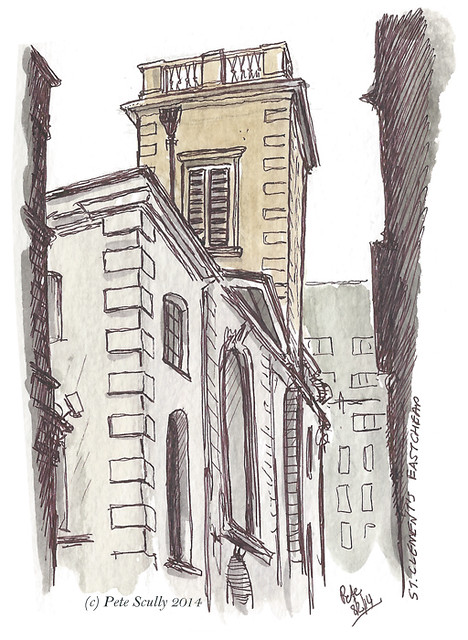
St Clement Eastcheap sm

I crossed over the busy traffic junction at King William Street and Cannon Street, and found the rather unassuming St. Clement’s Eastcheap. St. Clement’s…now where do you know that from, ah yes the famous song, “Oranges and Lemons”. This is the St.Clement’s of the song, not St.Clement Dane (the more famous one, located on Strand), and probably so alluded to because of the fruit cargoes offloaded from the riverboats nearby. Or maybe just because it kind of rhymes with lemons. I sketched in an alleyway. It’s not one of the more interesting pieces of Wren architecture. In fact it’s almost as though he couldn’t be bothered at all. “Oranges and lemons, do me a favour, I’ve got fifty-odd churches and a bunsen burner to build,” he was reported to have said, before designing the more handsome and dashing St. Clement Dane. This one is the forgotten little brother.

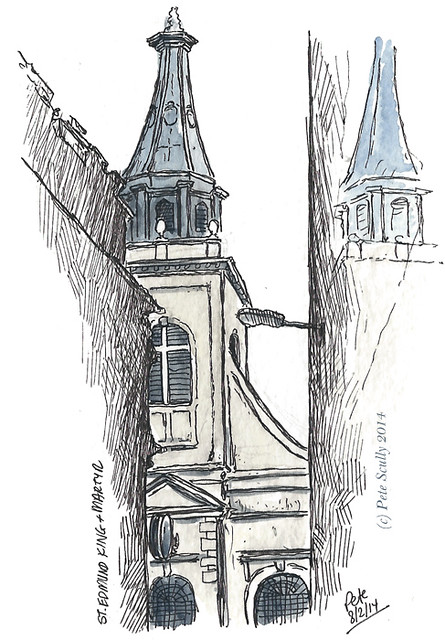
St Edmunds sm

Further down that same alleyway I found the church of St.Edmund, King and Martyr. A lot of Martyrs around here. I have a joke for you, what is King Edmund’s favourite sauce? Martyr Ketchup!     …   Anyway, as you can see I attempted to draw the reflection in one of the shiny buildings, so I hope that’s obvious somehow. Standing on Lombard Street, in the shadow of mightier structures, St. Edmund’s is no longer a practicing parish church but is home to the London Centre for Spirituality.

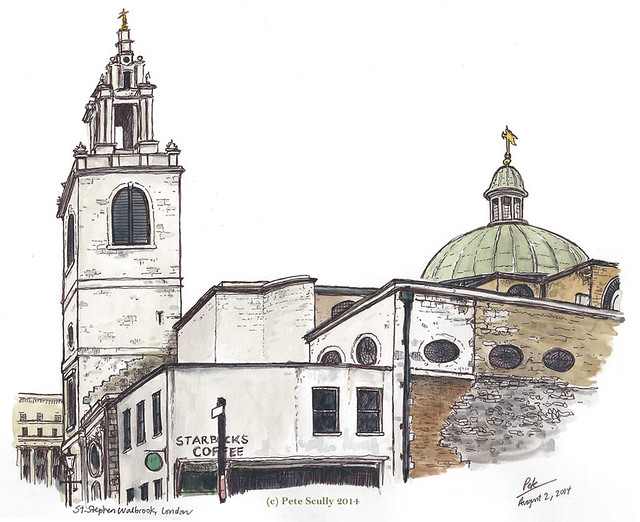
St Stephen Walbrook sm

I met my good friend Simon (seen below sketching in messy charcoal), the actor and TV Tsar (no really, watch Houdini on the History Channel this week, he plays the Russian Tsar) and my friend Tamara (herself a stage director and playwright), out sketching with her family, and we sketched the wonderful domed church of St. Stephen Walbrook, one of Wren’s most beautiful churches. Oh, on the inside that is. It was closed this day (doh!) so we made do with sketching its wonderful exterior, Starbucks and all. Still, it was very nice to catch up with old friends and do some sketching. St. Stephen Walbrook by the way was Wren’s dummy-run for St. Paul’s (spoiler alert for part two, St. Paul’s is domed as well) and the inside truly is a delight to behold, ok it’s not the Aya Sophia or anything but it’s still lovely. You’ll have to just imagine it I’m afraid, or maybe I will just sketch it next time.

Sketching Wren's City, Aug 2 2014

Please join me tomorrow for more urban sketches in Part Two: Wren’s Wrevenge…