among the stones in hampstead and highgate

Hampstead St John Church yard 061224

I think I sought out quieter spots on this London trip, I wasn’t really looking for the busy crowds and bustle of the city, it’s been too stressful a year for that. I found myself in Hampstead a few times, only a few stops down the Northern Line from Burnt Oak, but a world away in how it looks. It’s a bit nice round there. We went down one afternoon to walk about a bit, before I would be meeting up with a friend in the evening for dinner. I had a bit of time to myself to go and do some sketching, and I stood on Fitzjohn’s Avenue and sketched this weathered old post box (below), which bore the royal cipher of King Edward VII, so it’s quite old. I love old pillar boxes. I saw one from Queen Victoria’s reign on Hampstead High Street, although it was kept as a relic and was not in actual use (despite being opposite the post office). My brother called me up, and as I spoke to him I found myself wandering down old streets I had never been to, not really paying much attention to where I was going. I found myself at the Parish Church of St. John at Hampstead, an impressive old church with an adjacent burial ground, rows of gravestones poking out of long grass. It was quite peaceful, and I do like a graveyard. Real England is old brick and stone and greenery. Local ladies walked their small dogs about, and I sketched this scene above. I felt it had to be in pencil. If I still lived in London I would probably spend a lot more time sketching graveyards.

hampstead postbox 061224

On a different day, I came through Hampstead to pick up some photos I had put in to Snappy Snaps on Hampstead High Street a few days before to be developed. That’s right, an actual roll of film. I haven’t developed a roll of film in nearly 20 years, and in fact I still have some rolls of undeveloped film that I brought with me when I emigrated to America, memories still waiting to jump out at me from the past. Well this roll of film was from just the past few months. A friend got me a basic film camera for Christmas, and so I bought some film (not cheap any more like the old days!) and was taking pictures on some of our recent travels. I maybe got the film wrong (it was good quality and cost me enough), but the photos turned out terrible. Like almost unanimously awful. The ones in Zion Canyon for example were just big dark masses. It wasn’t cheap to develop either, but there you go. Fun experiment, I suppose, but I’ll stick to digital, and sketching. My son was using the film camera on our Europe trip this time, so we will see how they turn out. Better than mine, I hope. Anyway, on my way back to the tube, after stopping in Cass Arts to pick up yet another sketchbook (I never seem to not need sketchbooks), I stopped in Flask Walk to draw. The sketch is below. I like Flask Walk, it’s narrow and full of interesting little shops. I like the Flask pub, I usually pop in there when I’m back in London. When my son was little, I took him ghost hunting there, because it is supposed to be one of those haunted pubs London has so many of. I like all the little antique shops, though I’m not the sort of person who shops at antique shops. I stood nearby and drew the view looking down, trying to catch some of the things people were saying to each other, like the older woman saying “bye darling! bye darling!” to her friend. I got asked by someone passing by if they could take my photo while sketching. I said of course (I get that occasionally when I’m in London, I think it must be the way I hold my sketchbook). They had a nice digital camera; I said I had tried taking photos with a film camera but just got them developed and they had turned out really bad, so I will be sticking to the sketchbook in future. I asked if they drew and they said they did but not much, and would like to do more, so I gave them the information about Urban Sketchers London, and said they should join them on their regular sketchwalks. If you are interested, check out their calendar for the rest of 2024 at the USk London website. When I was done with my sketch, it was time to head home.

hampstead flask walk 062424 sm

But I have a couple of other sketches to show from the area. On a different day, we all came back down to Hampstead to look around before taking a walk across Hampstead Heath. I love Hampstead Heath, it;s easy to get lost along its tree covered paths. I have a photo of my holding my son by the ponds when he was only four months old, he’s sixteen now, so we took the same one, though I wasn’t carrying him this time. As we rested on top of the Heath, looking towards Highgate Village, I did a quick small paint sketch, below. It’s hard to imagine, we lived over there before moving out to California. It was a bit of a walk, but we’d sometimes come over this way on a Sunday, enjoying the peaceful English day. We lived on Hornsey Lane, and I still love that area. We went over there on of our first days back, it had been so many years. In another universe, if we had not moved to the US, we might be over there still, my son might have grown up there. We joked about that; the truth is, working for universities which don’t pay much in England, and with the extortionate cost of living in London, there’s no way we could have afforded a bigger place in Highgate unless we got very lucky, and would probably have moved our further, or back up to Burnt Oak, or just moved to California anyway. You can’t see the multiverse. There are a lot more hills here than in Davis. We did explore Crouch End again though, I miss that neighbourhood so much, and Highate Village, and Waterlow Park. We walked down our old street and took a photo outside the house where we rented a flat, those horrible old windows were unmistakable (except they were mistakable, because we were stood outside the wrong house; our old one was a couple of doors down, so we took a photo outside that one instead).

hampstead heath 061724

After the walk across the Heath, the final destination beckoned: Highgate Cemetery. That is the literal final destination for many people, from your Karl Marxes, your Douglas Adamses, your Jeremy Beadles, even your Eric Hobsbawns, your Malcolm McLarens. We only walked about the East side; I’ve never been to the West side, some day I will, but I notice that David Devant (the magician after whom one of my favourite bands is named) is buried there, as is Prof. Lisa Jardine, who I actually knew from my days as a drama student at Queen Mary, and Michael Faraday, one of my favourite scientists. George Michael is in the West side too; he was a local lad from near where I grew up, and he also lived in Hampstead in his later years, and speaking of the Snappy Snaps on Hampstead High Street, that was, er, the place where he crashed his car back in 2010. Anyway, we just looked around the East side, found the big Karl Marx, found a few other names I was looking for, talked about vampires, and then went down to the village at Parliament Hill for an overpriced pub lunch. Anyway, some nice times spent in Hampstead and Highgate, still some of my favourite parts of London.

highgate cemetery 061724

mile end afternoon

Mile End old building

I was done pretty early with exploring Queen Mary University of London on my first day back in Mile End in over 20 years. I walked round the corner to Burdett Road, and decided to draw this old building that was mostly boarded up, I do remember using the post office back in the late 90s. I didn’t live in Mile End while I was at university, I stayed back home in Burnt Oak, so I would commute in on the tube. I knew quite a few people who did decide to live locally, or a bit further out, and there would always be parties in those days. I took a lot of Night Buses as well, the old N25. Fall asleep on that, it bounces you back from Trafalgar Square right out into like Essex or somewhere. I stood by Mile End Park to draw this, but only got as far as the outline, because I was getting hot, so I drew most of it later on. I had another part of Mile End to look for.

Lord Tredegar Pub Mile End

A couple of years ago my wife (who is American) and I were looking at this impressive family tree document that her great aunt had put together many years before, and I noticed that there was a ‘Sir’ on there, Sir William Morgan, Earl of Tredegar. It was exciting to discover, and it turns out the Morgans are a pretty storied family, both from their Welsh aristocracy days, through the British Civil Wars and subsequently those that emigrated to the US and became big names in the fledgling country (founding the city of Springfield MA for one thing). In short, it turned out my wife had some pretty interesting ancestors, the Earls of Tredegar, and then all of a sudden I started seeing that name everywhere (we even chanced upon William Morgan of Tredegar’s memorial in Westminster Abbey last month). Pretty much the same day we were looking all of this up, my friend Simon (an actor and and former QMUL alumnus) told me about a film he’d just appeared in, Once Upon A Time in London, so I watched that, looking out for him. One of big scenes involved being beaten up in a pub, anyway right afterwards the gangsters involved walked out of the pub and it was called “The Lord Tredegar”, of course. I had to look up the pub – and it was in Mile End, very close to “Tredegar Square” and “Morgan Street”. Presumably the family had owned land round here. Well I found the pub – it’s in quite a nice part of Mile End, some impressive old houses around here – though it was closed, so I drew the outside, although I didn’t bother finishing all the colour later. A block away, there was a lovely post-box dating from Queen Victoria’s reign, which I drew with the Morgan Street sign in the background. This was right by Tredegar Square.

Mile End Postbox

I was done with exploring Mile End, and decided to head back into central London, but I saved one last very quick sketch for Mile End tube station. This is where I’d come in and out every day while at university, after an hour-long packed tube ride from Burnt Oak. Another tube station sketch for the collection, I think I expected more stories to come flooding out of this one, but not really. I do remember one thing, it’s opposite the Territorial Army (TA) centre. Back when I was doing Richard III in early 1998, I was charged with arranging for props for the production, and asked for a bunch of army materials, including an army table. How I thought I could do that given that I had no car or means of transporting it, I do not know, but I was resourceful enough. There’s a big TA centre in Burnt Oak near where I lived, so I went there and kindly asked to borrow some equipment. To my surprise they said yeah sure, just bring it back. I got lots of army cups and hats and things like that, and a table, a big heavy green wooden table. Like, really heavy, like impossible to actually carry heavy. Carry it I did, halfway down Deansbrook Road, like an idiot. I would have called my dad, if we lived in the era of the mobile phone, but we did not just yet. I think I ended up leaving it, coming home, and then having one of my parents come and help me get it in the car. And I was going to bring this to Mile End to use in a play? What, on the tube? That wasn’t happening. I felt a bit stupid, but I had the other props, Richard III was just going to have to make do with a regular table to plan his battle with Richmond. Anyway the next day I came to Mile End station, walked out and immediately saw the TA Centre across the street, which I had hitherto never noticed. I didn’t bother going to ask them if I could use a table, I’d give myself a bad back carrying that, I’d end up looking more like Richard III myself. So, I do think of that when I think of Mile End station.

Mile End Tube Station

lisbon and her histories

Lisbon Street tiles sm
I intended on waking up early, as I like to do when I travel, and wander Lisbon’s streets in the dawn light, try to find a little bakery with amazing delicious pastries. However my bed was just too comfortable, so I stayed there. It was the last full day of my three-week trip before I would be flying back to America. I’d been to London, Warwick/Stratford-upon-Avon, Madrid, Toledo, Porto, and Lisbon. I was overdue a long lie-in. But I had a Lisbon to sketch, so eventually I dragged myself out from the comfy covers and headed towards Alfama. I walked through the long grid system of Baixa, which owes its layout to the massive rebuilding of Lisbon after its devastating earthquake in 1755. That earthquake really was devastating – it is estimated to have been between 8.5 and 9 on the Richter scale, and resulted in the deaths of anywhere between 30,000 to 40,000 people in Lisbon alone, most of whom died in the resulting firestorm and tsunami caused by the quake. Lisbon was rebuilt, but the Baixa area is sometimes called Baixa Pombalina, after the Marquis of Pombal who led the reconstruction and was responsible for a more earthquake resistant architecture. Now I didn’t end up do any sketching around here, except for the man above, a workman repairing some of the mosaic pavement tiles. So I also drew some of the various mosaic pavements I came across in Lisbon. This style is ubiquitously Portuguese, black and white square tiles, often laid out in intricate patterns, a feature especially common in Lisbon but also found in far-flung former Portuguese colonies, like Brazil and Macau.
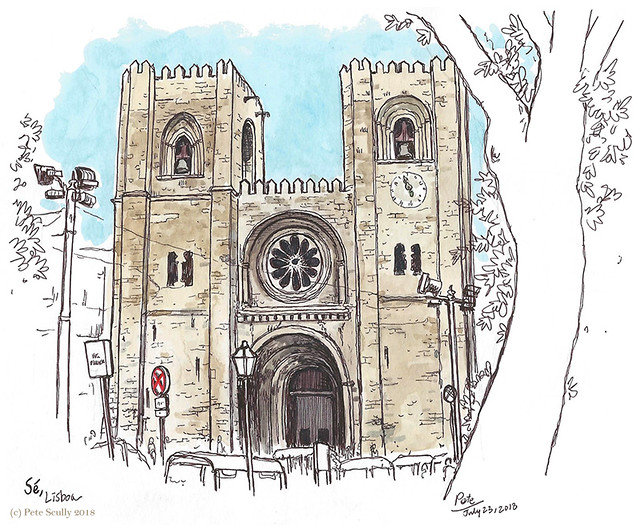
Lisbon Se Cathedral sm
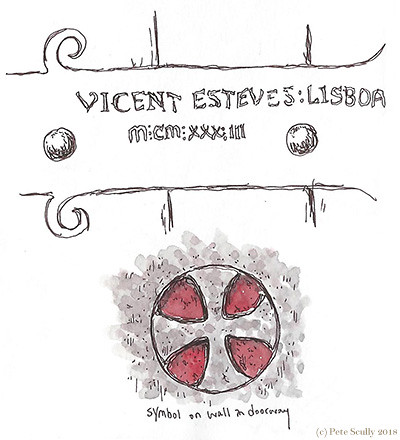
I passed into the Alfama district, which I did not visit back in 2011, and headed up to the cathedral, the Sé. You’ll remember that the cathedral in Porto was also called the Sé. IT is related to the English word ‘See’, as in the ‘Holy See’. Do you see? Anyway it shares some similarities (or “Sé-milarities”, eh) with the Sé in Porto, well I think they look alike, I don’t care what you sé. Anyway I sketched outside next to a statue of a famous actor (I’ve never heard of him) and walked around inside. It turns out the proper name is Santa Maria Maior de Lisboa and it dates back to 1147, when the city was retaken from the Moors. Actually the cathedral was built on the site of the city’s largest mosque. The doors were interesting, and as you can see from the inscription on the metal part, they date I think from 1933, made by a bloke called Vicent Esteves, aka Vince Stevens, old Vinnie Steves. I am assuming the doors are from 1933, that is, for all I know the cathedral was built then and the whole of Lisbon was built then too. In the post-truth era people might believe this. There was another symbol in the masonry on the wall, a circle with a greek cross, although it might be the view you see when being thrown down a well by four radishes.
Lisbon Se Cathedral details sm
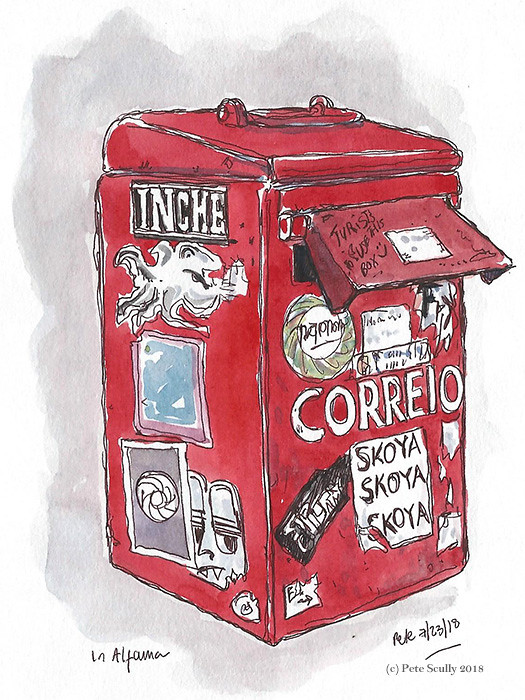
Ok enough cathedral based silliness. So I started walking around Alfama, an old windy-street hilly part of town with red rooftops and twisty alleys. Then I stopped and ate some sardines for lunch, the classic Lisbon food, I had forgotten how many bones are in those. I found this post-box, next to a similar looking blue one. I only drew the red one. Speaking of the post, can I just point out that I sent a postcard home from Spain and thus far it has not arrived, but we received the postcard I sent from Porto already so that’s 1-0 to Portugal in the postcard wars. Well, last year we sent a card from the Vatican City State which got here super fast, but thirteen months later we are still waiting for the Italian postcard from Rome.
Lisbon Postbox in Alfama sm
I liked walking around Alfama. There’s so much history around here, it’s hard to believe Lisbon was only built in 1933. Only joking. Actually much of this neighbourhood was apparently spared widespread destruction in the 1755 quake. This was the stronghold of the Moors, but they don’t live there any moor. (Travels with me is an endless series of admittedly excellent puns) Alfama the name is itself Moorish deriving from the Arabic “al-hamma”, which means thermal baths or fountains. Before them, the Visigoths. Before the Visigoths, the Suebi, the Alans (“Ah-Ha!”) and the Vandals (such as our old pal Vinnie Stevens), and before them of course were the Romans, when Lisbon was known as ‘Olisipo’. And before the Romans, it was the Celts who lived here. The area around the Castelo de São Jorge was (it is thought) home to a Celtic fortification, and archaeological excavations even suggest a Phoenician trading post here dating back to around 1200 BC. And before the Phoenicians, there were the Oestrimni, and the Beaker people, the old Bell Beaker culture. And before them, the Neanderthals, living around the Tagus estuary 30,000 years ago or so. I could go on but I’m just not sure which dinosaurs exactly had nesting sites in the Alfama area so perhaps we’ll just carry on our story from here.
Lisbon Alfama Street sm
This scene was drawn near the Castelo, in the winding maze of streets around the castle hill. As I was drawing, I (again) bumped into fellow urban sketcher Genine Carvalheira, with her girlfriend. She may have thought I was just one of many Pete clones dotted around Lisbon with sketchbooks (I wish I had access to that sort of technology, can you imagine how many sketches I would get done?). It was a hot afternoon and I stood in the shade.
Lisbon Alfama View sm

And here is the view from the shady leafy gardens of the Miradouro de Santa Luzia. Those red rooftops of Alfama, that blue Tagus river, it was a gorgeous day in a gorgeous – and very historic – city.

and don’t dilly-dally on the way

st james church, piccadillypiccadilly postbox

Londonistas, fear not. I still haven’t finished posting all of my London sketches from December. There are still more to come. I’ve been spreading them out over a period of a couple of months to keep you coming back. Or rather, because I’ve just not gotten around to scanning and cropping and blah blah. Still, it mixes it up a bit – San Francisco here, Islington there, Sacramento here, little bit of Davis. This is Piccadilly, in central London. It’s a thoroughfare named after those ruff collars that people used to wear years ago (think Shakespeare, Raleigh, Blackadder…) and full of fine shops and elegances. St. James’s church (above left) is a great old Wren church, free of stained glass (as was the fashion in Protestant England) and a building I’ve wanted to sketch for quite a while. Light was fading though (the sun goes down at about midday in England in December) so I had to be quick. A few people asked if I sold my sketches while I was sat there. One even asked me in Italian. Another said he’d give me a fiver for it. Sorry, I said, this is part of my sketchbook and I don’t cut out pages. A tenner then, he said. Hmmm, five hundred quid, I said. Bargaining ended there, and I got back to sketching.

I sketched a post box on St. James Street. It has two slots for letters, which is handy if you’re in a hurry. It reminded me of that line in Little Britain, “if you put a second class stamp on a letter in Britain, it’s guaranteed to arrive somewhere at some point in the future, maybe.” Ah, Britain. When I used to be a tourguide I would tell my American tourists that the “ER” meant ‘Emergency Room’. I also used to tell people that, where an ‘L’ plate on a car means ‘Learner’, the ‘GB’ sticker means ‘Getting Better’.   

the angel commonly called erosgielgud theatre, shaftesbury avenue

I also used to tell them that Piccadilly Circus was the Times Square of London (which is what we’re supposed to say), and that the statue of ‘Eros’ isn’t Eros at all. It’s called the Angel of Christian Charity, and was erected for the Earl of Shaftesbury. It is supposed to point up Shaftesbury Avenue, but now i fact points the other way, due to a mistake when re-erecting it. Now it’s used as the emblem of that paragon of virtue and unbiased truth, the Evening “we can’t even justify being paid for so now we’re free” Standard. It was, as always, very busy. McDonalds was jam packed; it was like Piccadilly Circus.

And there on the right, the Gielgud Theatre on Shaftesbury Avenue, in the Theatreland of Soho. I remember when this used to be the Globe Theatre, but it got changed and now we have a different theatre called the Globe (something to do with that Shakespeare guy again, they’re still going on about him). As I sketched, a group of small oiks gathered around me to watch. I sped up and moved to a different spot. I don’t trust small oiks, out in feral packs on the streets of London. I do like it round here though; a mate of mine lived about a block north of this spot years ago, up in Berwick Street, and those were great times. I can even remember some of them.

snow is falling, all around us…

snowy norwich walk

This is Norwich Walk, the street where I grew up. On this very block in fact; my old bedroom window is on the third house from the right.  I’ve never seen so much snow in London, as fell on my recent trip. It was on the Saturday morning a week before Christmas, and despite a little fall of snow the day before, we decided to take the short trip to Colindale to visit the RAF Museum. I wanted to draw old planes. In Burnt Oak, carol singers stood outside the station singing Christmas songs as snow fluttered down like a picturesque postcard (without the picturesque of course; it was Burnt Oak tube station, not one of London’s nicer spots). Then our bus stopped due to ice on the road, and we got out and walked across the estate. As we did, an absolutely massive amount of snow pounded down upon us. We were walking snowmen by the time we finally snowy pillar boxreached the musuem, which had just decided (wisely) to close. The buses then stopped, as did the tube, and cars were quickly becoming buried beneath feet of snow. Thankfully my dad managed to dig his car out and came to rescue us, though the roads were treacherous, and we had to crawl along. Snow was coming down in ice cubes. I wouldn’t have been surprised to see those little paper umbrellas too. We got home, and warmed up, and then I went straight back outside with my little sketching stool to fill the last page of moleskine sketchbook #6 and freeze my fingers off. The snow had just stopped falling, and I had to capture this before it all vanished (little did I know it wouldn’t vanish for another week and a half).

Passing locals must have thought I was a nutter (those that have known me all my life knew it for a fact…). I quickly sketched the pillar box I’d drawn two days before, and then drew the street panorama. I gave up halfway through, my fingers freezing off, but then decided to soldier on, finish the block, and I’m glad I did. My micron pen didn’t give up so neither would I. Thankfully snow isn’t hard to draw. I added the paint when I got home.

So this is the last page of this sketchbook, which was started on a very hot day in southern Oregon on the fourth of July, and finished in freezing cold London in December. I did a good bit of travelling in this book, and you can see the whole journey on my flickr site: Moleskine #6 

from pillar to post

pillarbox at top of my road

And so onto my sketches from London. Not having any fire hydrants, it was obvious I would have to sketch soemthing even better – the post box (or pillar box) at the corner of the street where I grew up. I got up early (as jetlagged travellers do) and sketched it as Burnt Oak locals passed thinking, ‘nutter’. This dates from the reign of King George V (hence the GR cypher on the front) and is of the standard pillar box design. I drew this more than once – the second time it was covered in snow…