sketchcrawl 44: uc berkeley

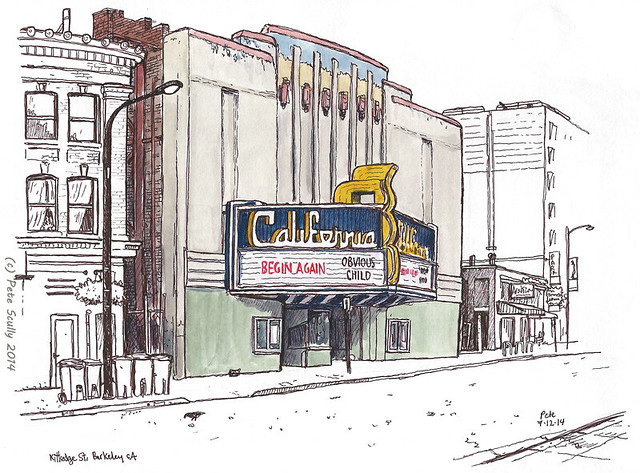
california theater berkeley
Last week was the event of the 44th Worldwide Sketchcrawl. Regular listeners will know I have been on many of the worldwide sketchcrawls over the years in many cities. Last Saturday morning I woke up, and decided: I’m going to Berkeley. The sketchcrawl was on the UC Berkeley campus, which for me was significant as one of the first sketchcrawls I ever took part in (it was in fact the second, the first being in Davis at the end of 2005, but I did not do much that day) was at UC Berkeley, in March 2007. On that day I sketched a lot but kept to myself, too shy to talk to other sketchers. I’m not so shy these days, but I did sketch solo, though it was great to meet and talk to other sketchers. I also remembered just how much I love being in Berkeley. The theatre above, the Calfiornia, I sketched in the morning before meeting the sketchcrawlers. I remember one of the last times I was in Berkeley saying, I must sketch that next time. That was five years ago, so I got there eventually.
south hall uc berkeley
Above, my first sketch of the day. It took about an hour and a half, and I had intended to colour it but I haven’t yet. All of the colouring in I did was done later, because I didn’t bring a little jar of water for my paints (of my two small jars, one was lost and one broke, I haven’t found a good small one since). I don’t really do the waterbrush thing any more. So, it gives me more time for penwork, diving into the details. This is South Hall. Davis has one of those too, but it’s not as nice as this. This radiates grandeur.
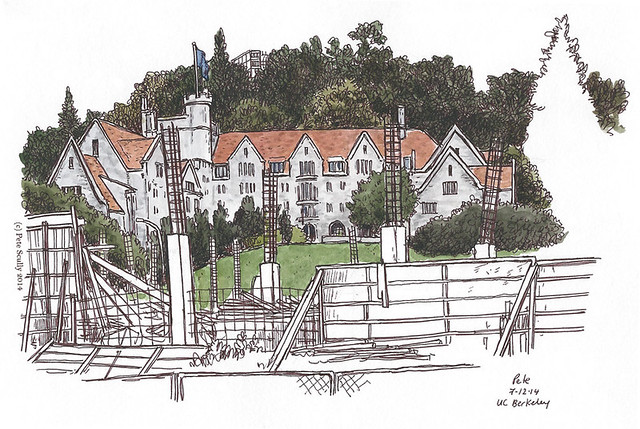
bowles hall uc berkeley
This is a building I have sketched before, Bowles Hall further up the hill. It looks like an old English country public school (Americans note, ‘public’ school in England is actually what we call private schools; our public schools are called ‘state’ schools. Mine was always in a state, anyway). I sketched it in 2007 on a much sunnier day (sunnier, but through the fog I actually still got burnt last week, stupid deceptive weak bay fog). This time there was construction going on in front of it, so I imagine this view will look different next time.
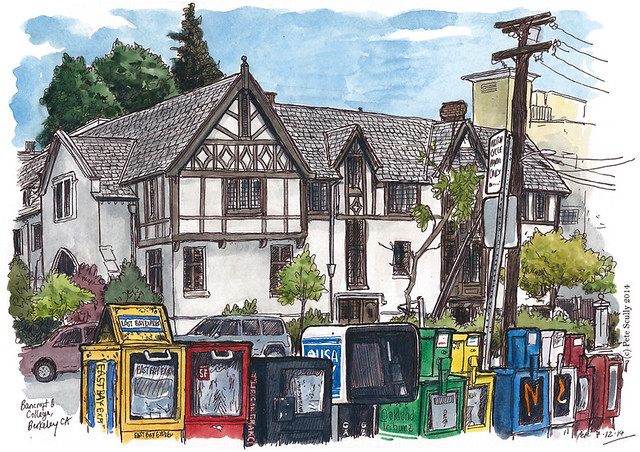
bancroft and college, berkeley
I went down the hill to the southern edge of campus, to the corner of Bancroft and College. This building is called the Free House I think. I was enticed by the colourful newspaper boxes which again, I had to colour in later, but spent a good deal of time (just over an hour) sketching all the little marks on each one. By the time I was done it was time to reconvene with the other sketchers, back at Sather Tower. There was quite a gathering. Here I am with a few fellow sketchers (left to right) Jana Bouc (one of the SF Bay Area Urban Sketchers and whose own sketchblog Jana’s Journal in fact inspired me to start this very blog you are reading); Pete (that’s me there with uncoloured version of sketch above); Gary Amaro (also an original Urban Sketchers correspondent, see his work online at garyamaro.blogspot.com); and Flory Nye-Clement, a sketcher from Benicia (who by the way is organizing a sketchcrawl at the Benicia Capitol State Historic Park on August 23, starts at 11am). Results of the sketchcrawl in Berkeley are being posted on the forum at sketchcrawl.com.
berkeley sketchcrawl

I’ve been quite a hermit lately in terms of sketching, and I must say it was very nice to get back out there and meet fellow sketchers again. It’s always good to rub shoulders with other people on this planet who ‘get it’. Hey, there are a lot of us urban sketchers out there!

what’s it all about, alpha?

uc davis boards
It’s the time of year when the Frat Boards are out in force. Not just for Fraternities, but Sororities and other organizations too. I have lived in Davis for seven years and they are all still a mystery to me. Obviously not all these societies are ‘Greek’ (or maybe they are), or rather they don’t all have mystical Greek acronyms, but many of them have big frat houses and spend a lot of October pursuing recruitment activities and initiations (such as ‘hazing’). Fraternities are national, with chapters at many big American schools, and some societies are very old indeed. Some are specialist organizations, such as the ones for Pre-Med students or Latino students, or that fraternity for those really into boating (Rho Rho Rho) and another one for dairy farmers (Mu Mu). (There is probably one for really crap old jokes too, Tee Hee Hee).

Speaking of the Greek alphabet, I was listening to an excellent podcast today, the History of English Podcast by Kevin Stroud. As an avid and excitable enthusiast of language history I was giddy to discover this recently, and listened to all the podcasts so far almost every day on iTunes. It is a history of the English language alright, but is starting from the very beginning, in a super comprehensive way that you do not get in standard English language histories. It does not start from the usual “Angles, Saxons and Jutes crossing the North Sea” angle (excuse the pun, just this once), but from the roots of Proto-Indo-European. As the series has progressed, Kevin Stroud has neither skipped a connection nor simply narrowed the focus into proto-Germanic, but includes anything that is relevant to the development English and shows us why. There was one episode devoted solely to the letter ‘c’. Now I understand that this may not excite you in quite the same way it excites me, but I have listened to that one quite a few times and have already started doing some reading again. I studied Germanic philology as part of my MA in Medieval English and so the episodes on sound shifts and Grimm’s Law made my heart race, as all those hours spent pondering dusty books and dictionaries in Senate House and the Maughan Library came flooding back to me. This was my passion, more so even than drawing, and one I have not had time for these past few years (though I was interviewed on ABC radio in Australia about the topic of my MA thesis last year). Today’s eagerly anticipated episode was about the alphabet, and its origins in Phoenician and subsequently Greek. The move from a syllabic-based script to an alphabetic script was huge, as it made learning to read and write a lot easier, there being far fewer phonemes or letters in a language than syllables. Imagine if we’d stayed with Cuneiform or hieroglyphs, and that show Countdown would have been very different (“a scarab please Carol, and a bird, and a river…”). As I say, Stroud always ties it to English, as that is the podcast’s name, and since we use that alphabet every single day the origins of it are of immense importance to the history of English. If you have an interest in such stuff, I strongly recommend this podcast. More than anything, it is good to listen to while out and about sketching, especially when you sketch Greek letters and can say, ‘Alpha’, ah yes, that used to be a consonant, not a vowel.

in the belly of the beast

inside the death star

The Death Star, or ‘Social Sciences and Humanities Building’ as some pedantic people call it, is one of UC Davis’s most loved/hated/bloody annoying buildings.  I’m not a fan myself, having been lost and confused in there on too many occasions, making me late for meetings. It’s like being lost in an Escher painting. I am glad it’s there though, it’s such an oddity. It’s so complicated you would need two R2-D2s to hold its schematics. Even the maddest 1960s British council estate designers wouldn’t come up with something so utterly mental. I sketched it last week while braving the pollen and the dark side (notice how doorways are big here, so stormtroopers can’t bang their heads), and you can sort of see how I hold my pen as well.

how does your garden grow

RMI building

On Friday lunchtime, I sketched inside the Robert Mondavi Institute for food and wine and other stuff, because I needed to get out and sketch and it’s a couple of minutes from where I work. I have drawn inside here before, from a different angle, and they have an incredible garden full of all kinds of plants and herbs and lemons and what not. There’s a nice smell as you sit and sketch. It’s called the Good Life Garden. I’m not making it up; I was expecting Richard Briers and Felicity Kendall to turn up, or at the very least, Neil from the Young Ones. 

I used a white gel pen to emphasize the bare trees. This sunny February weather is amazing! I want to do a long sketch of the building from the new vinyards at some point, but I think time of day is importnat. Lunchtime sketching can be a little frustrating – even though the light is still great, it’s better in the early mornings and late afternoons. At least I have this sunlight. Some places are grey and cloudy and drizzly at this time of year.

beer and wine, i’ll be fine

RMI building

UC Davis does wine, I mean really does it. No, they’re not all winos, there aren’t lots of expensive fancy fashionable Napa style wineries around here, but this is the place where those vintners come to learn what the hell is going on with those grapes. The viticulturalists and enologists here are the top of the game, and they know their stuff. So now they have a shiny new complex and vinyard on campus to work with, the Robert Mondavi Institute for Food and Wine Science. I sat out there yesterday lunchtime and sketched inside the courtyard’s Good Life Garden. More new additions are being, er, added to this complex, including facilities for the study not just of winemaking but beer-brewing too (I’m sure a few frat houses have their own micro-brew facilities already set up).

Beer and Wine, I’ll be fine“, that phrase comes from a friend of mine who vehemently claimed it to be true, and then after downing a bottle of red plonk and a few pints of amber nectar, spent the rest of the night disproving his theory in the toilets of the Dublin Castle in Camden Town. Don’t mix grape and grain. I wonder if any of the high-tech labs are working on similar experiments. No need, mate – just go down Camden, innit.

the sky’s the limit

This is Maurice J. Gallagher Hall, one of the newest shiniest new shiny buildings at UC Davis. It’s home to the Graduate School of Management.

graduate school of management

I don’t often draw such modernity. I was interested in giving it a go, a study in perspective, and decided that I’d leave the big blue sky blank. The sky is literally the limit. I’m not into management speak. I never give people a heads up, aka an FYI,  vis a vis the big picture all on the same page. Sometimes I sketch small pictures on the same page though.

bic to school

bag

It’s that time of year again. Things start getting busy in the academic world. I invigilated (or ‘proctored’ as they say here) an exam today, during the air-conditioned silence of which I drew part of my bag (“draw what is in front of you”) in my rhodia notebook, in ball-point pen. I like drawing in biro, though I don’t do anything other than scribble endlessly and mindlessly in it (this accounts for at least 70% of all the drawing I do, mostly scowling faces and figures with lightsabres or football shirt designs, which you never see). Squared rhodia paper seems so appropriate (and I love it, it reminds me of France). Behind the bag, some of the extremely hard stats stuff, none of which I could make head nor tail of, but which I’m sure looked like elegant poetry to the trained eye.

grusinia on my mind

grusinia on my mind

NATO went into Kosovo in 1999, bombing targets (such as bridges) not only in the region but all over Serbia. Serbia, Russia’s traditional ally. Russia could do only so much. They sent troops down, but not to oppose NATO. Why did the US led forces need to go in? The risk of imminent genocide, not wanting to stand by and watch a repeat of what had happened in Bosnia.

I couldn’t begin to understand what’s actually going on between Georgia and Russia, how strongly the Russians feel about the South Ossetians, how strongly Georgia feels about not wishing to disintegrate further, or be under the sway once more of the bear to the north. Caucasus troubles run deep, and are far less well understood in the West than the Balkan troubles. It was interesting however to read that one side is accusing the other of genocide, while the other is counter-accusing them of ethnic cleansing. The threat of which, as we all know, apparently justifies invasion.

The picture: funny enough, I had this book slotted down the pocket of my bag since I bought it in a second-hand bookshop in the Castro a couple of weeks back. Brecht’s Caucasian Chalk Circle (der Kaukasische Kreidekreis). One of my favourite (if not, my favourite) plays, one I have performed in German at university, back in the spring of 1999, at the same time that Kosovo was being torn apart. I co-directed a chaotic, ramshackle and very Brechtian version, in which I got to play the fantastic role of Azdak the judge. In those days I had a Beard to defeat all others. We had almost no set, and so I drew backgrounds of Grusinian buildings with Georgian graffiti over them, backdrops of hanged men, and great mountains, all on transparent cels using only four colours of pen, projecting them onto a white screen behind the actors using a bog-standard (and noisy) classroom overhead projector. For those actors who were gotten rid of for not coming to rehearsal, I recreated their characters in cartoon form and had them projected next to the real actors, even getting involved in dialogue. It was largely shambolic, but I have good memories of the other cast members, and it was great fun. And I think Brecht would have approved.

the cast; that's me in the top middle, azdak the judge

the cast; that's me in the top middle, azdak the judge