deacon brodie’s tavern

Deacon Brodies Tavern Edinburgh

The other drawing that I’ve put into the Pence Gallery’s Art Auction was this one of Deacon Brodie’s Tavern, on the Royal Mile in Edinburgh. I wanted to draw an old pub, and I decided to go beyond London this time and draw one I never got around to sketching while I was in the Scottish capital. I didn’t even pop in for a pint, I’m sad to say. The one evening I went out to sketch a pub, I didn’t go further than the block near our apartment, but this was just a little way up the hill. I had taken a few photos of it before, as I remember seeing it on one of Rick Steve’s many shows, so I knew it was famous. It dates back about 200 years or so, and was named after a well-known local character, Deacon Blue Brodie. Sorry, Deacon William Brodie. He was an upstanding Edinburgh citizen, a maker of cabinets, but boy did he have things in his closet. Do you see what I did there. By night, he would turn to a life of crime, becoming a burglar to pay off his gambling debts, trying not to ‘drawer’ attention to him ‘shelf’ and fall foul of the long ‘armoire’ of the law. Ok enough cabinet gags. The point is, Deacon Brodie led a double life, eventually leading to his being hanged in 1788 – ironically, as the sign outside the pub states cheerfully, on gallows he himself had designed. There’s a lesson for you. His story however inspired a much more famous one, when Robert Louis Stephenson created the characters of Dr. Jekyll and Mr. Hyde. (Spoiler alert, Jekyll and Hyde are the same person). The pub sign on the corner shows the respectable Jekyll-like goodie Deacon Brodie on one side, with the Hyde-like villain Deacon Brodie on the other.

As I say, I never went in this time, but I guess it’s one of the stops on the literary pub tours of Edinburgh, when you presumably go to literally every pub. I had to draw it, and this will be in the Pence Gallery’s Art Auction this year; details are at: https://pencegallery.org/events/art-auction/. As I said in my last post, there’ll be a Preview Exhibit on September 8th if you’re in Davis, and bidding starts on Sept 10 through Sept 23, when the Art Auction Party takes place at the gallery.

in search of elusive scottish creatures

Urquhart Castle, Loch Ness

And so, the final leg of our Scottish adventure. We were all pretty tired by that point, I may have had all the Irn Bru I could drink, and all the Tunnocks Teacakes I could eat, but we were off to see a place we’d heard of all our lives but never imagined we would get to see – Loch Ness. And we were in search of a mysterious creature we had heard so much about, seen so many cuddly toys and fridge magnets of, yet had thus far proved elusive – the hairy Highland Coo. We left Fort William and drove up through the Great Glen, which is what we call the huge valley that cuts through Scotland and forms Loch Ness. As opposed to Great Glenn, who was one of the best passers of the ball in football history, though I wish he’d passed at recording ‘Diamond Lights’ with Chris Waddle. The roads were fairly narrow, and the speed limits great, with cars belting around those bends at 60 miles an hour. It was pretty nice though, not raining like on our trip through Loch Lomond, and we all breathed a deep breath when we first saw the great, incredibly deep Loch Ness. It’s the largest body of fresh water in the UK, and is 788 feet deep at its deepest point. The water is very dark, making it nigh impossible to see very much in front of you when beneath the surface. But no, it does not contain an ancient plesiosaur that has mysteriously survived the geological eras to confound scientists and excite tourists, that would be ridiculous. Kelpies, Selkies, Redcaps, Blue Men of The Minch, Giants, Finfolk, Bogles, Trows, Wild Haggis, all of those definitely exist, but Nessie? Please. Or does it…

IMG_8121s

We took a boat tour out onto the Loch, in the ‘Nessie Hunter’, and our guide gave us a fun account of all the Nessie sightings, and details about the Loch. The boat was equipped with a sonar to detect things moving way beneath the surface, and he pointed out a house that has a webcam trained on the Loch 24/7, so you can go online and look at water, in the vain hope that you will see a head pop out. You’re more likely to see Messi. One of my favourite shows when I was a kid was The Family Ness, a very silly cartoon about a group of Nessies all with different personalities that befriended a couple of Scottish kids who helped them hide from the scientists. I loved the theme tune (“…but you’ll never find a Nessie in the zoo!”). Kids TV theme tunes from the 80s is be my specialist subject. Our guide told us that due to its constant movement, Loch Ness does not freeze over, but I clearly remember one episode of The Family Ness where they were ice skating on the Loch, so I don’t know. The ride was quite bumpy though, lots of waves (I presume they were waves…). We had a great view of the partly ruined Urquhart Castle, on an outcrop in the Loch. That was our next destination. After lunch of fish and chips (Scotland does the best fish and chips) in Drumnadrochit, we visited the old Urquhart Castle, which is where I did the sketch at the top of this post. (I have also drawn it once before, on my Google Street View Tour of Great Britain, during the pandemic). That was a super interesting place with amazing views over the water, and hundreds of years of history. While I sketched, my wife and son had a delicious afternoon tea overlooking the scenery.

IMG_4077s

We were flying out of Inverness that night, but we still had one more mission – to find the Highland Coo. That’s a very hairy type of cow with long horns that they have up here, but we still had not seen them. So we found a little guest house and tea room that purportedly had some on their grounds, and after buying some cakes, they let us go and take a look at them. Lovely big beasts they are. We found some more hairy cows a bit further up the Loch, they reminded me a bit of that big creature Ludo from the film Labyrinth. Unfortunately, we had to get going. We drove to Inverness, sat in very slow traffic a couple of times, popped into a gigantic Tesco to buy a sandwich and one last Irn Bru, tried to figure out how to drop the car off, and then flew a very late night Easyjet flight from Inverness to Luton (less said about Luton, and our journey back from there, the better), utterly exhausted. There was no time to visit Culloden on this trip, but this won’t be our last trip to Scotland. There’s so much more to see, more castles to visit, more Lochs and Islands to explore, more trains to catch, and so many more Tunnocks Teacakes to eat.  Slàinte Mhath! 

Thistle

Going for a ride on the Jacobite Steam Train

Glenfinnan 062823 sm

Our main reason for visiting the Highlands was to take a ride on the Jacobite Steam Train, which chugs along from Fort William, over the world famous Glenfinnan viaduct, to the coastal village of Mallaig, in sight of the Isle of Skye. We would not go to Skye on this trip, but at least I saw it out there in the distance. This is one of several steam trains that operates in the Scottish Highlands and there is honestly no better way to see the Highlands than by train. Other than hiking maybe, but you can sit down on the train and watch it all go by from your window. The Jacobite Steam Train – so called because it goes through the heart of the countryside most associated with the Jacobite uprisings – is probably most famous as the inspiration for the Hogwarts Express in the Harry Potter movies, where you see it going over the big viaduct, probably followed by a Dementor or a flying car. So, the route is as you can imagine very popular with Harry Potter fans, and we saw a lot of people in their Gryffindor or Slytherin scarves, and you could purchase Harry Potter themed snacks. It wasn’t all Wizarding World cheesiness though, this train was all about experiencing the golden age of steam. Before we took the train however, we wanted to actually see it go over the viaduct from below. We drove out to Glenfinnan, about 20 minutes or so from Fort William. It was raining, but there were a lot of people out ready to photograph this iconic view. We had to park a little way up the hill, but Glenfinnan is so beautiful even in the dreary wet that we enjoyed the walk and the fresh air. We found a spot with a great view of the huge viaduct, built between 1897 and 1901, took some photos, and waited for the train. I had to sketch it of course, as best I could in the by now very light rain. What a fantastic moment as it passed by. There were scores of people on the hillside with their cameras, and we were one of many down below at ground level. We didn’t have time to go and look at the Glenfinnan monument but could see it clearly. Glenfinnan was where Bonnie Prince Charlie raised his standard in 1745 to gather the Highland clans in uprising against the British crown, to regain the throne for the Stuarts. Despite many victories and a deep advance into England (getting as far as Derby) the uprising was ultimately unsuccessful, and ended at the tragic Battle of Culloden in 1746 with Hanoverian victory and a lot of bloodshed. Anyway, on to the steam train!

IMG_3755s

We had been looking forward to this ride for quite a while, and it did not disappoint, in fact it was the highlight of our trip. We took our seats which were reserved to face out towards the curve of the viaduct as we passed it – on the return journey, you switch sides with the passengers on the opposite side of the aisle, which is a nice way to do it. The scenery was beautiful, but it was still raining a fair bit, and had been coming down as we boarded the train. I did a quick sketch of my son looking out at the rolling Scottish scenery, a bottle of Highland Spring water and a can of Irn Bru Xtra giving us no doubt as to which country we were in. Our neighbours across the aisle were visiting from Canada, along with their friend who was an older man from Glasgow, an interesting chap I enjoyed talking geology with. He enjoyed telling my wife his joke that “the best thing to come out of Edinburgh is the train to Glasgow,” which she had heard once or twice before, I think Glaswegians like to remind people!

On Jacobite Steam Train sm

This is the Hogwarts Express, whatever anyone says, and so you expect a bit of magic. We got some – the rainy morning suddenly gave way a few minutes before we arrived at Glenfinnan, blue skies and sunshine started breaking through the Highland clouds, and our journey over the viaduct was probably one of the most beautiful views we’ve ever seen. And we have been to the Grand Canyon, Delicate Arch, the Golden Gate Bridge; well this was right up there, because we were part of it. I was safe to poke my phone out of the window to take pictures; they do of course warn you not to stick your head out of the window as the train is moving, for fear that it will get lopped off by a tree (like that scene in The Young Ones).

IMG_3816s

We made a short stop at Glenfinnan station, where we could stretch our legs, look at the little museum in the station, or buy souvenirs (I spent 20 quid on a set of small prints of classic LNER Scottish railway posters). Then it was back on the train for the scenic stretch to Mallaig. That train journey was one of the best we’ve ever done, but as you leave the hills and go along the silvery coastline, you get the feeling that you’re approaching the edge of the world. It really sparks the imagination.

Mallaig 1 sm

Mallaig is a small fishing village and port and the terminus of this branch of the West Highland Line. We had a couple of hours to look around, get some ice cream, enjoy the little harbour. It was warm and sunny by this point, and while my wife and son had a wander, I sat and drew the scene above, which took well over an hour. Many of the people around town were from the steam train as well, but there were hiker families too, from all over – the group sat next to me were Finnish. When I was finished (nice segue there), I did another very quick outline sketch of some moored boats, with the intention of drawing it all in more details and colour later. In the end I only added the ink (I did that on the flight back to America) but didn’t colour it in. So you can imagine all the bright colours of those boats for yourself. We all got a soft-serve ice cream, some mroe drinks for the two-hour journey back to Fort William, and went back to the train. As it rolled out of Mallaig, there were people in their yards waving at all the passengers, the train tracks just a few feet away from the back doors.

Mallaig 2 sm

We took so many photos on the way back. It became a joke in our part of the carriage that every time I would get up to take a picture from the window, we would suddenly pass by some trees or enter a short tunnel. Sometimes the view would be just the side of a steep hill, but sometimes it would be a cinematic sweep over a deep blue loch, like below. You cannot get enough of this type of thing. I live in California and we have some of the best views in the world, but Scotland is just mind-blowing. We want to go back and explore all the rest. I think there’s some Irn Bru and Tunnocks Teacakes we haven’t yet consumed too.

IMG_3903s

I did get a nice local beer on the train though. I went to the dining car, and asked for a beer please. The guy on the counter said, “Oh aye, I can recommend this one!” He gave me a super delicious beer called “Sheepshaggers Gold”, by Cairngorm Brewery. Chuckling at the name, it was a tasty way to round off our train journey. Here I am enjoying it, wearing my lovely FC Red Star Paris shirt.

IMG_3919s

With our epic steam train journey over, we spent another night in Fort William, before our final day in Scotland, when we would visit Loch Ness, and we would finally find that elusive creature that every single gift shop sold cuddly toys and magnets and postcards and t-shirts of. No, not Nessie, but the Hairy Highland Coo…

just fort william

Fort William church 062823 sm

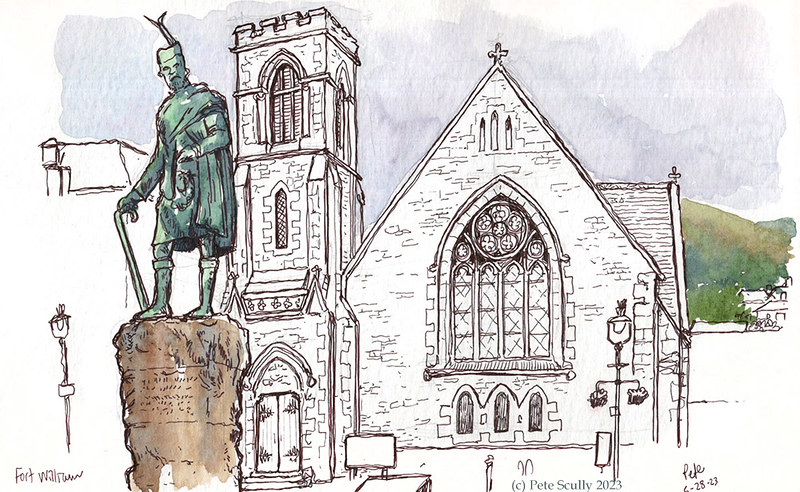
We arrived in Fort William, parked our rental car on a very steep slope, and checked into our hotel. I think I’d imagined it to be a bit nicer, like some cosy guest house, but it wasn’t, it seemed furnished like an old office building, and was spartan to say the least. There was a sizeable colony of mould on the ceiling. The shower in our tiny bathroom was also unbearably hot to the touch, and would not go any colder than the insides of a new McDonalds apple pie (which if you’ve ever had one of those, you’ll know why it says “caution: HOT” on the sleeve). We had the front desk staff come up to see if it could be fixed, and they fiddled about and turned it on, to the same temperature, and touching it momentarily with their finger they said they thought it was fine. It definitely wasn’t. So no showers on this two night stay, unless you want to be scalded. So I dubbed the hotel “Faulty Showers”, and now I can’t remember the actual name, so it’s just Faulty Showers. The view from the bedroom was nice, overlooking the hills and the church of St. Andrews. We were in Fort William because (a) we were going on a very special trip on the Jacobite Steam Train the next day, and (b) this is really the best place to stay to explore the Highlands, being the biggest town for quite a way. I didn’t really warm to Fort William as a town. Great connections, some good shops (it had a good Tesco Metro close to our hotel, for sandwiches and supplies – ie, Irn Bru and Tunnocks Teacakes, which we brought onto the Jacobite with us). Dinner options were a little limited, because this being the main hiking and Highlands hub it’s where everyone stays, so they all go out for dinner at the same time, and food is expensive. One place we saw it was eighteen quid for a burger. We had a decent Indian meal on our first evening there; I was surprised to see “Haggis Naan” on the menu; I don’t even know how that works. The pubs didn’t look as inviting as I’d have expected, the best one looked like the Ben Nevis, but on this evening it didn’t exactly exude the Highland pub atmosphere I’d imagined, mostly tired hikers and tables of empty glasses, while some of the other pubs on the main pedestrianized drag seemed a little bit, well, ‘English lager lad’, doorways spilling with middle-aged English men and women aggressively smoking and vaping and swearing, so I gave them a miss. Around the rest of the town centre, teenage youths ambled up and down with an air of boredom, and hikers tiredly made their way in small crowds to whatever expensively priced and cheaply run hotel they were pitstopping at. This is the end of the Great Highland Way, but also the start of the Great Glen Way which goes up by Loch Ness, and of course it’s right at the foot of Ben Nevis, Britain’s highest mountain, which was completely shrouded from view by Scottish mist. the sketch I did above, early in the morning, was the Memorial to Donald Cameron of Lochiel, with the Duncansburgh Church behind it. As I sketched, a man passed by walking back to his hotel and said to me (in a southern English accent), “It would be quicker to take a photograph you know,” and just walked on. Something in his tone was so dismissive, it irked me. I just glared nonplussed as he hiked off towards his hotel, but in my mind I thought, “ooh, you’re my enemy now.”

Fort William Loch Linnhe 062823 sm

Still, what a view over Loch Linnhe at sunset. After our day on the Jacobite, and after dinner (which due to the lack of available options at the time we ate at the Wetherspoons, not exactly my first choice, but it tasted fine), I decided not to go back to Faulty Showers and stayed out sketching. Sunset here is even later than in Glasgow, and it wasn’t raining, so I sat by the Loch which was pretty peaceful and drew the lovely colours. We really were on the other side of the world now, it felt like. Even though I’m from Britain, for a Londoner this feels like a million miles from home, let alone for a Californian. The Highlands really are lovely, and there’s so much of it to explore, we were only seeing a little bit. Satisfied with my sketch, I turned around and drew the scene behind me, the Highland Hotel. Perhaps a tad nicer (and a wee bit more expensive) than Faulty Showers, this looks like the place to be. It was the sunset-kissed clouds that drew me in though. And I am sure Ben Nevis is around there somewhere, but he wasn’t showing his face. I went back to our hotel and went to be (after watching with my son a few sketches from the old mostly-Scottish sketch show from the early 90s, ‘Absolutely’, which I used to love, because the ‘Stonybridge’ sketches had popped into my head while we were driving north the day before).

Fort William Highland Hotel sm

There was a really nice bookshop in Fort William though that we spent a bit of time in, and got some lovely prints. I nearly got a book to teach myself how to speak Gaelic, but I know I’m probably not going to do that, unless I take a class. It’s a lovely language though, and you will see it on so many road signs up here. Fort William is called An Gearasdan in Gaelic, and about 7% or so of the population speak it. While this is the main town for this part of the Highlands, it was built to, you know, put the Highlands people down. Originally established by Oliver Cromwell to keep the local Clan Cameron in line, it was later named Fort William after King William III who built the fort to control the local Highlands clans, who over the next century would rise up in Jacobite rebellion several times. We heard a lot about the Jacobites during this part of the trip. There was also a really nice visitor centre in Fort William where I got some postcards, magnets, tea coasters, because I am a tourist and you can never have too many of those.

Fort William St Andrews Church

I did get up early on our last morning there and draw the church of St. Andrews, which was close to Faulty Showers. The gateway was so pretty and covered in moss, which I didn’t end up colouring in, and the kirkyard had a lot of character (and probably a lot of characters). I was up to get some nice pastries (and Tunnocks Teacakes) from the little Tesco. I was also, if I’m honest, kind of hoping to see that English guy who had made the irksome comment the morning before. I’m not saying I had spent a lot of the day thinking of what my comeback should have been, like George Costanza (like “yeah, well the jerk store called, and they said it would be quicker for you to just bugger off mate”, yeah not that good really) but I was perfecting my dirty look. He was probably already halfway up Ben Nevis by now. At which point I thought, ooh I should walk past him trying to climb Ben Nevis, all out of breath and red-faced, and say, “it would be quicker for you to take a photo!” or something similarly witty. However that wouldn’t be true, because Ben Nevis just would not show itself to us, hiding behind all that mist. Rather than wait for the mist to clear, I determined it would be quicker to look at a picture of Ben Nevis on Wikipedia, and we left Fort William and its faulty showers behind us.

raining champions

Falls of Falloch, Scotland

It’s going to rain in Scotland. It’s Scotland, not Arizona. Of course, it didn’t have to rain quite so much on the very day we hired the car and drove north from Glasgow, past the mighty Loch Lomond and the Trossachs, over wild Rannoch Moor and through the awe-inspiring Glencoe, on to Fort William at the foot of Ben Nevis (which we never actually saw, it was so shrouded in cloud). We never saw most of these lovely scenes because the rain was very thick, but we did our best and still explored. We first stopped bu the shores of Loch Lomond at the pretty little village of Luss, and stood looking out at the greyness, unable to see the other side. I came to Loch Lomond once before, in 1999 with my friend Simon and his uncle who drove a Jaguar, and can vouch that it is beautiful here. So, we continued through the rain along the shores, going north up to the Falls of Falloch. I had warned my wife before our tip to Scotland that we had to be aware of Scotland’s biggest menace – the Midge. Being from the south of England, we don’t get them, but I remember camping in Cumbria when I was 17 and everyone was being constantly eaten alive by the things. Tiny little fly creatures that bite you to pieces. We watched videos of people walking around the Highlands dressed in nets, we bought loads of midge-repellant, we checked the Midge Forecast online. Yet in the whole trip, the only time we encountered the Midge was at the Falls of Falloch, and they didn’t really get us at all. We got lucky, maybe, or the Midges know not to mess with me. The Falls of Falloch are lovely, and it was raining, but I tried to grab a sketch of them. As you can see my Fabriano sketchbook is splotched with raindrops. If you look closely though, you can see the remains of one dead Midge. See you later, sucker.

Glencoe in the rain

After a brief stop for lunch at a pub in Crianlarich, just beating the rush of hikers making their way up the West Highland Way (some day! There’s a lot of hiking I want to do in Scotland, some day), we continued our drive north through the rain. We crossed the boggy Rannoch Moor, one of the largest wildernesses in Britain, which I’d been eager to see. We couldn’t see very far. It wasn’t too long before we arrived at the main attraction, Glencoe. Or Glen Coe, as it’s usually written, Gleann Comhann in Gaelic. Even in the gloomy rain it was breathtaking scenery. We stopped a few times for photos and to take in the sheer Scotland-ness of it all. I’ve heard so much about Glen Coe since I was a kid, and its tragic history with the Glencoe Massacre of 1692, and its geology, the work of ice age glaciers carving through ancient volcanic rock. Scotland looks very different from England, and this is because geologically they are not from the same place, but collided together millions of years ago, Scotland originally being part of the same landmass that is now North America. Of course I had to at least attempt a sketch. I had it in mind that I would come up here and do sketches like Richard Bell in that book of his that I love, but the weather had other ideas. I even tucked my umbrella into my jacket to attempt some shelter, to no avail, I couldn’t look upwards and the wind and rain just laughed in my face. I drew the panorama above, of the Three Sisters, and decided to just leave it like that, rain splotches making my watercolouring impossible. It was a brave effort. Sometimes what comes out in these moments says more about your time than trying to draw it later. I drew another quick pencil sketch a little way up the road, adding a quick grey wash afterwards, but otherwise enjoyed what scenery we could. We visited the Glen Coe visitor centre, saw their little film about Glen Coe, went into the reconstructed turf hut, and bought stuff in the gift shop. And then we drove on through more dramatic, wet countryside, to our next port of call, Fort William. We were going on the famous Jacobite Steam Train… 


Glencoe grey

IMG_7955s

kelvingrove and the west end

Glasgow Kelvingrove

We took the bus over to the Kelvingrove neighbourhood, in Glasgow’s west end, to see the famous Kelvingrove Art Gallery and Museum. It’s free to go inside, and was a fun (if slightly eccentrically organized) journey through art, design, culture and natural history. The building is beautiful, dating to the end of the Victorian age, beside the large and leafy Kelvingrove Park. Next to the Museum there are lawn bowling greens, build for the Commonwealth Games, that I had seen in Belle and Sebastian’s guide to Glasgow (on YouTube), I guess they come and bowl here from time to time. I think they were playing in Belgium that day so unlikely I’d bump into any of them. Inside there are loads of things to draw, but I wasn’t really going to draw much (the above was mostly an outline with everything else drawn when I got back to the hotel; it was on-off raining that morning). I did however have to spend the time sketching the dinosaur you see below, a Ceratosaurus from Wyoming. They did apparently live in Scotland though, I can’t imagine how I’d feel if this thing turned on me and said “hey what you lookin’ at pal?” in a Glaswegian growl. Probably very scared. That’s my son in the background looking around while I drew.

Glasgow Ceratosaurus Kelvingrove

I really enjoyed the strange floating heads installation in the East Court, by Sophie Cave. I did start drawing the Spitfire that was suspended above us, but didn’t want to hang about too long so gave up. There were some lovely paintings, including a really great Lowrie, and a bunch of pieces by Mackintosh, but I think most of all I liked the big Elvis sculpture, “Return to Sender” by Sean Reed. I thought he was taking a selfie, so I joined in. Fun fact, we were married by an Elvis in Las Vegas.

IMG_7906s

The leafy park was a pleasant walk, and we headed past Glasgow University. This would have been a nice place to study. We were hungry for lunch and so headed to the shops in the west end. I was looking for a couple of guitar shops though, where my son and I spent a nice bit of time looking at guitars. The first was CC Music, on Otago Street, they were very friendly in there and I chatted with the guy about California while my son tried instruments. He’s getting really into the guitar now, having first been playing the ukulele. We then went to Jimmy Egypt & Son’s on Great Western Road, a great little shop, where I bought a cool new guitar strap (unfortunately no guitar purchases, not as easy carrying back to the US). We lunched at a great little burger place called Brgr, then walked about the cool little shops. It reminded us a bit of Muswell Hill. We didn’t go to the Botanical Gardens, but we did pass through the university again on the way back to the bus stop. By the way, the dates on all these sketches are wrong, it says 6/25/23 when actually it was the 26th, not sure why I did that. Anyway, since I was in Britain I should have written 26/6/23, but I’m Americanized now ain’t I.

Glasgow St Vincent Street

This was not in the west end, but back in central Glasgow on St. Vincent Street. While the family rested at the hotel, I went out drawing for a while, and for some reason I really liked these roofs. This reddish sandstone is emblematic of much of Glasgow’s architecture, such as the old Evening Citizen offices further down in St. Vincent Place (I wish I’d drawn that building), and of course in Kelvingrove Art Museum. The sky was nice, blue with moving clouds, and as I sketched lots of Metallica fans kept walking past, in their Metallica t-shirts. I supposed Metallica must have been playing somewhere. Actually now I think of it, it was Iron Maiden, not Metallica. I always get those confused. Wait was it Def Leppard? No, it was definitely Iron Maiden. Yes, loads of Iron Maiden fans walking past, in their Iron Maiden t-shirts. I can’t believe I got that wrong, actually. I was in my Belle and Sebastian t-shirt (maybe it Camera Obscura? I’m so forgetful). Not that I felt uncomfortable, it’s not like I was in an Ireland shirt while watching the Orange Order march past. Iron Maiden fans are pretty friendly in my experience, back in the 90s when I would go to heavy metal clubs in London, they were usually the nicest places to be at night. Anyway I thought about going to draw an old Glasgow pub, and nearly sketched a big old place called the Horseshoe, but it was getting on for dinner time. I forget what we ate, some Scottish fast food thing, but we did afterwards finally try that classic delicacy, Deep Fried Mars Bar. It was actually amazing, and even thinking of it now, I want another. Maybe not super healthy, but you don’t come to Scotland to eat super healthy. With that in mind, we retired to the hotel for more Tunnocks Tea Cakes, washed down with Irn Bru. Here’s my drawing of one of those delicious little beauties.

Tunnocks teacake sm

Next up, we drove north, through rain and country. I would like to revisit Glasgow some day, wander about a bit more, chat with some locals in the pub, climb a few more hills, see some music. Another day.

“I belong to Glasgow”

Glasgow Necropolis

It rained hard on the train journey to Glasgow. I suppose you don’t come to Scotland for the sun. We passed by Falkirk, a place I’d like to have seen, mostly for the huge Kelpies. We arrived at Queen Street and the rain stopped for long enough to let us walk up hill to our hotel, further than it looked on the map. We sat in the hotel lounge watching the driving rain outside, eating those little Tunnocks marshmallow Teacakes I love so much, strumming on the ukulele. I could tell my family were maybe a little less wowed by Glasgow than by Edinburgh, but I’d been waiting most of my life to come and have a look around here, rain or not. I went for a little walk as the rain eased off a bit; we weren’t far from the Art School, but after the big fire they had a few years back, it’s still covered in this big white plastic while it’s being remodeled. Glasgow’s an artist’s town though, that is clear. Charles Rennie Mackintosh is the big name here, but he’s not the only one. Musically too, Glasgow is a creative city, and one of my favourite bands of all time are from here, Belle and Sebastian. I’ve always wanted to come here and explore.

Glasgow Orange march

I wandered about a little, and then I heard some music, it sounded like flutes and drums. Marching up the road were the men and women of the Orange Order, decked out in their suits and their orange sashes with their big orange and purple banners, lads in Rangers shirts flanking them, as well as police clearing the road for them. I was glad I wasn’t in my Celtic shirt, nor my Ireland shirt. I had heard about the Orange Marches since I was a kid of course, the ones in Northern Ireland at least, usually in the backdrop of some news story, and I had forgotten that Marching Season was starting. I knew from my mum that it was big in Glasgow (she spent some time in Glasgow as a kid, I think some of our Ulster family lived up here), and of course I’m well aware of Rangers and Celtic and the whole sectarian thing. Still, I was actually surprised to see them in person. I did see them marching the day before in Edinburgh actually, going up the Royal Mile in the morning with their flutes, playing “The Sash Me Father Wore” (I am sure they have other tunes, that’s the only one I know). It didn’t seem as big (though I saw coachloads of other men in orange sashes arrive a bit later), and was certainly dwarfed by the huge Pride marches that were happening on the same day in Edinburgh. The Glasgow march seemed to go on for a long way.  I got a quick sketch done, and went and looked at something else.

Glasgow Wellington Statue

When the rain had stopped and we were filled up on delicious fish and chips (washed down with more Irn Bru of course) we walked about the city centre. The pedestrianized Sauchiehall Lane looked like it had seen better days, and could have done with a little less of those food delivery bikes careening down them, a scourge in many cities now. But I liked the city centre, and while looking at our map a young lad came up and said “you look lost, can I help youse find something?” This it turns out was a feature of Glasgow – the people are just willing to give you a hand, this happened several times. We explored the George Square area and found that statue of the Duke of Wellington on his horse with the traffic cone on its head, outside the Gallery of Modern Art. I have seen this before on my one super brief stop in Glasgow, in 1999, and its the only thing I remember. It’s a Glaswegian tradition to put a cone on the head of the Iron Duke. Incredibly they have tried to stop people doing it, yet the cone is way more famous than the statue without the cone. We took a bus out towards Glasgow Cathedral, and on the way an elderly fellow had overheard us tell the driver where we were going, and was giving us directions in that thick Glaswegian accent that I love hearing so much. Honestly, it’s always been my favourite accent. My best friend when I was 12 was from Glasgow, Ralph, I think we became friends largely because I actually tried to understand him, but as a result of his influence at a formative age I do slip into a kind of Scottish pronunciation of certain words when I hear the accent again. I also watched maybe too much Rab C. Nesbitt as a kid as well. It was Ralph who got me interested in the guitar, and we were both big Beatles fans; I remember we talked about starting a band called The Flies, and eventually I got a cheap pretty crap acoustic for a fiver at a car boot sale, and learned my first chords (and also taught myself how to string a guitar). Anyway, we got off the bus and followed the old man’s helpful directions to the cathedral, known as St. Mungo’s Cathedral, and also the High Kirk of Glasgow (I’m not sure if it’s technically a cathedral, as we learned with St.Giles in Edinburgh, but it calls itself cathedral and it looks like one and that’s good enough for me). The cathedral was not actually where we wanted to go. We were looking for the Necropolis, which is a large cemetery at the top of a steep hill behind the cathedral with amazing views over the city. See my sketch at the top of the post, that was from there. The views were remarkable, you could see Celtic Park stadium, but we didn’t linger too long. In terms of location, I think it’s up there with my favourite cemeteries, and I was even more pleased to find the grave of William Miller, the guy who write Wee Willie Winkie. I took this photo of an ivy-covered memorial to a young lad named John Ronald Ker, who in 1867 had drowned while shooting wild fowl from his boat at the age of 21, and this monument was erected by his friends and family in his memory. It’s a beautiful celtic cross, and a sad story.

After the Necropolis, we bussed it back to the hotel and relaxed for the rest of the night, eating more Tunnocks Teacakes. More Glasgow sketches to come.

“Bloody MacKenzie, Turn the Key!”

Edinburgh Greyfriars Bobby

A must-see spot in Edinburgh for ghost hunters (or ghost hunted?) is Greyfriars Kirkyard. I went there twice. The second time was early on our final morning in the city, when I got up and walked across the old town until I reached the statue of Greyfriars Bobby, outside the Greyfriars Bobby pub. If I had heard of Greyfriars Bobby before, I don’t remember it, but I probably assumed he was some sort of policeman, maybe one that wandered the spooky graveyard in the foggy night looking out for graverobbers and ghouls. No, it turns out Greyfriars Bobby is a dog, a wee little pooch, and Disney even made a film about him. The story goes that the wee Bobby was the dog of a local policeman, a little Skye Terrier who was so loyal to his master that when the man died and was buried in the kirkyard around Greyfriars Kirk, Bobby would guard his grave every night for about fourteen years. Greyfriars Bobby, as he became known locally, eventually died in January of 1872 (thereby missing the first ever Scotland v England international football match by eleven months). Such was Bobby’s celebrity, a small fountain was commissioned by Lady Burdett-Coutts, president of the Ladies Committee of the RSPCA, topped with a little statue of Bobby sculpted by William Brodie. It was unveiled in November 1873 (almost exactly a year since that first Scotland v England international football match, which ended 0-0 by the way). I had to add Bobby to my sketchbook, and I added the eponymous pub in the background so that you know his name (the pub I think came later, and in those days they did not show international football on TVs in pubs, due to the lack of international football, plus the lack of TVs what with them not being invented, though a Scotsman would later fix that too). You will notice that Bobby has a very shiny nose. If you ever saw him you might even say it glows. This is because of a very silly tradition that tourists have, perhaps told by silly guides in years gone by, that if you touch Bobby’s nose you will have good luck, because (and you have to say this in a Scottish accent) obviously that makes loads of fuckin’ sense, doesn’t it. The problem has got so bad that the statue is in danger of being permanently damaged, so locals have taken to making up stories of bad luck that will befall people that rub Bobby’s nose, and those stories I might actually believe. One thing we do not want is for Bobby’s nose to come off, because the absolute last thing Edinburgh needs are endless jokes from its tour guides about how Edinburgh’s dog has no nose, “how does it smell?”, “reeky!”, etc and so on. So people please, leave wee Bobby’s nose alone.

City of the Dead guide

Speaking of tours, the first visit we had to spooky Greyfriars was the very night before, when we took the ‘City of the Dead’ walking tour. This started outside St. Giles Cathedral on the Royal Mile, I sketched the little scene above while we awaited our tour group to assemble. We were met by our guide, a man dressed all in theatrical black with a spooky hat adorned with black flowers and crow’s wings,, round glasses, charcoal coloured paint around the eyes, and unnerving milky-white lenses in his eyes. He reminded me at first of the Crow Man from Worzel Gummidge, but with his white beard he also looked a bit like Terry Pratchett. He gave us an illustrative tour of the old town, full of ghosts yes but mostly full of bodies. Some of the stories were long, detailed and very gruesome, especially those concerning the infamous Old Tolbooth. We then moved through the city towards Greyfriars Kirkyard. It was not yet dark – it’s late June in Scotland, no chance – so we didn’t feel completely spooked out yet. Still the light was getting gloomy and the Kirkyard, packed with weatherworn graves, gnarly trees and mossy old monuments, was the perfect stage for this storytelling. It was also full of other guided tour groups, many from the Harry Potter realm. Greyfriars was a favourite thinking spot for JK Rowling as she came up with ideas for the Potter books, and she would write in a cafe just up the road from here. Many of the graves have names familiar to Potter fans, such as McGonagall (who was actually a poet, apparently a very bad one), James Potter, and the one everyone comes to see, Tom Riddle. It’s actually ‘Thomas Riddell’ but that’s close enough. On our tour, however, we were in for a very ‘real’ bit of spookiness. We were here for the infamous poltergeist, Bloody MacKenzie.

IMG_3380s

George MacKenzie, aka ‘Bloody’ MacKenzie, was the enforcer of King Charles II’s punishment and persecution of the Covenanters in the late 1600s. He imprisoned about 1200 Covenanters – Presbyterians who supported the National Covenant in Scotland resisting Charles I’s changes to the Scottish Kirk – in a little field next to Greyfriars Kirkyard, in terrible cramped conditions, with so many either starving to death or being executed that George MacKenzie gained that ‘Bloody’ (or ‘Bluidy’ in Scots) nickname. MacKenzie died in 1691 in Westminster, but he was ultimately buried at a mausoleum right here in Greyfriars, mere feet away from where so many of his victims were imprisoned. Now here’s the thing. His ghost is not only said to haunt this place, but it’s been well documented in recent times. I won’t tell all the stories here, but a lot of people have encountered the dreaded MacKenzie Poltergeist. As our guide told us (after locking us into the ‘Covenanters Prison’ area; only official guides can access this part), many people have encountered this spirit, often feeling a strange presence or the sense of being attacked, or getting home the next day and discovering strange scratches on their body. It was getting gloomy when we entered one of the more sinister feeling tombs, where at the end of the 1990s a homeless man apparently encountered the restless spirit and started a new wave of hauntings. Our guide told us his tales. As he did, an American lady stood at the back of the tomb was becoming increasingly freaked out, interrupting him every minute or so to say that she felt something pressing down on her forehead, as if being pushed back. I thought she was going to faint. While I like the stories, I don’t really believe in ghosts being actually ‘real’ (though I will get shivers down my spine and feel very creeped out), but she certainly did and it was real enough for her. Our guide did a good job though not to freak her out more, but he performed a parlor trick to show us that Bloody MacKenzie can at least turn a huge iron key that was placed in the palm of his hand, making us all recite “Bloody MacKenzie! Turn the Key!” in the dim light while watching this key magically turn of its own accord. It was entertaining; as the guide said at the end, that’s just a wee bit of fun. Still, the American lady was sticking with this ghost tale. “Oh my God!” she exclaimed suddenly. “Does anyone have any AirPods on right now?” Um, no I don’t think so, people mumbled. “Some AirPods have just tried to connect to my iPhone! This has never happened before. That’s so weird. What’s causing that? Is anyone else having this happen?” We were in a literal tomb at night. “Well the poltergeist can sometimes have an effect on electronics,” our guide said reassuringly. The lady was utterly convinced, Bloody MacKenzie was trying to connect his Bloody AirPods to her iPhone. As I wondered what music he might make her listen to, the theme from Rentaghost just popped into my head, mysteriously. (There was a Scottish ghost in Rentaghost too wasn’t there, Hazel McWitch?) It was a fun evening of spooky stories, and it was dark when we walked back to our apartment, our last night in Edinburgh.

Edinb Mackenzies Mausoleum sm

So I woke up next morning and came back to Greyfriars, drawing Bobby, and then coming in to explore in the damp morning light. Of course I had to draw MacKenzie’s mausoleum. I wasn’t too worried about being attacked by a poltergeist, or getting mysterious scratches on my arms, or even of having random bagpipe music commandeer my AirPods, though I was a bit nervous of getting eaten by midges, the biggest terror in Scotland as everyone knows. I drew the tomb safe from any supernatural danger, and went home for our final Edinburgh breakfast. We were off to Glasgow that day.

Edinburgh Old Town – a wee bit more

Edinburgh Tolbooth Tavern

I am glad we stayed in the Old Town of Edinburgh, among all those tall sandstone tenement buildings, just steps away from the Royal Mile. So this Royal Mile, what exactly is it? Well it is a long stretch of connected streets that slope downwards from Edinburgh Castle, sitting at the top of a 300 million year old volcano, all the way down towards Holyrood Palace (the official residence of the British monarch in Scotland), as well as the area where now the Scottish Parliament can be found. It was likely part of what was left over by a retreating ice sheet thousands of years ago. Along the way, if you can see past all the cashmere shops and whisky tasting shops and stores selling little Nessies with tartan hats on, are storybooks full of history both bloody and noble, pubs spilling out music and English stag parties, upon cobblestones haunted by the ghosts of so many dead Fringe plays that got bad reviews in The Scotsman. I walked one morning round to a building we really loved the look of, the Tolbooth Tavern. I never went into this tavern, but I knew I wanted to draw it. I got a can of Irn Bru (Tropical Irn Bru to be precise, it had a flamingo on the can), stood outside a shop selling tartan scarves or little wooden cows or something, and had to turn my landscape sketchbook very much into portrait mode to fit it all in. Edinburgh is tall and it’s worth getting the tops of these buildings. I didn’t feel like painting the whole thing, but added just enough that you can imagine the rest of the brickwork. This building was once the Canongate Tolbooth, originally dating from from 1591. It’s probably haunted, because why not, everywhere else is.

Edinburgh Tempting Tatties

One of my absolutely favourite memories form our trip to Edinburgh was getting jacket potatoes from Tempting Tattie. This was about a block away from us on Jeffrey Street, and even thinking about it makes me feel hungry from some delicious buttery jacket spuds. Tempting Tatties had some fantastic toppings – I got a huge one with loads of cheese and baked beans on it, pure comfort food for not very much money. My wife got the one topped with Coronation Chicken, that was delicious. I got another next day topped with Chicken Tikka Masala, also very tasty. If I lived in Edinburgh I would need to be climbing up Arthurs Seat every day to burn of all the calories from the jacket potatoes I’d be eating (all washed down with Irn Bru naturally – though it was the Irn Bru Xtra, the zero-sugar one, that I drank mostly – the tropical version was nice, though I did try an Ice Cream flavour Irn Bru which went very much into the bin, yeuch). I must have visited this Tempting Tatties when we came here in 1999, what with it being close to the place where we put on those shows, but I don’t remember, I mostly ate greasy bags of chips.

Edinburgh John Knox House

One evening following a lot of touristing, my wife and son rested at the hotel while I went out to put some more sketches into my book while the light was good. The John Knox House, just a couple of minutes from our flat, was another of our favourite buildings from along the Royal Mile, and dating from the 1480s is one of the oldest surviving medieval buildings on John Knox was the founder of the Scottish Presbyterian Church, leading the Scottish Protestant Reformation back in the 16th century. The ground floor of this building is home to the Scottish Storytelling Centre, which we had a little look around – there were some interesting performances they were hosting that we unfortunately would miss. I’d definitely take a look there before any future trip to Auld Reekie. The little cafe in there also served haggis both meaty and vegetarian. I drew on this light evening (it was after 9pm, still so much daylight) but it started to rain a little, so I sheltered in the covered close directly opposite.

Edinburgh No1 High St Pub

When I was all done, I popped into a pub on the corner – called “No. 1 High Street”, right opposite the busier World’s End where I couldn’t find a table to sit at (they were setting up for some live music in the corner, which I presumed would be one of those traditional Scottish folk nights that Rick Steves and all the guidebooks said I had to experience), and rested my very weary feet. I hadn’t filled in the details on many of those windows yet (repetitive actions like that are often a “do-later” job) so I got to work on that over a nice pint of something cold and Scottish, but of course I can’t stop and always need to draw something new, so I sketched the bar instead. It wasn’t very busy; there was an American couple in, sat next to a couple of young lads from Northern Ireland (with strong and amazing accents), who were there for some farmworkers conference. The young lady at the bar was from the north of England and very conversational with them, and even had a look through my sketchbook, being an artist herself. The Americans I think were from Texas, apparently they met on a TV show, and one of the young lads asked if they have cowboys in Texas. Nearby an older Scottish man chatted with the owner, it was a friendly little place. It didn’t get dark until about 11pm. I walked back to the flat as they were closing, pretty tired, but at least I finally got a Scottish bar sketch from the inside. Walking past the World’s End, the music being played wasn’t quite folk music, more of the generic singer-songwriter variety, so I’m glad I didn’t stand to wait for it, though it sounded nice enough. At least it wasn’t bagpipes. I know it’s an odd thing to admit when I’m touristing around Scotland, but I don’t really like the sound of bagpipes much…

Edinburgh Old Town

Edinburgh St Giles Cathedral

“Auld Reekie”, that is Edinburgh’s nickname. Back about four or five hundred years ago, the old walled city had little room to grow, so the buildings got very very tall – many still are. All these homes and all these chimneys gave out a lot of smoke, blanketing Edinburgh in thick smog, so locals would call it Auld Reekie – that’s ‘Old Smokey’ in the Scots tongue. A bit like the way London was referred to as The Smoke (I don’t know if people still call it that; perhaps it’s The Vape these days). I always thought Auld Reekie referred to the smell, like when something reeks, and it seems it was a smelly place, but no more than many cities. People would throw their toilet water out of those tall windows into the narrow streets shouting the phrase “Gardyloo!” which came from the French “garde à l’eau”, ‘watch out for the water’. By water we mean of course wee. I mean, listen I’d love to time travel, but I’d die of some vile disease within half an hour of time travelling back then, it sounds disgusting. I had all this history in mind (and in my ears thanks to the podcast I was listening to) when I got up early and went out to sketch this part of Old Town. I hadn’t slept that well, the apartment was nice but very warm, and the fan that was on had given me a dry mouth, and irritated my allergies so my nose was starting to run again. It was raining lightly. I walked up to the cathedral of St. Giles, which is the High Kirk of Edinburgh, to get my cathedral drawing in. I love to draw a cathedral, and this one has a very crown-like spire. Technically it is not a cathedral, not any more, not since 1689, when the Church of Scotland, which is Presbyterian, gave up having bishops, and therefore cathedrals. It’s still allowed to be called one though, because, what you gonnae do about it pal. It does date back to about 1184, long before they started calling it cathedral, and much later this was the church of John Knox, the big figure in the Scottish Reformation – I also drew his house, which will be in a later post (plus I think his brother Hard ran a school?) It started to rain while I was drawing this, so I stood a bit closer to the wall in an attempt to stay dry. That worked for a while, until it didn’t. I did most of it, then scarpered into one of the many alleys that branch off of the Royal Mile.

Edinburgh Advocates Close

If you’ve been to Edinburgh you’ll know the sort of alley I mean. Through archways in many of the terraced buildings, you suddenly find yourself in a long passage that doesn’t just go through to another street, but down (or up) steps into a whole new level. Edinburgh’s old town is very hilly, many of the streets have to curve around to get over the steepness (“stepth?” That should be a word, I’m inventing it). These narrow portals cut through the town providing short cuts to those fit enough to brave the steep staircases, and they can also provide sudden photogenic vistas across the city. One such alley with a magnificent view is Advocates Close. We went through there on our first evening in Edinburgh and waited in line (I mean, not a long line) to take a photo looking down at the Sir Walter Scott Monument. On this morning when it started raining, I ducked into this now empty alley – save for the odd passer by with an umbrella – to draw the view myself. It was still before breakfast, and this sketch illustrated an aspect of Edinburgh any visitor would get to know. I listened to more Stories of Scotland, telling me about Greyfriars Kirkyard, which we would visit on a ghost hunting tour the next evening. When I was done here, I picked up some delicious cannoli from a little bakery on Jeffrey Street and headed back to wake everyone up, for a day of touristing.

Edinb Heart of Midlothian

This above is another thing found on the Royal Mile, which I only outlined while passing in the rain, but drew later on at the flat. The Heart of Midlothian is a mosaic made of cobblestones that marks where the Old Tolbooth once stood, outside St. Giles Cathedral. The Old Tolbooth was a big medieval building whose jail was a dreadful place by all accounts, and many executions took place there. Heart of Midlothian football club – Hearts – is named after this landmark. Sir Walter Scott (he of the aforementioned big monument) wrote a book called The Heart of Midlothian, referring to the Old Tolbooth. Apparently there is a tradition of spitting on the heart, either for good luck or to show disgust at all the executions that this place hosted. I decided against gobbing on the street, though I’m sure worse happens during the Fringe Festival.

Edinburgh Castle 062323

Later that day, we were able to get tickets to go into Edinburgh Castle. Tip for tourists – if you ever go to Edinburgh and want to go to the castle, get those pre-booked tickets in advance because they will sell out fast. The castle was a hike uphill, past all the cashmere shops and whisky shops and shops where you can buy little cuddly Highland Coo or Nessie toys, but the view was great. We got the self-guided audio-tour, which in respect wasn’t as interesting as I’d have hoped (they rarely are, I never like standing there listening to those little plastic radios, when I could read a small sign much more quickly – in fact the small signs they did have often included QR codes to hear someone talking in Gaelic for example, on your phone). We explored the castle in depth, it was enjoyable, and interesting to see the room where James the Sixth / First was born. He was the Stuart King that was on the Scottish throne when Elizabeth I died and he was invited to also be the King of England, uniting the monarchies but not the countries, we were still a century away from the United Kingdom. So he was James VI in Scotland, and James I in England. There was a big queue to get inside this building to see the Crown Jewels, so my wife and son decided to do that while I decided to stay outside and sketch, having seen enough Crown Jewels at King Charlie’s Coronation. I did notice on the shiny plate above the door dating from 1993, two swords and the official royal cypher of Queen Elizabeth II, that is “ER”. Er… where’s the “II”? It should be “EIIR”. You all know this if you spent any time in Britain during the Queen’s funeral, or any time at all in the past seventy years. Except this is Scotland, and they didn’t have an Elizabeth I, so she can’t be Elizabeth II here, right? That’s apparently the case, I hadn’t even considered it. I noticed that a lot of postboxes don’t have the royal cypher on them either, just the crown of Scotland – except older pillar boxes did have a royal cypher, such as those of George V for example. From what I can tell it was down to what has been called the “Pillar Box War”, which was a dispute in Scotland as to whether Elizabeth II could style herself II in Scotland or not. There was a legal challenge, and in the end they decided it was Royal Prerogative for the Queen to bally-well call herself she bally-well liked. Still after a bunch of pillar boxes were vandalized, tarred, hammered, even blown up, Royal Mail decided in Scotland that new post boxes would just have the crown of Scotland on them and not any EIIR. I don’t know what will happen for King Charles III, but as all Kings Charles came after the union of the crowns (it was James VI/I who named his son something completely new, that being Charles I, ingeniously getting around the confusing numbering system). I don’t know what happened during the reigns of William III and William IV, since Scotland didn’t have a William I or II,  but perhaps in those days they were too worried about people throwing piss out of their windows to care much. I bet King William V won’t get his initials on the postboxes though.