the mother of all parliaments

parliament square sm

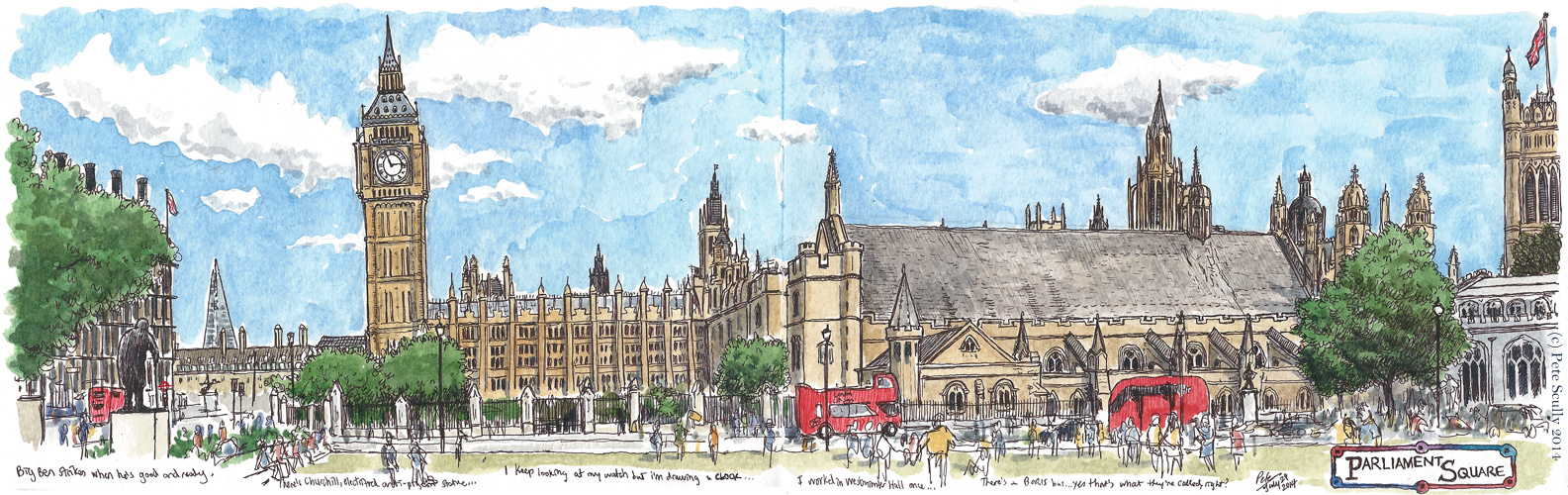
Parliament Square! Click on the image for a closer view. After sketching the Royal Court I went back to Westminster, and stood in Parliament Square to sketch a panorama of the Palace of Westminster, that is, the Houses of Parliament. I know what you’re thinking, I spent a lot of time sketching the tourist attractions this time and not enough time sketching little newsagents or hidden side-streets, but they are all to come, don’t worry. When I passed through the frankly impossible Parliament Square I thought, well why not. There really is a lot of traffic around this square, and not many crossings to get into the middle; it’s never been one of my favourite places. But in the golden sunshine, what a spectacular view! When I was a tour guide I loved the turn into this square, it was almost cinematic with Big Ben (yes I know it’s the bell) and centuries of history unfolding all at once. We’ve had a parliament here since the thirteenth century, though most of the Palace of Westminster – including the Clock Tower (that houses the bell Big Ben), now officially called “Elizabeth Tower”, being renamed in 2012 after the Queen’s Diamond Jubilee –  was built in the 1800s by Sir Charles Barry after the old palace burned to the ground. The oldest part of the building is Westminster Hall, built by King William II (William Rufus) in around 1097. That’s the part with the big sloping roof.

The square is, naturally, a popular place for protest movements. On the left is Parliament Street which leads to Whitehall, many of the British government buildings are located here. Westminster Bridge leads off, over the Thames; in the distance there you can see the Shard, tallest building in Europe. I’ve included the statue of Winston Churchill which, I was told when training as a tour guide, is actually electrified with a low voltage to prevent pigeons from sitting on his head. “We will fight them on the statues.” It’s hidden away a bit but you can just make out the statues of Oliver Cromwell, former Lord Protector, a strange choice for a statue outside Parliament because despite leading Parliamentary forces in defeating the Royalists in the Civil War, he did also shut Parliament down as and when it suited him too. On the right hand side you can just about make out St. Margaret’s Church, the parliamentary church; on my old tour I would joke that it was a place where Tory and Labour MPs would go and pray together but not the Lib-Dems because they haven’t a prayer, tee-hee, well times have changed now haven’t they. This church backs onto Westminster Abbey.

parliament square bigben sm

Here’s a close-up. I worked in Westminster Hall once back in the 90s, serving tea as part of a catering job I was working on (it if I recall rightly a Jewish single’s night organized by the MP Oona King). I remember walking about the amazing building, seeing where William ‘Braveheart’ Wallace was tried before his execution, wandering about the old stone corridors and hearing voices echoing down the stairwells. I went to the toilet, and remember the booming sound of Big Ben making me jump, opening the window and seeing the large clock face right there. I do love this old building.

Here’s a map showing whereabouts I stood. After this, my drawings were done for the day, and I spent the rest of the afternoon mooching around bookstores.

westminster map

the royal court

the royal court theatre
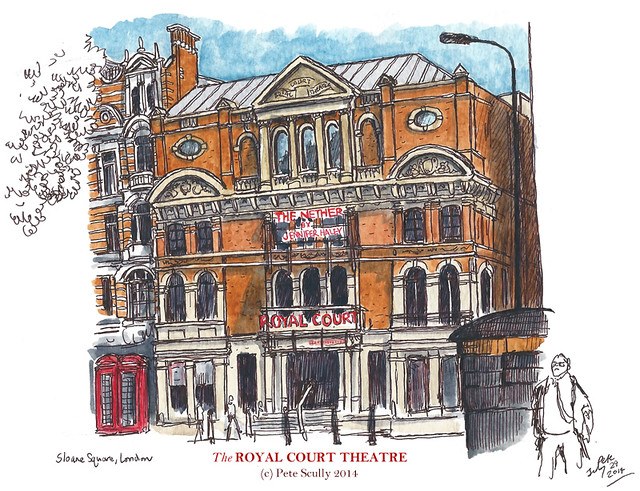
Sloane Square. As a native Burnt Oaker, I feel out of place down here. Oh it’s just a place, like any other, and I’ve been around the world, but part of me thinks ‘Sloane Square’ and thinks ‘the 80s’, fil-o-faxes, champagne, upper classes, butlers, top hats, I don’t know, the rich. My part of North London was the opposite, so this was ‘how the other side lives’. Which is all a bit nonsense in the scheme of things, but it does explain why I don’t go down there very often. Also I live in California and have no reason to make special trips to go to Sloane Square in West London and look at exclusive boutiques or whatever they have down there. However, what they do have is the Royal Court Theatre, and I’ve been there a good few times, and I love it. This is one of the most important theatres in London, it is not one of your big commercial Andrew Lloyd Webber nonsense theatres that you get all over the West End; no, this venue fosters proper writing and has birthed many importnat modern playwrights such as Mark Ravenhill and the late Sarah Kane. They also house the Young Writers Program to develop young theatrical talent. This is a place for new and exciting work. I once saw a play there – I cannot recall the name now – with three actors on a bare sloping stage which utilized rudimentary puppetry and long, long mid-sentence pauses, and I absolutely loved it. It’s a great building also, modern and renovated inside but with a classic Sloane Square exterior. My friend Tamara spent a good few years working there too, so I’ll always think of her when I think of the Royal Court. I stood here for the best part of an hour sketching away, having to stop each time a huge bus hulked into view (I stood by a bus stop so this was often), drawing in the newly opened watercolour Moleskine. I had thought about sketching around Kings Road and all the little Chelsea boutiques, with all the butlers and yuppies and stockbrokers and Dukes with their massive mobile phones and their fil-o-faxes and barbour jackets, but I didn’t want to stand out too much as an oik from the estate, and headed off to Westminster to draw a panorama of Parliament Square.

go west, young man

westminster abbey sm
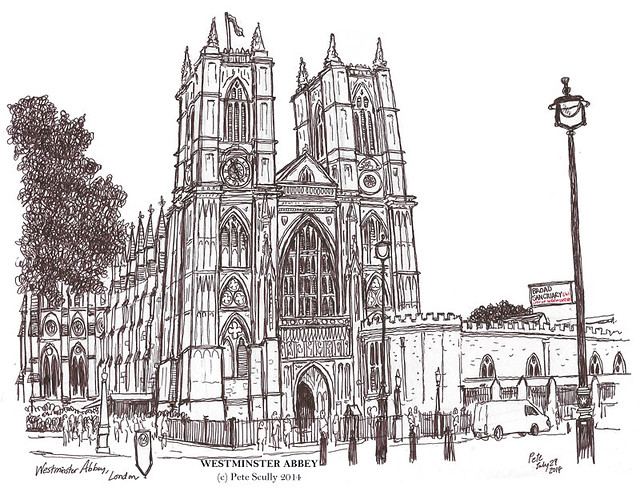
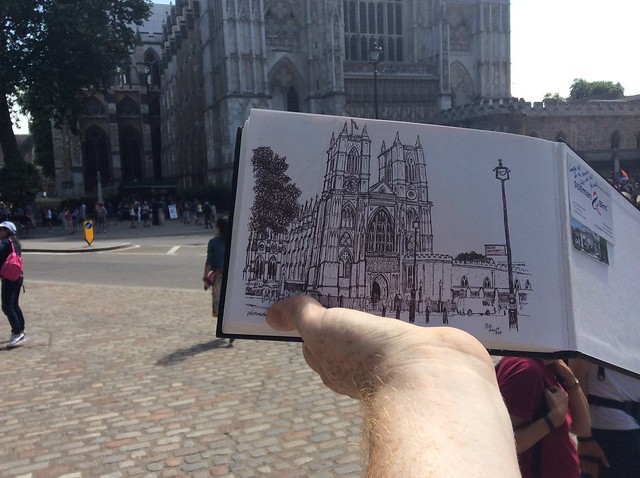
I got on the tube on my second morning in London and went to work – another day of sketching my old city – but without a real plan as to where I would sketch. When I am at a restaurant sometimes I spend ages looking at a menu just to whittle it down to three or four items that I will ultimately decide upon only when asked, on a whim usually (yet I always end up eating the same thing, it’s weird), well sometimes I am like that with the sketching. I had no idea what I wanted to sketch. So I just went where the wind took me. I ended up outside Westminster Abbey, that great spiritual epicentre, the Royal Peculiar, both crowning and final resting place of kings and queens for a millennium. I’ve never ever sketched it, but some recent Spanish sketching visitors to London (that would be Inma Serrano and Miguel Herranz) had sketched it from this very angle and so I was inspired. I love to sketch a cathedral (of course it’s not technically a cathedral, nor is it an abbey, but as I’ve mentioned it’s a Royal Peculiar, direct responsibility of the monarch). I haven’t actually been inside since I was a kid, going to see Poet’s Corner and all that, but I sat across the street amid a crowd of Japanese tourists snapping away with their massive cameras and sketched upwards. It’s a spectacular building. It actually brings me a lot of joy to look at it, knowing its place in English history. This was Edward the Confessor’s church. Admittedly not this particular heap of architecture but it’s been going since his day. Or before, if legends are to be believed, for it was here on what was the Island of Thorney that a simple fisherman had a vision of St. Peter near here, and so in the seventh century an abbey was founded, and apparently the tradition of salmon being given to the Abbey years later was a reference to this incident where a local angler claims he saw a long-dead Pope splashing about in the Thames. William the Conqueror was crowned here, the Norman upstart who fancied himself a king and bloody well became one. And most recently, our latest royal William married Kate Middleton here, at an ungodly hour that meant certain American family members getting up ridiculously early to watch it all on TV. Ah, it’s all spectacle and nonsense, really, but it’s all good fun. This was the last page of my landscape Stillman and Birn ‘Alpha’ sketchbook and what a book it has been. It’s a little larger than my usual size but the paper and the format have been superior, really nice quality, smooth but not too smooth, and takes watercolour very nicely, but really allows for detailed penwork without feeling like I’m chipping away at granite. Of course that is also the uni-ball signo pen I’m using, the old micron pigma was a bit harder work but that’s because I’m tired of nibs that wear down in general. I did originally plan to colour this in, but I liked the pen version so much when I’d finished that I decided against it.

IMG_1177

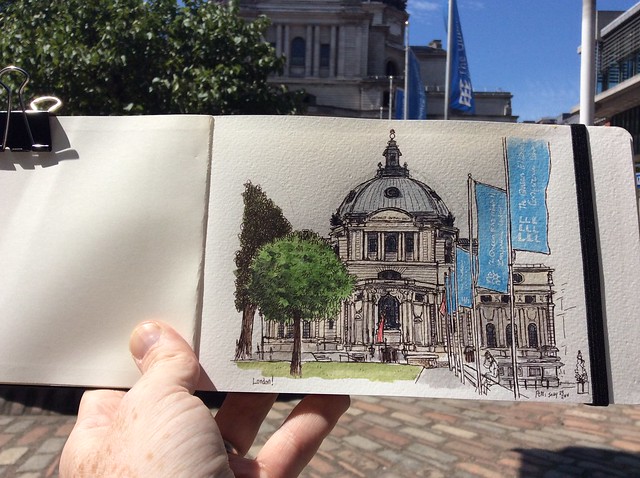
I moved onto the first page of my new sketchbook for the next building. After a year off, I went back to the old favourite, the watercolour Moleskine. This was to be #13 in that particular series. However, as has been pointed out in reviews by fellow urban sketcher and watercolour-Moley fan Liz Steel, the paper in these newer “Art-Plus” Moleys is…different. It isn’t quite the same. Grainier, yes a little, but also different sides of the paper have different textures, like a front and a back, a common feature in lots of watercolour paper but not in the older watercolour Moleskines. Still, I haven’t had too many problems with them and I still love the format and pocket at the back…but somehow it’s not quite the same. By the end of the book I’m sure I’ll be totally used to it and ready for Moley 14…we’ll see!
westminster central hall sm
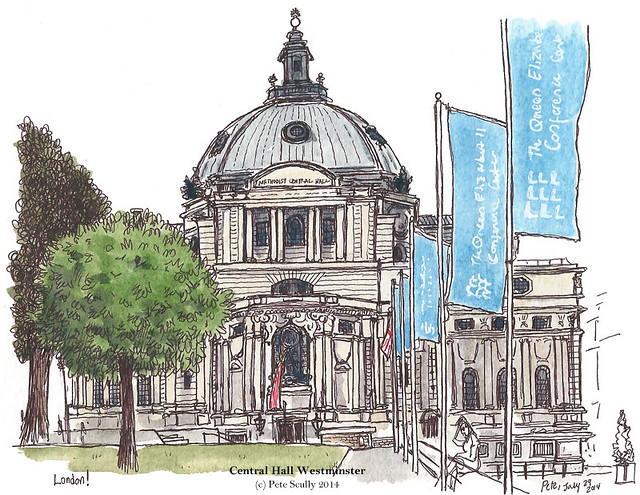
Anyway what I sketched next was the big domed building across the street from Westminster Abbey, known as Methodist Central Hall (or Central Hall Westminster). This took under an hour, paint included, stood in the shade of a tree while local workers lunched. For my next sketch, I jumped on a tube and went down to Sloane Square… to be continued…
IMG_1181