Here are the last few from my trip to Europe last summer, starting with the sketch drawn on the flight home. It’s like if I don’t sketch on the flight now I can’t tell if I flew or not. It does relax me on the flight though, helps pass the time rather than watch some silly movie, which I do anyway. This particular flight took off late, which is always fun as I love airports so much. This was the last page of that Moleskine sketchbook I really didn’t like much; you can see a few paint swatches from the Aquarius Watercolours that I got at the Symposium, plus a few others I was trying out there. I was definitely ready to go home by this point though, real life was calling, and as much as I love London it was starting to get on my nerves. I had a 5k race to run the next morning in Davis too (the Labor Day Run; I did pretty well too), and it was super nice to be back in Davis, back to routine, back to my own bed. There were a couple of sketches from my last Saturday morning in London though, as I decided to jump on the tube and head down to Oxford Circus for some very last minute shopping. I went to Liberty’s, they had their Christmas stuff up already (it was August!), and then found the Oasis ‘Live 25’ pop-up shop and bought some merch, and a nice black Adidas long sleeve shirt. I then sketched the church with the very pointy steeple just past the top of Regent Street, All Soul’s Langham Place. I remember years ago, when I was an open-top-bus tour-guide, we’d go past this and I’d say it was the sharpest pointiest church in London. It was designed by John Nash, who built Regent Street and also a lot of the buildings around here that date from the Regency period. You could say he suffered from Regency Bias. (Damn, I wish I had said that on my tour).
Then I walked down Mortimer Street, and started a sketch of the buildings below, which caught my eye. I started drawing the windows, and outlines, but then decided it would have to be finished later as I needed to get the tube back to Burnt Oak, as I was going up to Watford with my mum. So I walked down towards Goodge Street; as I was about to cross Charlotte street, one of those guys on a delivery e-bike zipped in front of me, Deliveroo, having jumped the red light. I said instinctively “he just went through a red light,” and went on with crossing the road. But the bike man stopped, and yelled back at me, “yeah does it bother you?” I was a bit shocked but he kept yelling that at me. I responded yes it bothers me, you went through a light as I was crossing the road. Anyway I kept walking down Goodge Street. Next thing I know, he is right behind me, on the pavement on his bike, saying “I’m following you on the pavement now too does that bother you?” He was pretty aggressive, and started to threaten me and ride in front of me. After telling him to leave me alone he kept on, to the point where I realized he wants an argument here and probably more, so I just decided to ignore him completely, and walked around the back of his bike and across the street. I could hear him still when I turned into Goodge Street. I was a bit shaken about it, but not much, maybe I should have reported it to the delivery company but what’s the point in that. There had been so many times going around central London where those bloody e-bike delivery guys have cut in front of me as I’m crossing the road, it’s dangerous, and there are some not very nice people with tendencies towards aggressive behaviour out there. I got on the tube and back up to Burnt Oak.
After a month away, I was ready to get back home, and I was so done with London for now. I love London and won’t have people knocking it, but it can be exhausting and I’m often glad I don’t live and work there any more. When a man is tired of London, he is tired of those e-bike delivery drivers, add that to the list, but you get them everywhere now. While it was sad to leave my London family, it was nice to get back home to my California family, and do that 5k run while still jetlagged (easy peasy). Anyway a week later I would be off again to San Francisco to see Supergrass play, and then, though I did not know this at the time, flying off to Los Angeles to see Oasis. I’ll save all that for another post…
Back in London from Berlin, I rested for a day before heading down into central London on Friday for some more sketching before heading back to California. I had a standing ‘groundling’ ticket to see Twelfth Night at the Globe Theatre, but since it looked like rain and I was not up for a trek to the South Bank, I decided to go down to Soho and sketch around there before meeting up with my friend Roshan. If I’m going to stand for a few hours I may as well be sketching. I like exploring Soho. I made my way to St.Anne’s Churchyard on Wardour Street. I always liked the steeple of St. Anne’s. Many years ago when my mate Rob lived in Soho at the end of the 90s we could see the steeple from his living room window. It reminded me of a Teletubby. They have those big round ear things, if you remember, I didn’t really watch Teletubbies. I stood in the Churchyard and sketched the colourful bunting, love a bit of bunting, especially love the word ‘bunting’, it’s so ‘England’. Takes time to draw though. While sketching, two women (Romanian I think, I recognized some words) came in and sat in the churchyard dragging oversized suitcases with them. One of them was very noisy, yelling at the other in a loud raspy voice. It was a bit distracting, but you don’t really expect silence in Soho. I stood next to a tree, and soon an old man came up and started throwing bird seed on the ground, right in front of me. I didn’t think I thought I was a bird, but right away several dozen pigeons came out of the trees and surrounded me. This would make a good magic trick in a story, I thought, the old man throws birdseed, you are surrounded by pigeons and then VOOM you are gone, transported to a pigeon dimension. Actually that would be quite a bad story, the sort of one that would have been made in the 1970s and replayed right up to the 90s in the 5:10pm slot on BBC1 kids TV. I’d still watch it. At least no pigeons pooed on me. I was going to say ‘SHOO’ but remembered that this is an anagram of ‘SOHO’ and I thought, better not, magical anagrams and all that. It didn’t rain, a few droplets, so I drew the steeple as well. It doesn’t really look like a Teletubby, now I think about it. I looked up their website; St. Anne’s was built by William Talman, who was ‘clerk or works’ to Sir Christopher Wren, and consecrated in 1686. Then the Blitz came and destroyed it in 1940. It was rebuilt in 1990. I didn’t go inside, but being outside under the bunting was enough, like being in a village churchyard.
I remember coming down there as a teenager in the early 90s wandering about exploring London, when I would occasionally sketch but mostly just explore the city, make a map of it all in my head. This corner of Soho was a bit like stepping into a different, dangerous world, a Dickensian London but set in the 70s, all sex shops and seedy cinemas and prostitutes openly hanging about on a Saturday lunchtime. The corner below, leading into that little alley of Walkers Court just off Brewer Street, was one of the seediest spots, I remember being shocked at all the neon lights and dark doorways leading to god-knows-what, it was a world that I wasn’t part of and definitely didn’t want to be. Rupert Street facing it had market stalls and newsagents alongside shops selling bondage gear and ladies of negotiable affection calling out to passers-by, and passing down the narrow Tisbury Court back up to the relative normality of Old Compton felt like a brief passage through a frightening dimension. I found it fascinating that this was a real place in the middle of the city, and yet also just another neighbourhood where people lived their normal lives. I remember at school, we were tasked with doing a project about ‘community’, and I struggled for ideas, but I remember walking through this area (I think it was with my uncle who was going to a cool movie poster store down the street) and realizing there was a community living in Soho, even here in this bizarre world of neon lights flashing ‘girls! girls! girls!’ and shifty men in doorways. Soho is a blend of communities but it is and always has been a residential area, a village in the middle of the city. London has a lot of those. A few years later when I was at university and my mate Rob lived on the corner of Rupert Street and Winnett Street with his girlfriend, it was still an area of sex shops but already seemed less scary, and we would pass through Walkers Court on the way to the supermarket to buy milk and tea, not paying any mind to the red light district we were passing by. I remember that we stayed up and watched the whole Star Wars trilogy (back when there was only one trilogy), while from his kitchen window you could catch a glimpse into other windows, where there were other fantasies going on, some in full view (did these windows not have curtains?). These days, this part of Soho feels quite different. There are a few sex shops and the big green Soho’s Book Store on the corner of Walkers Court feels less like a seedy emporium and more like a cheeky part of Soho’s adult-themed heritage, but this mostly this area feels like it has gone upmarket now with fashion stores and such. Raymond Revuebar, the big theatre and strip club that I felt was the centre point of Soho, opened by Paul Raymond in 1958 but finally closed in 2004, having stood lighting up this corner for decades. I vaguely recall going to a gig there in about 99 or 2000, or maybe that was at Madame JoJo’s next door. When my friend lived around there he actually met Paul Raymond, and said he really was the King of Soho. There’s a fashionable clothes shop there now. I stood on the corner of Rupert Street to sketch this, thinking about all of this past, and how everything moves on.
Below, the spread of Wardour Street, just a few steps away from the last sketch. I feel like I spent a lot of the 90s down this street too, a busy but relatively narrow thoroughfare splitting Soho in two. I stood in a precarious location to draw this, a traffic island that has been converted as a parking spot for those electric bikes you see all over the place, with a narrow bike lane to my right. As I took a quick picture of the scene before starting to sketch, a policeman came up and said, “ello ello ello, what’s going on ‘ere then, you gotta be careful sah, there is ‘orrible tea-leaves on bikes who will nick your dog-and-bone, sunshine”. Actually he didn’t say it like that, my head was still in old 1970s films. He just said to eb careful taking pictures with my phone as there are people on bikes who will snatch it from my hands very quickly. I knew this is a particular plague of London these days and have been quite careful with this, though especially here you can’t be too careful, and I actually smiled and felt genuinely grateful that there are police out there watching for this and warning people. Though what I said was, “oh it’s ok, this is my old phone”. which it was – I used my old phone when out and about in London, just in case – but I was grateful and thanked him. Still, I held tight onto my sketchbook as I drew the scene, out of the way of the e-bike bandits. Wardour Street was always one of my favourite streets, and it contains The Ship, one of my favourite pubs in London. It used to contain The Intrepid Fox as well, the best rock pub in the city, where I sometimes would meet up with my friends from the Hellfire Club (on Oxford Street) and attempt to listen to figure out what each other was saying over the loud heavy metal music. It was sad when that place closed (it actually moved to New Oxford Street before closing for good). For a little while in ’96 I went out with someone from Italy, and she used to work in an arcade further down Wardour Street near Leicester Square, before she switched jobs to work in Las Vegas, not the city but the arcade on the left of this sketch, which still has the same sign as it had 30 years ago, a Soho relic. Cinema House is next door; this area is at the heart of the British film industry too, or at least it was (Cinema House has a fashionable clothes store now, because there aren’t too many of those). What was the Intrepid Fox next door is now a steak house, but you can still see the old stone sign of The Intrepid Fox on the outside corner. The sky was looking nice, above Oxford Street in the far distance. You can just about make out the Telecom Tower poking through on the right (follow the arrow). For some reason I remember being about 19 or 20, walking down here on a late afternoon having been to the Virgin Megastore, where I’d bought myself the Beatles Complete (Guitar/Vocal Edition), a massive book with all the Beatles songs in it (which I still have), and treating myself to a pastry and some tea at a nice cafe as a self-reward for finishing up all of my college projects and homework, and that being quite a nice moment down here. It often feels a little too busy or a little too cramped to stop and sketch on the corners around here, but I’m glad I spent the time looking at it again. Soho is always worth sketching. I’ve been back to London since this trip last summer, and I was in Soho sketching again just last month. By this rate I post my sketches on this blog, those will probably be up by about 2028. Click on the image to see it bigger.
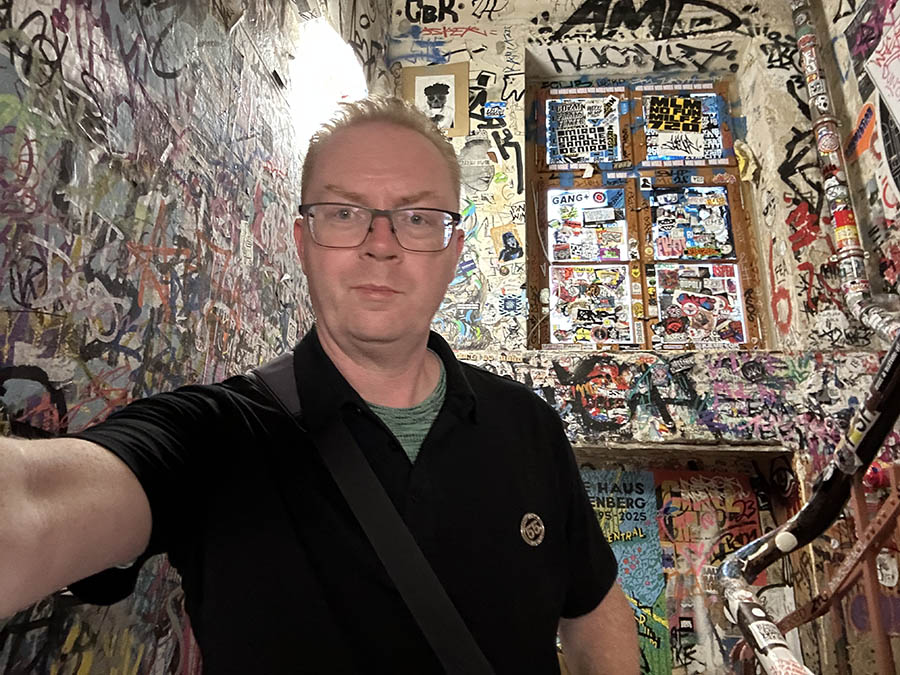
I’ll finish up with the remainder of my Berlin sketches and thoughts. I definitely had a lot of thoughts when visiting the Gedenkstätte Berliner Mauer (Berlin Wall Memorial) in the northern section of the city, close to the Nordbahnhof. before heading up there I walked over to the Hackescher Höfe, which I had visited a couple of days before with Omar. I wanted to visit the art and bookshop there, at the Haus Schwarzenberg, which is covered in graffiti and has a stairwell full of art and posters and stickers (and signs saying not to take photos; I broke that rule). The shop I visited was called ‘Neurotitan’ and was an incredible place, I bought some zines and stickers there, and asked the assistant if they had Detlef Surrey’s book ‘The Wall Revisited’ (I’m pleased to say I held a conversation in German and was totally fine; normally I need a couple of beers before the German comes flooding back). I had heard that this store stocked it, but she said that the last copy had just been sold that day, probably by someone else who had seen his talk in Poznan. I showed her my sketches of that talk, she said that I could probably get in touch with the publisher to get a copy (I did, once I got back to the US, but it took some time and a bit of extra money – thanks a lot, bloody tariffs – to get one sent over to America). I had that book on my mind now especially because I was going up to the Berlin Wall Memorial, which Detlef had talked about at length. I took the S-Bahn out to Nordbahnhof (I realize that sentence implies that I simply got on the S-Bahn, and just went to Nordbahnhof, but leaves out that I got on the wrong train in the wrong direction at least twice, like when you try to fix a scratch but end up smashing up the table, but I did end up at Nordbahnhof in probably more time than it would have taken to walk). The Berlin Wall Memorial is a preserved section of the Wall and the Death Strip, along Bernauer Strasse. It was already early evening when I arrived at Nordbahnhof (sketched below), which during the Cold War was closed down, a ‘Ghost Station’ on the divided S-Bahn system, where West Berlin trains would not stop but passengers would catch a glimpse of a time capsule manned with armed guards. I found the Berlin Wall Memorial chilling. This was not like the East Side Gallery, here was the Wall as it looked, along with rows of metal poles installed like bars you can walk through. One section remains closed off to give an idea of what the Death Strip really looked like. Berlin is a city that dares you not to forget its past. On a metal display in the middle of the grass are the names and faces of every person who was killed trying to escape from the East into West Berlin, 136 in all. The faces as they look out at you, some so young – even children – was frightening. There were blocks occasionally showing where people were shot trying to escape. The Wall was up from 13 August 1961 until 9 November 1989. I didn’t get to see all the areas of the Memorial, nor the documentation center, but I sketched the Wall as the light was fading, then took a tram out to Prenzlauerberg and back to the hotel.
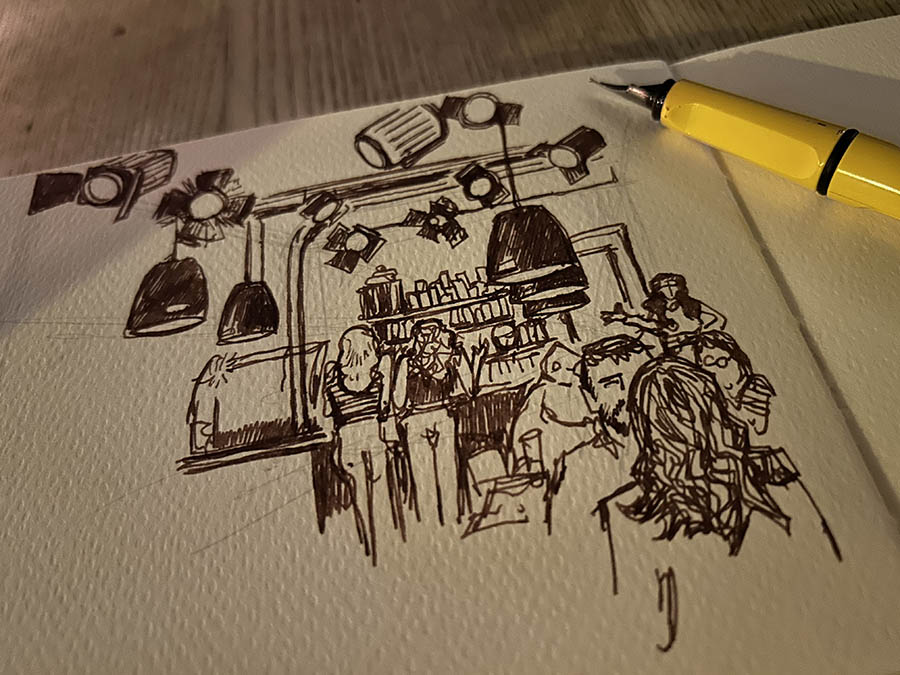
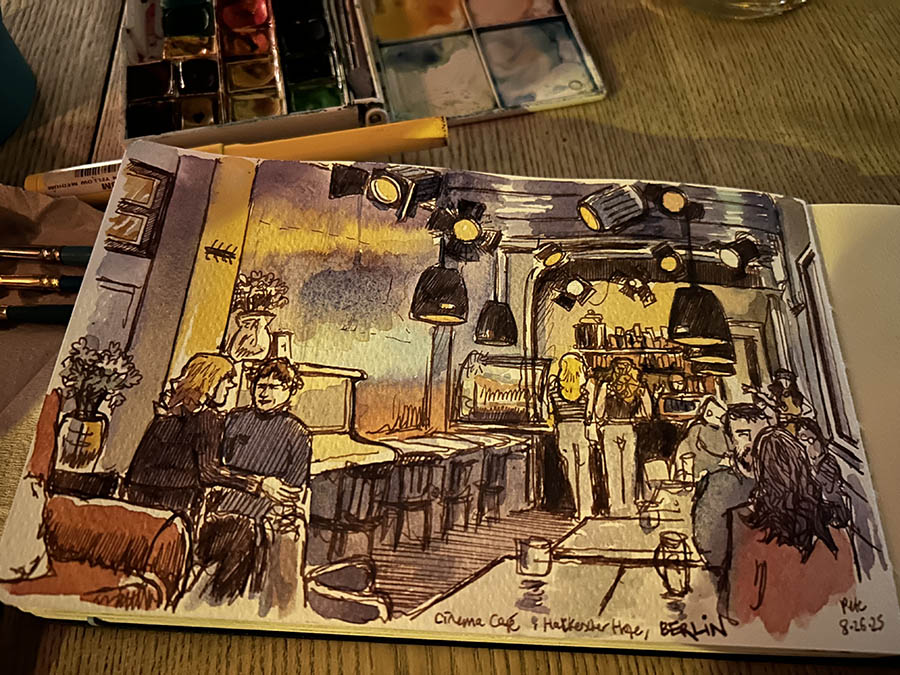
After a late dinner of spaetzle from the hotel restaurant I walked back over to Hackescher Markt. All over Berlin, but especially around here where there had once been a large Jewish population, you find the ‘Stolpersteine‘, or ‘stumbling stones’, which are actually little square brass plaques in the pavement that are slightly raised so that you might trip on them, by design. Each has the names of people who lived there previously, usually Jewish but many Roma, homosexuals, disabled, who were removed or forced to flee by the Nazis, along with the year, how old they were, and their fate (you see ‘Ermordert in Auschwitz’ a lot). This is an initiative by the artist Gunter Demnig started in the 90s, and has now spread to many other cities commemorating victims of the Holocaust. Each of the Stolpersteine is handmade. Berlin makes sure it does not forget. I went back over to Hackesche Höfe and had a beer at the Cinema Cafe, which I sketched in the poor light. It is interesting that a lot of places in Berlin are cash only, where I got so used to using my card everywhere in Poland, same back in California. It wasn’t a busy evening, it was Tuesday, but it was an interesting cafe to sketch, and I used my fountain pen. The outside area of the cafe is in that alley with all the graffiti and would have been an interesting sketch, if I could find somewhere to sit with a good view, which I couldn’t. After this, tired, I went to bed.
On my last morning in Berlin, at the end of my Poland-Germany trip, I was ready to go back to London but had a last sketch or two in me. I had considered adding in a short trip to Denmark onto the end of this adventure, since it was 30 years since my strawberry-picking visit there, but decided a couple more days in London would be better for me. I had also considered taking the overnight train from Berlin to Brussels, a fairly new service, and passing a couple of days in my old Belgian haunts, but I’m glad I didn’t in the end. It was nice to spend some time by myself in Berlin but it’s not 1998 any more. I walked down to the Museum Island (sketching a man fishing in the Spree along the way) and sat next to the Dom, drawing the view of the Museums in pencil.
It is fun (and quick) to draw in pencil but I don’t really like straight lines much. I do love that sky though, and miss those wispy cloud skies. Before long I was back up in the wispy clouds myself, and sketched the view on my very small plane (see below). It was easy to get the S-Bahn out to the Brandenburg airport, but took a very long time getting through the security line, which seemed to have one line per baggage inspector and the inspector seemed to have to open up every single bag and inspect every single thing. I eventually had to ask them to let me through as I would miss my flight despite being there super early. Word of warning for you in Berlin airport, it can be slow. I flew back into a new airport for me though, London City Airport out past Docklands, a very small and convenient place to end up. I jumped right onto the DLR to Bank, and onto the Northern Line back home to Burnt Oak. Auf Wiedersehen Berlin, it was nice to reconnect after all these years. I would like to get back to Germany again soon, but I’d like to go back to the South and West again, maybe explore the Rhine Valley at last.
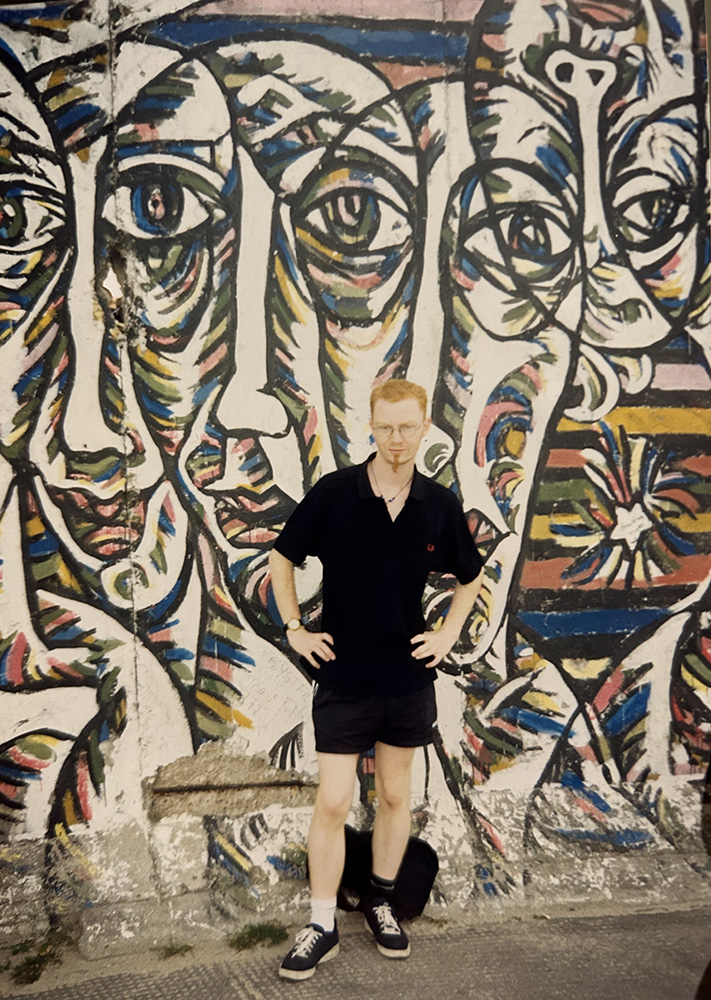
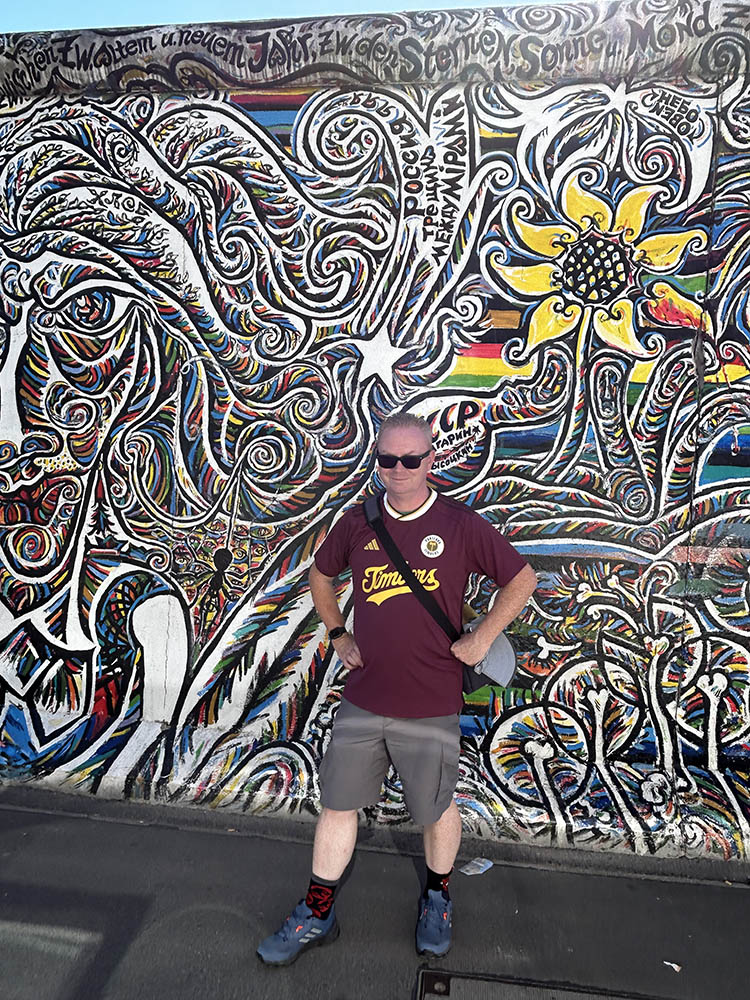
I took the U-Bahn out to Warschauer Straße, a wide busy road well out into the East, full of hostels and clubs and new buildings. I was headed to the East Side Gallery, a famous stretch of the remaining Berlin Wall that separates Mühlenstraße from the banks of the river Spree. Popular with tourists, I’ve been here before, but almost didn’t recognize the other side of the street, now all built up with tall steel and glass hotels and apartments and businesses, plus a big modern concert arena, not like the concrete DDR era blocks and empty spaces I saw on my last visit. The East Side Gallery starts close to the Oberbaumbrücke, a decorative bridge over the Spree, and is the longest bit of Berlin Wall left standing. It was covered in artwork by over a hundred artists in 1990 after the Wall fell, and has been left as a testament to the fall of the DDR. Some of the artwork has stayed in place over the years, much of it has been updated or renovated, or even had new artwork put in place. Some sections have even come down, as Berlin has started redeveloping, but this is considered to be the largest open-air gallery in the world and contains some now famous paintings such as the one of Brezhnev and Honecker kissing, My God, Help Me to Survive This Deadly Love by Russian painter Dmitri Vrubel. I stood and sketched the section above, showing Alles Offen (‘Anything Open’) by Rosemary Schinzler. I drew in pencil and watercolour (on that horrible bobbly Moleskine paper) and I likely had in mind the looser style of Detlef Surrey having been so inspired by his work at his talk. Plus it was just faster; I get bogged down with my penwork sometimes, and it’s good to be free; where better to be free than at the broken Berlin Wall. There were a lot of tourists about but it wasn’t crowded. I tried to find the spot where a photo of me was taken in 1998, and it was besides Wir Sind Ein Folk (‘We Are One People’ aka ‘Worlds People’) by Schamil Gimajew. I got someone to take a photo of me, so I could put them side by side. It’s clear that the original painting looks fairly different to the updated version, but still in that very distinctive style that I was so drawn to. The side by side photos are below. I remember we used a highly stylized black and white version of that photo in a poster for our small university production of Brecht’s Caucasian Chalk Circle (performed in German; I was Azdak the judge, the best possible character to play ever; that was a chaotic student production for our German Play course, in which I co-directed the first half, and designed the set to be projected on stage by one of those overhead projectors you get in schools, with extra characters drawn in pen and moved about alongside the real actors by me, it was very strange but we were on a budget and had to be creative…). Wir Sind Ein Folk is a really long piece and you could spend hours looking at all the details; there is more information about the piece and the artist on the East Side Gallery Exhibition website. Anyway here are the two photos, almost three decades apart (note the odd socks in the older one); I still stand in the same way.
1998 Pete, East Side Gallery2025 Pete, East Side Gallery
After exploring the East Side Gallery I walked along the Spree, the Sun was out and I like to find the shade, so I stood next to a big boat (which was also a hostel; seemed like a fun place to stay, or maybe not, maybe 1998 Pete would have enjoyed it). I wanted to draw the long Oberbaumbrücke. I had intended to colour it in but couldn’t be bothered in the end. It is a double-decker bridge, and connects two neighbourhoods (Friedrichshain and Kreuzburg) that were divided by the Wall. This bridge was built in 1896, replacing an older wooden crossing, and has those two distinctive brick towers inspired by those in the city of Prenzlau. Updates were made following reunification. While I sketched, an American man started to chat with me, he was another sketcher who had been at the Symposium and was part of Urban Sketchers LA, Kevin Riley, really good sketcher, so now I’m following him on Instagram. It’s this whole thing about urban sketching, we get to recognize our people out in public, make connections.
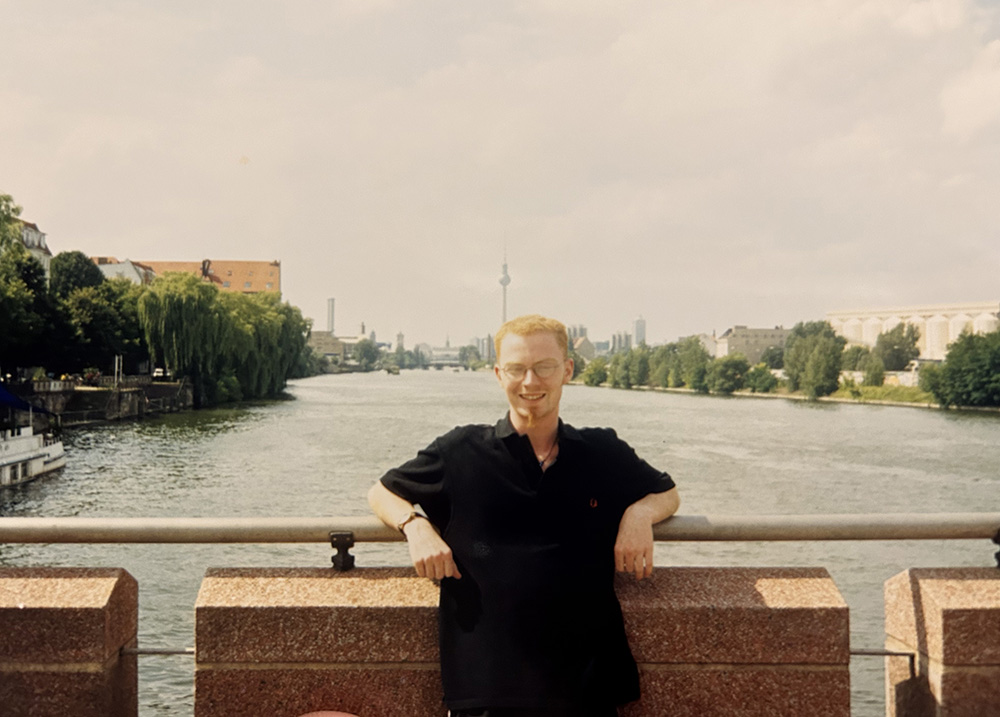
Here’s another picture of me in Berlin in 1998 standing on the Oberbaumbrücke, with the Fernsehturm in the background. I had thought about taking one of those riverboats down the Spree, that would have been interesting. Can’t do it all though. After I finished the sketch of the bridge, I walked back over to busy Warschauer Straße, had a fairly gross tasting vegetarian currywurst at the station, and headed back to the hotel for a rest before seeing some more remains of the Berlin Wall before it got dark.
For my second full day in Berlin, I had a few things I wanted to do. You can’t do it all; I couldn’t for example go out to Charlottenburg, where I had never been; nor to Neukölln and Tempelhof, which had been recommended to me; nor out to Potsdam, which I had explored in ’98 anyway. Things always take longer when I have my sketchbook anyway, but I spent a bit of time going about on the U-Bahn and S-Bahn. I had a leisurely breakfast in my hotel room, sat looking out of the window and strumming on the uke, then headed out to West Berlin, to the Zoobahnhof, the busy shopping street of Kurfürstendamm, and to the Kaiser Wilhelm Gedächtniskirche (Kaiser Wilhelm Memorial Church) at Breitscheidplatz. I was covering old ground; this is one of the first places I visited in 1998 on the day I explored the city on my own. It is the shell of a large bombed out church, with the more modern church structure next to it, a large concrete edifice made up of small windows of stained glass. The older building stands as a monument to the destruction of war, and there is an exhibit of its history inside, along with an iron nail cross from Coventry Cathedral, also destroyed by aerial bombing in the war. The two cathedrals have held a long friendship together. The original church was not that old, having been built by Kaiser Wilhelm II in the last years of the 19th century, opening in 1906. The new church doesn’t look much from the outside, but inside the largely blue windows create a thrilling effect as they surround the space, it reminded me of Liverpool Catholic Cathedral, though this is a Protestant church. I had always thought (probably someone told me when I went there years ago) that the glass was recovered from the original building, but that is not the case, the glass in fact being designed by Gabriel Loire. That makes more sense, I think that when clearing up they probably weren’t saying “collect all those little bits of glass, ja, that might come in handy”. I really enjoyed sitting in the new church and sketching, something about all that blue really calms you down. I also liked the design of the floor, all colourful circles. There is a big golden Christ with a long face flying above the altar; it’s actually made from a bronze alloy metal called tombac and designed by Karl Hemmeter. I sketched in there (below) before sitting outside and sketching the old and new, above.
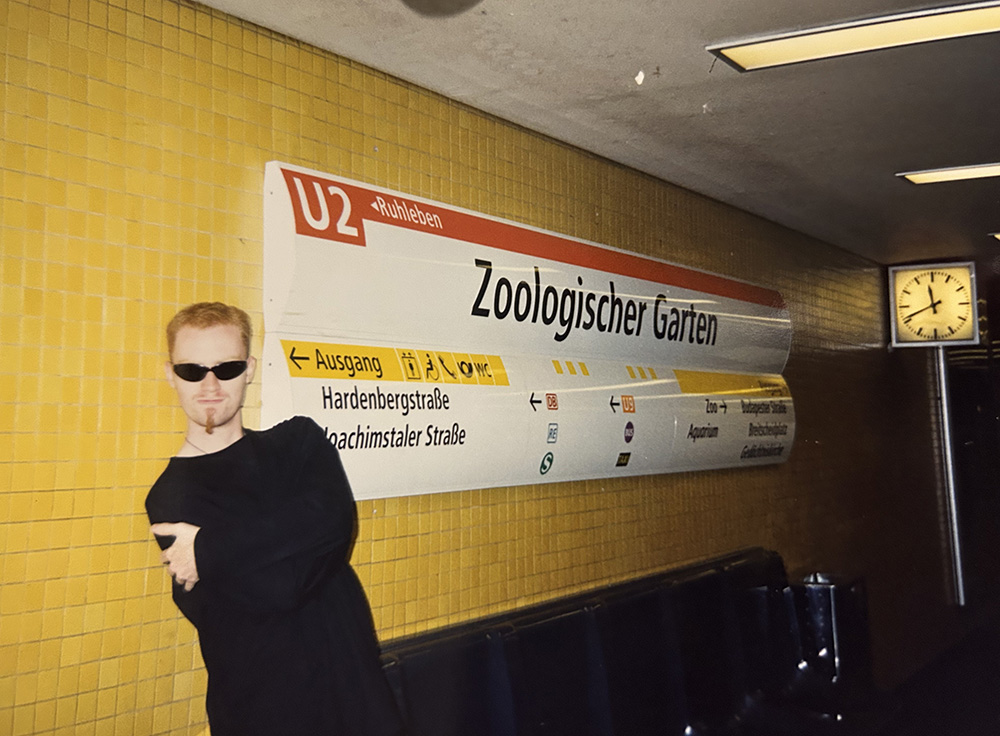
This is the commercial hub of the city and it feels like it, the Capitalist island in the old Communist sea; I remember that road map of Europe I had when I was a kid, West Germany was fully detailed, but only major cities were shown in the otherwise blank East Germany, except for those three autobahns that went from the West directly into the isolated West Berlin, with little warnings telling motorists they were not allowed to leave the road. According to that old road map, East Germany was a place that geographically didn’t exist. In his talk at the symposium, Detlef Surrey said that you got used to living with the Wall and the fact that there was this other place just over there, but that you mostly didn’t think about them, or maybe were encouraged not to. It was a different time, but I wonder about modern Korea, where you can say the Berlin Wall still exists, how do the people in the South think about those in the North. Germany is all one now, ever since 1990, but I hear many Germans say that it still feels like two, those divisions from decades ago and the years of change afterwards were a lot to expect to just heal. Was Germany ever really one? I always think about the north-south divide (sometimes called the Weißwurstäquator, depending on the type of sausage you might eat in different parts of the country), and the division between mostly Protestant and mostly Catholic regions, but in truth Germany as a federal nation has always been made up of very diverse places with differing histories. It’s a country and a language (all the different varieties) that has intrigued me since I was a kid, it is not a monolithic block. I would like to really explore it in more detail, but as I said, I don’t have time to go everywhere, mostly I’ll just draw the old buildings, and I don’t even eat sausages, well not pork ones. I was thinking of the old East-West as I walked around here though, since it had not changed as much as the other side had since my last visit in the 90s. I walked through the mall to find the toilet, and half expected to see posters of Hasselhoff in record shop windows. While we are talking retro, below is another photo of me in the 90s, posing like Bono with someone else’s sunglasses down in the Zoo station. Check out the little beard thing I had then, that is how you can tell it was the 90s. I took a photo of that sign as I pass through, it hadn’t changed much.
I had planned to take a wander through the Tiergarten. I wasn’t planning to go to the Zoo itself, who has time for that, but I love a massive park. This one is pretty big, and I only covered a small part of it. I started drawings some old lamp-posts, which were from all over the German-speaking world, plus some from other countries, a really interesting display of civic artistry all hidden together in this corner of Berlin. It was well past lunchtime now, and I was feeling hungry so decided to find the S-Bahn station and go back to the hotel for a rest before exploring the East Side. I wish I had been reading a novel set in Berlin, and that time passed a lot more slowly, to sit in the park or on the S-Bahn reading would have been perfect. As it was, I was still reading Agatha Christie’s Lord Edgware Dies (spoiler alert by the way) and it was taking me forever, because I’m a painfully slow reader.
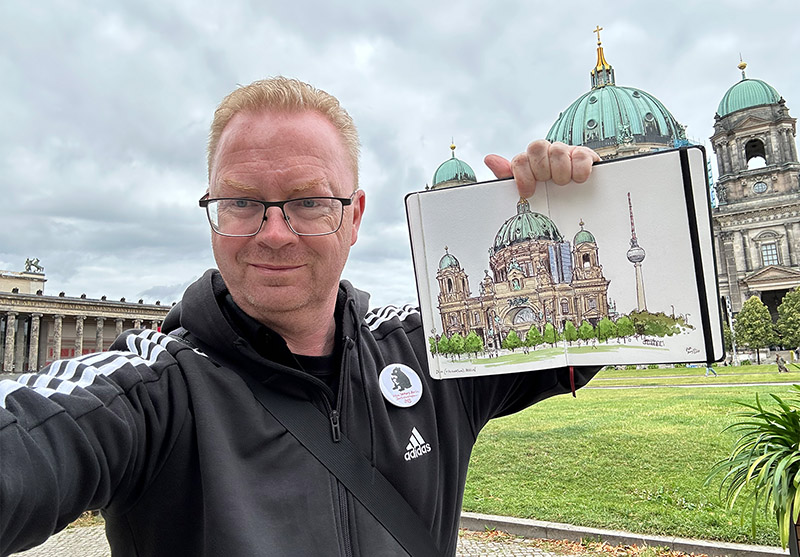
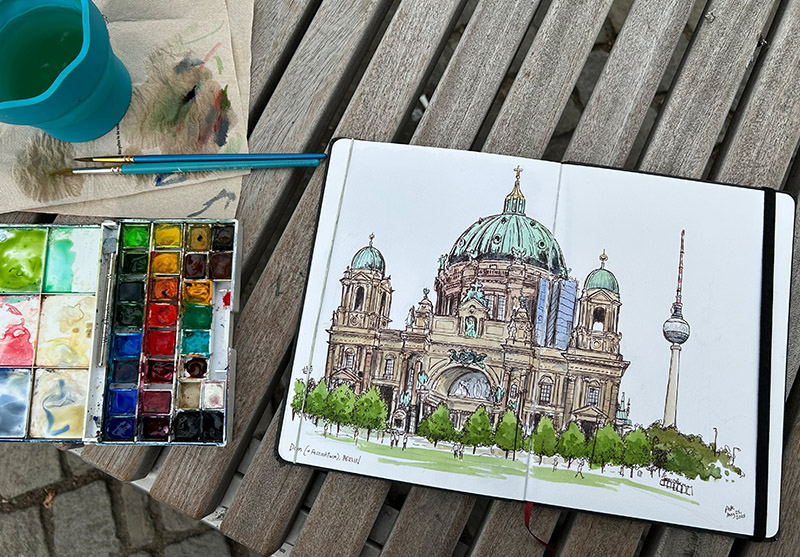
When I’m so behind in posting my sketches it is overwhelming to think of how much catch up there is, but then I remember that I’m looking back on my adventures from last summer, and it’s sometimes good to reflect on them when they are less fresh so you have had the time to digest them. Berlin is a lot to digest all at once, especially if you are mostly digesting by going around drawing it all. Berlin is a city with a lot of stories, and you can’t draw it all, and you can’t absorb it all. All those stories go through your head as you stand and look at them and try to make sense of things. You see how things are in the present day and you see how easily things went from one situation to another situation so quickly in the past and you think, well of course we should look at the past. Right now we are living in other peoples’ past. I remember feeling this very strongly the first time I was in Berlin, back as a scrawny 22 year old student dashing about Europe on night trains, feeling like this was a city coming to the end of the twentieth century where there were a lot of open wounds, but that it was about to become a different city again. Almost three decades later I was back with a more accomplished sketching habit to take a look around, and on this day I left my hotel near Alexanderplatz and walked down towards the MuseumInsel, which I’d explored the evening before with Omar. I sat in the grassy square outside the huge green-copper-domed Cathedral (Berliner Dom), which was peaceful except for the gangs of young women with indeterminate accents approaching people from all angles with clipboards. You see those gangs in many cities, they really want your signature for something or other, and your wallet too when you let them get too close. You have to keep these obvious pickpockets away from you, and I had to tell them to go away several times, eventually telling them to f-off, but I could see them going up to people all around the square. I was feeling pretty relaxed though, and was really happy with my drawing of the Dom with the Fernsehturm in the background. The cathedral itself has a long history going back to the 1400s, and has had several different iterations, but the present building designed by Julius and Otto Raschdorff was inaugurated in 1905. I didn’t go inside. It was a nicely overcast day, perfect for sketching where I’m not bound by looking for shade, and I think this was my favourite building sketch of the trip, drawn in the portrait sized Hahnemuhle, two page spread.
I was going to walk all the way down towards the Brandenburg Gate, but it was a long walk down Unter den Linden and there is an U-Bahn that goes all the way down it now. I love travelling on metro systems in other cities, it’s a whole new level of concentration. Berlin’s system is easy enough, the U-Bahn underground intermingled with the S-Bahn above, but that didn’t stop me getting lost a few times, or getting on a train in the complete wrong direction more than once, taking longer to mess about in stations than it would have taken me to actually walk the short distance. It was easy enough to get from the shiny Unter den Linden station down to the U-Bahn station formerly known as Unter den Linden but now called Brandenburger Tor.
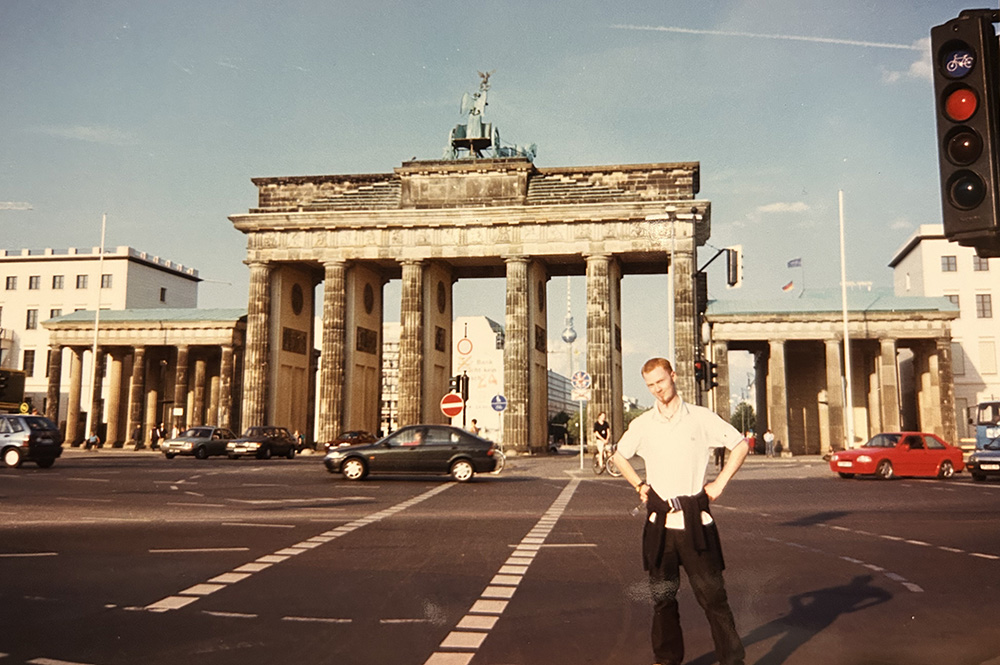
The Brandenburg Gate is for many the most well-known architectural symbol of Berlin, especially of my generation and before who lived in the Cold War era. This was that big ghostly gate, stranded in the no-man’s-land between the Berlin Wall, which we Westerners could only see the back side of. It was on the news a lot when I was a kid. I remember the strange thrill of being able to walk through it when I went in ’98, less than nine years after the Wall fell, while souvenir sellers hawked old Soviet and DDR era army hats and badges. It used to be at the very real and dangerous dividing line between two worlds. I was planning to see more of the old Berlin Wall locations on this trip, inspired by Detlef Surrey’s presentation on his book (which I now have) and the stories he told about his younger life living next to the Wall. The Brandenburger Tor was built in 1791 during the height of the Kingdom of Prussia. Since the Wall fell it has been a symbol of German and European peace and unity. I stood in Pariser Platz, tourists all around taking photos, a man on a platform talking about something or other political, tour guides (‘Tor’ guides?) pointing out the window at the nearby Hotel Adlon where Michael Jackson once dangled his baby (remember that?), and I sketched the gate and the people milling about. I always feel a little awkward sketching columns, I have always felt that life is too short to draw columns, but I just don’t like drawing straight lines. When I was done admiring it all, I walked through the gate and into what used to be called West Berlin.
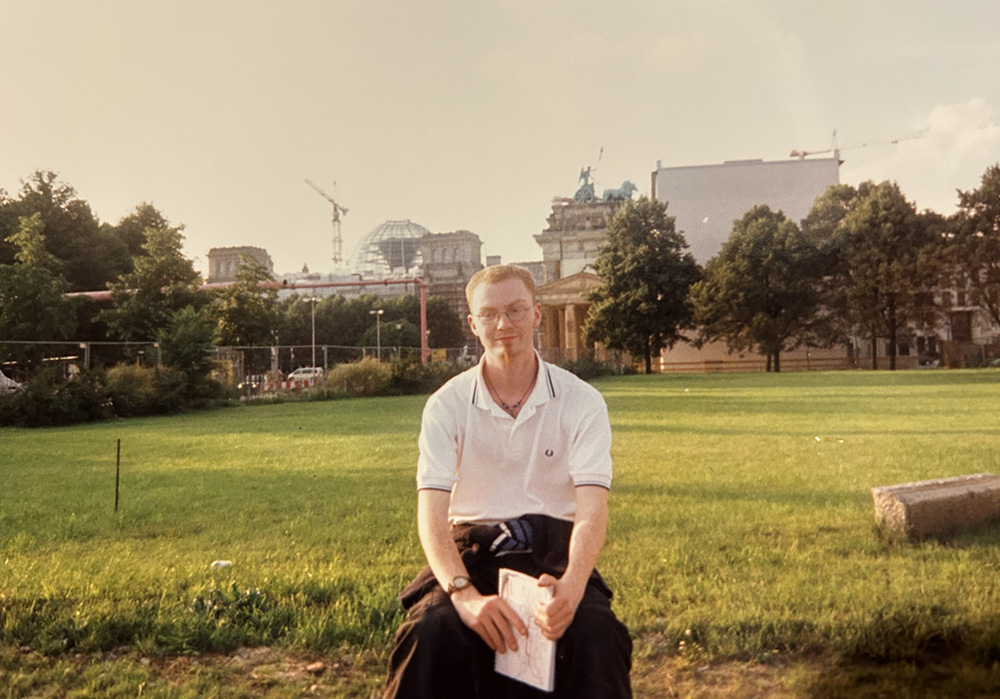
I had to sketch it again from the other side. I have a photo of me from that trip back in 1998 looking young and skinny, standing with this view in the background. there’s the picture below, along with another of the young me sitting where the Wall once stood (with the sort of look on my face that you see in YouTube thumbnails with clickbait headlines like “Berlin: Was It Bad?”). The view has not changed that much really, though my poor eyesight and short memory led to me write ‘Hotel Adler’ above the Hotel Adlon. There’s the Fernsehturm, finding a way to get into every sketch. Traffic rushed by this busy junction, and the massive Tiergarten park loomed behind me full of trees and joggers. I had thought about getting up in the morning and having a run through the Tiergarten, but decided against it. It’s really big.
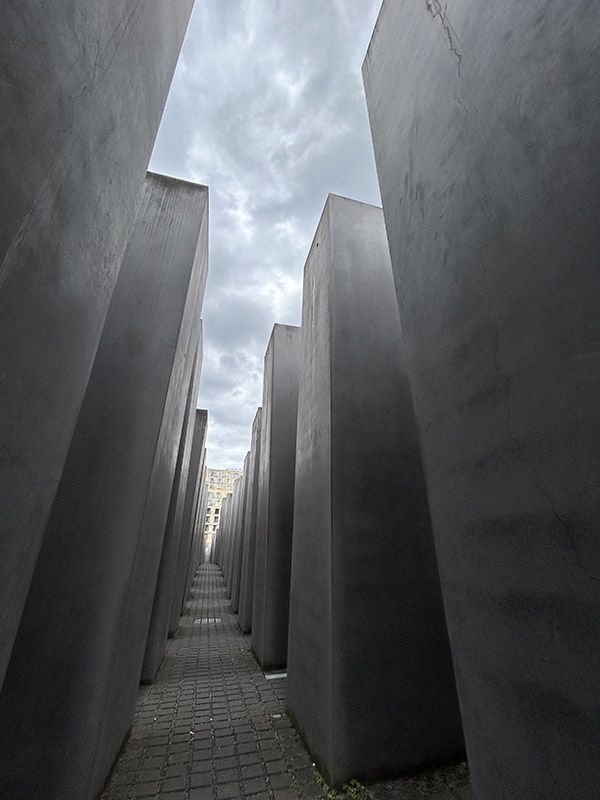
So I walked down Ebertstraße towards Potsdamer Platz, following the line of the old Wall, but first I was going to visit somewhere which was both moving and chilling, the Denkmal für die ermordeten Juden Europas ‘Memorial to the Murdered Jews of Europe’, also known as the Holocaust Memorial. Berlin does not turn its face away from the dark past, and the location of this huge memorial space is significant, nearby the Reichstag, on an area which used to be part of the infamous Death Strip inside the Berlin Wall, and close to where Hitler’s bunker was located. The memorial looks like a filed of smooth grey concrete blocks all lined up in symmetrical rows, appearing to move up and down as the ground level gets deeper and the slabs get taller. It resembles a graveyard, a colourless crop field, a grey grid system city that feels like a labyrinth; the designer Peter Eisenman left it open to interpretation. As you enter the monument the concrete blocks are short, resembling tombs, and children jump from one to the other, though they are not supposed to. The further you walk down each corridor, the taller the blocks get until they tower above you and everything feels…cold. There are people around, but you feel isolated. You might see them pass by ahead or behind, quickly in and out of view (reminding me of that scene in Yellow Submarine), leaving you along again. The rows may be meant to put you in mind of the lines of Jews being led into the camps or onto the transports, and you feel trapped inside this grey world seeing the sky above that can’t be reached. I felt a bit scared in there, not that anything would happen to me, but that the feeling of isolation descended so fast. It is not a labyrinth, every path is a way out, but it was easy to feel suddenly lost. It was sunny when I emerged and I needed a rest. I sketched the Memorial, with the green Tiergarten away to the left, the glass dome of the Reichstag and the solid block of the U.S. Embassy in the background.
It was a longer walk than expected to get to Potsdamer Platz; perhaps I was just tired. The day was already getting away from me, and I hadn’t eaten lunch. The last time I was in Potsdamer Platz it was just a building site, the biggest in Europe, but now it was all big modern buildings and infrastructure. The train station was complicated; you had to go back outside the find the U-Bahn, I decided to go back to the hotel for a rest before I did any more exploring. That was a lot of history for a small area.
Ok, a month of not posting (I went to England) but let’s get back to last summer before this summer comes around. After Poland, I spent a few days in Berlin, a city long on my go-to-and-sketch list (a list that includes all of the cities, but some are nearer the top than others, like Berlin). I was last there in 1998, which may as well have been in a different century. Which it turns out it was. I was staying in Mitte, in a hotel not far from Alexanderplatz, a good central location to explore from, but in the heart of the old East Berlin. This was a changed city from the last time I was there, but so am I. I arrived by crowded train from Poznan, which was headed for the Hauptbahnhof (a station that wasn’t even there in 1998) but ended up diverting to a different station at the last minute, confusingly. It was all good in the end. I got to my hotel, and then met up with fellow Urban Sketcher Omar Jaramillo, who has lived in Berlin for many years now. He showed me around on an extensive walking tour of the city centre, giving me all the histories and showing me all the details that I might have missed on my own. That was really great, and a nice introduction to the city before my sketching adventure (plus Omar’s awesome and I’ve been a big fan of his art since the first days of USk). I didn’t sketch him though! The first sketch I did of Berlin was the one above, of the massive Fernsehturm. The iconic TV Tower which can be seen from all over Berlin, a real Ost-Berlin landmark. I didn’t go up this time. I thought about it. I did go up in 1998, and there was a revolving restaurant up there. I love big telecommunications towers. I drew the BT Tower while I was in London as well. In the foreground there is St.Marienkirche. I stood out on Karl-Liebknechtstrasse as it was getting dark and looked up. Birds were circling the steeple. I had to remind them this was not a 1970s art film. When I was done I went to a small restaurant near the hotel and ate some spaetzle (which was not very good) and had a beer (which was also not good). Ah well, can’t win them all.
I got up and it was Monday. I had two entire full days on my own just to wander the whole of Berlin sketching what I can. I had a rough idea of where I wanted to go, but all the best Berlin stories start with a meeting under the big World Time Clock, Die Weltzeituhr, at Alexanderplatz. I wasn’t meeting anyone but myself on this day, and I was late, so while I waited I sketched. Those yellow streetcars hummed along dodging stray pedestrians, and the base of the Fernsehturm can be seen behind the big arch of Alexanderplatz station. I love this sketch. It was not that early in the morning, and the sky was threatening some light rain, but people were out and about and the city moved around me. I didn’t see any people meeting underneath the clock, unless they were spies, in which case good job lads, I never noticed you. I probably wouldn’t have been a good Cold War spy, I’m too obvious standing there with my sketchbook, or maybe that’s the most genius spy design. Anyway before we start my journey through Berlin, here are some other Berlin things I drew that I though I should share here.
If you have been to Berlin you will recognize these, the Ampelmännchen, which were the old East German street crossing lights that have become a big symbol of Berlin. You can’t move for tourist tack featuring the green Ampelmann in his hat and the red Ampelmann with his arms outstretched. And I couldn’t get enough of it, I bought the lot, even got Ampelmann socks, candies, stickers, one of those plastic reflective things you put on your bike, I loved them. When I did that 1998 trip I took notice of these, and the street-crossing signs, in many of the countries I visited, and drew them in my journal. Seeing these everywhere reminded me of that obsession. I don’t care, I love street furniture. Speaking of which, below is a fire hydrant from Alexanderplatz. Like London these are mostly underground and have to be brought up.
And finally, a sketch of the Fernsehturm that I did the next morning while looking out of my hotel bedroom. I stayed at the Lux on Rosa-Luxemburgstrasse, nice hotel but very slow elevators, especially when I need the loo. It was a lot sunnier that day and I ate breakfast in my room and played my blue ukulele a bit while watching the city. I sketched, and made the decision to add a little paint, golden yellow and turquoise blue, but unfortunately it was on that horrible new Moleskine paper and didn’t have the effect I was after. Still, I had a nice time drawing it. See you in the next post…
Saturday came around fast. I was going to go for a morning run along the river, having been told about some good running paths by one of the volunteers, but it was a little bit rainy and so I went to the hotel gym instead. I had a 5k race the day after getting back to California so thought I’d better keep it up, but I had run a lot in London. I was here to sketch. After breakfast, which by the way at my hotel was really nice, lots of interesting Polish food, I went to the Symposium hub for the morning sessions. they reminded us to submit work for the auction, and also submit a postcard size drawing to win special prizes later, both of which I forgot to make time to do. Oops. When it’s in my sketchbook I can hide it away with my other sketches. Anyway, feeling a little disappointed in myself, I went to the first talk, and I had been waiting for this one. I’ve followed Detlef Surrey for years, the Berlin based illustrator who draws in a quick almost cartoon-like style in pencil and always captures the energy and spirit of the places he is drawing. I feel like I loosed up my own sketching after seeing his, and that helps when sketching scenes like above (and of the other talks) where I have to draw everyone quickly while writing down what he says. Detlef’s presentation was about his book, “Berlin: the Wall Revisited” in which he explores his home city by following the length of the Berlin Wall, or where it used to be located anyway. I was going to Berlin after my trip to Poznan and planned to do just that myself, so it was pretty inspiring. He showed us pictures from when he was younger, and the Wall was still up, and talked about the experiences of living in the divided city. I used to be fascinated with Berlin when I was a kid, when it was still West Berlin and East Berlin, and I remember so vividly watching the news when the Wall came down. Detlef showed us sketches of some sections where parts of the Wall are still up, and where the ‘Death Strip’ was located, where so many people were killed just for trying to go from one side to the other. I did visit that place myself a few days later. Detlef spoke with emotion, and it was a very moving presentation. I did look for his book while in Berlin but kept missing it (at one shop I was told they just ran out, because people who had been at the Symposium were coming to buy it). I ended up ordering it from the publisher after returning to America, and that took a while, due to tariffs and other issues where postal services would not ship to the US, and it ended up costing me more than the prices of the book to finally get it, but it was worth it as it’s a great read. While in Poznan though Detlef did give me a really cool little Urban Sketchers Berlin booklet, which I think was from an Urban Sketchers meetup the year before, full of sketchwalks and bits about different areas of Berlin, and I carried that around with me every day there, and it showed me where to go for the Berlin Wall Monument. Anyway, more on that in a later post. It was time to dash off to the first Sketchwalk of the day.
A large group walked over towards ‘Fredry’ for the Sketchwalk. It wasn’t raining now and in fact was quite bright and sunny. I chatted with Liz Steel for the first time in ages, it was really nice to catch up and hear about all her work and travels, she is so prolific. Once we all got over to Fredry I stood next to an interesting little kiosk next to an old red brick building and sketched that in pencil. I liked sketching a bit looser like that and I liked the outcome. That sketch above is one of my favourites from Poznan, I can’t explain why but it said what I wanted it to. I did have to get into a bit of shade on a bench under a small tree to finish it, I can’t stand in the sun for too long. I went back across the street to sketch some of the sketchers, see below. The two on the top are (left) Xana Jasmin, sketched during the morning talk; this was the first time I’d met her in person but had spoken to her online a few years ago when she invited me on behalf of Urban Sketchers Jacksonville to give a short talk and demo to their group over Zoom, which was fun. That was in the Pandemic times still. On the right is Gabriela Romagna who I think is from Austria, and who I had met a couple of evenings before at the Drink and Draw.
Above on the left is my old urban sketching friend Omar Jaramillo, another Correspondent from the earliest days of USk who I first met in Lisbon in 2011. He lives in Berlin, I think he was in Italy back in those days. He was sat with a Polish sketcher who I think was called Mateusz, I didn’t speak to him but I think I remember him from the Manchester Symposium, I didn’t recognize him so wasn’t sure at first. On the right is Alexandra who is from Berlin, I’d sketched her at the opening ceremony and drew here wearing her new hat which had mushrooms all over it. That was actually from the evening Sketchwalk but is on the same spread of my small brown paper sketchbook. As you can see I stamped the pages with the official stamps of the Symposium and of USk Poznań.
I went into this little courtyard where an art and craft market was being set up. There were some great printmakers there; I totally got a bunch of printmaking stuff the years before and totally stopped doing any of it, the lino printing and such, and felt like it’s something I really need to work on again. (Six months later, still not done any of it). I was feeling a bit peckish so went into this cafe, called Nowe Lokum Stonewall, and got a massive slice of cake and a beer, and sketched the bar area. I wanted to draw all the LGBTQ+ flags up on the wall, and I really liked all the rainbow colours above the bar. I drew with my fountain pen in brown ink which was ok on that awful Moleskine paper; I made the mistake of stamping it with the Symposium stamp, which as you can see did not come out smoothly. This place was cool, and it was nice to hang out and sketch an interior after all the street sketching. It did start to look a bit like it might rain, but didn’t. Still I had more to go and sketch before the final meetup.
I could have sketched a number of pretty scenes in that area, and nearly drew the courtyard of the Imperial Castle / Cultural Center, or the dramatic tall concrete monument in Plac Adama Mickiewicza that many others drew, but instead I sat in a small park and drew this, the Katyń Monument, or Pomnik Katyński. Looking at it closely, it gave me the horrors. Reading a bit more about what it was a monument to, an awful series of mass executions in 1940 known as the Katyń Massacre, that gave me even more horrors. A lot of truly terrible atrocities happened in World War Two, and this was really horrible, 22,000 Polish officers were murdered by the Soviets on the orders of Stalin. After sketching, I had to just sit on a bench and think for a while. I couldn’t look at it for long. Soon it was time to meet up with the rest of the sketchers at the end on the steps of the Grand Theatre. That was when the skies opened up, and an enormous rainstorm, accompanied by a bit of thunder and lightning, exploded above us. We all huddled under the columns laughing and exchanging stickers and art cards, there was a large group from South Korea whose sketches were amazing (followed them all on Instagram and very much appreciated all the stickers, which I put in my new Urban Sketchers passport that I got at the Hub), and we all waited for the rain to stop before heading off for lunch back at the mall. My mood lifted a bit when I saw the football score, Spurs were beating Manchester City and that always puts me into a good mood. I could tell that 2025-2026 would be a really great season for Tottenham. (Narrator’s Voice, speaking in February after another defeat left us in 16th place – “it wasn’t”). Check back soon for Part 7…
Long post, I am lumping the afternoon and evening sketches all together, and starting at the end. Above is the Ratusz, the historic town hall, in the main square of Poznań on Friday night, sketched after all the other sketching and meetings, before heading back to the hotel. I was walking back and looked up and just knew I had this one more sketch in me, another pencil at night looking up type sketch, and this time on the nicer Hahnemuhle paper (so none of that bobbling paper I got on the Moleskine). It’s a big, striking and very well-lit building, shining in the night time as much as in daylight. It was busy out in the Poznań city centre, lots of people around the main square and lots of young people enjoying the cafes and bars. I still wasn’t that familiar yet with the old town and got a little bit lost while walking back to the hotel, ending up in some less well-lit quieter streets, though I didn’t feel unsafe. The last time I’d been in Poland in 1998 a group of skinheads in Krakow had ambushed me on my way back to the hostel, failing to steal my watch they instead stole my glasses and ran off. I did get them back (it was a long night, but I was determined, I needed my eyesight); I’ve not forgotten that, and brought a spare pair of glasses with me on this trip, just in case. A little bit about the Ratusz, this building dates from the 1550s, replacing an earlier town hall from the 12th century, and is now a museum. Its most famous feature are the two mechanical goats that come out at midday. The tower (and goats) were destroyed in 1675 by lightning, when a time traveller from 1985 attempted successfully to drive his car back to the late 20th century. There was a hurricane that damaged the tower in 1725, and the building sustained a lot of damage in World War II during the Battle of Poznan, and was rebuilt in the 1950s. I really liked all the green metal dragon gargoyle features around the building. That was a feature I noticed on the Armoury in Gdansk. I saw many dragon features around Gdansk, it may be a popular symbol in Poland.
Speaking of popular symbols, this is ‘Pan Peryskop‘, a very unusual sculpture located in Plac Bernardyński. The logo of the Symposium featured a cartoon version of this, and I soon discovered that those same cartoons and variants were spray-painted on walls all over Poznan. (Poznan, by the way, what a city for interesting graffiti, I loved it). It turns out the cartoon figure came first, created by a mysterious street artist called Noriaki. There is an article on Urban Sketchers about it: https://urbansketchers.org/2025/08/17/from-street-art-to-symposium-star-mr-periscope-welcomes-you-to-poznan/ Whether the man I had met the evening before around the Drink and Draw, who told me he was the creator and gave me a load of really cool stickers of Pan Peryskop for free which I placed on my sketchbook (seriously, people were envying my shiny Pan Peryskop stickers), was really the artist himself I’ll never know, but let’s just say yes he was, because he told me he was and I love free stickers. I read somewhere that Noriaki is sometimes called ‘the Polish Banksy’. I saw many other sketchers had drawn the sculpture so I went to look for it, a short walk from my hotel. It reminded me of No-Face from Spirited Away, but with a curved mirror. The sculpture is actually called ‘Selfie Watcher’. There were a few sketchers dotted around, and I drew a couple of them below sat on a wall, Julia from Ukraine, and Laeti from Berlin (but who I think is French).
I stopped to draw a hydrant (see the end of the post) while walking back into the old city centre, where I would be joining the early evening Sketchwalk, which would be around the, at the, it was somewhere in the old town. I need to look up the location, I cannot remember any of those long street names. Skwer Roman Wilhelmiego. I picked a big brick building and drew the top of it. The sky looked like a blue white and grey camouflage shirt. You can really see that bobbly paper. Having drawn a lot of towers and spires in Gdansk I needed to up my quota here, but only managed two of them. I sat and listened to a couple of sketchers from opposite sides of the world have a conversation about, I don’t know, food or roads or whatever. I’m not a good listener, I forget things easily. I saw some graffiti that said “Warning! Artists in the Area” That was right. I saw more Pan Peryskops around, and several cartoon pigs, there were a lot of those about, I liked them. As we all sat or stood about sketching, volunteers in orange hi-viz vests walked about slowly looking down sternly, as if they were inspecting the sketches. I started to imagine them as prison guards, the Urban Sketchers Police, checking to see that everyone is following the Manifesto. “What’s that, a ruler? Guards!” As with every silly idea I have, I found it hard to get that image out of my head, so when they weren’t looking, I made a run for it.
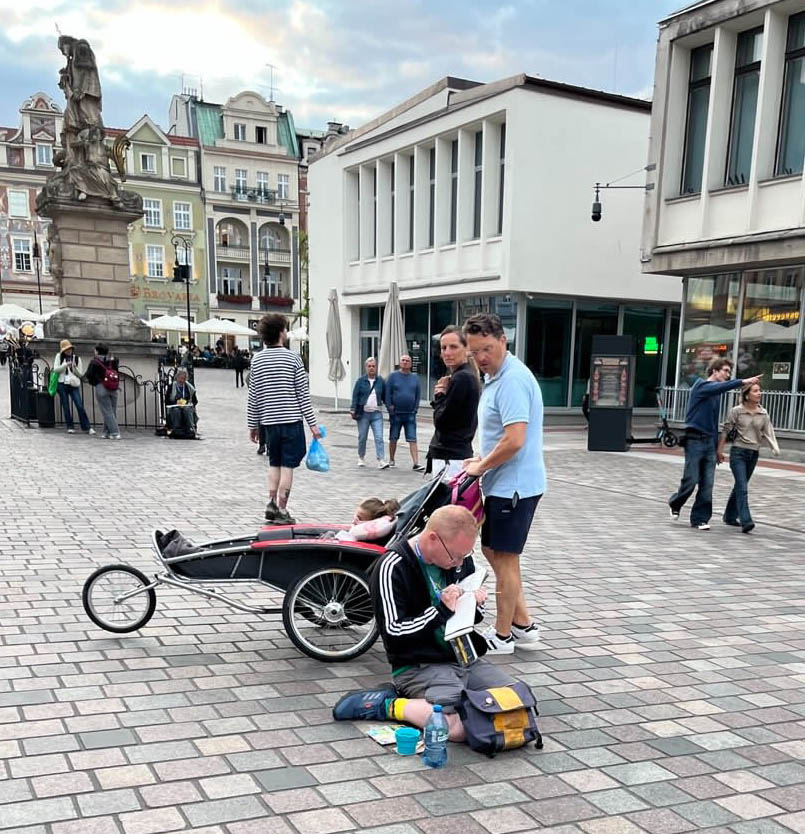
I went a couple of blocks away and stood right in the middle of Stary Rynek, the main square, which wasn’t part of the Sketchwalk route but I’m an urban sketching rebel. Plus I couldn’t find the next location on the map. I wanted to draw one of the rows of colourful old buildings in the main square; see below. I only had 30 minutes before the official end of the Sketchwalk, and I didn’t want to be late, I’m not that much of a rebel. So I went FAST. It may be one of the fastest most detailed sketches I did that day. I didn’t colour it in, except the sky which was pure theatre. I umped into some sketchers I knew, but I was on a mission and once the sketchbook was out I was in the ZONE. I didn’t even notice Rita Sabler took a picture of me sitting on the cobbles when I was adding my paint, oblivious to the man looking over my shoulder looking utterly perplexed or amazed at my sketch. Or maybe he was just thinking “why is he holding his pen like that?” or “wait are those Jurassic Park socks?” (which they totally are by the way).
I went to the final meeting spot of the Sketchwalk, which was uphill by the castle, the Zamek Królewski w Poznaniu, the Royal Castle of Poznań. I saw a few friends there, and sketched one of the volunteers (who signed it as Patyczak when I saw him again next day and was quite a funny guy) just before his call for the final photo, “Everybody here now!” We took our photos and most people went off to the drink and Draw; I was hoping to see Joe Bean in the main square so headed back down that way, thinking I’d join the others later. I never made it, too far to walk after the busy day, so after I bumped into a group of sketchers I knew I sat and had a drink in the main square, sketched them and looked through some incredible sketchbooks. I chatted with Sybille Lienhardt from Germany who had taken Peter Rush’s workshop, he is from Australia and he draws on the back of cereal boxes, these amazing big drawings. It’s something I should like to try. I also looked through her sketchbooks, wow! Her colours really jumped out. Detlef Surrey was there too but left early, he had to practice for his talk about his Berlin Wall book the next morning. I met for the first time Anne-Rose Oosterbaan, whose work I have followed for years and was amazed to finally meet, and see her incredible sketches in person (plus she knew of me!). I’ve seen so much of her work online that it doesn’t look real in person, and she was so productive on this trip. Also there was Peter Dutka who I had met in Manchester years before, I think he didn’t remember my name but called me Captain America (I wore the Cap hoodie in Manchester), I sketched him. His sketchbooks too were well impressive. Then there was the great Hungarian urban sketcher Örs Lévay whose sketches I have admired for years but I’d never met in person, lovely bloke. I sketched him in his hat. Also there was a sketcher from Hamburg whose work I have definitely seen but didn’t really know, Nicola Maier-Reimer, and I tell you what looking through her sketchbooks was a highlight of the trip, I’d never seen so many amazing sketches, particular her very comic style of sketching people, and her love of cars as well, there were so many stories everywhere on her pages. I sketched her too. Eventually it was getting late, there was another busy day tomorrow, so I went back to the hotel (but stopped to sketch the Ratusz, as you saw at the start of the post).
for some reason I’m putting these last two at the end of the post, they just seem to go together. One is a very old metal water pump I sketched on the Sketchwalk, how could I resist that. When I see metal pipes coming out of the ground I have to draw them. It’s like, these foreign cities know my algorithm, they know how to slow me down, make an ornate metal pipe appear every so often, and I’ll never get to my destination. I draw them fast though. The other is a red hydrant from Austria that I sketched on another street with a name I’m not even going to attempt to pronounce. And that was Friday, there was one day left of the Symposium, and that will be about three more posts, maybe a fourth. It’s only taken me six months to say what I did in Poland, and then there’s Berlin, and a few more days in London. Not to mention the rest of 2025. I’ll never catch up.
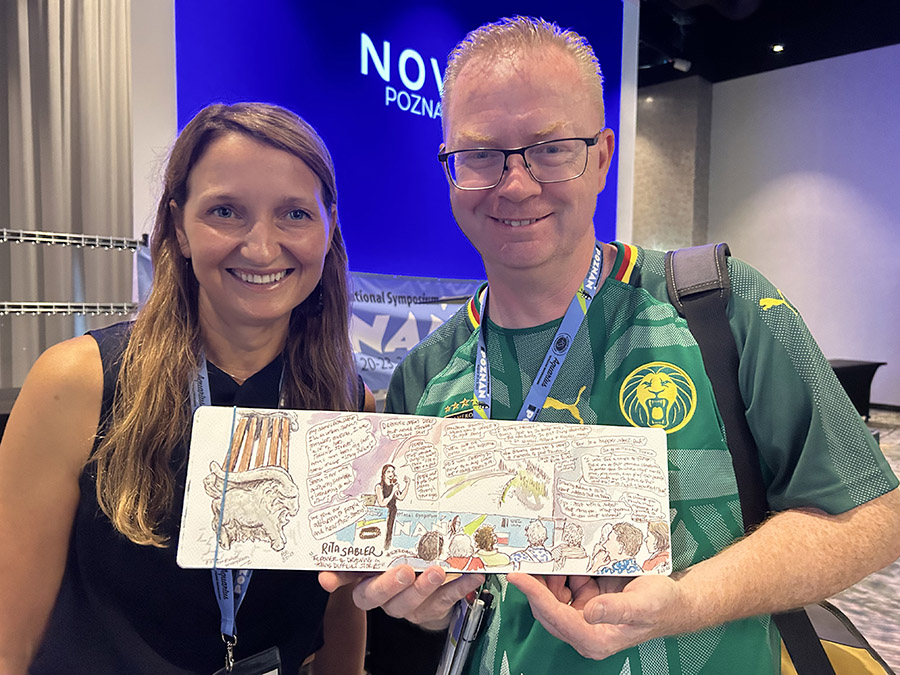
Friday morning at the Poznań Symposium, I was up at a good time and ready for a day of sketching. I had no workshops or demos to attend, but was planning to join two of the organized Sketchwalks in different parts of the city. I realized that I had not as yet been to the Old Town, just seen other peoples’ sketches of it posted online already. This morning though I’d be heading out with the group to Cathedral Island. Before that, I headed to the Symposium Hub at the Novotel Hotel for one of the morning presentations, and this one was by my friend Rita Sabler (who I also first met at Portland in 2010), who is an urban sketcher, journalist, musician and story teller, and gave a really moving talk called “The Power of Drawing in Telling Difficult Stories”. She travels all over, and so was presenting some of the stories she had documented on various assignments. I have sketched one of Rita’s talks before, back in 2016 in Manchester, and she is a really good presenter and empathetic teller of stories. “Drawing opens doors that would otherwise remain shut.” I drew another woman with pink (or maybe purple) hair listening to the talk (below) but didn’t catch her name. After Rita’s talk (there we are in the photo below, I’m wearing my Cameroon football shirt), I headed out to the meeting point for the Sketchwalk.
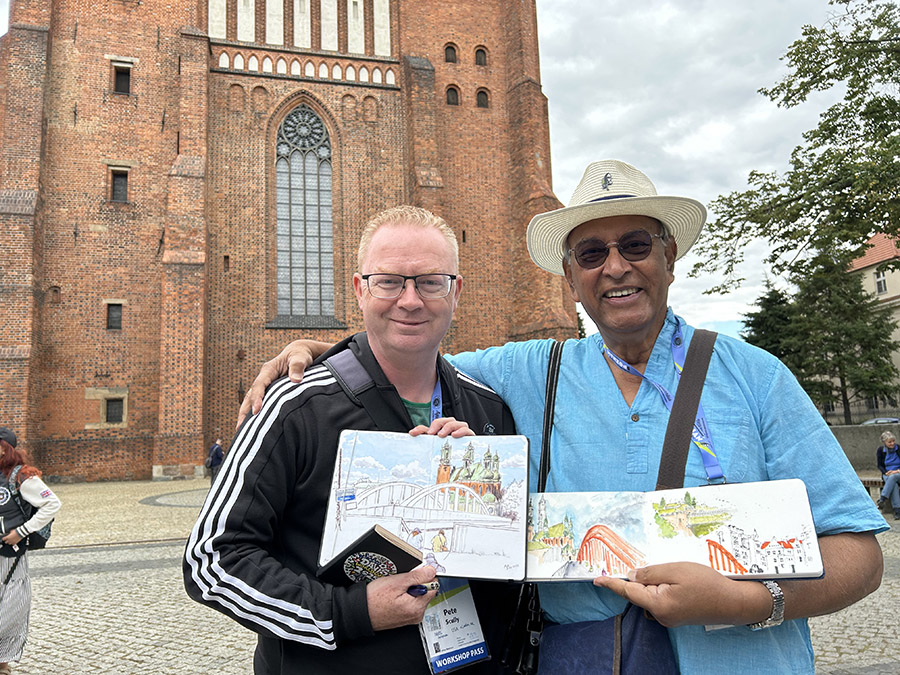
The sketch next to Pink-purple-hair by the way is London sketcher Lis Watkins, in the green jacket, who I’ve met a few times on our London sketchcrawls, I’m a big fan of her work. She was sketching over at Cathedral Island with so many of us. As a big crowd, we all got into the Poznań electric tram, and I chatted with some sketchers from Scandinavia. “This is the Symposium right here” I said, as we all squeezed in and tried to read each others name tags, “more than the sketching, it’s about all cramming into a tram and seeing where we end up.” It reminded me of the streetcars in Portland, or the buses in Manchester, or squeezing into that elevator in Amsterdam, sketchers off on an outing. We arrived at Ostrów Tumski, ‘Cathedral Island’, which is an island between branches of the river Warta, and is where the city of Poznań originated. The cathedral itself is one of the oldest in Poland. I’m a sucker for a cathedral, but it’s really nice to see one that looks so different from the big Gothic cathedrals of western Europe. I found a shaded spot in a garden by the river, chatting with Elizabeth Alley who told me a lot more stories about her Arctic adventure, and drew the view below. The bridge was red by the way but I never ended up colouring it in. I got to a point and was like, I’m done. This being on the portrait size paper, double spread, they always take a bit longer and I was really only interested in the cathedral. Looking at everyone else’s sketches though it did start to feel like I was deliberately not colouring in the obvious big red bridge, like a contrarian, but I really didn’t want to distract from the cathedral and that north-central-east European sky.
I went over the river and sat a bit closer to the Cathedral. I drew in pencil because I thought I might not spend as long faffing out with my pen, probably correct. I love those green oxidized roofs. It was peaceful over there, quiet. There were sketchers everywhere, quietly getting on with it. We all get it, we all know what it’s “for”. We all get it. It’s one of the things I love about symposiums, I don’t have to explain or feel like I need to justify why I need to stop and just bloody draw the world around me. I felt quite chilled at the end of this sketchwalk.
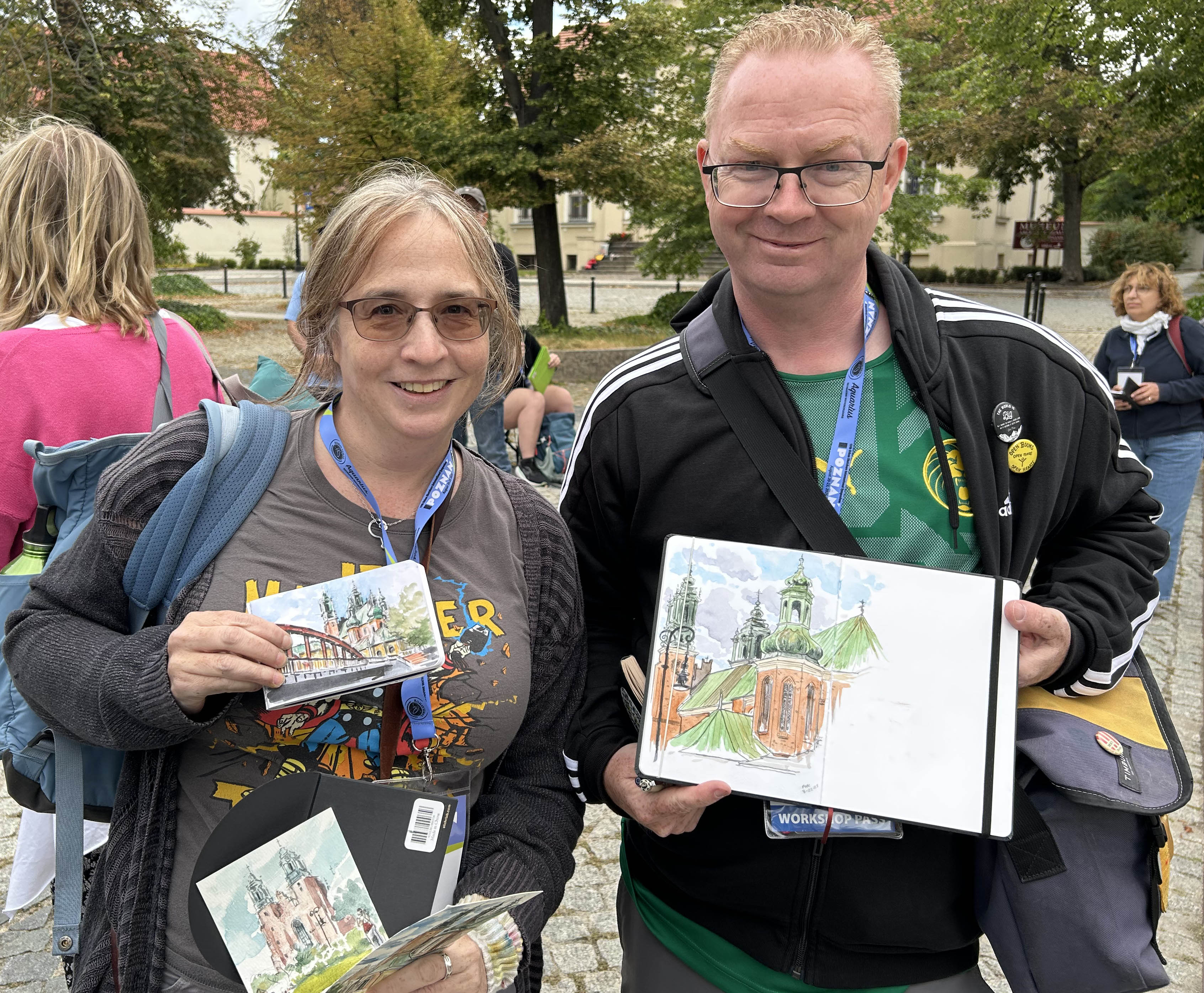
When we were all done sketching, we gathered in front of the Cathedral and did the obligatory and inevitable “Throw-Down”. People bloody love the Throw-Down don’t they. They all put their sketchbooks down on the ground, where people’s feet go, and all stand around the books like mourners at a grave, looking down at all the sketches from a distance of 5-6 feet which is totally how you look at art, no idea whose is whose. Like when I go to a museum, I always prefer it when they put all the paintings on the floor and make you look down at them. As you may know I don’t do the Throw-Down on my sketchcrawls, I prefer a show-and-tell, or maybe if we absolutely have to lay them out, then somewhere a bit higher up like a bench or a table. I don’t like leaving my sketchbook lying down on the pavement anyway. I did it once in France and a bike ran over it.
I met Kalina again who was wearing a Thor t-shirt, and also met with Mohan Banerji, a sketcher and actor who lives in Berkshire who I first met in Manchester 2016, it was really nice to see him again. I got the tram back to the city centre with him and a sketcher from Australia, Stuart Jenkinson (I sketched them both) and we had lunch at that place in the mall (where I had lunch every day, it was nice and there were always sketchers about). So far I was really enjoying Poznań, though I had still not sketched in the old town. I managed to finally do that in the evening, but had a brief rest at the hotel first to strum my ukulele and put my feet up.


















 petescully