in search of elusive scottish creatures

Urquhart Castle, Loch Ness

And so, the final leg of our Scottish adventure. We were all pretty tired by that point, I may have had all the Irn Bru I could drink, and all the Tunnocks Teacakes I could eat, but we were off to see a place we’d heard of all our lives but never imagined we would get to see – Loch Ness. And we were in search of a mysterious creature we had heard so much about, seen so many cuddly toys and fridge magnets of, yet had thus far proved elusive – the hairy Highland Coo. We left Fort William and drove up through the Great Glen, which is what we call the huge valley that cuts through Scotland and forms Loch Ness. As opposed to Great Glenn, who was one of the best passers of the ball in football history, though I wish he’d passed at recording ‘Diamond Lights’ with Chris Waddle. The roads were fairly narrow, and the speed limits great, with cars belting around those bends at 60 miles an hour. It was pretty nice though, not raining like on our trip through Loch Lomond, and we all breathed a deep breath when we first saw the great, incredibly deep Loch Ness. It’s the largest body of fresh water in the UK, and is 788 feet deep at its deepest point. The water is very dark, making it nigh impossible to see very much in front of you when beneath the surface. But no, it does not contain an ancient plesiosaur that has mysteriously survived the geological eras to confound scientists and excite tourists, that would be ridiculous. Kelpies, Selkies, Redcaps, Blue Men of The Minch, Giants, Finfolk, Bogles, Trows, Wild Haggis, all of those definitely exist, but Nessie? Please. Or does it…
IMG_8121s

We took a boat tour out onto the Loch, in the ‘Nessie Hunter’, and our guide gave us a fun account of all the Nessie sightings, and details about the Loch. The boat was equipped with a sonar to detect things moving way beneath the surface, and he pointed out a house that has a webcam trained on the Loch 24/7, so you can go online and look at water, in the vain hope that you will see a head pop out. You’re more likely to see Messi. One of my favourite shows when I was a kid was The Family Ness, a very silly cartoon about a group of Nessies all with different personalities that befriended a couple of Scottish kids who helped them hide from the scientists. I loved the theme tune (“…but you’ll never find a Nessie in the zoo!”). Kids TV theme tunes from the 80s is be my specialist subject. Our guide told us that due to its constant movement, Loch Ness does not freeze over, but I clearly remember one episode of The Family Ness where they were ice skating on the Loch, so I don’t know. The ride was quite bumpy though, lots of waves (I presume they were waves…). We had a great view of the partly ruined Urquhart Castle, on an outcrop in the Loch. That was our next destination. After lunch of fish and chips (Scotland does the best fish and chips) in Drumnadrochit, we visited the old Urquhart Castle, which is where I did the sketch at the top of this post. (I have also drawn it once before, on my Google Street View Tour of Great Britain, during the pandemic). That was a super interesting place with amazing views over the water, and hundreds of years of history. While I sketched, my wife and son had a delicious afternoon tea overlooking the scenery.

IMG_4077s

We were flying out of Inverness that night, but we still had one more mission – to find the Highland Coo. That’s a very hairy type of cow with long horns that they have up here, but we still had not seen them. So we found a little guest house and tea room that purportedly had some on their grounds, and after buying some cakes, they let us go and take a look at them. Lovely big beasts they are. We found some more hairy cows a bit further up the Loch, they reminded me a bit of that big creature Ludo from the film Labyrinth. Unfortunately, we had to get going. We drove to Inverness, sat in very slow traffic a couple of times, popped into a gigantic Tesco to buy a sandwich and one last Irn Bru, tried to figure out how to drop the car off, and then flew a very late night Easyjet flight from Inverness to Luton (less said about Luton, and our journey back from there, the better), utterly exhausted. There was no time to visit Culloden on this trip, but this won’t be our last trip to Scotland. There’s so much more to see, more castles to visit, more Lochs and Islands to explore, more trains to catch, and so many more Tunnocks Teacakes to eat.  Slàinte Mhath! 

Thistle

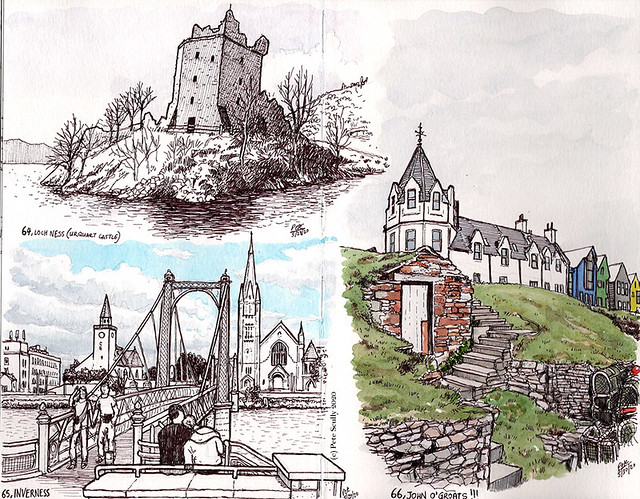
(64) Loch Ness, (65) Inverness, and (66) John O’Groats

GB 64-66 sm Our virtual journey is at an end. The traditional end-point for the island of Great Britain is John O’Groats (or the beginning point; end, begin, all the same), and so after all the cities and dramatic valleys we end at a tiny hamlet, well less hamlet and more medallion of bacon, or lardon, on the way to the Orkneys. People walk from Land’s End to John O’Groats for charity, or to see how far it is, or just to explore a route across the island of Great Britain. I can vouch, it’s a long way, with a lot in between. You have to miss a lot out; you can’t explore Great Britain and see everything. Doing this virtually means you miss out on meeting all the people, but on the plus side you don’t have to meet as many people. I don’t think that’d be a problem up here. In Edinburgh during the Festival maybe, or London while Camden Market is on, or Manchester on a Saturday night, or Bournemouth beach after lockdown is lifted (or even before), too many people for a crowd-avoider like me. The north of Scotland is significantly less populated, though I am sure it still gets a lot of tourists.

And why not, it’s spectacular. Loch Ness is a highlight, stretching up the Great Glen and slicing Scotland in two. I have started getting very interested in the geology of Great Britain, and I bought a book all about it, and have watched some shows on YouTube that talk about it, but I feel like I still have a way to go before I can really understand it – Britain has a very deep geological history. What is now Scotland in fact was once on a different continent to England, something which can never happen again in our lifetimes, at least not geologically, though maybe geopolitically. The area that is now the border between the English and the Scots is roughly where the geological border lies. But then you have the Great Glen, up in the Highlands of Scotland, a massive deep diagonal lobotomy through the head of Great Britain. The faultline is called the Great Glen Fault, where two tectonic plates meet and move slowly in different directions. In the Ice Age huge glaciers carved up this land, and glacial erosion in the Quaternary period formed the immensely deep freshwater lake called Loch Ness. The bit I drew was of Urquart Castle, from street View (but obviously on a boat, so Loch view) (incidentally, wen you use Google Street View here the little yellow person icon changes into a green Loch Ness Monster). You’ve all heard of the Loch Ness Monster, aka Nessie. It’s a monster that looks a bit like a plesiosaur or a dragon, and has to hide with his family of other Nessies whenever those damned scientists come along (I think they’ve had enough of ‘experts’), and there’s this family who helps them out, a couple of kids and a bloke with a big bushy red beard, he plays the bagpipes to warn them I think. I saw a documentary but it’s been a really long time. Actually I did watch a movie about it called “Loch Ness” with your man from Cheers in it, I actually saw that at the cinema in 1996. Bit of a story to go with that, I was on a date in central London, and we decided to watch Loch Ness at Leicester Square. I remembered it was a fairly boring film, but we heard this loudish bang during the film, thought nothing of it. Afterwards it was freezing outside but we walked down by the Thames talking about how Loch Ness wasn’t all that, until time to go home as I had college next morning (I was heading back to north London, she to south). But then the bridges across the Thames were closed, and I was stuck. The reason the bridges were closed was because the loud bang we had heard was actually a bomb going off on a bus on Aldwych, not that far away. It was an IRA bomb, but unannounced (often there would be a phone warning in those days) – this one was being carried by the bomber but went off accidentally while he sat on the bus. There were quite a few IRA incidents in the mid 90s. So, many of the bridges were closed, meaning I was stuck on the other side of the Thames. My date’s friend was picking her up by car and offered me to stay over if need be but I really needed to get home so I could be up for college next day (I was so responsible) so I said I’d be fine. I walked for ages down the Thames until I got to a bridge that was actually open; by the time I managed to walk back up to Trafalgar Square, absolutely freezing in the light snow, it was way too late for the tube (which I assumed would be closed anyway due to the bomb, that was a thing) and wondered if I’d need to walk home (which is about a four hour walk), there was thankfully a Night Bus. The good old N5. So, when I think of the Loch Ness, I think of that freezing cold night. 

At the top of the Great Glen is Inverness. I have to say, I found it hard to find something on Street View I wanted to draw. I think I imagined more than I got, I thought maybe there’d be a great whisky shop or statue of Nessie or Ted Danson, but in the end I found this nice bridge across the water. What I really liked about it was the couple in the foreground, sat by the river, the woman’s head resting on the man’s shoulder, it just seemed warm and touching. I’ve kept in the people were I can in these drawings, because I’ve learned that geography is not just about the inanimate objects, but the inanimate human beings as well. It’s a nice view of the bridge looking over at the church, but these people give it a warmer, happier feel. Inverness is often voted the happiest place in Scotland, which makes me want to visit it more now. Apparently the accent is quite different, with none of the usual rolled ‘r’s, but the accents change as you get further north up here and can be quite different to what English or other people expect to hear from a Scottish voice. I want to travel just to hear all these accents, as interesting as differences in geology. Inverness historically was a stronghold of Gaelic speakers too, though use of the native language has dwindled over the years. Scottish Gaelic is similar linguistically to Irish and Manx, and also related to Welsh, Cornish and Breton, the Celtic languages. I know a little Irish, just a few phrases really (nobody in my Irish family spoke it), but the only thing I ever learned in Scottish Gaelic was “Alba gu bràth” which means something like “Scotland forever”. 

We can’t stay in Inverness forever, so time for the sixty-sixth and final stop on this long journey, John O’Groats. As mentioned this is where charity walkers like to start or finish. The spot I chose to draw is right by the edge of the sea, at the little harbour where you catch the ferry to the Orkneys. The town is apparently named after an old Dutch ferryman. There’s not much here, but it’s the knowledge that you’re right at the tip of this big island with thousands of years of history and culture behind you. It’s been a fun journey, I hope to do it in person someday, but for now I’m at the desk in my house in California, the air quality from the wildfire smoke still making it hard to breath outside, a global pandemic making everything difficult, my son just started his first day of Junior High, all completely remote, and we had no big summer travels this year for the first time in ages. I suppose it’s good, we can sit at home and see the world in other ways, but we are looking through a keyhole, seeing only the bits we want to see, not hearing any real voices, or accents, not smelling the air or tasting the food, not getting a chill from a North Sea breeze or drenched in a Mancunian downpour or sun-burned on a Cornish beach, no exhaustion from climbing steep hills in Bristol or Edinburgh, no rushing to finish my sketch so I don’t miss the last bus out of Portmeirion. I should write a final page to close out the book, that I will keep to myself; I’ve left it blank. Anyway I hope you’ve enjoyed the journey, even the long rambly often nonsensical and sometimes made-up-ish posts that go with them. If I ever do exhibit shows again this will be a fun curio to look at, of a virtual journey in a year when were were told to stay home. What a bloody year. I hope next year is better than this.