Poznań (Part 6) – Saturday morning

Detlefs talk USk Poznan 082325

Saturday came around fast. I was going to go for a morning run along the river, having been told about some good running paths by one of the volunteers, but it was a little bit rainy and so I went to the hotel gym instead. I had a 5k race the day after getting back to California so thought I’d better keep it up, but I had run a lot in London. I was here to sketch. After breakfast, which by the way at my hotel was really nice, lots of interesting Polish food, I went to the Symposium hub for the morning sessions. they reminded us to submit work for the auction, and also submit a postcard size drawing to win special prizes later, both of which I forgot to make time to do. Oops. When it’s in my sketchbook I can hide it away with my other sketches. Anyway, feeling a little disappointed in myself, I went to the first talk, and I had been waiting for this one. I’ve followed Detlef Surrey for years, the Berlin based illustrator who draws in a quick almost cartoon-like style in pencil and always captures the energy and spirit of the places he is drawing. I feel like I loosed up my own sketching after seeing his, and that helps when sketching scenes like above (and of the other talks) where I have to draw everyone quickly while writing down what he says. Detlef’s presentation was about his book, “Berlin: the Wall Revisited” in which he explores his home city by following the length of the Berlin Wall, or where it used to be located anyway. I was going to Berlin after my trip to Poznan and planned to do just that myself, so it was pretty inspiring. He showed us pictures from when he was younger, and the Wall was still up, and talked about the experiences of living in the divided city. I used to be fascinated with Berlin when I was a kid, when it was still West Berlin and East Berlin, and I remember so vividly watching the news when the Wall came down. Detlef showed us sketches of some sections where parts of the Wall are still up, and where the ‘Death Strip’ was located, where so many people were killed just for trying to go from one side to the other. I did visit that place myself a few days later. Detlef spoke with emotion, and it was a very moving presentation. I did look for his book while in Berlin but kept missing it (at one shop I was told they just ran out, because people who had been at the Symposium were coming to buy it). I ended up ordering it from the publisher after returning to America, and that took a while, due to tariffs and other issues where postal services would not ship to the US, and it ended up costing me more than the prices of the book to finally get it, but it was worth it as it’s a great read. While in Poznan though Detlef did give me a really cool little Urban Sketchers Berlin booklet, which I think was from an Urban Sketchers meetup the year before, full of sketchwalks and bits about different areas of Berlin, and I carried that around with me every day there, and it showed me where to go for the Berlin Wall Monument. Anyway, more on that in a later post. It was time to dash off to the first Sketchwalk of the day.

kiosk near Phedry Poznan 082325 sm

A large group walked over towards ‘Fredry’ for the Sketchwalk. It wasn’t raining now and in fact was quite bright and sunny. I chatted with Liz Steel for the first time in ages, it was really nice to catch up and hear about all her work and travels, she is so prolific. Once we all got over to Fredry I stood next to an interesting little kiosk next to an old red brick building and sketched that in pencil. I liked sketching a bit looser like that and I liked the outcome. That sketch above is one of my favourites from Poznan, I can’t explain why but it said what I wanted it to. I did have to get into a bit of shade on a bench under a small tree to finish it, I can’t stand in the sun for too long. I went back across the street to sketch some of the sketchers, see below. The two on the top are (left) Xana Jasmin, sketched during the morning talk; this was the first time I’d met her in person but had spoken to her online a few years ago when she invited me on behalf of Urban Sketchers Jacksonville to give a short talk and demo to their group over Zoom, which was fun. That was in the Pandemic times still. On the right is Gabriela Romagna who I think is from Austria, and who I had met a couple of evenings before at the Drink and Draw.

Xana & Gabriela 082525 sm
Omar and Alex 082325 sm

Above on the left is my old urban sketching friend Omar Jaramillo, another Correspondent from the earliest days of USk who I first met in Lisbon in 2011. He lives in Berlin, I think he was in Italy back in those days. He was sat with a Polish sketcher who I think was called Mateusz, I didn’t speak to him but I think I remember him from the Manchester Symposium, I didn’t recognize him so wasn’t sure at first. On the right is Alexandra who is from Berlin, I’d sketched her at the opening ceremony and drew here wearing her new hat which had mushrooms all over it. That was actually from the evening Sketchwalk but is on the same spread of my small brown paper sketchbook. As you can see I stamped the pages with the official stamps of the Symposium and of USk Poznań.
Lokum Stonewall Poznan 082325 sm

I went into this little courtyard where an art and craft market was being set up. There were some great printmakers there; I totally got a bunch of printmaking stuff the years before and totally stopped doing any of it, the lino printing and such, and felt like it’s something I really need to work on again. (Six months later, still not done any of it). I was feeling a bit peckish so went into this cafe, called Nowe Lokum Stonewall, and got a massive slice of cake and a beer, and sketched the bar area. I wanted to draw all the LGBTQ+ flags up on the wall, and I really liked all the rainbow colours above the bar. I drew with my fountain pen in brown ink which was ok on that awful Moleskine paper; I made the mistake of stamping it with the Symposium stamp, which as you can see did not come out smoothly. This place was cool, and it was nice to hang out and sketch an interior after all the street sketching. It did start to look a bit like it might rain, but didn’t. Still I had more to go and sketch before the final meetup.

Katyn Monument Poznan 082325 sm

I could have sketched a number of pretty scenes in that area, and nearly drew the courtyard of the Imperial Castle / Cultural Center, or the dramatic tall concrete monument in Plac Adama Mickiewicza that many others drew, but instead I sat in a small park and drew this, the Katyń Monument, or Pomnik Katyński. Looking at it closely, it gave me the horrors. Reading a bit more about what it was a monument to, an awful series of mass executions in 1940 known as the Katyń Massacre, that gave me even more horrors. A lot of truly terrible atrocities happened in World War Two, and this was really horrible, 22,000 Polish officers were murdered by the Soviets on the orders of Stalin. After sketching, I had to just sit on a bench and think for a while. I couldn’t look at it for long. Soon it was time to meet up with the rest of the sketchers at the end on the steps of the Grand Theatre. That was when the skies opened up, and an enormous rainstorm, accompanied by a bit of thunder and lightning, exploded above us. We all huddled under the columns laughing and exchanging stickers and art cards, there was a large group from South Korea whose sketches were amazing (followed them all on Instagram and very much appreciated all the stickers, which I put in my new Urban Sketchers passport that I got at the Hub), and we all waited for the rain to stop before heading off for lunch back at the mall. My mood lifted a bit when I saw the football score, Spurs were beating Manchester City and that always puts me into a good mood. I could tell that 2025-2026 would be a really great season for Tottenham. (Narrator’s Voice, speaking in February after another defeat left us in 16th place – “it wasn’t”). Check back soon for Part 7…

Poznań (Part 5) – Friday evening

Ratusz (night) Poznan 082225 sm

Long post, I am lumping the afternoon and evening sketches all together, and starting at the end. Above is the Ratusz, the historic town hall, in the main square of Poznań on Friday night, sketched after all the other sketching and meetings, before heading back to the hotel. I was walking back and looked up and just knew I had this one more sketch in me, another pencil at night looking up type sketch, and this time on the nicer Hahnemuhle paper (so none of that bobbling paper I got on the Moleskine). It’s a big, striking and very well-lit building, shining in the night time as much as in daylight. It was busy out in the Poznań city centre, lots of people around the main square and lots of young people enjoying the cafes and bars. I still wasn’t that familiar yet with the old town and got a little bit lost while walking back to the hotel, ending up in some less well-lit quieter streets, though I didn’t feel unsafe. The last time I’d been in Poland in 1998 a group of skinheads in Krakow had ambushed me on my way back to the hostel, failing to steal my watch they instead stole my glasses and ran off. I did get them back (it was a long night, but I was determined, I needed my eyesight); I’ve not forgotten that, and brought a spare pair of glasses with me on this trip, just in case. A little bit about the Ratusz, this building dates from the 1550s, replacing an earlier town hall from the 12th century, and is now a museum. Its most famous feature are the two mechanical goats that come out at midday. The tower (and goats) were destroyed in 1675 by lightning, when a time traveller from 1985 attempted successfully to drive his car back to the late 20th century. There was a hurricane that damaged the tower in 1725, and the building sustained a lot of damage in World War II during the Battle of Poznan, and was rebuilt in the 1950s. I really liked all the green metal dragon gargoyle features around the building. That was a feature I noticed on the Armoury in Gdansk. I saw many dragon features around Gdansk, it may be a popular symbol in Poland.

Pan Peryskop Poznan 082225 sm

Speaking of popular symbols, this is ‘Pan Peryskop‘, a very unusual sculpture located in Plac Bernardyński. The logo of the Symposium featured a cartoon version of this, and I soon discovered that those same cartoons and variants were spray-painted on walls all over Poznan. (Poznan, by the way, what a city for interesting graffiti, I loved it). It turns out the cartoon figure came first, created by a mysterious street artist called Noriaki. There is an article on Urban Sketchers about it: https://urbansketchers.org/2025/08/17/from-street-art-to-symposium-star-mr-periscope-welcomes-you-to-poznan/ Whether the man I had met the evening before around the Drink and Draw, who told me he was the creator and gave me a load of really cool stickers of Pan Peryskop for free which I placed on my sketchbook (seriously, people were envying my shiny Pan Peryskop stickers), was really the artist himself I’ll never know, but let’s just say yes he was, because he told me he was and I love free stickers. I read somewhere that Noriaki is sometimes called ‘the Polish Banksy’. I saw many other sketchers had drawn the sculpture so I went to look for it, a short walk from my hotel. It reminded me of No-Face from Spirited Away, but with a curved mirror. The sculpture is actually called ‘Selfie Watcher’. There were a few sketchers dotted around, and I drew a couple of them below sat on a wall, Julia from Ukraine, and Laeti from Berlin (but who I think is French).

sketchers by peryskop sm

I stopped to draw a hydrant (see the end of the post) while walking back into the old city centre, where I would be joining the early evening Sketchwalk, which would be around the, at the, it was somewhere in the old town. I need to look up the location, I cannot remember any of those long street names. Skwer Roman Wilhelmiego. I picked a big brick building and drew the top of it. The sky looked like a blue white and grey camouflage shirt. You can really see that bobbly paper. Having drawn a lot of towers and spires in Gdansk I needed to up my quota here, but only managed two of them. I sat and listened to a couple of sketchers from opposite sides of the world have a conversation about, I don’t know, food or roads or whatever. I’m not a good listener, I forget things easily. I saw some graffiti that said “Warning! Artists in the Area” That was right. I saw more Pan Peryskops around, and several cartoon pigs, there were a lot of those about, I liked them. As we all sat or stood about sketching, volunteers in orange hi-viz vests walked about slowly looking down sternly, as if they were inspecting the sketches. I started to imagine them as prison guards, the Urban Sketchers Police, checking to see that everyone is following the Manifesto. “What’s that, a ruler? Guards!” As with every silly idea I have, I found it hard to get that image out of my head, so when they weren’t looking, I made a run for it.

Squ Roman Wilhelmiego Poznan 082225 sm

Poznan spire evening sketchwalk 082225 sm

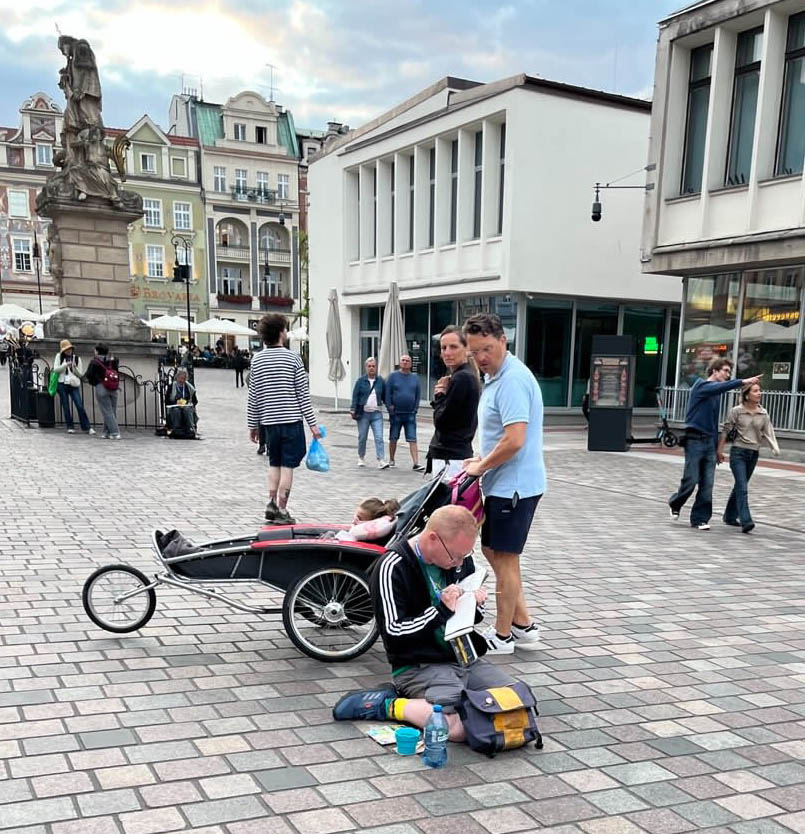
I went a couple of blocks away and stood right in the middle of Stary Rynek, the main square, which wasn’t part of the Sketchwalk route but I’m an urban sketching rebel. Plus I couldn’t find the next location on the map. I wanted to draw one of the rows of colourful old buildings in the main square; see below. I only had 30 minutes before the official end of the Sketchwalk, and I didn’t want to be late, I’m not that much of a rebel. So I went FAST. It may be one of the fastest most detailed sketches I did that day. I didn’t colour it in, except the sky which was pure theatre. I umped into some sketchers I knew, but I was on a mission and once the sketchbook was out I was in the ZONE. I didn’t even notice Rita Sabler took a picture of me sitting on the cobbles when I was adding my paint, oblivious to the man looking over my shoulder looking utterly perplexed or amazed at my sketch. Or maybe he was just thinking “why is he holding his pen like that?” or “wait are those Jurassic Park socks?” (which they totally are by the way).

Stary Rynek 082225 sm

I went to the final meeting spot of the Sketchwalk, which was uphill by the castle, the Zamek Królewski w Poznaniu, the Royal Castle of Poznań. I saw a few friends there, and sketched one of the volunteers (who signed it as Patyczak when I saw him again next day and was quite a funny guy) just before his call for the final photo, “Everybody here now!” We took our photos and most people went off to the drink and Draw; I was hoping to see Joe Bean in the main square so headed back down that way, thinking I’d join the others later. I never made it, too far to walk after the busy day, so after I bumped into a group of sketchers I knew I sat and had a drink in the main square, sketched them and looked through some incredible sketchbooks. I chatted with Sybille Lienhardt from Germany who had taken Peter Rush’s workshop, he is from Australia and he draws on the back of cereal boxes, these amazing big drawings. It’s something I should like to try. I also looked through her sketchbooks, wow! Her colours really jumped out. Detlef Surrey was there too but left early, he had to practice for his talk about his Berlin Wall book the next morning. I met for the first time Anne-Rose Oosterbaan, whose work I have followed for years and was amazed to finally meet, and see her incredible sketches in person (plus she knew of me!). I’ve seen so much of her work online that it doesn’t look real in person, and she was so productive on this trip. Also there was Peter Dutka who I had met in Manchester years before, I think he didn’t remember my name but called me Captain America (I wore the Cap hoodie in Manchester), I sketched him. His sketchbooks too were well impressive. Then there was the great Hungarian urban sketcher Örs Lévay whose sketches I have admired for years but I’d never met in person, lovely bloke. I sketched him in his hat. Also there was a sketcher from Hamburg whose work I have definitely seen but didn’t really know, Nicola Maier-Reimer, and I tell you what looking through her sketchbooks was a highlight of the trip, I’d never seen so many amazing sketches, particular her very comic style of sketching people, and her love of cars as well, there were so many stories everywhere on her pages. I sketched her too. Eventually it was getting late, there was another busy day tomorrow, so I went back to the hotel (but stopped to sketch the Ratusz, as you saw at the start of the post).

Patyczar & Dutka 082225 sm
Ors & Nicola 082225 sm

for some reason I’m putting these last two at the end of the post, they just seem to go together. One is a very old metal water pump I sketched on the Sketchwalk, how could I resist that. When I see metal pipes coming out of the ground I have to draw them. It’s like, these foreign cities know my algorithm, they know how to slow me down, make an ornate metal pipe appear every so often, and I’ll never get to my destination. I draw them fast though. The other is a red hydrant from Austria that I sketched on another street with a name I’m not even going to attempt to pronounce. And that was Friday, there was one day left of the Symposium, and that will be about three more posts, maybe a fourth. It’s only taken me six months to say what I did in Poland, and then there’s Berlin, and a few more days in London. Not to mention the rest of 2025. I’ll never catch up.

poznan waterpump 082225 sm
red hydrant poznan 082225 sm

Poznań (Part 4) – Friday morning

Rita Sabler talk at USk Poznan

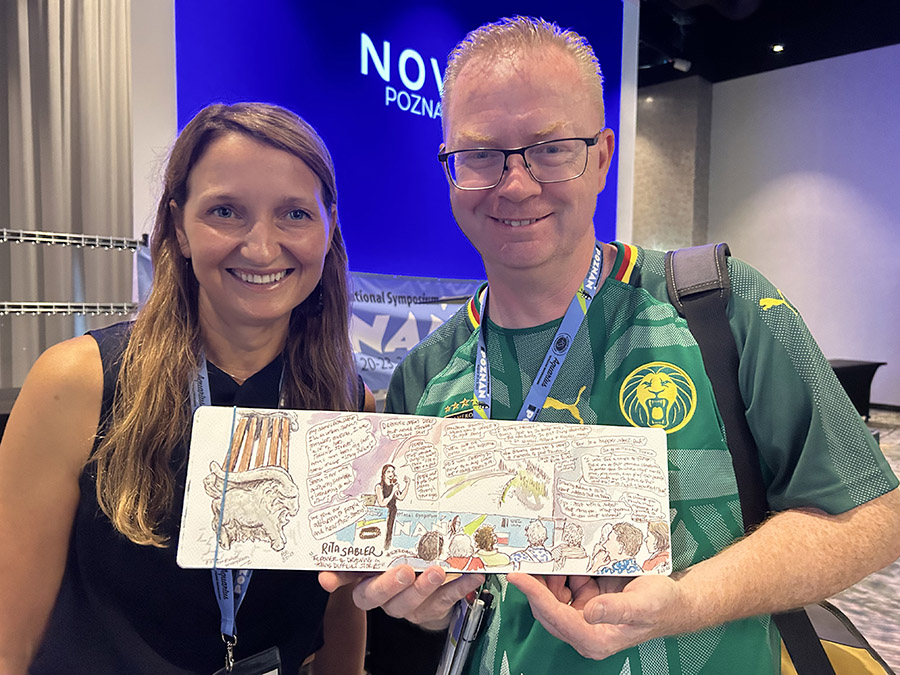
Friday morning at the Poznań Symposium, I was up at a good time and ready for a day of sketching. I had no workshops or demos to attend, but was planning to join two of the organized Sketchwalks in different parts of the city. I realized that I had not as yet been to the Old Town, just seen other peoples’ sketches of it posted online already. This morning though I’d be heading out with the group to Cathedral Island. Before that, I headed to the Symposium Hub at the Novotel Hotel for one of the morning presentations, and this one was by my friend Rita Sabler (who I also first met at Portland in 2010), who is an urban sketcher, journalist, musician and story teller, and gave a really moving talk called “The Power of Drawing in Telling Difficult Stories”. She travels all over, and so was presenting some of the stories she had documented on various assignments. I have sketched one of Rita’s talks before, back in 2016 in Manchester, and she is a really good presenter and empathetic teller of stories. “Drawing opens doors that would otherwise remain shut.” I drew another woman with pink (or maybe purple) hair listening to the talk (below) but didn’t catch her name. After Rita’s talk (there we are in the photo below, I’m wearing my Cameroon football shirt), I headed out to the meeting point for the Sketchwalk.

Pinkhair & Lis Watkins - Poznan 082225 sm

The sketch next to Pink-purple-hair by the way is London sketcher Lis Watkins, in the green jacket, who I’ve met a few times on our London sketchcrawls, I’m a big fan of her work. She was sketching over at Cathedral Island with so many of us. As a big crowd, we all got into the Poznań electric tram, and I chatted with some sketchers from Scandinavia. “This is the Symposium right here” I said, as we all squeezed in and tried to read each others name tags, “more than the sketching, it’s about all cramming into a tram and seeing where we end up.” It reminded me of the streetcars in Portland, or the buses in Manchester, or squeezing into that elevator in Amsterdam, sketchers off on an outing. We arrived at Ostrów Tumski, ‘Cathedral Island’, which is an island between branches of the river Warta, and is where the city of Poznań originated. The cathedral itself is one of the oldest in Poland. I’m a sucker for a cathedral, but it’s really nice to see one that looks so different from the big Gothic cathedrals of western Europe. I found a shaded spot in a garden by the river, chatting with Elizabeth Alley who told me a lot more stories about her Arctic adventure, and drew the view below. The bridge was red by the way but I never ended up colouring it in. I got to a point and was like, I’m done. This being on the portrait size paper, double spread, they always take a bit longer and I was really only interested in the cathedral. Looking at everyone else’s sketches though it did start to feel like I was deliberately not colouring in the obvious big red bridge, like a contrarian, but I really didn’t want to distract from the cathedral and that north-central-east European sky.

poznan cathedral from across bridge 082225

I went over the river and sat a bit closer to the Cathedral. I drew in pencil because I thought I might not spend as long faffing out with my pen, probably correct. I love those green oxidized roofs. It was peaceful over there, quiet. There were sketchers everywhere, quietly getting on with it. We all get it, we all know what it’s “for”. We all get it. It’s one of the things I love about symposiums, I don’t have to explain or feel like I need to justify why I need to stop and just bloody draw the world around me. I felt quite chilled at the end of this sketchwalk.

poznan cathedral 082225

When we were all done sketching, we gathered in front of the Cathedral and did the obligatory and inevitable “Throw-Down”. People bloody love the Throw-Down don’t they. They all put their sketchbooks down on the ground, where people’s feet go, and all stand around the books like mourners at a grave, looking down at all the sketches from a distance of 5-6 feet which is totally how you look at art, no idea whose is whose. Like when I go to a museum, I always prefer it when they put all the paintings on the floor and make you look down at them. As you may know I don’t do the Throw-Down on my sketchcrawls, I prefer a show-and-tell, or maybe if we absolutely have to lay them out, then somewhere a bit higher up like a bench or a table. I don’t like leaving my sketchbook lying down on the pavement anyway. I did it once in France and a bike ran over it.

Mohan B & Stuart J - Poznan 082225 sm

I met Kalina again who was wearing a Thor t-shirt, and also met with Mohan Banerji, a sketcher and actor who lives in Berkshire who I first met in Manchester 2016, it was really nice to see him again. I got the tram back to the city centre with him and a sketcher from Australia, Stuart Jenkinson (I sketched them both) and we had lunch at that place in the mall (where I had lunch every day, it was nice and there were always sketchers about). So far I was really enjoying Poznań, though I had still not sketched in the old town. I managed to finally do that in the evening, but had a brief rest at the hotel first to strum my ukulele and put my feet up.

Poznań Symposium – (Part 1) – Arrival

Poznan sketch 1 082025

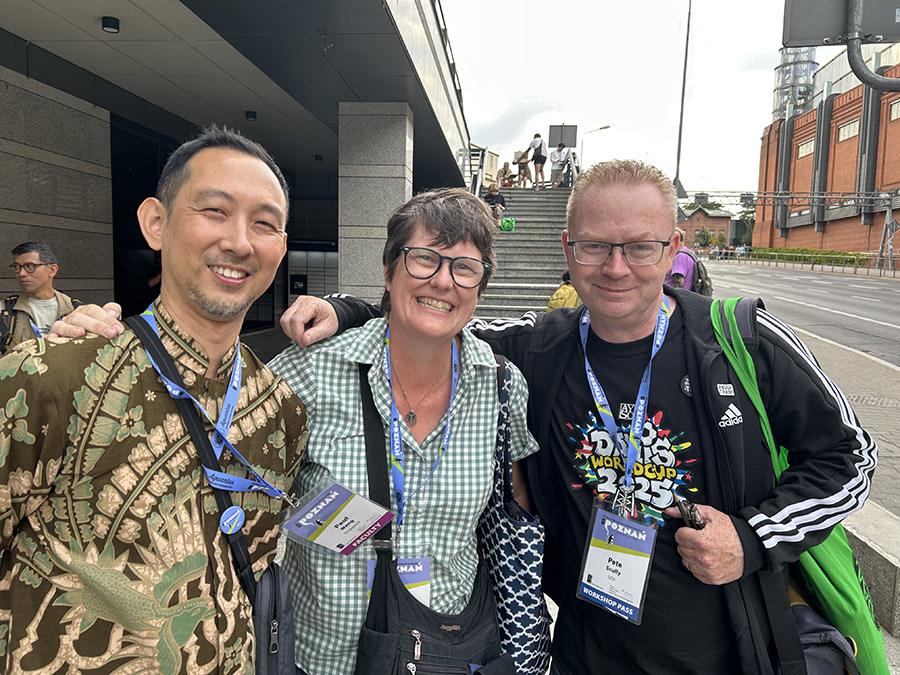
And so, finally to post my many sketches from the 2025 Urban Sketchers International Symposium in Poznań, Poland. I arrived by train from Gdańsk, a ride of about three hours across the Polish countryside, and I could tell Poznań was a much bigger city. My walk from the train station to the hotel took about twenty minutes, and I nearly got run over once, but it missed. I got quite lost walking from the hotel to the symposium hub, which was in the conference area of the Novotel Hotel, near a big (and very nice) mall, but I arrived in time to check in and get suddenly lost and overwhelmed among the hundreds of people. It was my first Symposium since 2019, that’s six years, and I didn’t see any familiar faces at first. I picked up my goodie bag (there were so many goodies this year), mooched around the Art Market, and eventually bumped into a few sketchers I met at previous Symposiums and chatted for a bit while looking at all the art materials in our goodie bags. (I still have stuff from Portland 2010 in my art cupboard!) I find myself extremely shy these days when in a big crowd, and nervous about meeting people I don’t know every well in case I don’t remember them, or them me, but we’re all sketchers and all a bit like that I think. I did see a few sketchers who I’ve followed online but hadn’t met yet, but was a little shy to go and say hello. So I went outside to start sketching, because that’s what we are here for isn’t it, before the big evening reception that would kick the whole thing off. I sat on the steps outside the hotel and drew this scene above, which lots of solo sketchers were also sat about drawing. It was a busy road looking over at an old brewery building that had been converted into a mall and entertainment area, and this would be the starting point for most of the workshops and sketchwalks. I had a Workshop Pass where I’d take just one workshop (with Fred Lynch, big fan), and just sketch free on the other days. The sky was interesting, the paper in my sketchbook however still horrible, and this was shown up when I pressed the Symposium stamp on the paper, it looks like a brass rubbing with a crayon. Still as I sketched I did see people I knew occasionally and got up to greet and hug, it’s been a really long time. I saw Liz Steel from Australia and Paul Wang from Singapore, both of whom I’ve known since the start of Urban Sketchers, and so we got our now traditional photo of the three of us, which we’ve done since Lisbon 2011.

I started sketching in my small brown sketchbook which I was reserving for the quick people sketches I knew I would do a lot of on the trip. I often keep a small ‘people’ book at the Symposiums. This is my opportunity to draw as many people as possible, and I’ve remembered sketchers years later just because I drew them. I’ve been drawn many times myself, I look very funny when I sketch. Below are Delphine Devoilles, who I didn’t know but is from Clermont-Ferrand (I’ve met a few sketchers from there), and Reham Ali from Egypt, whose work I’d seen before. They got to be my first sketched people of Poznań!

Reham & Delphine 082025 sm

After this, I took a break at the hotel (first of all getting extremely lost in the underground car park of the mall; ‘flight of the navigator’ strikes again) before heading back over to the hub for the Opening Reception. That was a lot of fun, there was food and drink, and I got to see many familiar faces from past Symposiums. I wandered and sketched people, and the current Urban Sketchers leadership as well as the organizing team from Poznan opened the massive event. I was lucky to get a ticket. When registration opened, it was the middle of the night over here in California, and I was out of town with friends visiting from England, so my wife got online and was able to get me registered when it opened at 3am our time. Tickets sold almost immediately. I knew a lot of people who could not go, and many came to Poznan anyway to join in with the activities open to the public. This event was for registrants only, and it was revealed that of the 500 people who registered, more than half were first-time Symposium attendees. Only a handful of us were there at the first one in Portland (but we got together on the last day for a special photo). I drew Ronaldo Kurita, from Brazil, speaking to the crowd. My first few people sketches were a bit shy and fast, but I got into the swing of it eventually. I drew the tall German sketcher Stefan Günther who I had never met before, this was a good trip for meeting new sketching pals, though I was still shy to say hello to people I did recognize but had not met yet.

Opening Reception, Kurita, Gunther 082025 sm
Bamber Poznan 082025 sm

There were a few women dressed in traditional looking dresses with massive (and heavy looking) floral headwear; these were the ‘Bambers‘ and are from Poznań. Well, as they explained, the Bambers were actually originally from Germany, from the city of Bamberg, but had moved to Poznań centuries before. In the early 18th century, this part of Poland experienced a terrible loss of population die to war and plague; in Poznań, the population had gone from 12,000 to 3,000. The Polish King Augustus The Strong (definitely a pro wrestler) invited families to settle in Poland, as long as they were Catholic (and especially if you wore massive hats made of flowers), and many families from Bamberg settled in Poznań and became known as ‘Bambers’. I think one went on to host the TV quiz show University Challenge many years later but I may be mistaken. The Bambers became very ‘Polonised’ (a new word I have learned, which means ‘assimilated into being Polish’ and has nothing to do with bees or indeed flowers, but I can see where you might make the connection). They are a very important part of Poznan’s identity and culture, and another reminder that every area in this big country has so many stories we might not know unless we go there.

Alexandra & Sybille Poznan 082025 sm
Daniel & Elizabeth Poznan 082025 sm

I went around sketching some more people; above are Alexandra Rudneva (‘Barsketcher’) from Germany, who I had met briefly in Porto (she was in my sketchbook though I don’t think we spoke at that time), and Sybille Lienhardt, also from Germany, who I had met in Amsterdam and have followed her work since. I always enjoy meeting the German sketchers, there were a lot more at this Symposium being geographically so much closer, and I finally got to meet Detlef Surrey, the Berlin-based illustrator whose work I’ve been a fan of for years. I sketched him below. Also above are a couple of sketchers I’ve known for many years, Daniel Green (who I had already seen briefly in Gdansk) from Minnesota, and Elizabeth Alley, from Memphis, who I first met in Portland in 2010, another Symposium Original. It was really nice to catch up with them; I did sketch Elizabeth’s talk about her adventures in the Arctic which was so fascinating, I’ll post that later.

Detlef Poznan 082025 sm
Kostera Poznan 082025 sm

Above, Detlef Surrey (as I mentioned), he also gave a fantastic talk about his book which was all about sketching where the Berlin Wall was (I’ll post that later), and a local Polish sketcher Katarzyna Kostera (Kasia), who was volunteering at the event. There were so many volunteers, and they kept the Symposium running so well. Kasia noticed I was busy sketching and didn’t have a drink so offered to go and get me a beer with my drink token, which was a really nice thing to do, so I sketched her with her beer. The beer was very good, and the food was nice too, but the opening reception was soon over and I wandered home to bed, a long roundabout walk since I still had not found the shortcuts. I did however see this incredible fire hydrant on the way, and stood to draw that, and a German sketcher who had been at the reception stopped and talked for a while while I drew, but I didn’t catch their name. I felt pretty tired by the time I got home, and it was a busy schedule next day. Check back at some point for part 2…

hydrant poznan 082025 sm

the king and queen of fitzrovia

King and Queen pub Fitzrovia 081625 sm

I went for a walk around an area I don’t visit often, Fitzrovia. This is the area of London to the west of Gower Street, south of the Euston Road, east of Great Portland Street, north of Oxford Street. I got out at Warren Street and walked down that way to Cleveland Street. It’s a quieter area than you’d expect on a Saturday afternoon in central London, full of surprises. London is full of surprises. I walked down Cleveland Street and sketched one of my favourite buildings in London, the BT Tower, and then walked further and sketched the King and Queen pub, on the corner of Foley Street. I had heard about this pub, being famous as the place where Bob Dylan first played in London, and they do mention this in a few places around the pub, but I was pleasantly surprised to find this was not some tourist trap full of Bob Dylan fans, but just a normal looking proper pub with locals and good beer. They even had a Southern Comfort mirror on the wall, proper old pub style, exactly the same one we used to have on our dining room wall when I was a kid (very likely from a pub). It was quiet around here, no traffic rushing by, hardly any of those bloody delivery cyclists cutting corners and red lights, and after I had sat across the street drawing I popped in for a couple of pints. This sketch took me a bit longer than I wanted, I was getting a bit bogged down with details, but I enjoyed sitting in the pub listening to the chat and the football results (Spurs won). Proper pub. These are a dying breed in this city. I was reluctant to leave, but I had some more wandering and sketching to do before I went home.

BT Tower from Celveland St 081625 sm

Here is my first sketch, which I drew while sitting on a wall outside the George and Dragon pub. By the way, look at that bumpy paper the watercolour Moleskine now has, I don’t like it. I prefer the Hahnemuhle I used in the other sketch. I love this building though, poking out above those old rooftops. It’s been the BT Tower (or Telecom Tower) all of my life, though when I was a kid it was still called the Post Office Tower by older Londoners so that’s how I first knew it. I always like that it looked like a lightsabre, but also it was visible from so many places, being all up on its own and very unique in the London skyline, a bit like the Fernsehturm of Berlin. The top featured a revolving restaurant, so you could never complain about the view. BT Tower is located at [REDACTED]. Ah, yeah I forgot, it’s a secret. Yes I know you can see it, but like a rainbow, you aren’t supposed to know where the base is. This is genuine, it was designated as an official secret back in the 1970s, and was referred to by a judge as “Location 23”. This is presumably due to its importance in national communications during times of emergency, this was the Cold War after all. Apparently the tower was recently sold by BT to an American hotel company who will turn it into a luxury hotel, hopefully restoring the revolving restaurant. They will have to find it first.

oxford’s treats

Oxford Cornmarket St 080725

I went to Oxford with my Mum, a city I’d not been to in years. It’s been on my to-sketch list for some time. We stayed at the Randolph Hotel in the city centre, which is where Colin Dexter wrote the Inspector Morse books, in the hotel bar. That bar is called the Morse Bar now, and the drinks all have Morse-themed names, pictures of John Thaw are all over the walls. I’ll tell you, before that trip I didn’t know who Colin Dexter was, and while of course I knew the Inspector Morse TV show (it’s really famous after all), I didn’t used to watch it, and can’t remember what the famous theme tune was. I know it was set in Oxford, and that his partner was that guy who played Neville in Auf Wiedersehen Pet. So I picked up a copy of the first Morse book from Blackstones (who had a first edition of the book, Last Bus To Woodstock, behind the counter) with the intention of reading it in that bar over a fancy drink, but I didn’t actually start reading it until after I got back to the US (I was still reading an Agatha Christie book, Lord Edgware Dies, and I’m a very slow reader). The book was pretty good, I didn’t feel like reading more in the series just yet. I did get out and draw before dinner, sketching the timber-framed buildings on Cornmarket. It was pretty busy in Oxford, this is a tourist centre, lot of people about. I saw a nearly-fight between one drunk guy and a busker, I think the drunk guy knew the busker because he kept calling him specific names. I had a conversation with one bloke who was really interested in learning how to draw and was asking me for advice, hopefully I gave good advice. Hopefully I was following it myself. I think the building I drew is actually a hat shop. This was page 1 (or spread 1) of a new sketchbook, the portrait format Hahnemuhle watercolour book. I really like their paper.

Oxford Radcliffe Camera 080825

This is one of the most famous sites in Oxford, the Radcliffe Camera. I got up early to go and sketch it before the crowds came, and had a really nice view in some warm morning light. That iconic stone you see all over Oxford, which is called Headington stone, exudes a warm and highly academic feel. The amount of clever that has seeped into these stones over the years has probably supercharged it with particles of extreme knowledge. If you put your ear up to the walls you can just about hear the theme tune to University Challenge. Radcliffe Camera is a big circular library, and the building was completed in 1748. It’s not open to the public, but I saw quite a few academics going in. I believe it is part of the Bodleian Libraries; we had wanted to do a your of the Bodleian, but couldn’t get a reservation. It looked pretty incredible. I love libraries, I mean I know people all say that, but there are a lot of people who seem to hate them and apparently want them gone. I love public libraries, but I love a university library and spent so much of my twenties in them; I miss that quiet, spending all day hidden away there researching. I wonder if I would have done well if I had been a student at Oxford, or Cambridge, or Oxbridge wherever that is. I don’t know. I like to think I would have, but then I get bored with the mandatory training videos at work and I spend a month reading an Agatha Christie novel and I wonder if I ever really did have the mind for serious academia. Who knows. If life had taken a different path maybe I would be organizing ‘Let’s Draw Oxford’ sketchcrawls around the old cobbled paths. I still ended up working for a university in a college town full of bikes. As I sketched the Radcliffe Camera, morning tour groups were already passing by telling their stories to American and Chinese tourists. Radcliffe Square and its Camera are named after the 17th century physician and MP John Radcliffe, who treated King George III, and whose money helped found the library after his death. It sits in between Brasenose College and All Souls College. Just around the corner from there crossing over New College Lane is another of Oxford’s most famous sights, the Bridge of Sighs, which I sketched below (much more quickly in pencil and paint, while walking around the area with my Mum). Unlike the similarly named bridge in Venice this one does not go over a canal. Cambridge has a Bridge of Sighs too, and that one goes over the river Cam. The proper name of this one is Hertford Bridge (being connected to Hertford College).

Oxford Bridge of Sighs 080725

I could spend weeks sketching around Oxford. When I retire, if my eyes and hands still work by then, maybe that’s what I’ll do. I bought a really good book of Oxford drawings at the second hand bookshop in Davis which I read to give me inspiration, and I’ve seen a lot of travelling urban sketchers drawing these same buildings and giving workshops there. It’s an attractive city. I think if we lived in England again it’s a city I’d want to live in, although I do have a soft spot for Cambridge. On the drive in, we passed through one suburb of Oxford and I saw out of the corner of my eye that house with the big metal shark sticking out of the roof. I didn’t draw it, but having seen it only online I was so excited to see it in person.
Oxford Tumnus Doorway 080825

Here is a sketch of another interesting detail, the Tumnus doorway. I don’t know if it is actually called that, but that’s what it is, a big wooden door with two gilded fauns holding up the awnings around it. The fauns look exactly as you imagine Mr Tumnus from The Lion, The Witch and the Wardrobe, and of course CS Lewis was a professor here in Oxford (and used to meet regularly with JRR Tolkien at the Eagle and Child, which currently is not open). This used to be the City Arms pub in centuries past, closing in 1881, and the building is now part of Brasenose College. On the wooden door is the face of a lion. Now I don’t know if Lewis saw these and thought, yeah I’ll have that, but it might have been an inspiration for him, maybe passing up here on a snowy evening lit by gaslamp. I loved that story, and adapted it for the stage when I was in France decades ago.

Oxford Ashomlean Marble Head 080725

Now these last two sketches are quick ones I drew while exploring the Ashmolean Museum, across the street form our hotel. The big head above is about 2000 years old, probably the head of Apollo (the Greek god, not the boxer from Rocky). The smaller head below is a lot older, the skull of Homo Georgicus, about 1.8 million years old and found in Georgia (the country in the Caucasus, not the state in the deep South). As I drew it I couldn’t get the voice of George from Rainbow out of my mind, imagining the skull talking with that voice, “Oh Geoffrey, Zippy has been so naughty”. I really enjoyed the Ashmolean Museum, but we didn’t stay too long. It was a brief visit to Oxford, and I’d like to go back some time. We did stop off at the Trout Inn, a beautiful pub by the river Thames just outside Oxford, which I knew from the Philip Pullman books (specifically La Belle Sauvage, it’s where the main character of that book, Malcolm, lives with his parents). If I ever go back to Oxford I’d like to go back there for lunch.
Oxford Ashmolean Skull 080725

The Theatre of the Thames

London South Bank 081525

More from last August in London. It was a lovely day down by the Thames, one of those perfect weather days, not too hot, nice river breeze, sunshine with a few wispy clouds. We were going to have a family day out down here, watch some theatre, eat some dinner, walk down the river. I came down a little early to get some sketching in, and drew the view over to St. Paul’s and the City. That skyline has changed so much since I left 20 years ago. I had bought tickets for The Merry Wives of Windsor at the Shakespeare’s Globe Theatre, in the seated areas rather than standing in the groundling spots, and I got the comfy cushion too. Those seats are a lot more than the standing sections, but I thought, well it’s important to support the London theatre scene. I did donate to the Globe during the pandemic when they were closed, they were posting full performances online and they were fantastic. To my shame I had never been to see a play at the Globe, in all those years since it opened. I’ve been to the gift shop loads of times. I remember when the Globe opened, as I was a drama student at Queen Mary at the time, and I wondered if it would get confusing that there is another theatre called The Globe down by Shaftesbury Avenue (that was subsequently renamed The Gielgud). Our ‘Places In Performance’ class taught by Richard Schoch (he is a published Shakespeare expert; he also recently wrote a very well-received book about Sondheim) did a tour of the new Globe, and some of the faculty at Queen Mary were part of the Friends of the Globe. I remember trying to walk there from north of the River and thinking, we could really use another bridge here you know, a pedestrian bridge nearby to St. Paul’s; a couple of years later we got the Millennium Bridge. I remember the tour, learning about Sam Wanamaker, the American actor (and Zoë Wanamaker’s father) who was the driving force behind the idea to rebuild the Globe right here in Southwark, but who did not live to see it finished. Yet in the twenty-seven years since my visit, I never ever saw a play there, until now!

Globe in pencil 081525

I selected our seats carefully, considering how the sun might move in this afternoon play, but obviously I completely miscalculated that because for the first half we were baking in the sun. Note to self, evening performances next time! It was great though, the performances were fun, I couldn’t tell if everyone was really following it but the costumes and physical humour was top notch. I did try a quick sketch before the show started (above) but didn’t draw during the show. I would like to do a proper sketch of the Globe’s interior some day, I’ve drawn the outside as few times.

This was not the only theatre I saw while I was back – I booked tickets to see My Neighbour Totoro at the Gillian Lynne Theatre on Drury Lane, a stage adaptation of one of our favourite animated Miyazaki films. It was without doubt one of the best things I have ever seen, so good that I immediately booked tickets to see it again when I got home. It was that good, especially how all the live music was performed. Looking at the program I realized that the director was Phelim McDermott, who co-founded Improbable Theatre Co, and I’d forgotten that name until that moment. I had seen his production of Shockheaded Peter many years ago at the Battersea Arts Centre, in about 2000 or 2001, and it erupted my imagination; some of the style of Totoro rang a bell with me. There were some elements of my own production of The Lion, The Witch and The Wardrobe in Aix-en-Provence in 2002 that were definitely inspired by that show. As a former drama student I don’t actually go to the theatre very much at all, so to go several times in one trip felt like making up for lost time. I even bought cheap five quid groundling tickets for Twelfth Night at the Globe a couple of weeks later, after my trip to Poland and Berlin, but ended up going sketching instead. I must go and see some more theatre though, and make more of an effort to see more in London.

Thames skyline 081525

Sometimes the best theatre is out on the streets though eh. Ooh, cheesy and not actually true. No, the streets is not the same as the theatre which takes a lot of effort in writing, acting, costumes, lighting, front of house; no, just standing on the streets and looking at things is not the same. The view above is quite a theatrical backdrop though. But nevertheless I do just that, I like to fill the sketchbooks with the stories of the world I see, and that is all my own story, my own theatre. I have often thought about the interaction between theatre/performance and urban sketching. As urban sketchers we ourselves might not see ourselves as performers but in a real sense we are. The act of standing on a street and observing makes us the ‘watched by C’ part of the Peter Brook equation of “A plays B watched by C” (that’s a very rough and probably inaccurate summarizing of his ‘Empty Space’ idea but I learned this in the first term of my drama degree, and that was in 1997 and I barely understood anything about theatre then, and probably even less now, but this ideas we discussed stuck with me, that everything can be boiled down to performance in some way). If I decide to observe and describe the scene in my sketchbook, I then become both observer (C) and performer (A), while the scene I am sketching becomes (B), the thing I am performing. I am starting to see why we drank so much at university now. That confusing calculus aside, the urban sketcher themself becomes a performer and attracts observation from people passing by, or sketched by other sketchers (A performs B watched by C who becomes A making the original A become B who is also performing another B which is also A; I’m surprised I didn’t get a D for that class). So we urban sketchers are performing in the act of drawing, and also in the act of sharing online with our fellow sketchers, who are the audience who then hopefully become inspired to keep sketching themselves. The thing I think about most though is that urban sketching, perhaps unlike more fine art styles, is an accessible art form that people feel more of a connection to when they see it. This is the everyday world as seen by the people living in it, who draw it because it’s there with the tools they have. I was always more interested in the basic idea of theatre as a storytelling device, one that anyone can take part in. I appreciate amazing acting, and the incredible hard work that goes into it, but it never interested me personally as much as the storytelling itself. We learned about interactive and forum theatre and the work of Boal, and I was very interested in Brecht. I look through the hundreds of posts each day that my fellow urban sketchers across the world are posting (that is, as much as the dreaded algorithms allow), and in very small and very big ways we are telling the story of the world we live in. It’s not necessarily in big determined narratives or five act structured entertainments but it’s all theatre of a sort, storytelling is at the heart of it, even if you don’t realize you are telling a story. I think a lot about this and try to get this small idea across in the sketchcrawls I organize. As with the interactive theatre work we did it’s all about accessibility and inclusiveness (in those first sketching events I ran, I brought along extra art materials and mini sketchbooks for people who saw us and might want to start sketching themselves) and what tools you have to tell your story with, that’s how I approach urban sketching. Or maybe, as with so many things with me, it’s just another excuse to draw.

The scene above, of the 2025 version of the City of London skyline, was drawn before the sun started setting, stood by Hay’s Galleria while people around me enjoyed an evening pint by the Thames. That skyline has changed so much in the 20 years since I left my home city, it’s unrecognizable. After this, my wife and I decided to walk down the Thames, and we walked and walked all the way to Charing Cross Station, for some reason. It was a really long way, and the South Bank was busy, really busy. London’s great, the Thames is my favourite, but it can be long and exhausting, just like some Shakespeare. Or some blog posts.

Richmond, by the river

Richmond White Cross Pub 081325sm

We met up with my friend Simon who was back visiting from Dublin, and took the Overground train down to Richmond. I was there last in the previous winter with Simon exploring the old pus and riverside walks, and wanted to go back in the summertime with the family. Richmond is London, but I hardly ever go there, it’s quite far but always worth a visit. I drew the White Cross pub, above, which we never went into but I know if it from videos I’ve seen online, apparently when the river tides get a bit high it cuts off the exits, and they lend you wellington boots to wade through to higher ground. I’d probably just stay in the pub. There are a lot of ducks around here, not surprising really. We had a nice refreshing drink at the cafe on one of the boats floating on the Thames. It didn’t go anywhere, but it was nice to sit and catch up. I sketched Simon (below; I was worried I was making him look like Pep Guardiola or Enzo Maresca, but it looked more like him this time, I always struggle sketching him for some reason). I was starting my new small Stillman & Birn brown paper sketchbook which would be my ‘people sketching’ book for this trip, and indeed I would get a lot of use from it in Poland at the symposium, Simon was a good page 1 subject. Some ladies were watching me sketch and asked if I could draw them, I respectfully declined (as they weren’t all that respectful themselves).
Simon M 081325 sm

I tried to draw Richmond Bridge while sat on the boat but only got as far as outlines, I ended up finishing the rest off later on. The bridge dates from the 18th century.
Richmond Bridge 081325

On the train back into central London I sketched a little more in that brown book, this time using some interesting Derwent ‘Inktense’ paints I had picked up, fun to test those out, I don’t think I’ve used them since. I drew my wife, and also drew Simon again looking very different this time.  Outside, it started raining, and got very heavy by the time we reached central London. Nothing more English than a mid-August downpour.
Angela & Simon 081325 sm

an afternoon in hampstead

Hampstead Heath St 081225

From Hemel Hemstead to regular old Hampstead, a place I’m a lot more familiar with. It was a nice summery day, and we went a few stops down the old Northern Line to look around. I did a quick sketch of Heath Street looking uphill past the tube station. These quick pen sketches while I’m waiting for people are often my favourite types, getting as much in as quickly as I can in a busy city. I love taking my time but dashing with a fountain pen is very liberating. I picked up a new book in Primrose Hill this summer by the artist David Gentleman called ‘Lessons for Young Artists’, a signed copy full of simple but powerful advice. I know, I know I’m not a ‘Young Artist’, but hey I’m significantly younger than David Gentleman so comparatively I still qualify. I’m a huge fan of David Gentleman; his book ‘London You’re Beautiful has pride of place on my shelf, and I look through it more than most books. I don’t often draw in a looser sketching style like he does, but when I do it feels like I’ve caught a bit more of how I really see London. It’s not static or linear, but organic and full of often incompatible personalities. London annoys me, but I can’t get enough of it, I don’t live there any more but my head is always in its space. The tree below, a huge London Plane in the shaded backstreet of Oriel Place is one of my favourite trees in London. We sat for a while eating our crepes, I did a quick sketch.

Hampstead tree 081225
We walked down to St. John-at-Hampstead church down Church Row, looked about for a bit, then I stayed down and did some sketching, drawing the tall house next to the graveyard that comes right out of an old novel. This street has had a lot of celebrated residents. H.G. Wells (he of the Time Machine) lived at number 17; Giles Gilbert Scott (he of the red phone box) lived number 26. Peter Cook also lived at number 17 in the 1960s, and would write here with Dudley Moore, as well as hosting parties. Famous scientist Henry Cavendish lived at number 34; he discovered Hydrogen, though he called it ‘inflammable air’ (he got that right). The most well-known resident of number 12, which I drew, was a 19th century Christian Socialist called Edward Vansittart-Neale, who opened the first co-op store in London. Everybody needs good neighbours. It’s very picture-book Hampstead around here, the sort of place a main character walks down in a soppy movie before bumping into a rich American out walking a small dog and spilling their big coffee before opening a small antiques shop or bookstore and we’ve all seen those films. It’s nice down here though. I drew the graveyard a couple of years ago.
Hampstead Fitzjohn Ave 081225

Burnt Oak Broadway, corner of Stag Lane

Burnt Oak Broadway - Stag Lane

Here are a couple of drawings from Burnt Oak that I did last summer. Specifically, Burnt Oak Broadway. I mentioned in a previous post that Edgware High Street was part of Edgware Road which is part of Watling Street which was an ancient Roman Road running from Dover to Wroxeter, passing through London and running in a north-westerly straight line, give or take. The A5, in modern parlance. It was probably a route before the Romans came as well, used by the ancient Britons, and we don’t really know what it was called before the Saxons migrated here from mainland Europe and called it Watling Street, or Wæcelinga Stræt, after a tribe that lived around what we call St. Alban’s now, the people of Waecla, or Waeclingas. Watling Street also marked the border between the Anglo-Saxon kingdoms under Alfred and the Viking-ruled territory of the Danelaw. Our side of the street, in Burnt Oak, that would have been in the Danelaw, which explains a few things about us (what’s the Old Norse for “yeah what you looking at, come on then”), with our longships and our Odins, while those posh Saxons lived over there in Harrow with their burnt cakes and their Wodens. Burnt Oak is where I was born and grew up, and supposedly has its origins in Roman times (what’s the Latin for “yeah what you looking at, come on then”) and refers to the old practice of burning an oak tree to mark boundaries (a simple sign would have probably been easier).  When we  say we are going ‘Up the Watling’ we are not referring to Watling Street, but to Watling Avenue which turns downhill from here. This part of Watling Street, Edgware Road, the A5 whatever, is called Burnt Oak Broadway. Hey this is Britain, we can have as many names for things as we bloody well like. One summer morning I got up and walked up to the top of the Watling, and stood on Burnt Oak Broadway looking over at the junction with Stag Lane. This junction is ancient, and you could grow ancient waiting for the bloody lights to change, and is probably named after the Bald Faced Stag pub which would have been to my left on the Broadway before it was closed about a decade or so ago. All the old pubs are closing, there will be none left soon. There are none left around here. That’s a different story. The large building on the left with the clock on top has stood there for many years, and reminds me so much of being a kid. It was a department store for a long time, but it reminds me of my Nan, because I would see it when going to her flat, which was just across the street further down the Broadway, or in the Stag, where she would spend most days. Across the junction on Stag Lane, that building painted an ugly blue is now an amusement arcade and casino called Silvertime, well I say amusement, who really knows. It’s in the former location of Nat West Bank, and this was my branch when I opened my first account as a kid, do you remember those porcelain NatWest piggy banks? My mum or dad still have them somewhere I think. Sad to see the bank closed. There used to be two NatWests in Burnt Oak, both closed now. There is another blue Silvertime across the street, also located in a closed down bank, where the old Midland Bank (later HSBC) used to be. Funny how these casinos open in old banks. I really don’t know why they have to paint these old buildings bright blue though. Next door is a Romanian food market, and a restaurant next to that. There’s a sizeable Romanian community in Burnt Oak now, that was not there when I left. My mum did have a friend from Romania when I was a kid, she used to work with him and we would often meet with his family. He had escaped Ceaucescu’s brutal regime in the 70s or 80s (hiding in a box, apparently), and was able to bring his family over after that. I still remember when the communist regimes fell, and he was finally able to go and visit his homeland. Last time I saw him he had opened a bakery on Burnt Oak Broadway, about seventeen years ago just down from here, and he gave me a massive plate of pastries, but that’s gone now. Everything changes, you can’t stop it, but we’ve all got our stories in these places.

Burnt Oak Broadway old Bingo Hall 081825 sm

Further down the Broadway, opposite the flats where my Nan used to lived (when she wasn’t in the Stag), I stood under a tree and drew this on the morning before heading off on my trip to Poland. This building is in a sorry state, disused, boarded up. When I was younger it was a Mecca bingo hall, but closed more than ten years ago. We love leaving this big old buildings empty and derelict. Years ago it used to be a cinema, when my Mum was a girl, the Savoy, she remembers seeing Calamity Jane there as a kid. Someone contacted me to let me know that there are proposals to convert this space and the spaces next to it into new flats, with concerns about some more local history being lost to the march of redevelopment. Luxury flats are probably better than bright blue ‘adult gaming centres’, but London is at the mercy of big corporate property developers these days. Communities would be nice, and they still exist, if you want it. Pubs would be nice, and newsagents, and a post office, and banks with humans, and a cafe where you can get a nice cup of tea. It’s funny, I like drawing these big old buildings whose presence echoes so much through not only my own history but that of my family and local friends, yet I think I only ever stepped foot in here once in my life, when it was a bingo hall when I was a kid, and I am probably misremembering that for somewhere else. Memory and Nostalgia are funny things. I was considering writing a book called “I Remember When Things Used To Be A Little Bit Different From How They Are Now” but things keep changing and changing again. So I will just keep on drawing what I see, until it does. These were the only sketches I did in Burnt Oak in this trip but I did more around London, stay tuned for those, they won’t all come with maudlin’ nostalgic stories, but most will.