
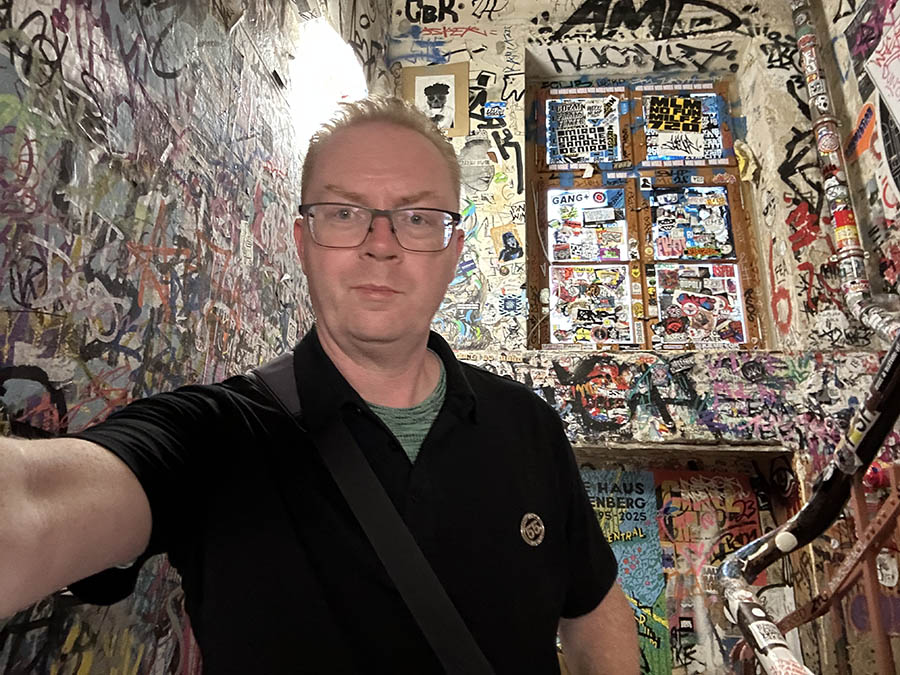
I’ll finish up with the remainder of my Berlin sketches and thoughts. I definitely had a lot of thoughts when visiting the Gedenkstätte Berliner Mauer (Berlin Wall Memorial) in the northern section of the city, close to the Nordbahnhof. before heading up there I walked over to the Hackescher Höfe, which I had visited a couple of days before with Omar. I wanted to visit the art and bookshop there, at the Haus Schwarzenberg, which is covered in graffiti and has a stairwell full of art and posters and stickers (and signs saying not to take photos; I broke that rule). The shop I visited was called ‘Neurotitan’ and was an incredible place, I bought some zines and stickers there, and asked the assistant if they had Detlef Surrey’s book ‘The Wall Revisited’ (I’m pleased to say I held a conversation in German and was totally fine; normally I need a couple of beers before the German comes flooding back). I had heard that this store stocked it, but she said that the last copy had just been sold that day, probably by someone else who had seen his talk in Poznan. I showed her my sketches of that talk, she said that I could probably get in touch with the publisher to get a copy (I did, once I got back to the US, but it took some time and a bit of extra money – thanks a lot, bloody tariffs – to get one sent over to America). I had that book on my mind now especially because I was going up to the Berlin Wall Memorial, which Detlef had talked about at length. I took the S-Bahn out to Nordbahnhof (I realize that sentence implies that I simply got on the S-Bahn, and just went to Nordbahnhof, but leaves out that I got on the wrong train in the wrong direction at least twice, like when you try to fix a scratch but end up smashing up the table, but I did end up at Nordbahnhof in probably more time than it would have taken to walk). The Berlin Wall Memorial is a preserved section of the Wall and the Death Strip, along Bernauer Strasse. It was already early evening when I arrived at Nordbahnhof (sketched below), which during the Cold War was closed down, a ‘Ghost Station’ on the divided S-Bahn system, where West Berlin trains would not stop but passengers would catch a glimpse of a time capsule manned with armed guards. I found the Berlin Wall Memorial chilling. This was not like the East Side Gallery, here was the Wall as it looked, along with rows of metal poles installed like bars you can walk through. One section remains closed off to give an idea of what the Death Strip really looked like. Berlin is a city that dares you not to forget its past. On a metal display in the middle of the grass are the names and faces of every person who was killed trying to escape from the East into West Berlin, 136 in all. The faces as they look out at you, some so young – even children – was frightening. There were blocks occasionally showing where people were shot trying to escape. The Wall was up from 13 August 1961 until 9 November 1989. I didn’t get to see all the areas of the Memorial, nor the documentation center, but I sketched the Wall as the light was fading, then took a tram out to Prenzlauerberg and back to the hotel.

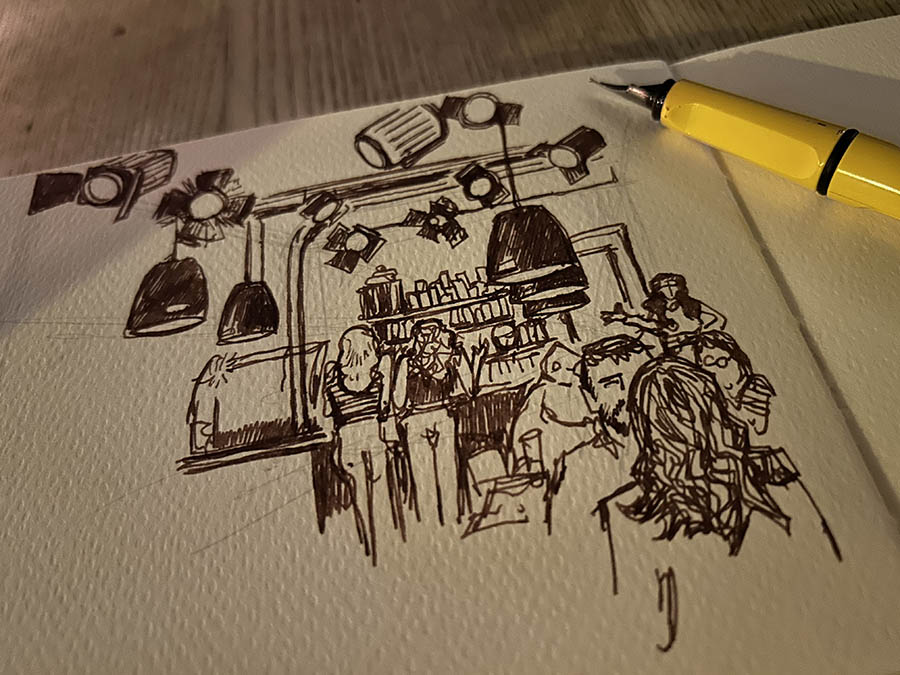
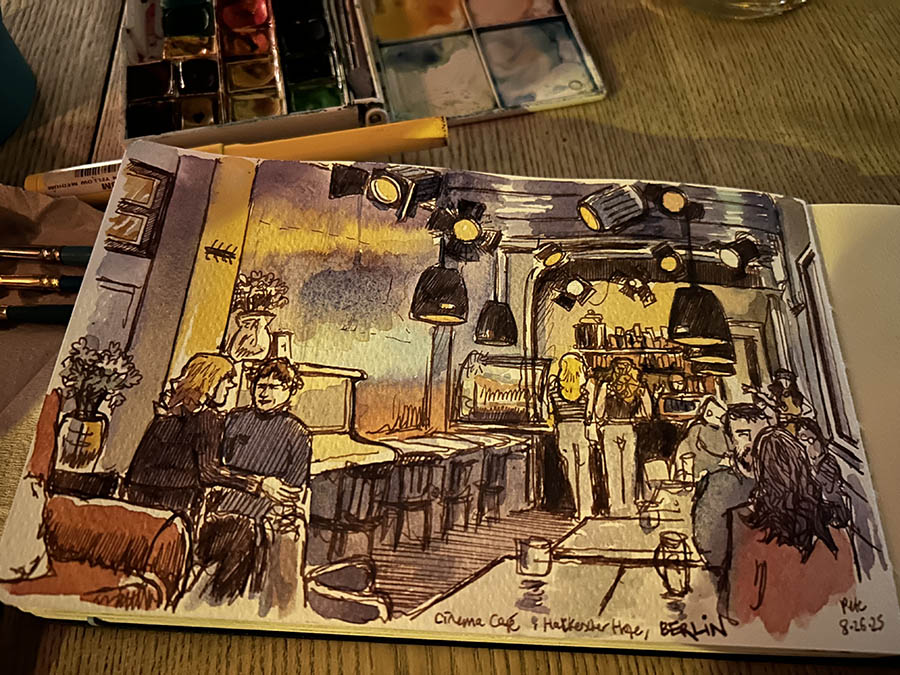
After a late dinner of spaetzle from the hotel restaurant I walked back over to Hackescher Markt. All over Berlin, but especially around here where there had once been a large Jewish population, you find the ‘Stolpersteine‘, or ‘stumbling stones’, which are actually little square brass plaques in the pavement that are slightly raised so that you might trip on them, by design. Each has the names of people who lived there previously, usually Jewish but many Roma, homosexuals, disabled, who were removed or forced to flee by the Nazis, along with the year, how old they were, and their fate (you see ‘Ermordert in Auschwitz’ a lot). This is an initiative by the artist Gunter Demnig started in the 90s, and has now spread to many other cities commemorating victims of the Holocaust. Each of the Stolpersteine is handmade. Berlin makes sure it does not forget. I went back over to Hackesche Höfe and had a beer at the Cinema Cafe, which I sketched in the poor light. It is interesting that a lot of places in Berlin are cash only, where I got so used to using my card everywhere in Poland, same back in California. It wasn’t a busy evening, it was Tuesday, but it was an interesting cafe to sketch, and I used my fountain pen. The outside area of the cafe is in that alley with all the graffiti and would have been an interesting sketch, if I could find somewhere to sit with a good view, which I couldn’t. After this, tired, I went to bed.

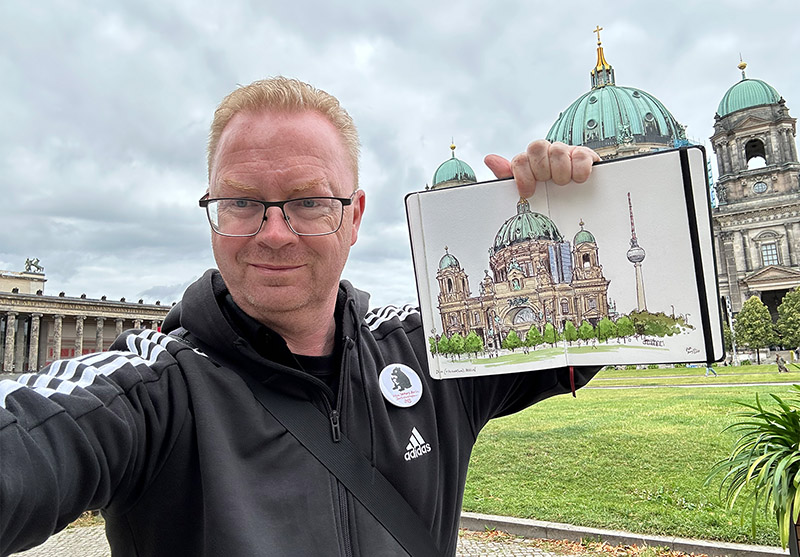
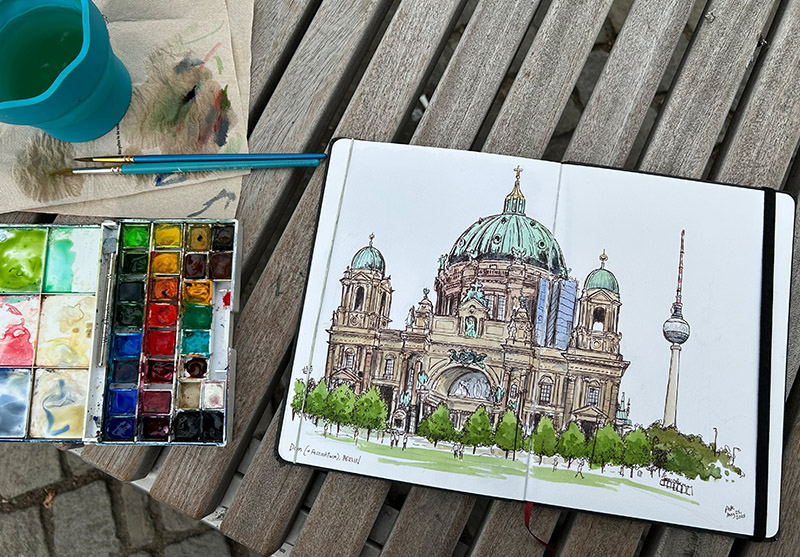
On my last morning in Berlin, at the end of my Poland-Germany trip, I was ready to go back to London but had a last sketch or two in me. I had considered adding in a short trip to Denmark onto the end of this adventure, since it was 30 years since my strawberry-picking visit there, but decided a couple more days in London would be better for me. I had also considered taking the overnight train from Berlin to Brussels, a fairly new service, and passing a couple of days in my old Belgian haunts, but I’m glad I didn’t in the end. It was nice to spend some time by myself in Berlin but it’s not 1998 any more. I walked down to the Museum Island (sketching a man fishing in the Spree along the way) and sat next to the Dom, drawing the view of the Museums in pencil.


It is fun (and quick) to draw in pencil but I don’t really like straight lines much. I do love that sky though, and miss those wispy cloud skies. Before long I was back up in the wispy clouds myself, and sketched the view on my very small plane (see below). It was easy to get the S-Bahn out to the Brandenburg airport, but took a very long time getting through the security line, which seemed to have one line per baggage inspector and the inspector seemed to have to open up every single bag and inspect every single thing. I eventually had to ask them to let me through as I would miss my flight despite being there super early. Word of warning for you in Berlin airport, it can be slow. I flew back into a new airport for me though, London City Airport out past Docklands, a very small and convenient place to end up. I jumped right onto the DLR to Bank, and onto the Northern Line back home to Burnt Oak. Auf Wiedersehen Berlin, it was nice to reconnect after all these years. I would like to get back to Germany again soon, but I’d like to go back to the South and West again, maybe explore the Rhine Valley at last.












 petescully