where the creek is green

mrak & king halls

Since coming back from London (and I still have a few more sketches to post) I have done very little sketching. Next to none, in fact, bar the odd thing here or there. I realised however that it was high time to get back out there, now that the weather is not in the ‘phew-what-a-scorcher’s, and went out at lunchtime yesterday to sketch a familiar scene. I sketch this view every summer at around this time, since 2007, and the view changes every year. When I first sketched it in 2007 the building at the front, King Hall, was not even there, and you could see all of Mrak Hall in the distance without interuption. Preparation for the law school extension began a year later, followed by slow construction, and I charted its progress until last year’s sketch showed completion. Now there is no change from last year to this, so this may be the last time I sketch the view. Still, it’s a peaceful little spot, right beside Putah Creek, which is increasingly green at this time of year.

angels and bus-stops

angel inn highgate

Another north London pub, sketched quickly before meeting up with a friend. This is the Angel Inn on Highgate Hill, a pub I’ve been to many times before (it used to be my local, though when I lived there I went once every few months or so at most, I wasn’t exactly Norm from Cheers). It’s a really nice pub though, warm and welcoming, and in a great location – home was always down hill. I lovegolders green Highgate Village. There are great views over london, nice little shops, intimate little restaurants and warm pubs, plus it’s near Hampstead Heath. Can someone please pay me loads and loads of money to just draw around the world, so I can move the family back there? Cheers.

Anyway, my bus got there fifteen minutes early so this was what I got, not a bad capture for quaretr of an hour. An example of ‘draw what you have time for’. Know what’s possible in a certain amount of time and do what you can. On the way there, I got off the tube at Golders Green to catch the 210 bus, and had eight minutes to spare, so I also drew the sketch on the right, a rooftop opposite the bus-stop. How did i know I had eight minutes? The nice little LED display at the bus-stop told me so, and it was pretty accurate. That is very handy. I remember it not being too long ago that waiting for a bus in London was a case of ‘anyone’s guess’, but it’s not too bad these days.

I keep meaning to do a big detailed pub interior sketch inside the Angel Inn. Next time, perhaps I will.

down camden

Hawley Arms, Camden
While back in London I wanted to get at least one in-bar sketch done, and I usually find it harder to draw at the bar when I’m busy talking to non-sketching friends. So one night I met up with a mate at the Hawley Arms in Camden Town, so I got there a bit early, got a pint (not cheap in London, much dearer than in Hawley Arms exteriornorthern CA), and drew from a little table at the end of the bar. It took about twenty minutes. You can see my reflection if you look hard. I do like drawing bars, there are all the usuals, the beer-taps, the bottles, the little shower things that dispense sodas, and of course the black straws. All bar drawings I do have to have a big stack of those black straws that just seem to get in the way of everything else in the sketch. I don’t see that many people using them, but they always keep them right there.

This was a nice pub, popular with famous musicians I guess (well known for one in particular), though I had never actually been here before, in all the nights I have been out in Camden. I used to go to Camden quite a lot back in the old days – the Mixer, the Dublin Castle, NW1 (in the reverse order of appearance) – so always have to go there at least once on any return trip.


the anchor by the thames

the anchor, southwark
And so on I went down the South Bank, until I came to the Anchor pub, decked out for the Jubilee. It was surrounded by a large horde of shaven-headed lager-drinking chain-smoking England football fans, getting a few in before hitting the tube to Wembley for a pre-Euro 2012 warm-up match against Belgium. All good natured, of course, and enjoying the day with all the tourists and Jubilee celebratories. As I sat down in a nice quiet spot to sketch the historic riverside pub, they all moved off, singing about being off to Wembley, leaving only the passing tourists. stoney st southwarkI didn’t drawn any of those, they kept moving, so I focused on the building itself. To be fair most people who milled were milling away from this spot and in the pub’s beer garden to the right. I sat for almost an hour and sketched (I did finish some detailing later, but chose not to colour it). One young lady came up and asked if she could ask a wierd question. Depends on how wierd, I replied. How wierd could it be? Not very wierd in fact. “How do you find time to draw?” She was an artist herself it seemed but never seemed to have time for it. I had struggled to find time to do all the drawing I wanted to do on the trip (you wouldn’t believe it) but still managed to get a lot done, because it is really important to me to have drawing time. I get grumpy if I don’t (quite grumpy indeed) so I make sure I find the time for it, even when I’m ridiculously busy. I told her about Urban Sketchers, and the Drawing London groups, and said that by seeing how other people busier even than me manage to somehow fit art into their lives inspires me.

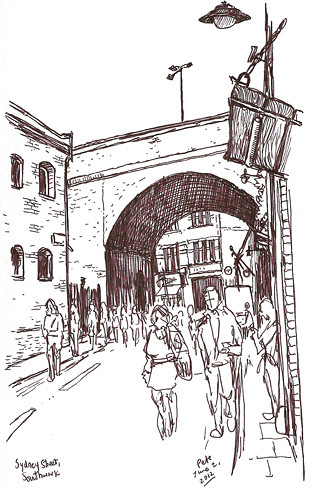
With this sketch of the Anchor, I wanted to sit and do something detailed and old and full of bricks. With this other sketch on the right, Stoney Street in Southwark (near Borough Market), my time was running low so I did a quick about-ten-minute sketch to capture the scene. When time is short, think what you might be able to get in with that time, and be ok with it. I hate watsing time, even though I do it often, when I could be sketching already something else. I went on to the market and had the most amazing grilled halloumi sandwich, right by London bridge. Even thinking of the smell makes me ravenous for more – I’ll say it again, I love coming to this part of London.

sketching south of the river

southwark bridge

‘Bunting’ is a word which, sure I had heard of, but had completely forgotten. It’s not a verb, not that I know of, it’s the stuff you hang up all over the place with the coloured triangles, to decorate in times of celebration. Not a word I hear very often, I don’t think it’s used in America. Anyway, the bunting was blowing wildly in the wind on this day, while I was sketching beside Southwark Bridge on the south bank of the Thames. It was the first day of the Jubilee weekend, the Jubilee stewards were already out keeping an eye on things (one kept coming over to see what I was sketching, but in an interested way not an ‘oi what you doin’ way), and people and tourists (who are people too) strolled this way and that. A rather terrible street band played in the underpass behind me, correctly thinking that the tunnel would amplify their music. Nonetheless, the general mood was upbeat, and I rather enjoy sketching this part of London.

cardinals wharf

Here is another sketch drawn by the river – it is a pretty looking house right in between Shakespeare’s Globe theatre and Tate Modern. I was drawn to the red door, though workmen kept coming in and out, busy preparing for some big event it would seem. When I was done, I went and read the little stone plaque beside the door. It turns out that none other than Sir Christopher Wren lived here during the construction of St.Paul’s Cathedral, which is directly opposite across the river! For those who are not familiar with London’s architectural history, Wren designed and built many amazing churches in London after the Great Fire of 1666, but St.Paul’s is his masterpiece and greatest legacy. Pretty convenient location then, you may think, well they didn’t have Millennium Bridge in those days, or even Southwark Bridge, so he would probably have had to take the ferry across. I’m actually a little surprised he didn’t think to be a bridge builder as well (actually, he did design a bridge built in Cambridge).

More London sketches to come…

camping by the river

thames jubilee campers

As some of you may have been aware, this year is the Queen’s Diamond Jubilee – celebrating 60 years on the throne. It’s only the second time in the history of the country that a monarch has reached that milestone, the previous one of course being Queen Victoria. Long live our noble Queens, eh. On Sunday June 3 (59 years and 1 day since the actual coronation) a huge and historic River Pageant was planned, taking the royal party down the Thames followed by a large flotilla of boats. I was going to a street party in my old road so was unable to stand by the Thames in the rain with thousands of others (ah well, next time), so I went down to the river on the Saturday (June 2nd, 59 years since the coronation!) and sketched some of the people who would be braving the elements to see the Queen. This was down by Tate Modern, and the weather, while overcast, was very pleasant. The folks setting up camp had come from all over the UK, and the atmosphere was very happy. I think they were even looking forward to Sunday’s impending rain – nothing like a brolly, a cup of tea, a nice bit of cake and the Queen sailing by, Rule Britannia. Fair play to them. I sketched, and then moved on down the Thames to sketch some more.
sketching the jubilee campers

the clock at the top of burnt oak

burnt oak broadway

This was sketched on Burnt Oak Broadway, at the top of Watling Avenue, on the corner of Stag Lane. This is another from the part of London where I am from, and this is the iconic building with the clock tower that was originally the Co-Op’s ‘finest grocery store’. That was long gone by the time I came into the world, and it was several things while I was growing up (I recall buying a stylus for my record player in there when it was a department store), I think it’s Peacocks now. Either way, that big clock tower sits at the top of Burnt Oak looking over us all, and it always reminds me of my Nan, who we called Nam, who lived in the flats across the road and spent many days in the Stag pub, directly opposite. Looking at it makes me feel very sad, and very happy.

On the other corner of Stag Lane there is the Nat West bank. This is the branch where I had my first ever bank account. Kids form the 1980s in Britain will remember the Nat West piggies, and I had the whole set of piggy banks, awarded when you saved to a certain level. My dad still has them, though one of them broke falling from a shelf when I was a teenager (yes, I had old piggy banks on my shelf as a teenager, and I used them too).

It was a cloudy day when I sketched this, the first day of June. We were coming to the end of our trip, and I was feeling pretty exhausted. Travelling back home takes it out of you, so it’s nice to unwind and just draw stuff. I haven’t done much drawing since I got back to Davis, hardly any in fact, and stress is getting the better of me, so I think it’s time I took my own advice and made time for it.

two cities, two views from the bridge

Westminster skyline
I love Hungerford Bridge. I can’t express this enough. Not so much to draw, but to draw from. The old Hungerford Bridge was a nightmare, rattling and rusty, a walkway tacked onto the side of the real bridge itself (a railway bridge, stretching south from Charing Cross station). My memory recalls it as like an urban version of one of those rope bridges from Indiana Jones or something, with the deadly brown Thames rolling beneath the cracks. The most annoying thing was that it was on the wrong side of Hungerford Bridge, for those who want a nice view of Parliament and the City of Westminster. While the railway bridge is still there, a decade ago they finally built two modern and spectacular new pedestrian bridges on either side of it, thereby giving us access to the amazing view above. I am still in awe that this bridge exists (technically it is now a trilogy of bridges, the two pedestrian ones being more properly called the Golden Jubilee Bridges, nice shiny name but a bit of a mouthful). One day I may draw it, but the novelty of drawing from it has not gone away just yet. I had promised my son I would include the London Eye in one of my sketches – I do like the wheel, but really don’t like drawing it! The bridge is Westminster Bridge, and the clocktower, commonly called Big Ben after the large bell inside, is siply called the Clock Tower – for now. The powers that be decided recently that they would like to rename it Elizabeth Tower, in honour of the Queen on her Diamond Jubilee (the tower on the other side of parliament is called Victoria Tower, renamed from the previous King’s Tower for Queen Victoria’s Diamond Jubilee. The Thames will always be the Thames, however (unless Britain gets totally broke and sells the naming rights, the JP Morgan River or something; I am surprised they haven’t considered such things already).

After completing the first sketch, I then decided that I needed to do a full two-spread panorama from the eastern span, looking out towards the City of London. It was an incredibly windy, sunny day, and lots of people passed by as I sketched. It took me nearly two hours to draw the view below, the skyline of London, ever evolving. In the right hand side, the tall glass 1984-ish Shard building pokes into view. St.Paul’s of course is in the middle, the dome being the symbol of London, and on the right is Cleopatra’s Needle, which of course pre-dates Cleopatra by centuries. Spanning the Thames is Waterloo Bridge, designed by the same fellow that gave us the classic red phone box and the old Bankside power station (now Tate Modern). Click on the sketch below for a larger image.
Waterloo panorama

an afternoon at the allotments

dawn's shed

One Monday afternoon while back in London I went to the East Finchley Allotments. My cousins have an impressive allotment there, and invited me along to do some sketching with them, and catch up after so many years. It’s been a while sincedawn's birdhouse I was in East Finchley – I used to pass through on my way to work every day, a million years ago it seems – but I found the place, a large and historic allotment site behind a primary school, surrounded by woods and residences. For those who don’t know, an allotment is kind of like a garden space that you rent and maintain for non-commercial use, a bit like the community gardens you get here in the US. My cousin Dawn (check out her lovely site London Clay Birds), who I had sketchcrawled with a couple of days earlier, met me and showed me around, and we did some more drawing. She built the shed above, in fact, and my other cousin Lester constructed the roof. It was a sketcher’s paradise, and very peaceful too. I drew one of several birdhouses (also Dawn’s creations), in that brown pen I go on about so much. My cousin Claire came along a little later, with their Mum Sue, and we had some lovely catching up. Claire brought her incredible sketchbooks too (check out her site The Quiet Revolution), and then we explored the site a bit more, doing some more drawing.

Some of the allotments really are rambling patches of loveliness, with a lot of hard work and devotion involved. I’m always impressed at the dedication people have to gardening; being essentially living things, gardens are not something you can just ignore. Dawn writes the newsletter for the East Finchley Allotments, and showed me the impressive map she is working on, hand-drawn of course. I like drawing old things like sheds, so we got some more sketching in. The one below drew me in largely because of the French signs in the window.

east finchley shed
It was a hot day, and after stopping to sketch the quick scene below (the sloping grounds of the allotments leading up to a primary school which looks a lot like the one I went to, but isn’t), we all sat in the shade of the allotment and caught up. Dawn gave me a bag of wonderful hand-made goodies, including some of the beautiful London Clay Birds (check them out on her Folksy and Etsy stores). It was a very nice afternoon, I hope to have more of them.
east finchley allotments

white hart lane

tottenham high road
White Hart Lane Stadium, on Tottenham High Road, home of the mighty Spurs. Well, we could be a bit mightier, but still we’re pretty mighty. We ‘might’ have come third, etc, we ‘might’ have gotten into the Champions League, Harry ‘might’ have committed to staying about four months ago rather than let uncertainty about England affect our previously epic season, etc. It’s all water under the Stamford Bridge now (by the way we did finish above  Chelsea, though of course Arsenal pipped us in the end). Ah well! New season, new manager, new kit, new dawn at White Hart Lane. New stadium too, in a few years time, or so the plan goes. I hadn’t been up there in a good while, to the Lane, so on tis one day when a day trip to Brighton was aborted due to very bad traffic, my friend drove me over to Tottenham to look around the Spurs shop (I picked up a nice retro 1981 Cup Final top), and gave me a bit of time to sketch the stadium. There’s no truly great angle to draw it from the outside, so I chose a spot which I think sums up this block. Many of the older buildings which were there the last time I visited have been knocked down, in preparation for the possible new ground, to be built directly north of the current ground which Spurs have occupied since 1899. My older brother, an ever-present at the Lane for several years as a boy himself, took me to games when I was a kid, back in the days of Hoddle, Ossie, Falco, Clemence, the Allens. Whatever happens with this club, I will always have that. The thrill of approaching the stadium after a long walk up the High Road from Seven Sisters, and entering the ground which was smaller then but seemed massive with the packed terraced crowds, reading the matchday programme while bigger men around me sang, swore, shouted and clapped, as real-life football sticker heroes ran around the perfect turf; now that was football.

I didn’t have a great deal of time to sketch, so I drew the stadium and the outline work of the rest, and finished off the detailing and colour later on. I had to make sure there was a lamp-post – legend has it that the grammar school boys who founded the club as Hotspur FC in 1882 would meet beneath a lamp-post (and shortly after that they sacked their first manager, changed the lightbulb and ushered in a new dawn, the first of many).