among the stones in hampstead and highgate

Hampstead St John Church yard 061224

I think I sought out quieter spots on this London trip, I wasn’t really looking for the busy crowds and bustle of the city, it’s been too stressful a year for that. I found myself in Hampstead a few times, only a few stops down the Northern Line from Burnt Oak, but a world away in how it looks. It’s a bit nice round there. We went down one afternoon to walk about a bit, before I would be meeting up with a friend in the evening for dinner. I had a bit of time to myself to go and do some sketching, and I stood on Fitzjohn’s Avenue and sketched this weathered old post box (below), which bore the royal cipher of King Edward VII, so it’s quite old. I love old pillar boxes. I saw one from Queen Victoria’s reign on Hampstead High Street, although it was kept as a relic and was not in actual use (despite being opposite the post office). My brother called me up, and as I spoke to him I found myself wandering down old streets I had never been to, not really paying much attention to where I was going. I found myself at the Parish Church of St. John at Hampstead, an impressive old church with an adjacent burial ground, rows of gravestones poking out of long grass. It was quite peaceful, and I do like a graveyard. Real England is old brick and stone and greenery. Local ladies walked their small dogs about, and I sketched this scene above. I felt it had to be in pencil. If I still lived in London I would probably spend a lot more time sketching graveyards.

hampstead postbox 061224

On a different day, I came through Hampstead to pick up some photos I had put in to Snappy Snaps on Hampstead High Street a few days before to be developed. That’s right, an actual roll of film. I haven’t developed a roll of film in nearly 20 years, and in fact I still have some rolls of undeveloped film that I brought with me when I emigrated to America, memories still waiting to jump out at me from the past. Well this roll of film was from just the past few months. A friend got me a basic film camera for Christmas, and so I bought some film (not cheap any more like the old days!) and was taking pictures on some of our recent travels. I maybe got the film wrong (it was good quality and cost me enough), but the photos turned out terrible. Like almost unanimously awful. The ones in Zion Canyon for example were just big dark masses. It wasn’t cheap to develop either, but there you go. Fun experiment, I suppose, but I’ll stick to digital, and sketching. My son was using the film camera on our Europe trip this time, so we will see how they turn out. Better than mine, I hope. Anyway, on my way back to the tube, after stopping in Cass Arts to pick up yet another sketchbook (I never seem to not need sketchbooks), I stopped in Flask Walk to draw. The sketch is below. I like Flask Walk, it’s narrow and full of interesting little shops. I like the Flask pub, I usually pop in there when I’m back in London. When my son was little, I took him ghost hunting there, because it is supposed to be one of those haunted pubs London has so many of. I like all the little antique shops, though I’m not the sort of person who shops at antique shops. I stood nearby and drew the view looking down, trying to catch some of the things people were saying to each other, like the older woman saying “bye darling! bye darling!” to her friend. I got asked by someone passing by if they could take my photo while sketching. I said of course (I get that occasionally when I’m in London, I think it must be the way I hold my sketchbook). They had a nice digital camera; I said I had tried taking photos with a film camera but just got them developed and they had turned out really bad, so I will be sticking to the sketchbook in future. I asked if they drew and they said they did but not much, and would like to do more, so I gave them the information about Urban Sketchers London, and said they should join them on their regular sketchwalks. If you are interested, check out their calendar for the rest of 2024 at the USk London website. When I was done with my sketch, it was time to head home.

hampstead flask walk 062424 sm

But I have a couple of other sketches to show from the area. On a different day, we all came back down to Hampstead to look around before taking a walk across Hampstead Heath. I love Hampstead Heath, it;s easy to get lost along its tree covered paths. I have a photo of my holding my son by the ponds when he was only four months old, he’s sixteen now, so we took the same one, though I wasn’t carrying him this time. As we rested on top of the Heath, looking towards Highgate Village, I did a quick small paint sketch, below. It’s hard to imagine, we lived over there before moving out to California. It was a bit of a walk, but we’d sometimes come over this way on a Sunday, enjoying the peaceful English day. We lived on Hornsey Lane, and I still love that area. We went over there on of our first days back, it had been so many years. In another universe, if we had not moved to the US, we might be over there still, my son might have grown up there. We joked about that; the truth is, working for universities which don’t pay much in England, and with the extortionate cost of living in London, there’s no way we could have afforded a bigger place in Highgate unless we got very lucky, and would probably have moved our further, or back up to Burnt Oak, or just moved to California anyway. You can’t see the multiverse. There are a lot more hills here than in Davis. We did explore Crouch End again though, I miss that neighbourhood so much, and Highate Village, and Waterlow Park. We walked down our old street and took a photo outside the house where we rented a flat, those horrible old windows were unmistakable (except they were mistakable, because we were stood outside the wrong house; our old one was a couple of doors down, so we took a photo outside that one instead).

hampstead heath 061724

After the walk across the Heath, the final destination beckoned: Highgate Cemetery. That is the literal final destination for many people, from your Karl Marxes, your Douglas Adamses, your Jeremy Beadles, even your Eric Hobsbawns, your Malcolm McLarens. We only walked about the East side; I’ve never been to the West side, some day I will, but I notice that David Devant (the magician after whom one of my favourite bands is named) is buried there, as is Prof. Lisa Jardine, who I actually knew from my days as a drama student at Queen Mary, and Michael Faraday, one of my favourite scientists. George Michael is in the West side too; he was a local lad from near where I grew up, and he also lived in Hampstead in his later years, and speaking of the Snappy Snaps on Hampstead High Street, that was, er, the place where he crashed his car back in 2010. Anyway, we just looked around the East side, found the big Karl Marx, found a few other names I was looking for, talked about vampires, and then went down to the village at Parliament Hill for an overpriced pub lunch. Anyway, some nice times spent in Hampstead and Highgate, still some of my favourite parts of London.

highgate cemetery 061724

“I belong to Glasgow”

Glasgow Necropolis

It rained hard on the train journey to Glasgow. I suppose you don’t come to Scotland for the sun. We passed by Falkirk, a place I’d like to have seen, mostly for the huge Kelpies. We arrived at Queen Street and the rain stopped for long enough to let us walk up hill to our hotel, further than it looked on the map. We sat in the hotel lounge watching the driving rain outside, eating those little Tunnocks marshmallow Teacakes I love so much, strumming on the ukulele. I could tell my family were maybe a little less wowed by Glasgow than by Edinburgh, but I’d been waiting most of my life to come and have a look around here, rain or not. I went for a little walk as the rain eased off a bit; we weren’t far from the Art School, but after the big fire they had a few years back, it’s still covered in this big white plastic while it’s being remodeled. Glasgow’s an artist’s town though, that is clear. Charles Rennie Mackintosh is the big name here, but he’s not the only one. Musically too, Glasgow is a creative city, and one of my favourite bands of all time are from here, Belle and Sebastian. I’ve always wanted to come here and explore.

Glasgow Orange march

I wandered about a little, and then I heard some music, it sounded like flutes and drums. Marching up the road were the men and women of the Orange Order, decked out in their suits and their orange sashes with their big orange and purple banners, lads in Rangers shirts flanking them, as well as police clearing the road for them. I was glad I wasn’t in my Celtic shirt, nor my Ireland shirt. I had heard about the Orange Marches since I was a kid of course, the ones in Northern Ireland at least, usually in the backdrop of some news story, and I had forgotten that Marching Season was starting. I knew from my mum that it was big in Glasgow (she spent some time in Glasgow as a kid, I think some of our Ulster family lived up here), and of course I’m well aware of Rangers and Celtic and the whole sectarian thing. Still, I was actually surprised to see them in person. I did see them marching the day before in Edinburgh actually, going up the Royal Mile in the morning with their flutes, playing “The Sash Me Father Wore” (I am sure they have other tunes, that’s the only one I know). It didn’t seem as big (though I saw coachloads of other men in orange sashes arrive a bit later), and was certainly dwarfed by the huge Pride marches that were happening on the same day in Edinburgh. The Glasgow march seemed to go on for a long way.  I got a quick sketch done, and went and looked at something else.

Glasgow Wellington Statue

When the rain had stopped and we were filled up on delicious fish and chips (washed down with more Irn Bru of course) we walked about the city centre. The pedestrianized Sauchiehall Lane looked like it had seen better days, and could have done with a little less of those food delivery bikes careening down them, a scourge in many cities now. But I liked the city centre, and while looking at our map a young lad came up and said “you look lost, can I help youse find something?” This it turns out was a feature of Glasgow – the people are just willing to give you a hand, this happened several times. We explored the George Square area and found that statue of the Duke of Wellington on his horse with the traffic cone on its head, outside the Gallery of Modern Art. I have seen this before on my one super brief stop in Glasgow, in 1999, and its the only thing I remember. It’s a Glaswegian tradition to put a cone on the head of the Iron Duke. Incredibly they have tried to stop people doing it, yet the cone is way more famous than the statue without the cone. We took a bus out towards Glasgow Cathedral, and on the way an elderly fellow had overheard us tell the driver where we were going, and was giving us directions in that thick Glaswegian accent that I love hearing so much. Honestly, it’s always been my favourite accent. My best friend when I was 12 was from Glasgow, Ralph, I think we became friends largely because I actually tried to understand him, but as a result of his influence at a formative age I do slip into a kind of Scottish pronunciation of certain words when I hear the accent again. I also watched maybe too much Rab C. Nesbitt as a kid as well. It was Ralph who got me interested in the guitar, and we were both big Beatles fans; I remember we talked about starting a band called The Flies, and eventually I got a cheap pretty crap acoustic for a fiver at a car boot sale, and learned my first chords (and also taught myself how to string a guitar). Anyway, we got off the bus and followed the old man’s helpful directions to the cathedral, known as St. Mungo’s Cathedral, and also the High Kirk of Glasgow (I’m not sure if it’s technically a cathedral, as we learned with St.Giles in Edinburgh, but it calls itself cathedral and it looks like one and that’s good enough for me). The cathedral was not actually where we wanted to go. We were looking for the Necropolis, which is a large cemetery at the top of a steep hill behind the cathedral with amazing views over the city. See my sketch at the top of the post, that was from there. The views were remarkable, you could see Celtic Park stadium, but we didn’t linger too long. In terms of location, I think it’s up there with my favourite cemeteries, and I was even more pleased to find the grave of William Miller, the guy who write Wee Willie Winkie. I took this photo of an ivy-covered memorial to a young lad named John Ronald Ker, who in 1867 had drowned while shooting wild fowl from his boat at the age of 21, and this monument was erected by his friends and family in his memory. It’s a beautiful celtic cross, and a sad story.

After the Necropolis, we bussed it back to the hotel and relaxed for the rest of the night, eating more Tunnocks Teacakes. More Glasgow sketches to come.

“Bloody MacKenzie, Turn the Key!”

Edinburgh Greyfriars Bobby

A must-see spot in Edinburgh for ghost hunters (or ghost hunted?) is Greyfriars Kirkyard. I went there twice. The second time was early on our final morning in the city, when I got up and walked across the old town until I reached the statue of Greyfriars Bobby, outside the Greyfriars Bobby pub. If I had heard of Greyfriars Bobby before, I don’t remember it, but I probably assumed he was some sort of policeman, maybe one that wandered the spooky graveyard in the foggy night looking out for graverobbers and ghouls. No, it turns out Greyfriars Bobby is a dog, a wee little pooch, and Disney even made a film about him. The story goes that the wee Bobby was the dog of a local policeman, a little Skye Terrier who was so loyal to his master that when the man died and was buried in the kirkyard around Greyfriars Kirk, Bobby would guard his grave every night for about fourteen years. Greyfriars Bobby, as he became known locally, eventually died in January of 1872 (thereby missing the first ever Scotland v England international football match by eleven months). Such was Bobby’s celebrity, a small fountain was commissioned by Lady Burdett-Coutts, president of the Ladies Committee of the RSPCA, topped with a little statue of Bobby sculpted by William Brodie. It was unveiled in November 1873 (almost exactly a year since that first Scotland v England international football match, which ended 0-0 by the way). I had to add Bobby to my sketchbook, and I added the eponymous pub in the background so that you know his name (the pub I think came later, and in those days they did not show international football on TVs in pubs, due to the lack of international football, plus the lack of TVs what with them not being invented, though a Scotsman would later fix that too). You will notice that Bobby has a very shiny nose. If you ever saw him you might even say it glows. This is because of a very silly tradition that tourists have, perhaps told by silly guides in years gone by, that if you touch Bobby’s nose you will have good luck, because (and you have to say this in a Scottish accent) obviously that makes loads of fuckin’ sense, doesn’t it. The problem has got so bad that the statue is in danger of being permanently damaged, so locals have taken to making up stories of bad luck that will befall people that rub Bobby’s nose, and those stories I might actually believe. One thing we do not want is for Bobby’s nose to come off, because the absolute last thing Edinburgh needs are endless jokes from its tour guides about how Edinburgh’s dog has no nose, “how does it smell?”, “reeky!”, etc and so on. So people please, leave wee Bobby’s nose alone.

City of the Dead guide

Speaking of tours, the first visit we had to spooky Greyfriars was the very night before, when we took the ‘City of the Dead’ walking tour. This started outside St. Giles Cathedral on the Royal Mile, I sketched the little scene above while we awaited our tour group to assemble. We were met by our guide, a man dressed all in theatrical black with a spooky hat adorned with black flowers and crow’s wings,, round glasses, charcoal coloured paint around the eyes, and unnerving milky-white lenses in his eyes. He reminded me at first of the Crow Man from Worzel Gummidge, but with his white beard he also looked a bit like Terry Pratchett. He gave us an illustrative tour of the old town, full of ghosts yes but mostly full of bodies. Some of the stories were long, detailed and very gruesome, especially those concerning the infamous Old Tolbooth. We then moved through the city towards Greyfriars Kirkyard. It was not yet dark – it’s late June in Scotland, no chance – so we didn’t feel completely spooked out yet. Still the light was getting gloomy and the Kirkyard, packed with weatherworn graves, gnarly trees and mossy old monuments, was the perfect stage for this storytelling. It was also full of other guided tour groups, many from the Harry Potter realm. Greyfriars was a favourite thinking spot for JK Rowling as she came up with ideas for the Potter books, and she would write in a cafe just up the road from here. Many of the graves have names familiar to Potter fans, such as McGonagall (who was actually a poet, apparently a very bad one), James Potter, and the one everyone comes to see, Tom Riddle. It’s actually ‘Thomas Riddell’ but that’s close enough. On our tour, however, we were in for a very ‘real’ bit of spookiness. We were here for the infamous poltergeist, Bloody MacKenzie.

IMG_3380s

George MacKenzie, aka ‘Bloody’ MacKenzie, was the enforcer of King Charles II’s punishment and persecution of the Covenanters in the late 1600s. He imprisoned about 1200 Covenanters – Presbyterians who supported the National Covenant in Scotland resisting Charles I’s changes to the Scottish Kirk – in a little field next to Greyfriars Kirkyard, in terrible cramped conditions, with so many either starving to death or being executed that George MacKenzie gained that ‘Bloody’ (or ‘Bluidy’ in Scots) nickname. MacKenzie died in 1691 in Westminster, but he was ultimately buried at a mausoleum right here in Greyfriars, mere feet away from where so many of his victims were imprisoned. Now here’s the thing. His ghost is not only said to haunt this place, but it’s been well documented in recent times. I won’t tell all the stories here, but a lot of people have encountered the dreaded MacKenzie Poltergeist. As our guide told us (after locking us into the ‘Covenanters Prison’ area; only official guides can access this part), many people have encountered this spirit, often feeling a strange presence or the sense of being attacked, or getting home the next day and discovering strange scratches on their body. It was getting gloomy when we entered one of the more sinister feeling tombs, where at the end of the 1990s a homeless man apparently encountered the restless spirit and started a new wave of hauntings. Our guide told us his tales. As he did, an American lady stood at the back of the tomb was becoming increasingly freaked out, interrupting him every minute or so to say that she felt something pressing down on her forehead, as if being pushed back. I thought she was going to faint. While I like the stories, I don’t really believe in ghosts being actually ‘real’ (though I will get shivers down my spine and feel very creeped out), but she certainly did and it was real enough for her. Our guide did a good job though not to freak her out more, but he performed a parlor trick to show us that Bloody MacKenzie can at least turn a huge iron key that was placed in the palm of his hand, making us all recite “Bloody MacKenzie! Turn the Key!” in the dim light while watching this key magically turn of its own accord. It was entertaining; as the guide said at the end, that’s just a wee bit of fun. Still, the American lady was sticking with this ghost tale. “Oh my God!” she exclaimed suddenly. “Does anyone have any AirPods on right now?” Um, no I don’t think so, people mumbled. “Some AirPods have just tried to connect to my iPhone! This has never happened before. That’s so weird. What’s causing that? Is anyone else having this happen?” We were in a literal tomb at night. “Well the poltergeist can sometimes have an effect on electronics,” our guide said reassuringly. The lady was utterly convinced, Bloody MacKenzie was trying to connect his Bloody AirPods to her iPhone. As I wondered what music he might make her listen to, the theme from Rentaghost just popped into my head, mysteriously. (There was a Scottish ghost in Rentaghost too wasn’t there, Hazel McWitch?) It was a fun evening of spooky stories, and it was dark when we walked back to our apartment, our last night in Edinburgh.

Edinb Mackenzies Mausoleum sm

So I woke up next morning and came back to Greyfriars, drawing Bobby, and then coming in to explore in the damp morning light. Of course I had to draw MacKenzie’s mausoleum. I wasn’t too worried about being attacked by a poltergeist, or getting mysterious scratches on my arms, or even of having random bagpipe music commandeer my AirPods, though I was a bit nervous of getting eaten by midges, the biggest terror in Scotland as everyone knows. I drew the tomb safe from any supernatural danger, and went home for our final Edinburgh breakfast. We were off to Glasgow that day.

pottering about paris

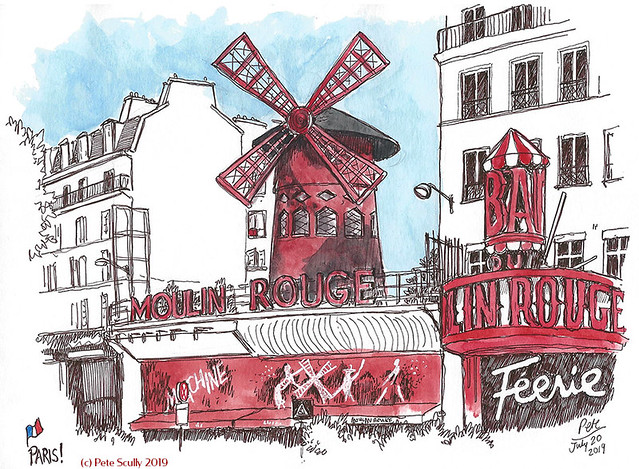
Paris Moulin Rouge
I really like Paris, but it has always felt like the city I never really got to know very well, and is better friends with other people. It’s not really very far from London, its history has long been bound up with every other country around it in some way – if Paris sneezes, Europe catches [insert whichever virus is trending that year], and yet from Britain it felt a world away; funny how the British see near neighbours. “Paris m’est inconnue“, a line I remember from Cyrano. My time spent in France was mostly down in the far south, which is why my French accent is so different (see also my time in Belgium, more on that in the next posts) (actually the real reason is that I’m just not that good at French) (I do have a degree in French though). But in all the times I have been to Paris, I realized that I’d only ever been there by myself once, and that was over 20 years ago, for the day, on my way elsewhere. I had been as a 13 year old kid on a day-trip with school, when I first entered Notre Dame and felt the cold ancient stone, and our bus went past the Moulin Rouge. I went when I was about 20 with a girl, that didn’t really work out, and all I really remember now is when I decided to go for a late night wander by myself and walked all over the city, exploring Paris after dark fearlessly and completely without any sort of map. I went another time (with another girl) and I remember going to Pere Lachaise and up Montmartre but little else, it was a long time ago. My solo visit was during the World Cup 1998, as the opening part of my summer-long European rail journey, and I spent the evening watching Brazil beat Holland on a big screen in front of the Hotel de Ville. I never went back, save for changing trains to catch the Eurostar, until my family and I went in 2012 when my son was quite young, and that was my favourite Paris visit, hitting many of the sights, watching Les Guignols in the Jardins de Luxembourg, and taking my son on all the metro lines because he liked being on the train. I really like Paris but have rarely been on a solo trip. And this day, well I was by myself, but it was another day trip. However I was determined to just wander about one area only, the steep hill of Montmartre. I landed at CDG, took an RER to Paris Nord, and set out on foot. And when I arrived on rue Pigalle, on the leafy traffic islands flanked by sexy DVD shops and nightclubs, I saw the one thing that reminded me I am back in France – a man pissing openly in the street, and nobody caring. Some things don’t change. That was a fairly common sight when I lived in Aix, but back then I was not Californian, and didn’t think anything of it. But hey when you gotta go you gotta go. Later that same day I went to Brussels, whose most famous statue is a boy very happily having a public wee.

So anyway, as you can see above, I stopped on Pigalle, and drew the famous Moulin Rouge. It’s so famous that Nicole Kidman made a film about it. It’s so famous that Rod Hull made a TV show about it, although he watered it down a bit. As I mentioned my French isn’t as great as it should be so I think Moulin Rouge means ‘Mussels in Lipstick’ but I didn’t go in to find out, so instead I just drew the big red windmill that is for some reason on the top. I know that the famous ‘can-can’ dance has something to do with this place, presumably it’s about canned mussels (which btw are fine but not as nice as fresh mussels). The can-can was very popular when I was a kid in around 1980-81, I think it had been released in the charts to compete with Shakin’ Stevens, and I remember at parties in our street people attempting to dance a can-can and kick their legs up high. So anyway I drew the windmill because I figured, I am going to be spending a good amount of time in the Netherlands on this trip, this will be the first windmill of many. Spoiler alert, this was the only one I drew. Incidentally, I decided to put a Gnome – a ‘Nain de Jardin’ – on my sketchbook. We all remember that film Amelie, in which there was a gnome that disappeared and traveled the world sending postcards back as you do. That film was set around here, so there’s a photo of me trying to do as the gnomes do (“when in Gnome…”), and failing because I couldn’t get the focus right on the background. This is filed under the chapter “Why I Am An Urban Sketcher (And Not An Instagram Photographer)”. All that said, I will intersperse these stories with the odd photo, such as this one and also the one of the little pixelated wall-sprite, to flesh out the experience. My little gnome, he is in French colours (or maybe Dutch flag colours), and has the sign of the Euro on his belt.
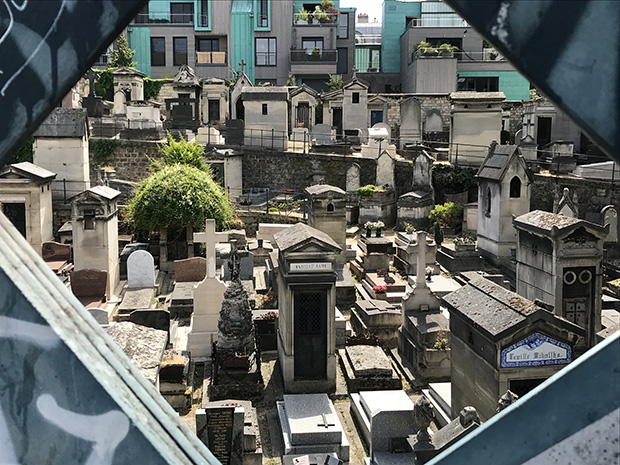
Paris Montmarte Cemetery
I love the big city. The big city is my natural environment. Put me in a big city and I’m like that video that always gets shared of a dog running out of a car into a lake and splashing around. Not that I splashed around in that bloke’s wee, but I just feel energized being back in the urban environment again. Davis, you ain’t Paris. But even I need some quiet time, so I went to Montmartre Cemetery and got all the quiet time I could want. I had never been there before, and it is quite a place, small and yet massive, with secluded corners and grand boulevards. Part of it runs underneath a bridge. I found a bench and sketched while the sound of trees and wind and crows gently muffled out the distant traffic. Peace and calm. Speaking of crows, seeing crows on gravestones was, I thought, the most gothic thing ever. Until I saw a dead crow on a gravestone. I like cemeteries, I am always careful not to walk across any graves and I’m solemn around the dead. We’re all going where they have gone, some way or other. Maybe not this cemetery though, you might have to be quite famous and French to end up here. I looked at the map showing where all the famous corpses were, most of whom I did not know. Except Adolphe Sax, Belgian inventor of the Saxophone. Francois Truffaut is buried here too, but I never watched his films, despite my degree in French, I kinda turned my nose up haughtily at Truffaut, as one of those film-makers that the university wannabes all said they loved at the pub when comparing coolness. “Oh you think that thing’s cool? Then I don’t,” was how I went about things. Even choosing my location for a year abroad, everyone went to France, so I went to Belgium, to be different. So anyway, I didn’t find Truffaut’s grave, and one day I might watch his films. Whoah…Edgar Degas was buried there. I found his grave. Foucault, he’s there too, though admittedly I know Foucault about him. And Emile Zola! I was impressed there. And Stendhal, I looked for his grave too. And the last name I had heard of was Nijinski, though I thought that was a racehorse.

IMG_3497IMG_3516

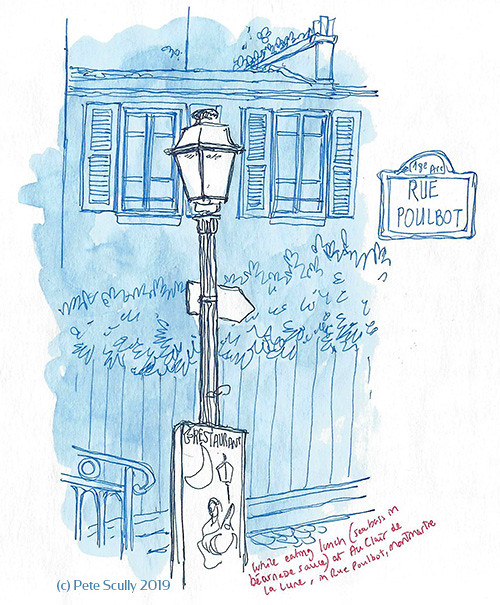
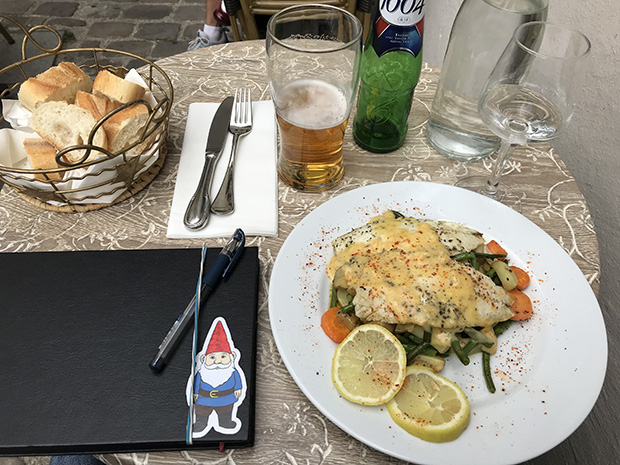
After a couple of hours spent among the dead, it was time for lunch. I climbed uphill into the windy streets of Montmartre, and found a nice little restaurant called Au Claire De La Lune, on Rue Poulbot. I sat outside, the most Parisian of settings, with a surprising lack of foreign tourists, everyone around me was French. I had sole with bearnaise sauce, and a Kronenbourg 1664. This was a good day.
Paris Rue Poulbot

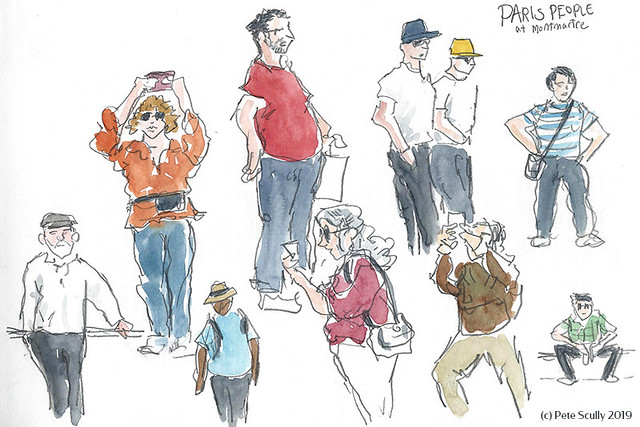
IMG_3553IMG_3550Paris People

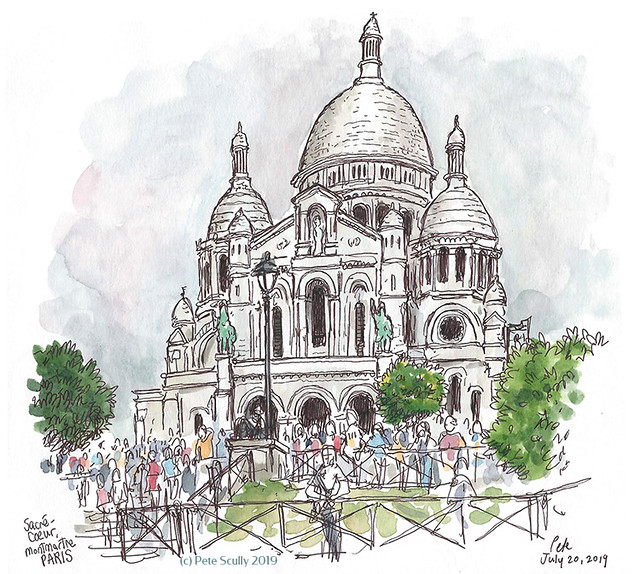
And finally I had to wander the streets around Sacre Coeur. I’m a big fan of Sacre Coeur, although I must admit, I have never been inside. I never gave myself time. I had time to sketch though, and I was pretty pleased with what I drew. The sky had character, and the view up to those white domes is one of the most iconic in the world. The view across Paris is jaw-dropping, but you can see the fire-damaged Notre Dame, missing the famous central spire. I didn’t go down to see what has happened to those ancient stones in that awful fire, but I gave her a nod of respect from afar.


Paris Sacre Coeur

And that was all the time I had. There was a train to catch, the high-speed Thalys, taking me to Brussels, a city I had a lot more history in, a springboard for a few days jaunting about Belgium, that country of rain, chocolate, frites, rain, moules, beer, and rain.

What I didn’t know was that it wasn’t going to rain, but it was going to get hot –  very, very hot.


frame thy fearful cemetery

What are the roots that clutch, what branches grow
Out of this stony rubbish? Son of man,
You cannot say, or guess, for you know only
A heap of broken images

(T.S Elliot, ‘The Waste Land’)

highgate cemetery

I love Highgate Cemetery. They used to say there were vampires here, many years ago, but surely they would all have book deals by now. I haven’t been into the famous boneyard in a long time but really wanted to come and catch some sketches here. Or one at least, while the sunlight was still good. I didn’t bother with the main paved routes but dove straight into the thick overgrown muddy paths, where not a single grave is standing straight, and ivy covers the moss-green stone tombstones of someone possibly famous who you’ve never heard of. Everyone is here to see Marx, of course, the tourists from China who all had to study his works at college, snapping a photo next to the bearded tomb; I tried to sketch it but it looked like Santa. I took photos of the cemetery myself – who couldn’t? – and one of them is below. As for sketching, I enjoyed hiding among the dead and drawing the above. I was out of the way. There was one other person I think who appeared from time to time, stealing photos between the stones, but otherwise all I could hear were the crows. I was eager to include the entrance ticket (four quid to get in, by the way) on the page but forgot to account for the red writing contrasting with the greens and greys. It didn’t stop me.

Highgate Cemetery

silent is the house

davis cemetery

I cycled around Davis today. It was cool outside, the autumn is upon us and I lost myself in streets and cycle paths I had never been to. I ended up at Davis Cemetery; I have never looked around it before. It isn’t very big. This surprised me, but then I suppose Davis isn’t as old as Highgate, where I used to live. It was peaceful, sad and peaceful. Maybe I’ll draw Highgate Cemetery when I’m back in London again next month. 
Completely coincidentally: I just looked on Twitter and saw an update from Davis Forever about Art in the Cemetery, an exhibition of art in Davis Cemetery that I guess was going on in that very building as I was drawing it, and I knew nothing about it. I do recall thinking that people didn’t look all that funereal coming out of there.