
For my second full day in Berlin, I had a few things I wanted to do. You can’t do it all; I couldn’t for example go out to Charlottenburg, where I had never been; nor to Neukölln and Tempelhof, which had been recommended to me; nor out to Potsdam, which I had explored in ’98 anyway. Things always take longer when I have my sketchbook anyway, but I spent a bit of time going about on the U-Bahn and S-Bahn. I had a leisurely breakfast in my hotel room, sat looking out of the window and strumming on the uke, then headed out to West Berlin, to the Zoobahnhof, the busy shopping street of Kurfürstendamm, and to the Kaiser Wilhelm Gedächtniskirche (Kaiser Wilhelm Memorial Church) at Breitscheidplatz. I was covering old ground; this is one of the first places I visited in 1998 on the day I explored the city on my own. It is the shell of a large bombed out church, with the more modern church structure next to it, a large concrete edifice made up of small windows of stained glass. The older building stands as a monument to the destruction of war, and there is an exhibit of its history inside, along with an iron nail cross from Coventry Cathedral, also destroyed by aerial bombing in the war. The two cathedrals have held a long friendship together. The original church was not that old, having been built by Kaiser Wilhelm II in the last years of the 19th century, opening in 1906. The new church doesn’t look much from the outside, but inside the largely blue windows create a thrilling effect as they surround the space, it reminded me of Liverpool Catholic Cathedral, though this is a Protestant church. I had always thought (probably someone told me when I went there years ago) that the glass was recovered from the original building, but that is not the case, the glass in fact being designed by Gabriel Loire. That makes more sense, I think that when clearing up they probably weren’t saying “collect all those little bits of glass, ja, that might come in handy”. I really enjoyed sitting in the new church and sketching, something about all that blue really calms you down. I also liked the design of the floor, all colourful circles. There is a big golden Christ with a long face flying above the altar; it’s actually made from a bronze alloy metal called tombac and designed by Karl Hemmeter. I sketched in there (below) before sitting outside and sketching the old and new, above.

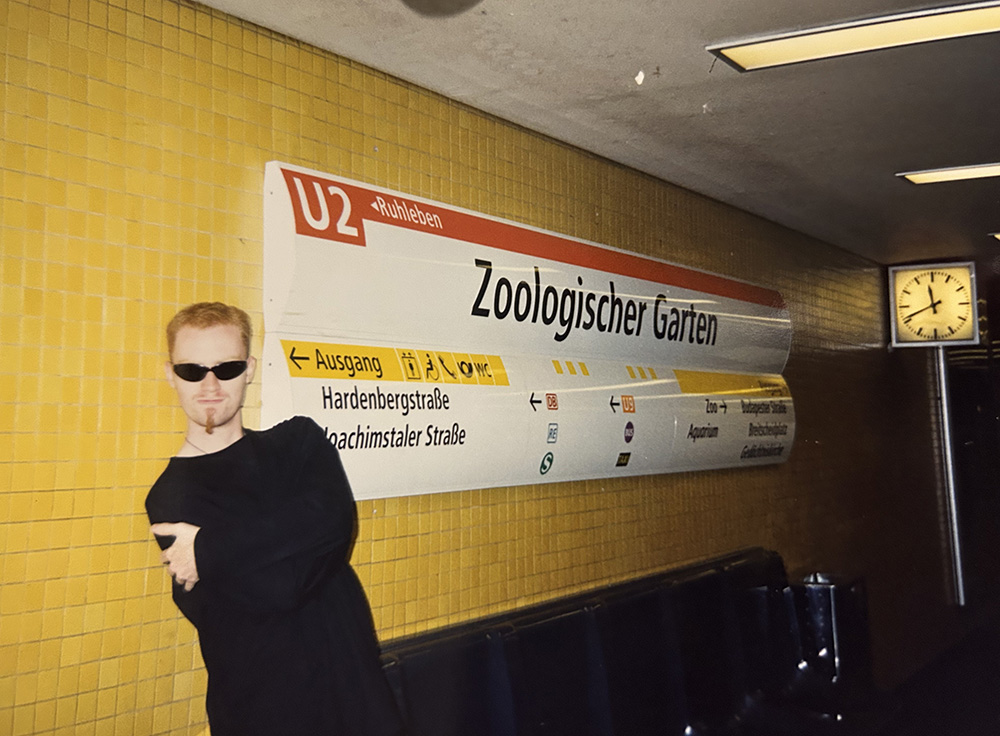
This is the commercial hub of the city and it feels like it, the Capitalist island in the old Communist sea; I remember that road map of Europe I had when I was a kid, West Germany was fully detailed, but only major cities were shown in the otherwise blank East Germany, except for those three autobahns that went from the West directly into the isolated West Berlin, with little warnings telling motorists they were not allowed to leave the road. According to that old road map, East Germany was a place that geographically didn’t exist. In his talk at the symposium, Detlef Surrey said that you got used to living with the Wall and the fact that there was this other place just over there, but that you mostly didn’t think about them, or maybe were encouraged not to. It was a different time, but I wonder about modern Korea, where you can say the Berlin Wall still exists, how do the people in the South think about those in the North. Germany is all one now, ever since 1990, but I hear many Germans say that it still feels like two, those divisions from decades ago and the years of change afterwards were a lot to expect to just heal. Was Germany ever really one? I always think about the north-south divide (sometimes called the Weißwurstäquator, depending on the type of sausage you might eat in different parts of the country), and the division between mostly Protestant and mostly Catholic regions, but in truth Germany as a federal nation has always been made up of very diverse places with differing histories. It’s a country and a language (all the different varieties) that has intrigued me since I was a kid, it is not a monolithic block. I would like to really explore it in more detail, but as I said, I don’t have time to go everywhere, mostly I’ll just draw the old buildings, and I don’t even eat sausages, well not pork ones. I was thinking of the old East-West as I walked around here though, since it had not changed as much as the other side had since my last visit in the 90s. I walked through the mall to find the toilet, and half expected to see posters of Hasselhoff in record shop windows. While we are talking retro, below is another photo of me in the 90s, posing like Bono with someone else’s sunglasses down in the Zoo station. Check out the little beard thing I had then, that is how you can tell it was the 90s. I took a photo of that sign as I pass through, it hadn’t changed much.
I had planned to take a wander through the Tiergarten. I wasn’t planning to go to the Zoo itself, who has time for that, but I love a massive park. This one is pretty big, and I only covered a small part of it. I started drawings some old lamp-posts, which were from all over the German-speaking world, plus some from other countries, a really interesting display of civic artistry all hidden together in this corner of Berlin. It was well past lunchtime now, and I was feeling hungry so decided to find the S-Bahn station and go back to the hotel for a rest before exploring the East Side. I wish I had been reading a novel set in Berlin, and that time passed a lot more slowly, to sit in the park or on the S-Bahn reading would have been perfect. As it was, I was still reading Agatha Christie’s Lord Edgware Dies (spoiler alert by the way) and it was taking me forever, because I’m a painfully slow reader.

 petescully