
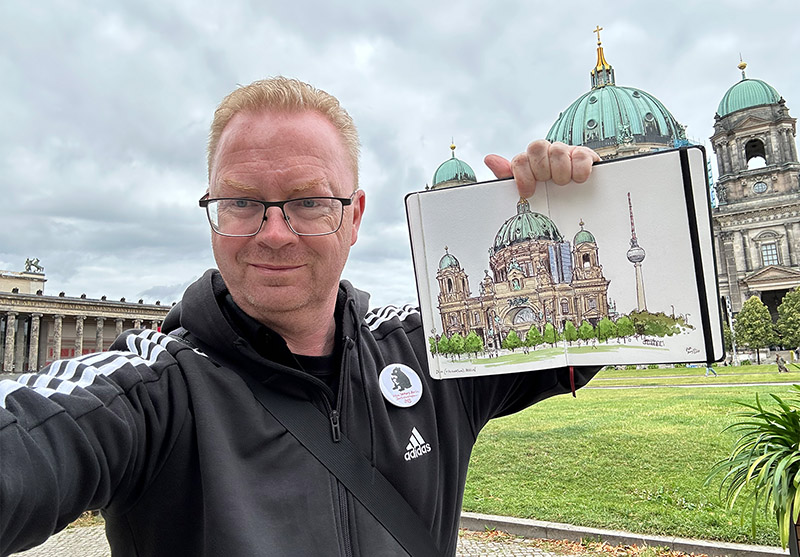
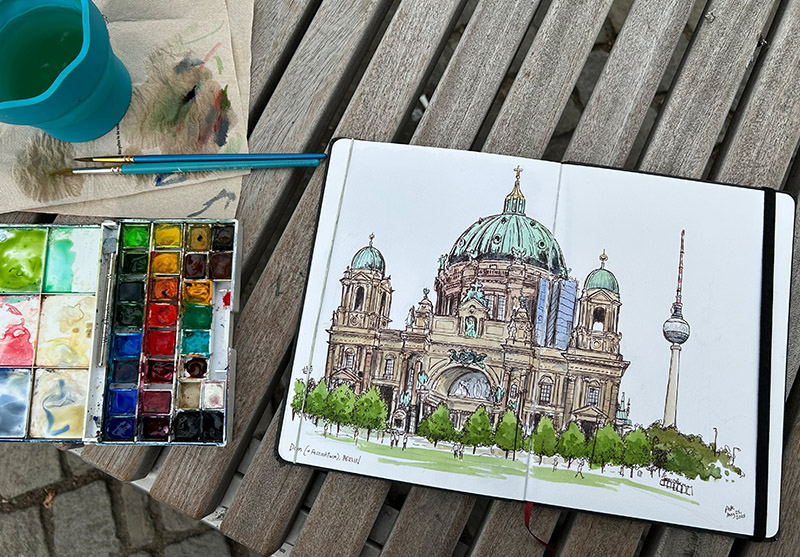
When I’m so behind in posting my sketches it is overwhelming to think of how much catch up there is, but then I remember that I’m looking back on my adventures from last summer, and it’s sometimes good to reflect on them when they are less fresh so you have had the time to digest them. Berlin is a lot to digest all at once, especially if you are mostly digesting by going around drawing it all. Berlin is a city with a lot of stories, and you can’t draw it all, and you can’t absorb it all. All those stories go through your head as you stand and look at them and try to make sense of things. You see how things are in the present day and you see how easily things went from one situation to another situation so quickly in the past and you think, well of course we should look at the past. Right now we are living in other peoples’ past. I remember feeling this very strongly the first time I was in Berlin, back as a scrawny 22 year old student dashing about Europe on night trains, feeling like this was a city coming to the end of the twentieth century where there were a lot of open wounds, but that it was about to become a different city again. Almost three decades later I was back with a more accomplished sketching habit to take a look around, and on this day I left my hotel near Alexanderplatz and walked down towards the MuseumInsel, which I’d explored the evening before with Omar. I sat in the grassy square outside the huge green-copper-domed Cathedral (Berliner Dom), which was peaceful except for the gangs of young women with indeterminate accents approaching people from all angles with clipboards. You see those gangs in many cities, they really want your signature for something or other, and your wallet too when you let them get too close. You have to keep these obvious pickpockets away from you, and I had to tell them to go away several times, eventually telling them to f-off, but I could see them going up to people all around the square. I was feeling pretty relaxed though, and was really happy with my drawing of the Dom with the Fernsehturm in the background. The cathedral itself has a long history going back to the 1400s, and has had several different iterations, but the present building designed by Julius and Otto Raschdorff was inaugurated in 1905. I didn’t go inside. It was a nicely overcast day, perfect for sketching where I’m not bound by looking for shade, and I think this was my favourite building sketch of the trip, drawn in the portrait sized Hahnemuhle, two page spread.
I was going to walk all the way down towards the Brandenburg Gate, but it was a long walk down Unter den Linden and there is an U-Bahn that goes all the way down it now. I love travelling on metro systems in other cities, it’s a whole new level of concentration. Berlin’s system is easy enough, the U-Bahn underground intermingled with the S-Bahn above, but that didn’t stop me getting lost a few times, or getting on a train in the complete wrong direction more than once, taking longer to mess about in stations than it would have taken me to actually walk the short distance. It was easy enough to get from the shiny Unter den Linden station down to the U-Bahn station formerly known as Unter den Linden but now called Brandenburger Tor.

The Brandenburg Gate is for many the most well-known architectural symbol of Berlin, especially of my generation and before who lived in the Cold War era. This was that big ghostly gate, stranded in the no-man’s-land between the Berlin Wall, which we Westerners could only see the back side of. It was on the news a lot when I was a kid. I remember the strange thrill of being able to walk through it when I went in ’98, less than nine years after the Wall fell, while souvenir sellers hawked old Soviet and DDR era army hats and badges. It used to be at the very real and dangerous dividing line between two worlds. I was planning to see more of the old Berlin Wall locations on this trip, inspired by Detlef Surrey’s presentation on his book (which I now have) and the stories he told about his younger life living next to the Wall. The Brandenburger Tor was built in 1791 during the height of the Kingdom of Prussia. Since the Wall fell it has been a symbol of German and European peace and unity. I stood in Pariser Platz, tourists all around taking photos, a man on a platform talking about something or other political, tour guides (‘Tor’ guides?) pointing out the window at the nearby Hotel Adlon where Michael Jackson once dangled his baby (remember that?), and I sketched the gate and the people milling about. I always feel a little awkward sketching columns, I have always felt that life is too short to draw columns, but I just don’t like drawing straight lines. When I was done admiring it all, I walked through the gate and into what used to be called West Berlin.

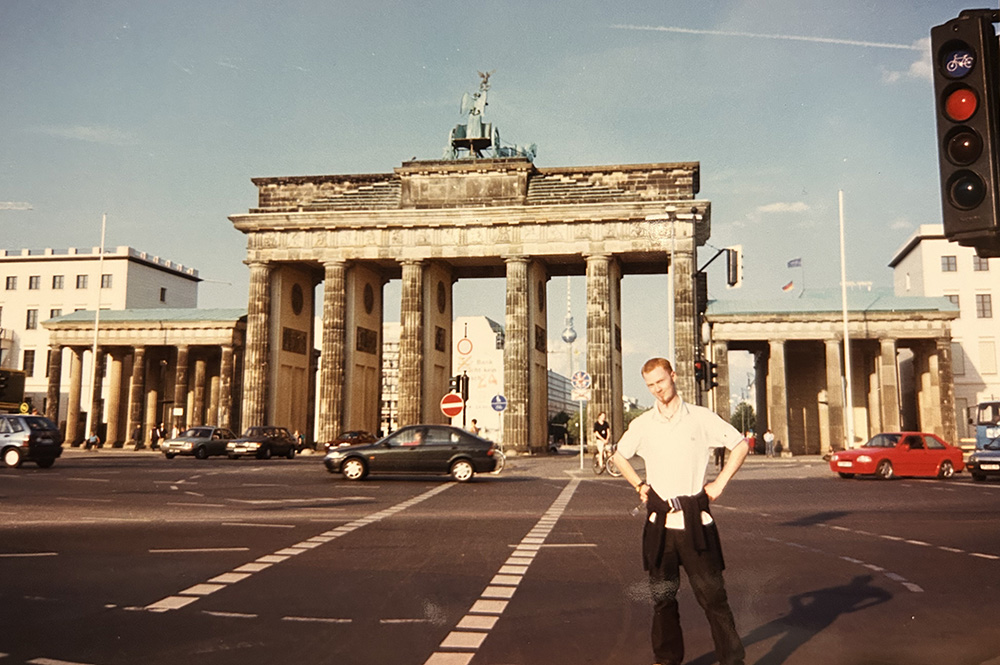
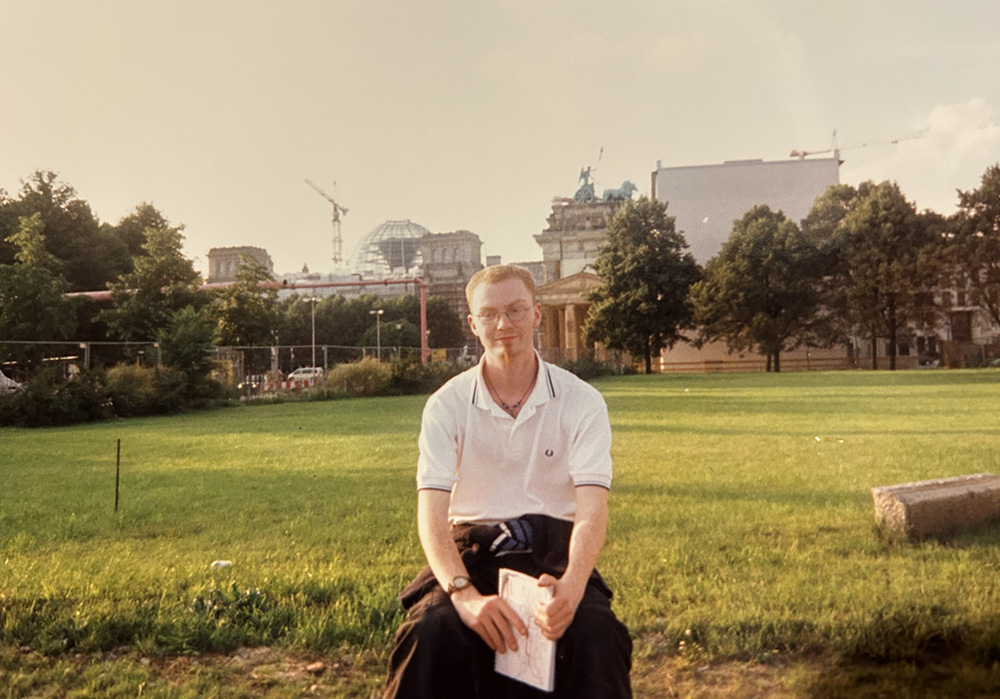
I had to sketch it again from the other side. I have a photo of me from that trip back in 1998 looking young and skinny, standing with this view in the background. there’s the picture below, along with another of the young me sitting where the Wall once stood (with the sort of look on my face that you see in YouTube thumbnails with clickbait headlines like “Berlin: Was It Bad?”). The view has not changed that much really, though my poor eyesight and short memory led to me write ‘Hotel Adler’ above the Hotel Adlon. There’s the Fernsehturm, finding a way to get into every sketch. Traffic rushed by this busy junction, and the massive Tiergarten park loomed behind me full of trees and joggers. I had thought about getting up in the morning and having a run through the Tiergarten, but decided against it. It’s really big.
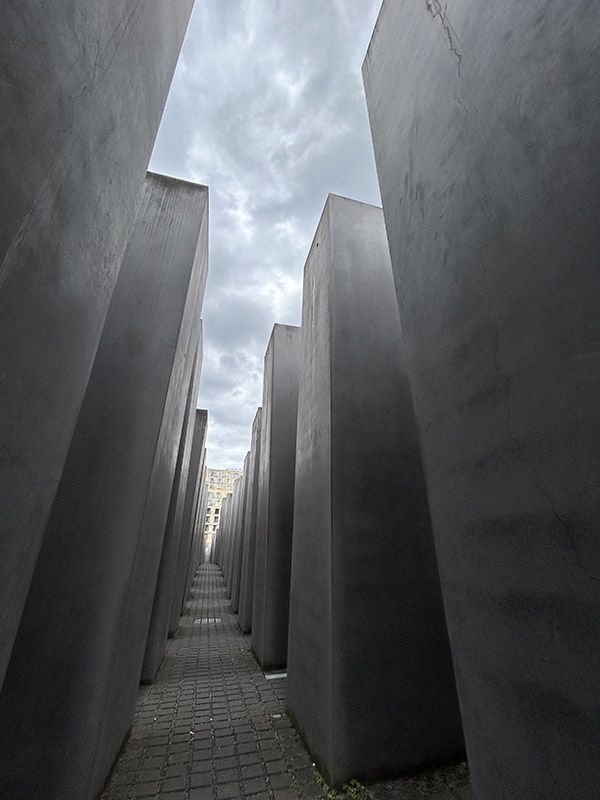
So I walked down Ebertstraße towards Potsdamer Platz, following the line of the old Wall, but first I was going to visit somewhere which was both moving and chilling, the Denkmal für die ermordeten Juden Europas ‘Memorial to the Murdered Jews of Europe’, also known as the Holocaust Memorial. Berlin does not turn its face away from the dark past, and the location of this huge memorial space is significant, nearby the Reichstag, on an area which used to be part of the infamous Death Strip inside the Berlin Wall, and close to where Hitler’s bunker was located. The memorial looks like a filed of smooth grey concrete blocks all lined up in symmetrical rows, appearing to move up and down as the ground level gets deeper and the slabs get taller. It resembles a graveyard, a colourless crop field, a grey grid system city that feels like a labyrinth; the designer Peter Eisenman left it open to interpretation. As you enter the monument the concrete blocks are short, resembling tombs, and children jump from one to the other, though they are not supposed to. The further you walk down each corridor, the taller the blocks get until they tower above you and everything feels…cold. There are people around, but you feel isolated. You might see them pass by ahead or behind, quickly in and out of view (reminding me of that scene in Yellow Submarine), leaving you along again. The rows may be meant to put you in mind of the lines of Jews being led into the camps or onto the transports, and you feel trapped inside this grey world seeing the sky above that can’t be reached. I felt a bit scared in there, not that anything would happen to me, but that the feeling of isolation descended so fast. It is not a labyrinth, every path is a way out, but it was easy to feel suddenly lost. It was sunny when I emerged and I needed a rest. I sketched the Memorial, with the green Tiergarten away to the left, the glass dome of the Reichstag and the solid block of the U.S. Embassy in the background.

It was a longer walk than expected to get to Potsdamer Platz; perhaps I was just tired. The day was already getting away from me, and I hadn’t eaten lunch. The last time I was in Potsdamer Platz it was just a building site, the biggest in Europe, but now it was all big modern buildings and infrastructure. The train station was complicated; you had to go back outside the find the U-Bahn, I decided to go back to the hotel for a rest before I did any more exploring. That was a lot of history for a small area.
 petescully